Goa Gajah sits below the road at Bedulu, six kilometres east of Ubud, and you cannot see any of it from the car park. The whole complex is a descent: a staircase, then the pools, then the cave, then a ravine that keeps going down past the point where everyone else has turned round.
It is also small, and this is the part the guides that rank for it will not say. Fifty minutes covers the site properly. Ninety covers it exhaustively.
That does not make it a bad stop. It makes it a stop rather than a destination, and the difference decides whether you leave pleased or disappointed.
On this page
There is no elephant: what Goa Gajah actually means
Say it first because everyone arrives expecting one. Goa Gajah translates as Elephant Cave, there are no elephants native to Bali, and nothing about the site has ever housed one. Three explanations for the name circulate and none of them has won.
Why is it called the Elephant Cave?
The statue. Inside the cave sits a Ganesha, the elephant headed god, and naming a cave after the figure in it is the least strained of the three. It is the explanation most guides on the site will give you.
The river. The Javanese poem Desawarnana, written in 1365, mentions a place called Lwa Gajah, elephant river. The complex stands above a river, and the identification is old and plausible without being proven.
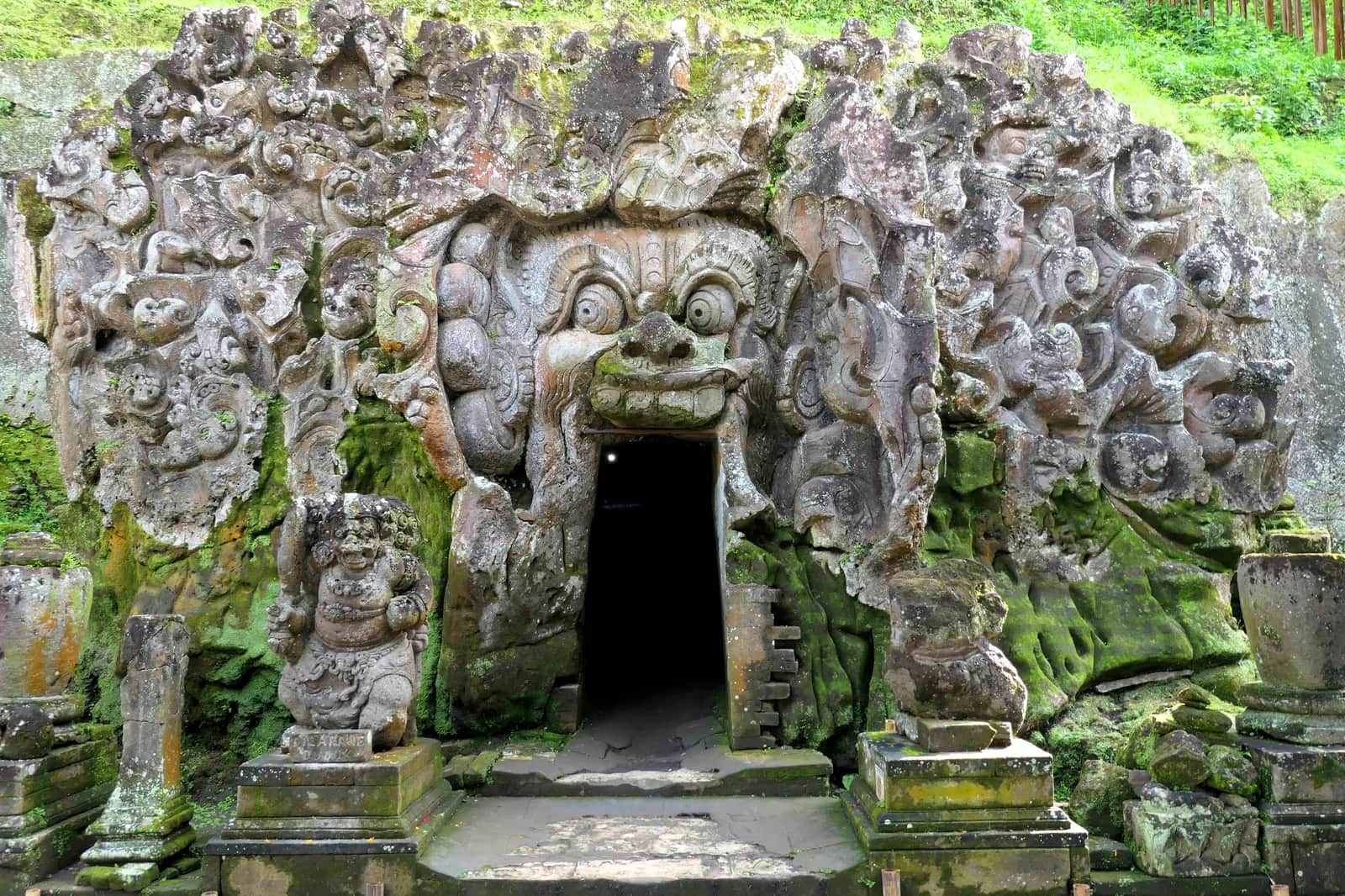
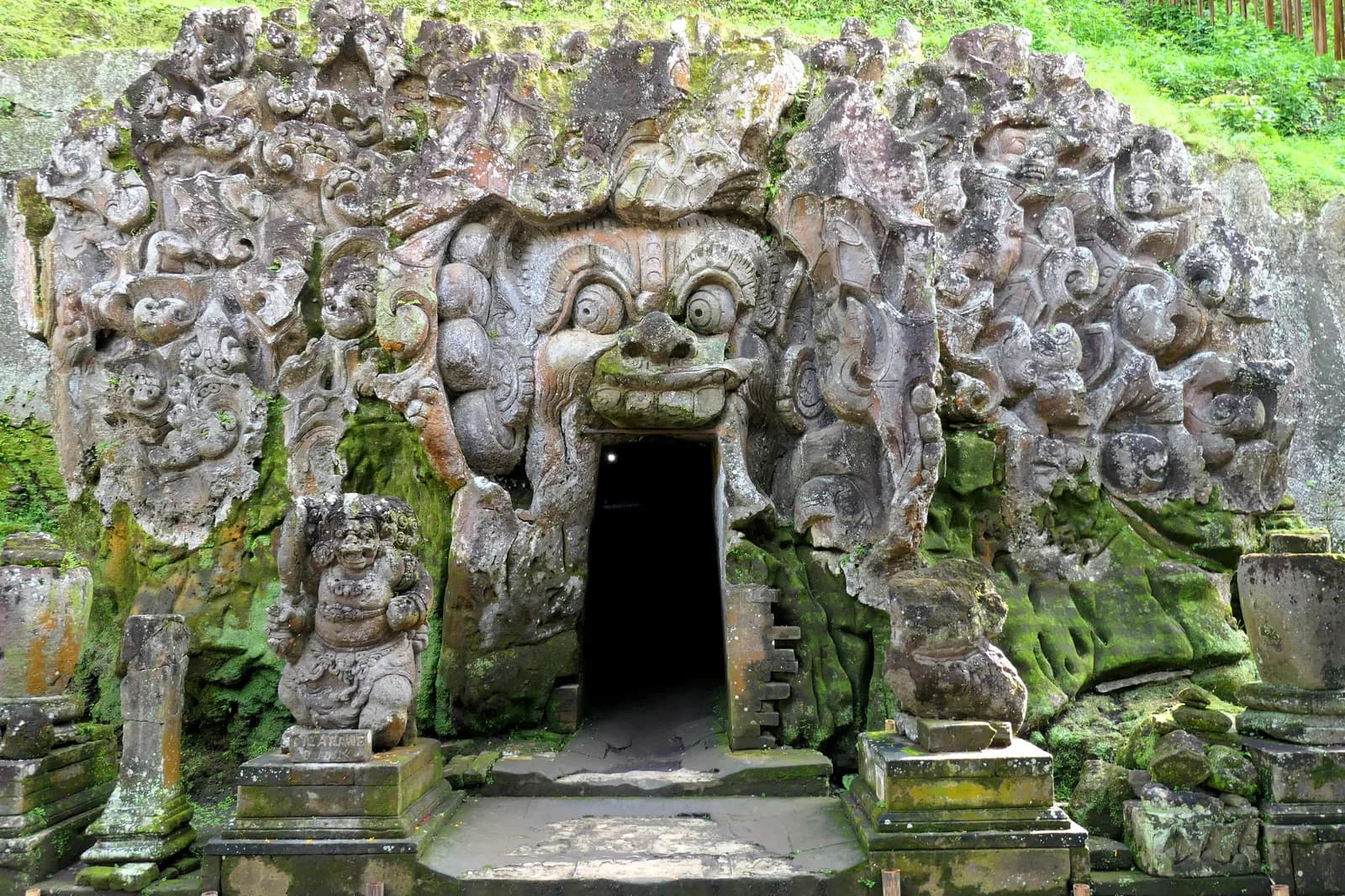
A misreading. The carved face at the entrance was taken for an elephant by early visitors. Stand in front of it and you can see how, once, from a distance. It is not one.
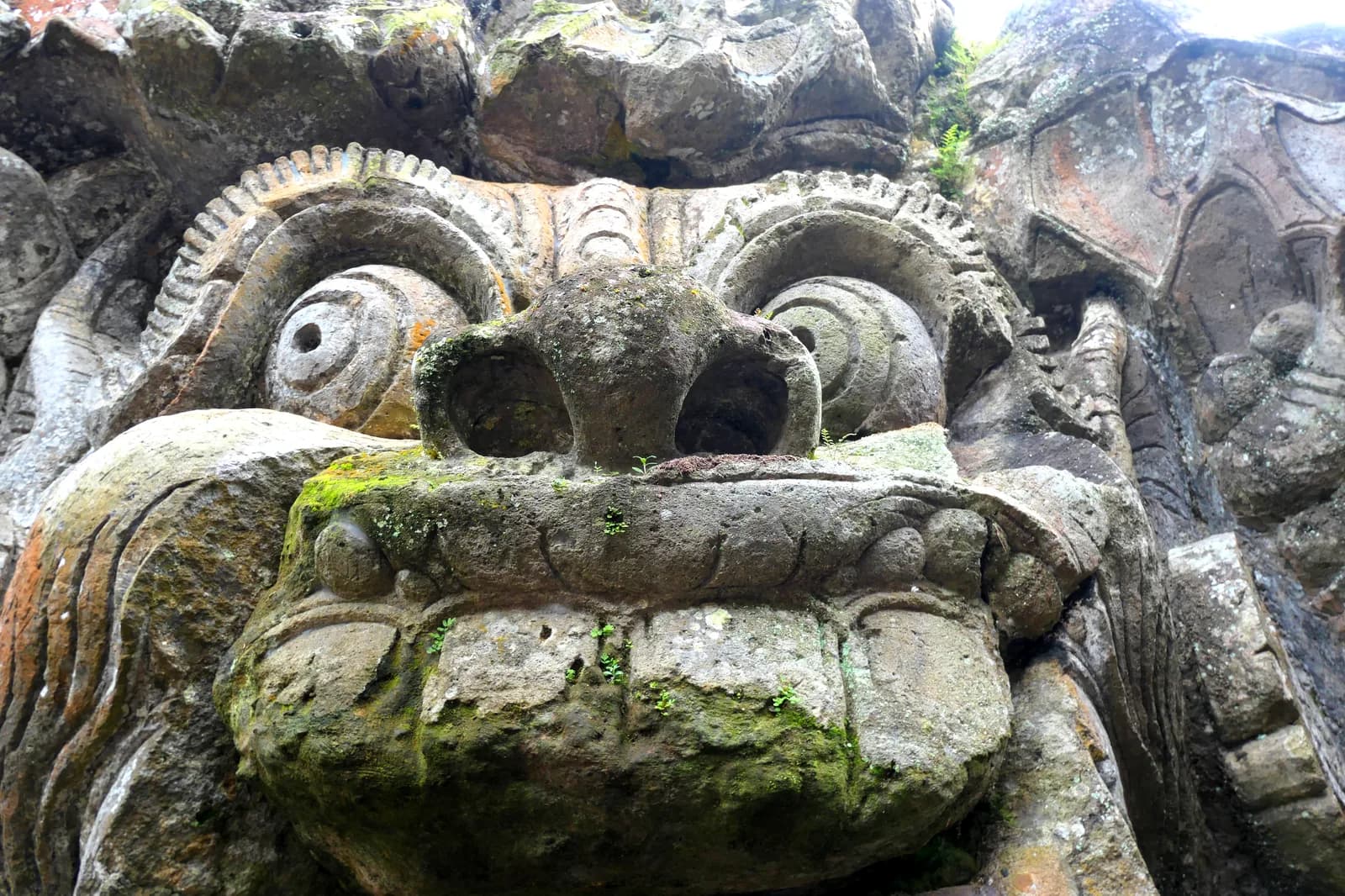
Photo Anandajoti Bhikkhu, CC BY-SA 4.0
The figure is usually identified as Bhoma, a guardian carved to stop anything malevolent from following you inside. What nobody looks at is the rest of the wall: the rock around the face carries hands, leaves and small creatures worked into the stone, and the face takes all the attention. Give it thirty seconds after you have taken the photograph.
Is Goa Gajah worth visiting? The honest answer
This is the question everybody types and the reviews split hard on it. The split is not about the site. It is about how much of the day people gave it.
Worth it, clearly
If you like carved stone, old things, or knowing what you are looking at. The entrance is the best piece of rock carving in central Bali that you can stand a metre away from, and it costs about the same as a coffee in Ubud. It also reads completely differently from the island's big ceremonial temples, which is worth something once you have seen a few.
Worth it, with a condition
If it is one of two or three things you are doing on that road. On its own it is a two hour round trip from Ubud for a fifty minute site, and the arithmetic is what people are really complaining about when they call it overrated.
Probably skip it
If stairs are a problem, since the only way in is down a long flight and back up it. If you have two days in Bali and have not seen a rice terrace yet. Or if you are hoping for a cave: this one is about the length of a corridor.
Where Goa Gajah fits in a day out of Ubud
Goa Gajah is on the road that leaves Ubud to the east and turns north, which is the road most people take anyway. What decides whether the stop works is not how long you spend inside. It is which end of the day you put it at, and that depends entirely on what else you have planned.
Pick what is already in your day and the order sorts itself out.
| Already in your day | Put Goa Gajah |
|---|---|
| Tirta Empul the same morning | First, and early |
| Tegallalang and the rice terraces | Last, on the way home |
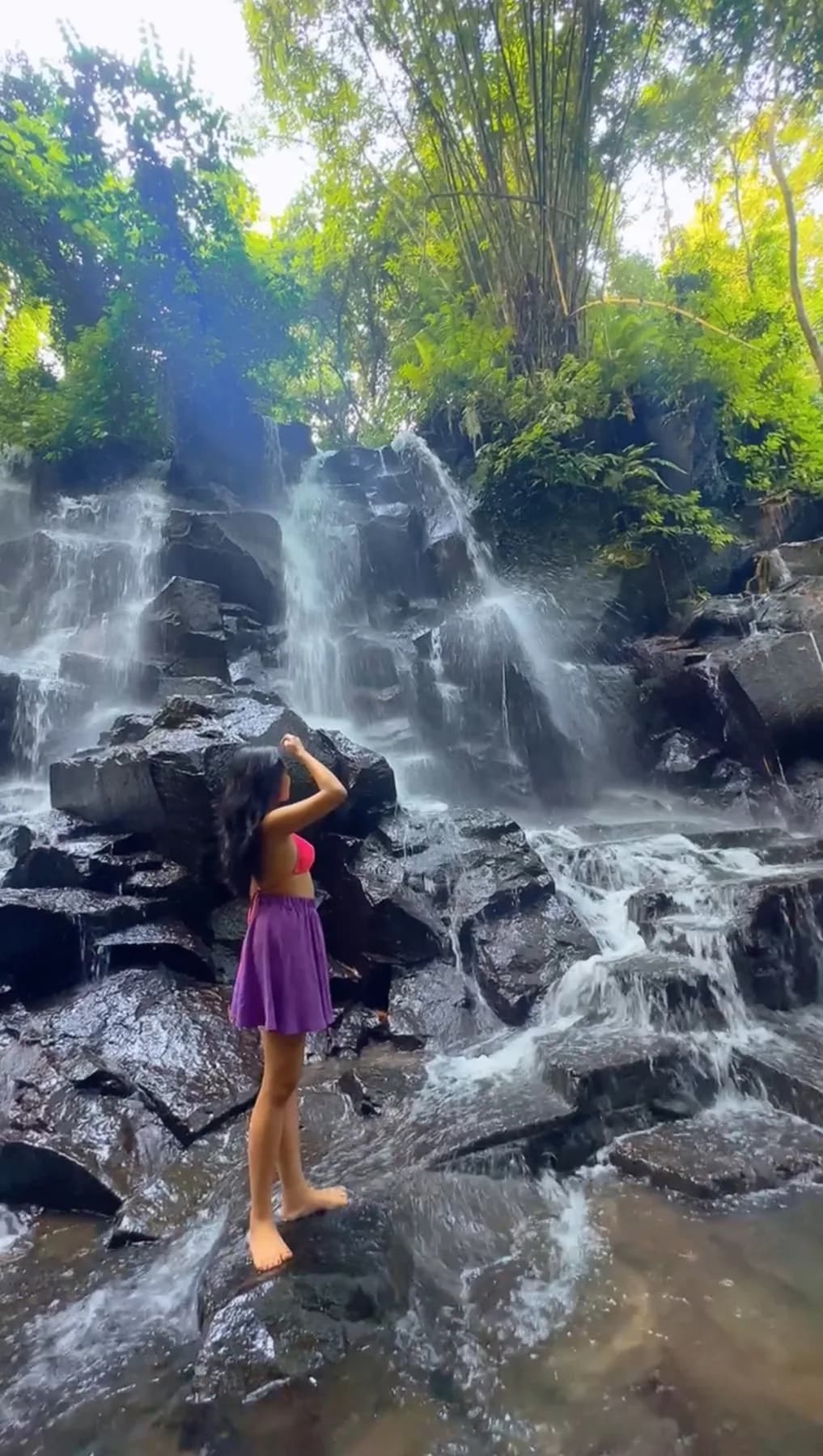
| Kanto Lampo waterfall | Both in one morning, waterfall second |
| Nothing else, just this | Do not build a day around it |
Pairing with Tirta Empul: Goa Gajah first, and early
The classic pairing, twenty minutes apart. The two sites sit on the same road north out of Ubud and Goa Gajah is the closer of them, so passing it on the way up costs nothing and passing it on the way back costs an hour of doubling. It also has the shorter visit, which means you spend it while you are still fresh and give the long one to Tirta Empul, where the queue for the purification pools is the thing that actually eats time. Doing it the other way round puts you at Goa Gajah in the middle of the day, which is when the coach groups from the east coast arrive and when the courtyard has no shade left.
Pairing with Tegallalang: Goa Gajah last, on the way home
Opposite direction, so the order matters more. Tegallalang is north of Ubud and Goa Gajah is east, so they are not on one line. What saves the day is that the terraces are only worth the drive before nine in the morning, when the light is low and the coaches have not landed. That leaves the whole middle of the day free, and Goa Gajah is the right size to fill the end of it without needing another early start. Trying to open the day with Goa Gajah instead means reaching Tegallalang around eleven, which is the hour the terraces are at their worst and their busiest.
Pairing with Kanto Lampo: both in one morning, waterfall second
Fifteen minutes down the same road. These two are closer to each other than either is to Ubud, and almost nobody pairs them. Goa Gajah is stone, shade and a descent on foot, Kanto Lampo is water and a scramble over rock. Doing the dry one first means you are not walking a temple courtyard in soaked clothes, and the waterfall is better once the sun is high enough to reach the bottom of the gorge. The waterfall needs light down in the gorge and Goa Gajah does not, so putting the temple second wastes the only hours that make the water photograph well.
Nothing else planned: do not build a day around it
The version most guides describe. This is the honest answer and it is the one missing from every page that ranks for the site. Goa Gajah is fifty minutes of walking, looking and going back up a staircase. Driving out from Ubud, parking, changing into a sarong and driving home again turns that into a two hour round trip for a site you have already finished. It is a good stop and a thin outing, and the difference matters. Add Yeh Pulu and you have solved it: the rock carvings are ten minutes away through the rice fields, they take twenty minutes, and hardly anyone goes.
What to see at Goa Gajah, in the order you meet it
Nothing at Goa Gajah is visible from the road, and each part of it sits lower than the last. That geometry explains the visitor behaviour better than anything else: the crowd thins with every level, and the half of the complex that holds the Buddhist carvings is at the bottom of a ravine most people never learn is there.
| Level | Crowd | Time |
|---|---|---|
| The road and the ticket booth | Everyone | 5 min |
| The staircase down | Everyone | 2 min |
| The bathing pools | Everyone, all at once | 10 min |
| The carved mouth and the cave | Everyone, in a queue | 10 min |
| The lawns below the terrace | Thinning out | 10 min |
| The ravine and the Buddhist remains | Almost nobody | 15 min |
The road and the ticket booth
Jalan Raya Goa Gajah runs along the top of the site and nothing is visible from it. You park, pay, and are handed a sarong if your knees are showing, which is included rather than hired. There is a row of stalls along the top edge and a small warung. This is the whole of what a passing car sees, and it is why the site reads as underwhelming to people who never get past it.
The staircase down
A long flight of stone steps drops from the car park into the complex. It is the only way in and the only way out, it has no handrail for much of its length, and it is the reason this site is a poor choice for anyone with bad knees. Going down you see the courtyard open up below you, coming back up in the middle of the day, in a sarong, is the part nobody photographs.
The bathing pools
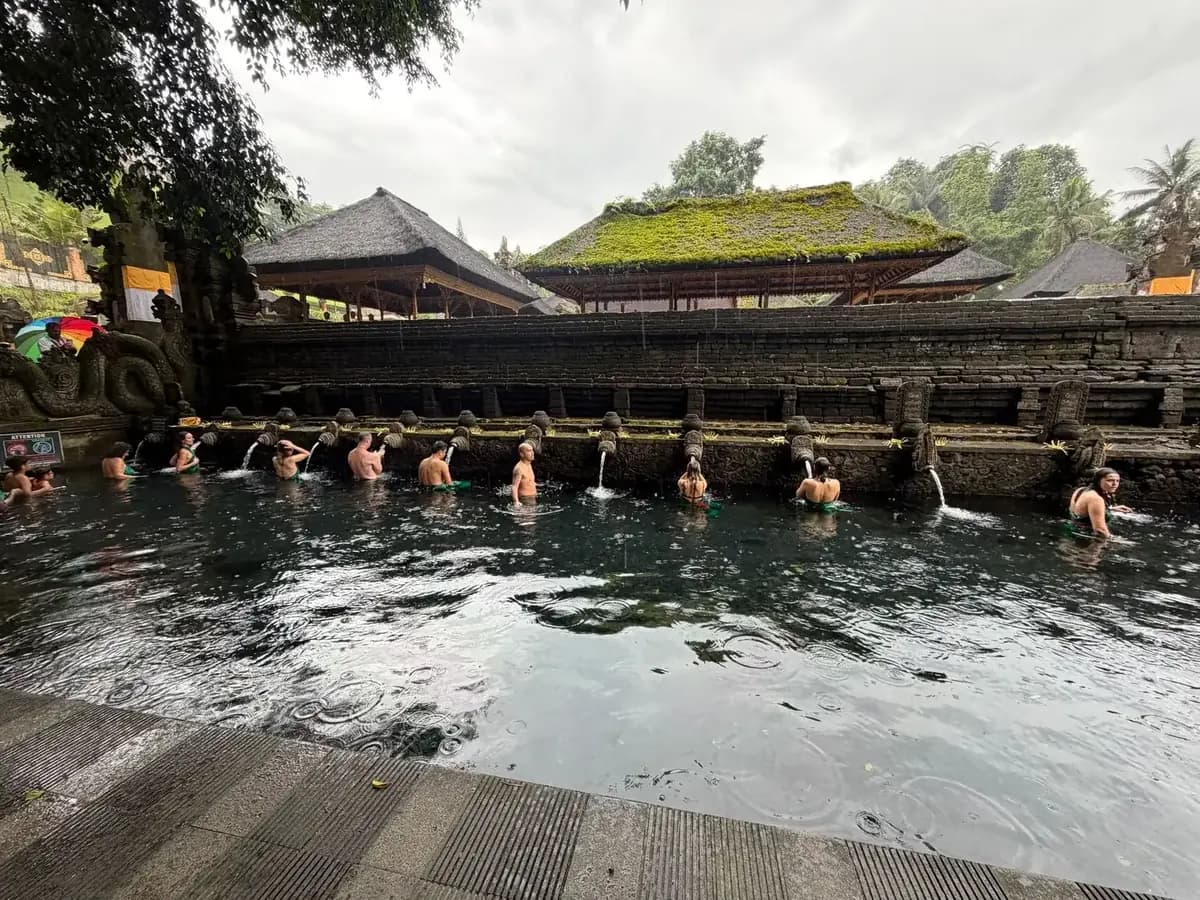
The first thing at the bottom, and the busiest square of ground on the site. Two rectangular pools sunk into the terrace, fed by stone figures holding water pitchers. They were under earth until 1954, which is why they look sharper than the rest of the complex: they spent a thousand years buried instead of weathering. Six of the seven figures survive, the seventh lost to an earthquake, and the gap in the row is visible if you count.
The carved mouth and the cave
Twenty metres along the terrace, the rock face opens into a mouth carved with a face that is not an elephant. Inside, the passage runs a few paces and forks in a T, so the whole interior is smaller than a bus and smells of incense. In one arm sits a Ganesha, in the other three lingga in stone sheaths. There is room for perhaps eight people at a time, so the queue outside is longer than the visit inside.
The lawns below the terrace
Past the cave the ground drops again into open lawns with fragments of carved stone laid out on them, a few shrines, and enough shade to sit down. Most visitors have already turned back for the staircase by this point, which makes this the first quiet part of the site and the best place to actually look at the pools from a distance.
The ravine and the Buddhist remains
A path leaves the lawns and drops through trees to the stream at the bottom of the gorge. Down there, cut into the rock and half swallowed by the vegetation, are carved stupa and chattra fragments. They are Buddhist, not Hindu, and the reason the site is described as holding two religions at once rather than one. There is a small waterfall on the same path. It is the most interesting ten minutes at Goa Gajah and the section that almost every guide to the place reduces to a single sentence.
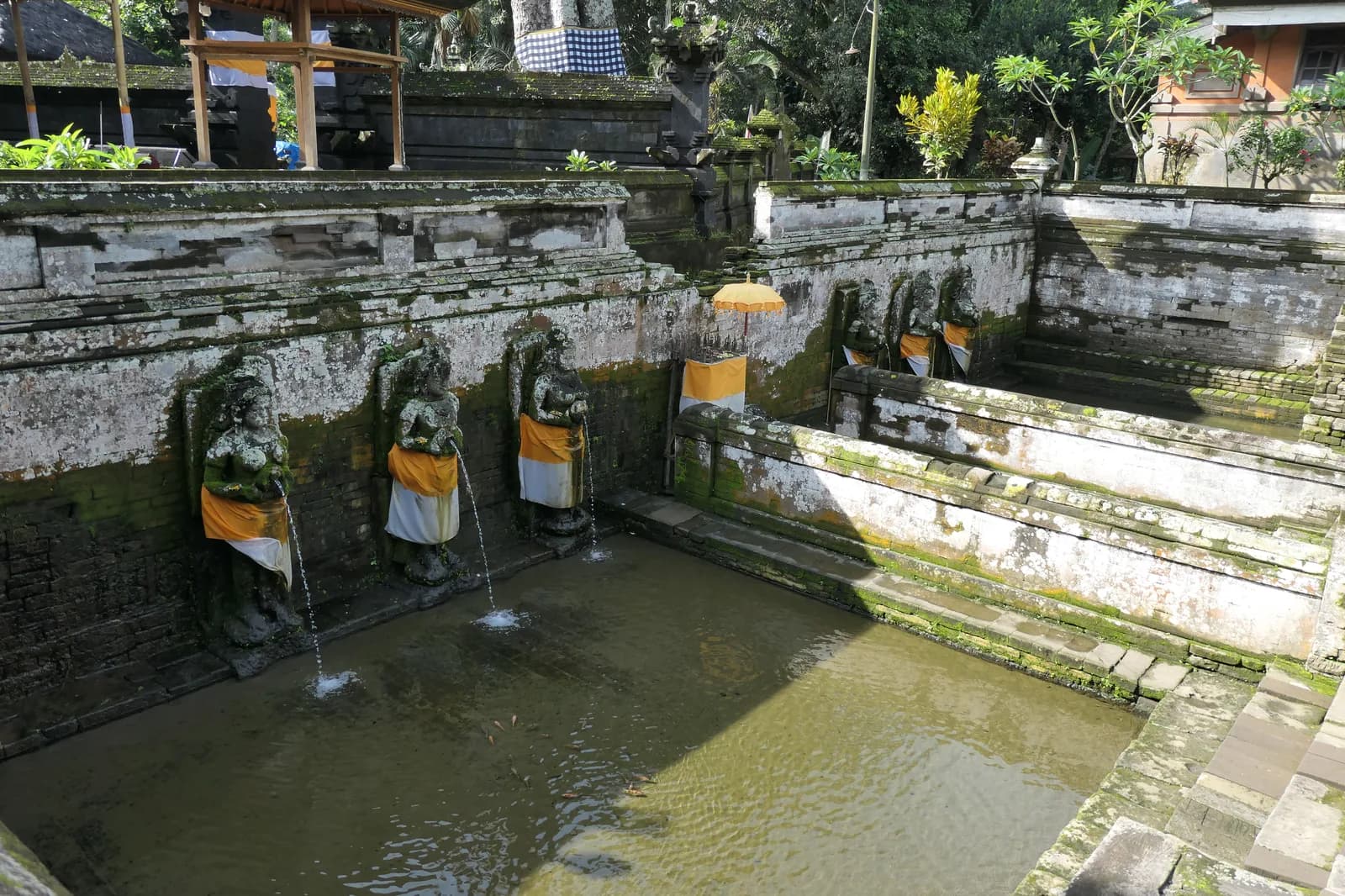
Photo Anandajoti Bhikkhu, CC BY-SA 4.0
Goa Gajah history: the cave in 1923, the pools in 1954
Dutch archaeologists reached the cave in 1923. The bathing pools in front of it stayed under earth for another three decades and were not excavated until 1954, which is why the stonework down there looks so much crisper than the weathered rock above it. A thousand years underground preserves carving better than a thousand years of Balinese rain.
The figures along the walls hold pitchers and are read as the holy rivers of India. One of the seven was destroyed by an earthquake and the gap in the row is easy to spot once you know to count. The water still runs, and the pools are in use rather than roped off.
Hindu and Buddhist on the same site
Inside the cave there is a Ganesha in one arm of the passage and three lingga in the other, which is Shiva and Hinduism. Down in the ravine there are carved stupa and chattra, which are Buddhist. The same site holds both, a few dozen metres and a steep path apart.
That is what makes Goa Gajah more interesting than its size. Two traditions were practised here alongside each other, probably from around the eleventh century, and the layout still shows it. You walk from one to the other in about four minutes.
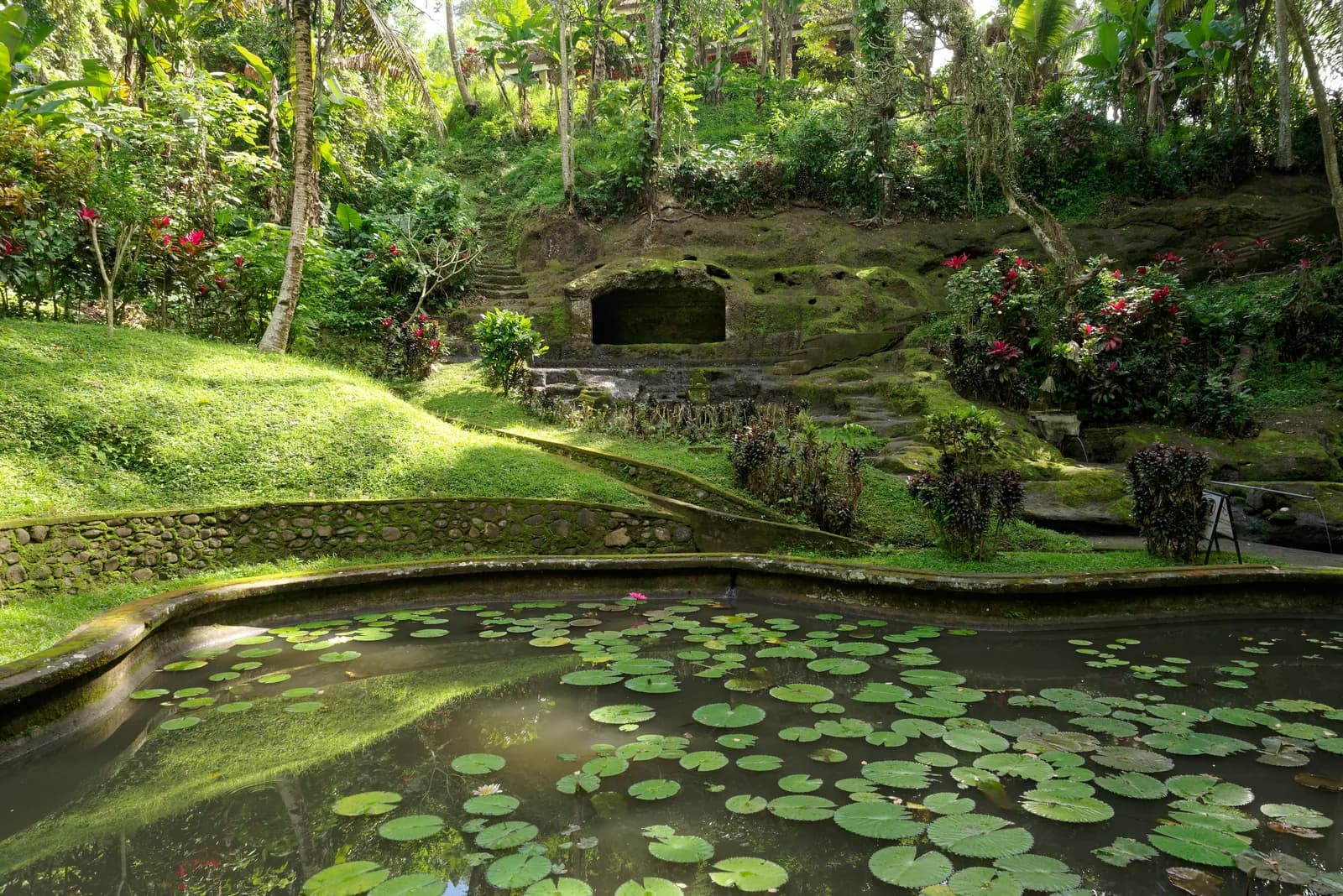
Photo Jakub Hałun, CC BY-SA 4.0
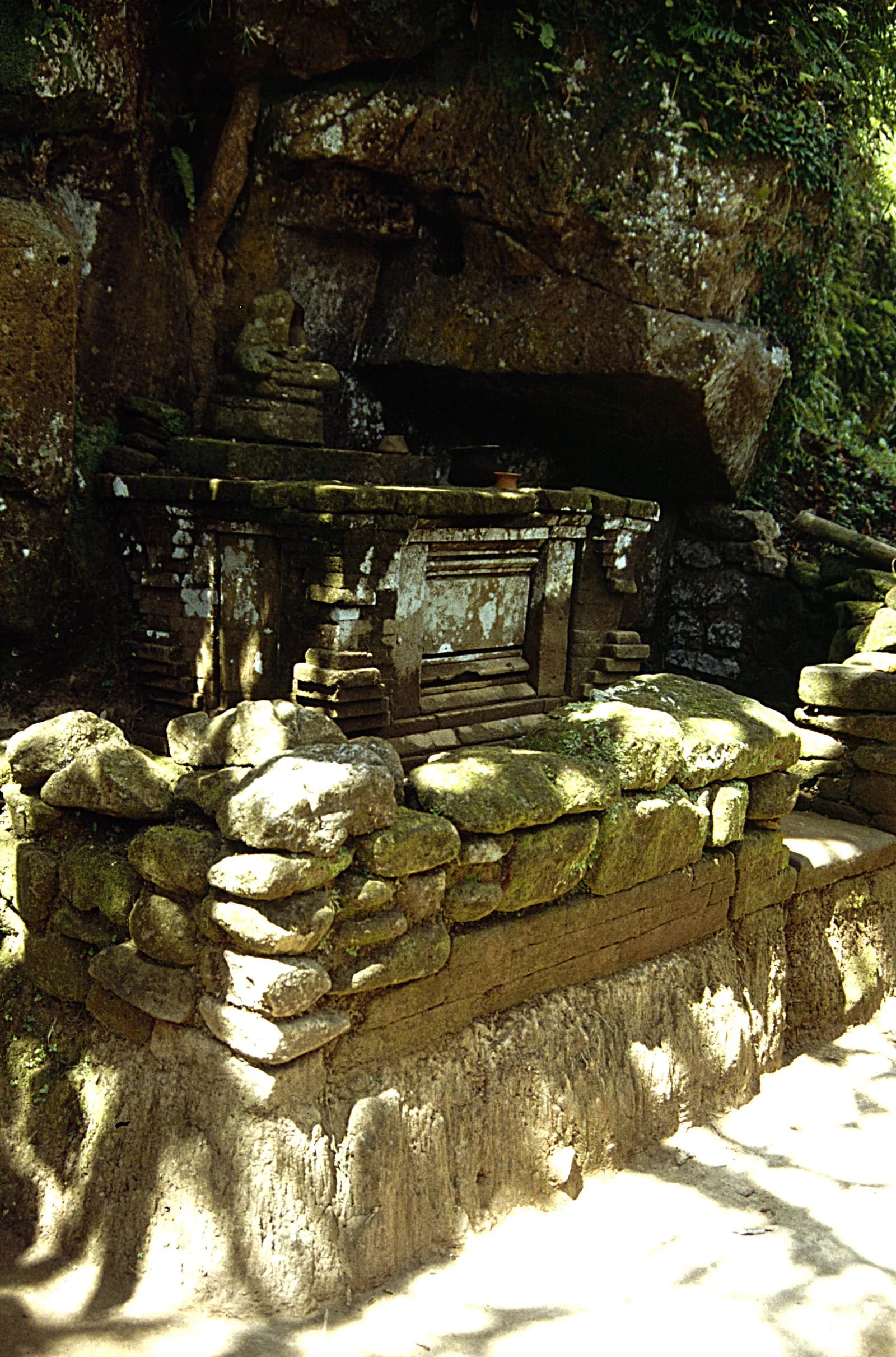
Photo Ziegler175, CC BY-SA 4.0
Goa Gajah entrance fee, opening hours and dress code
The site opens in the morning and closes in the late afternoon, and the useful hours are the early ones. Coach groups working their way inland from the east coast reach Bedulu towards the middle of the day, which is also when the courtyard has lost its shade and the queue at the cave mouth is at its longest.
The sarong comes with the ticket. You are handed one at the entrance if your knees are showing and you return it on the way out, so unlike at Besakih there is nothing extra to pay and nothing to bring. Shoulders covered is the sensible standard.
The entrance fee itself is a few dollars a head, in cash, at a booth by the car park. Indonesian residents pay less than foreign visitors and children pay less than adults, which is how every ticketed site on the island is priced.
Nothing on the site is labelled. There are no panels, no numbers on the stones and no map at the gate, which is why the freelance guides waiting at the top of the steps are a better purchase here than at most Balinese temples. Half an hour with one is the difference between a carved wall and a carved wall you can read.
Cash matters more than it looks. The booth, the parking and the guides all want rupiah, and the nearest reliable machine is back towards Ubud rather than at Bedulu.
What Goa Gajah costs, item by item
Orders of magnitude rather than prices. The entry rate is set locally, it is cash, and it moves. Everything below the ticket and the parking is optional.
| What you pay for | Detail | Order of magnitude |
|---|---|---|
| Entrance | Per person, cash at the booth by the car park. Foreign visitors pay more than Indonesians, which is standard across the island, and children pay less. It is among the cheapest tickets at any named site in Bali. | ≈ $3 |
| Sarong | Handed to you at the entrance and included in the ticket rather than hired. You return it on the way out. Bringing your own saves nothing here. | included |
| Parking | Charged on the vehicle at the gate. Cars and scooters pay different rates and the car park fills by mid morning. | ≈ $0.30 to $1 |
| A guide at the gate | Freelance guides wait at the top of the steps and offer to walk you round for thirty or forty minutes. There is no fixed rate, nothing is signposted on the site, and this is the one purchase here that changes what you get out of it. | ≈ $7 to $15 |
| Offering to leave at the cave | Sold at the stalls above the steps if you want to take one down. Entirely optional and nobody expects it of visitors. | ≈ $1 |
| Driver for a half day from Ubud | Car and driver for a morning covering Goa Gajah and one or two other stops on the same road. Priced by the block of hours, not by the site. | ≈ $20 to $35 |
The Bali tourist levy is separate and is paid once on arrival rather than at each site. See the tourist levy explained for how and when to pay it.
How to get to Goa Gajah from Ubud
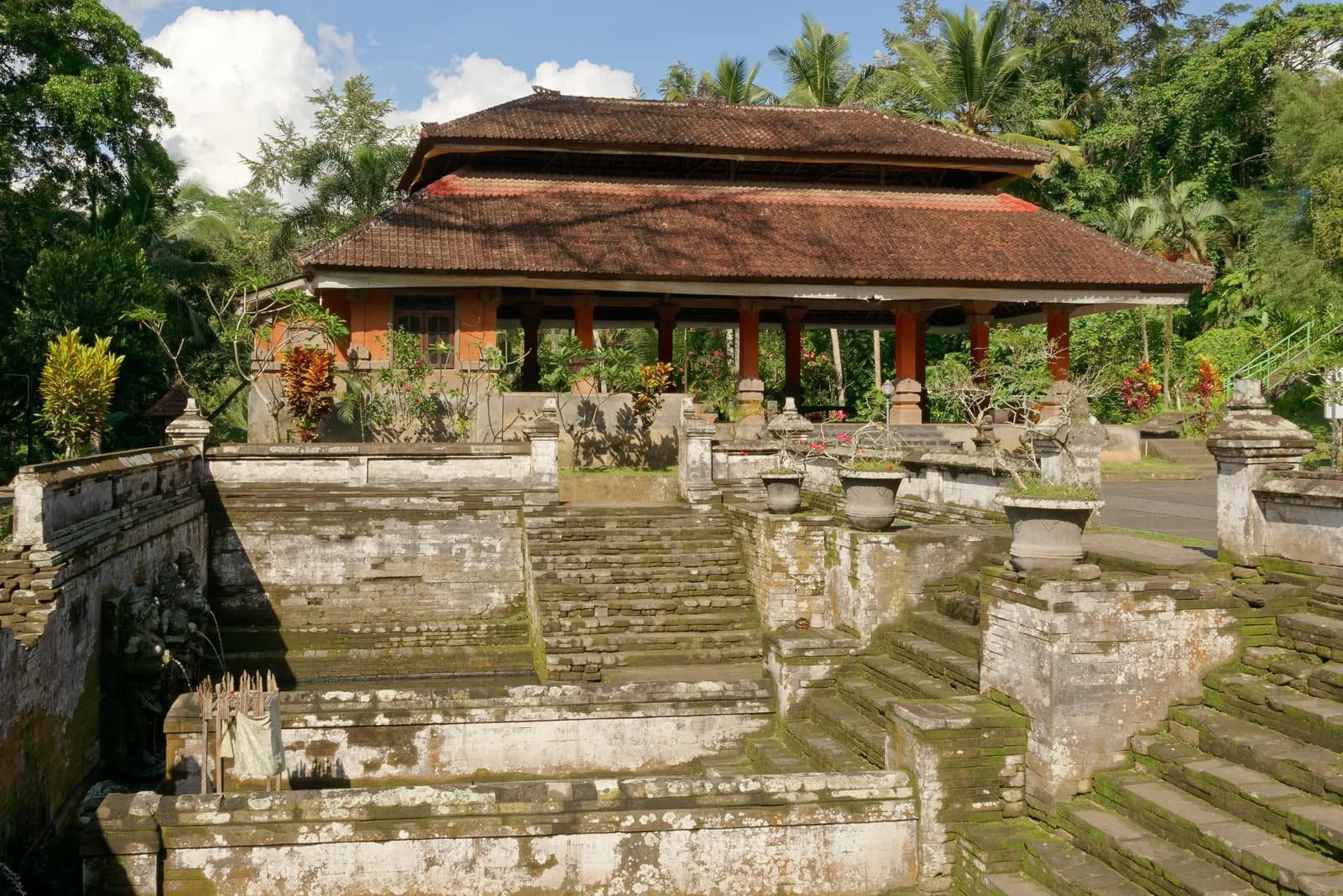
Photo Jakub Hałun, CC BY-SA 4.0
Goa Gajah is at Bedulu, about six kilometres east of central Ubud on Jalan Raya Goa Gajah. Fifteen to twenty minutes by car when the road is behaving, a little less on a scooter, and any driver on the island knows it by name. From the south of Bali allow an hour and a half, which is why almost nobody comes here from Seminyak on purpose.
The car park is on the road and the site is entirely below it. There is no view in from the gate and no way to judge the place before you have paid, which is worth knowing if you are travelling with someone who wants to decide from the car.
On a scooter the stop is easy: the road is straight, the parking is at the door and you are back in Ubud in twenty minutes. In a car it is worth combining, because the same driver waiting for you costs the same whether you spend fifty minutes here or half a day on the whole road.
The staircase down, and who should skip it
There is no step free way into this site. The only entrance is a long flight of stone steps down from the car park, without a continuous handrail, and the path into the ravine below is steeper and often damp.
Going down is easy and nobody thinks about it. Coming back up in the middle of a hot day, in a sarong, is a genuine effort, and it is the single most common complaint in reviews from older visitors. Go early and the same staircase is unremarkable.
What to combine with Goa Gajah nearby
Everything here is within twenty minutes of the car park, and none of it requires backtracking through Ubud.
Yeh Pulu, ten minutes away
A twenty five metre panel of rock carvings cut into a cliff at the edge of the rice fields, reached on foot along a path from a small car park. It takes twenty minutes, it is quiet enough that you may be the only person there, and it is the obvious answer to Goa Gajah being short. Almost no guide to the cave mentions it.
Tirta Empul, twenty minutes north
The purification spring, on the same road going up. It is the natural second stop and the two make a proper morning together: one is stone and looking, the other is water and taking part. See how the ritual at Tirta Empul actually works before you go, because the queue rewards knowing.
Kanto Lampo, fifteen minutes south
A wide fan of water over stepped rock in Gianyar, and the closest waterfall to the site by some distance. It answers the Goa Gajah waterfall searches better than the trickle on the path down the ravine does.
The one pairing to think twice about is Tegallalang. It is north of Ubud rather than east, and it is only worth the drive before nine in the morning, so it does not sit on the same line as Goa Gajah. It works as the start of the day with the cave at the end, not as the stop after it.
The cave as one stop on a road with several
Free cancellationUbud day tours that stop at Goa Gajah
- ✓Goa Gajah bundled with Tirta Empul or the rice terraces, which is how the site is worth the drive
- ✓Hotel pickup in Ubud and a driver who waits while you go down and come back up
- ✓Private listings let you set the order, which matters more here than the stops themselves
- ✓Free cancellation on most listings
Affiliate link. Booking through GetYourGuide costs you nothing extra and supports the guide. Prices are indicative and vary by option and season.
For how Goa Gajah sits against the rest of the island's sanctuaries, and which of them are worth a drive of their own, start from the temples of Bali.