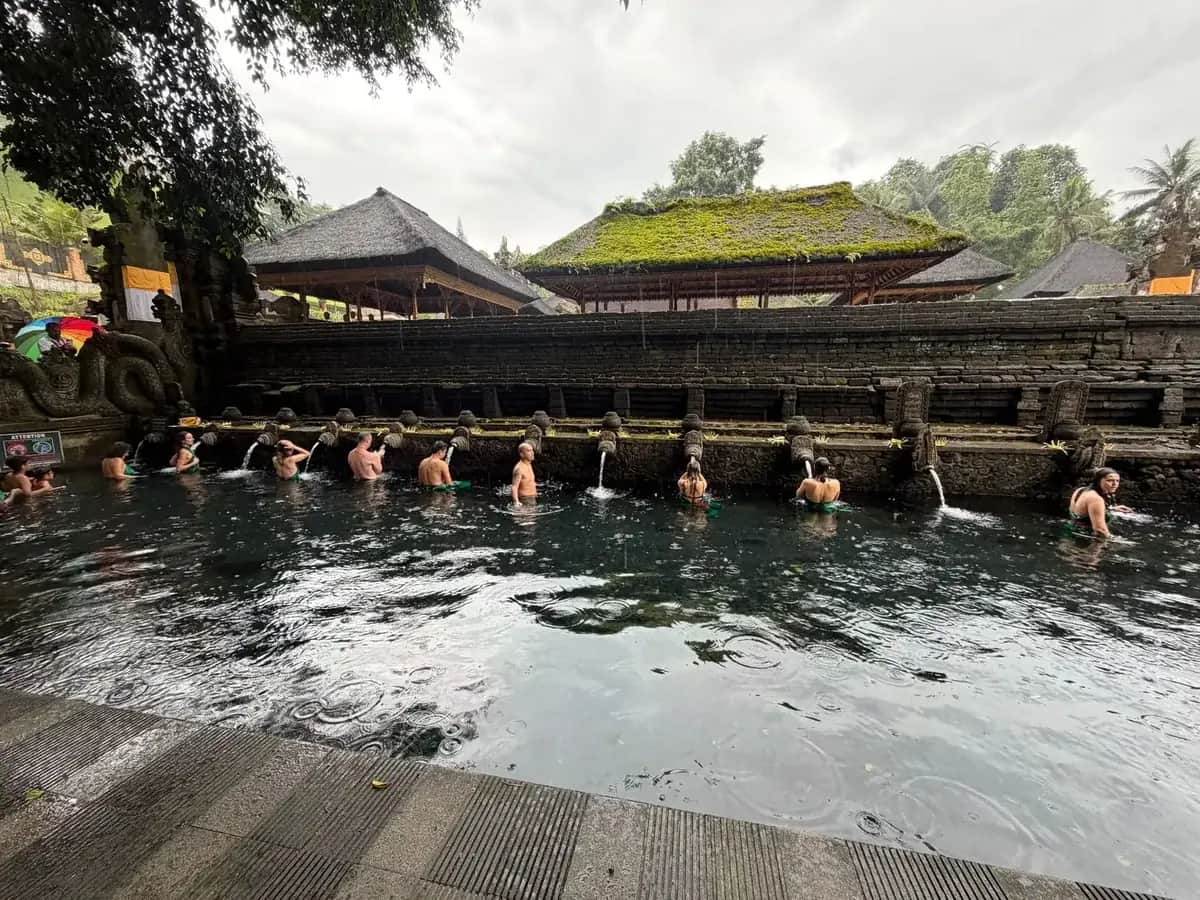
Tirta Empul is built around a spring that rises inside the temple grounds and has never stopped running. The water is channelled into long rectangular pools and out through a line of carved stone spouts, and Balinese Hindus come to stand under them and be purified. Not on holidays. On a Tuesday, before work, with the children.
That is what separates it from every other stop on a standard Ubud itinerary. Most of the island's famous temples are architecture you look at. This one is a rite you can join, which is also why turning up at eleven behind four coaches gets you something quite a lot worse than what you came for.
This page covers the part almost nobody writes down: what you actually do in the water, in what order, and the two fountains you walk past without stopping. Then the practical layer, the dress code, the drive, the cost, and the honest answer to whether a non-Hindu should be in the pool at all.
With a guide who explains the rite
Tirta Empul purification tours from Ubud
- ✓A guide who tells you which spouts to skip, which is the whole difficulty
- ✓Offering, bathing sarong and locker usually handled for you at the gate
- ✓Normally combined with Tegallalang or Gunung Kawi on the same loop
- ✓Free cancellation on most listings, useful in the wet season
Affiliate link. Booking through GetYourGuide costs you nothing extra and supports the guide. Price and rating checked September 2026. Both move with season and demand.
On this page
What Tirta Empul actually is
A spring, a legend about poisoned water, and a thousand years of people queueing at the same fountains.
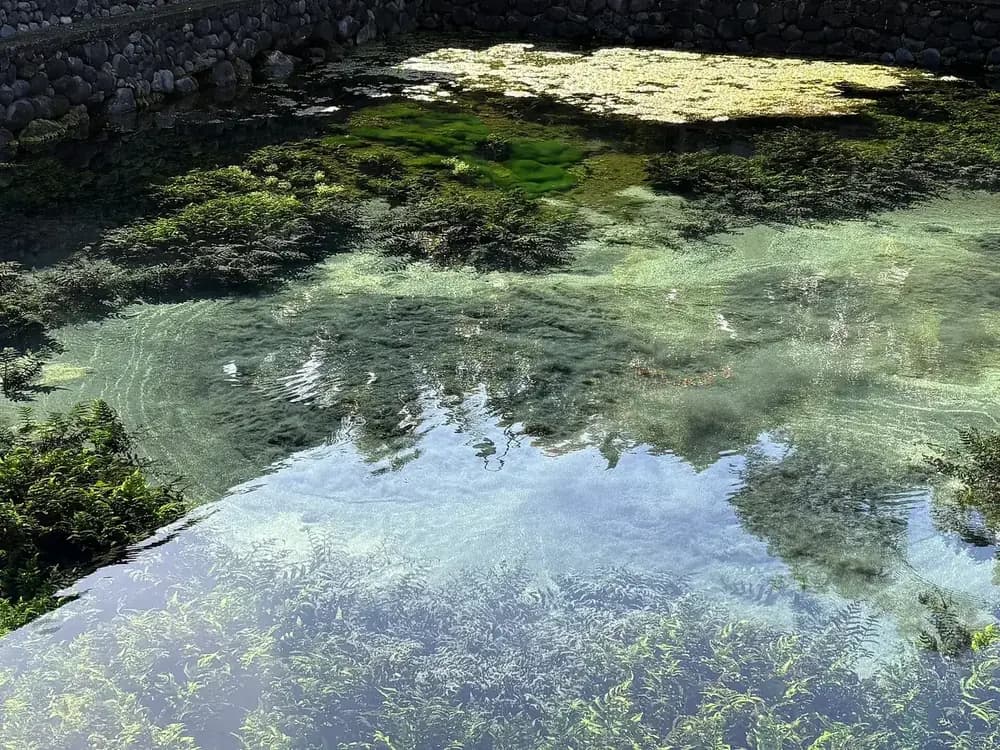
The name means holy water spring, and the spring is the reason for everything else. It rises in a clear pond in the innermost courtyard, bubbling up through sand at a rate that has not visibly changed in living memory, and the temple was built around it rather than the other way round. From that pond the water is fed downhill into the bathing pools, out through the carved spouts, and eventually into the Pakerisan river below.
The founding story is one of the better ones. A tyrant king, Mayadenawa, is said to have poisoned a stream to destroy the army sent against him, and the god Indra struck the ground to release a spring of amerta, the water of immortality, which revived the dying soldiers. That spring is this one. Whatever you make of the story, a stone inscription found nearby dates the temple to the tenth century, which puts its use somewhere around a thousand years of continuous worship.
It has never become a museum. Water is still drawn from here and carried to other temples for their own ceremonies, the compound closes for major rites, and the people beside you in the queue are not performing anything for your benefit. That is worth holding onto when the car park is full of minibuses.
Three courtyards
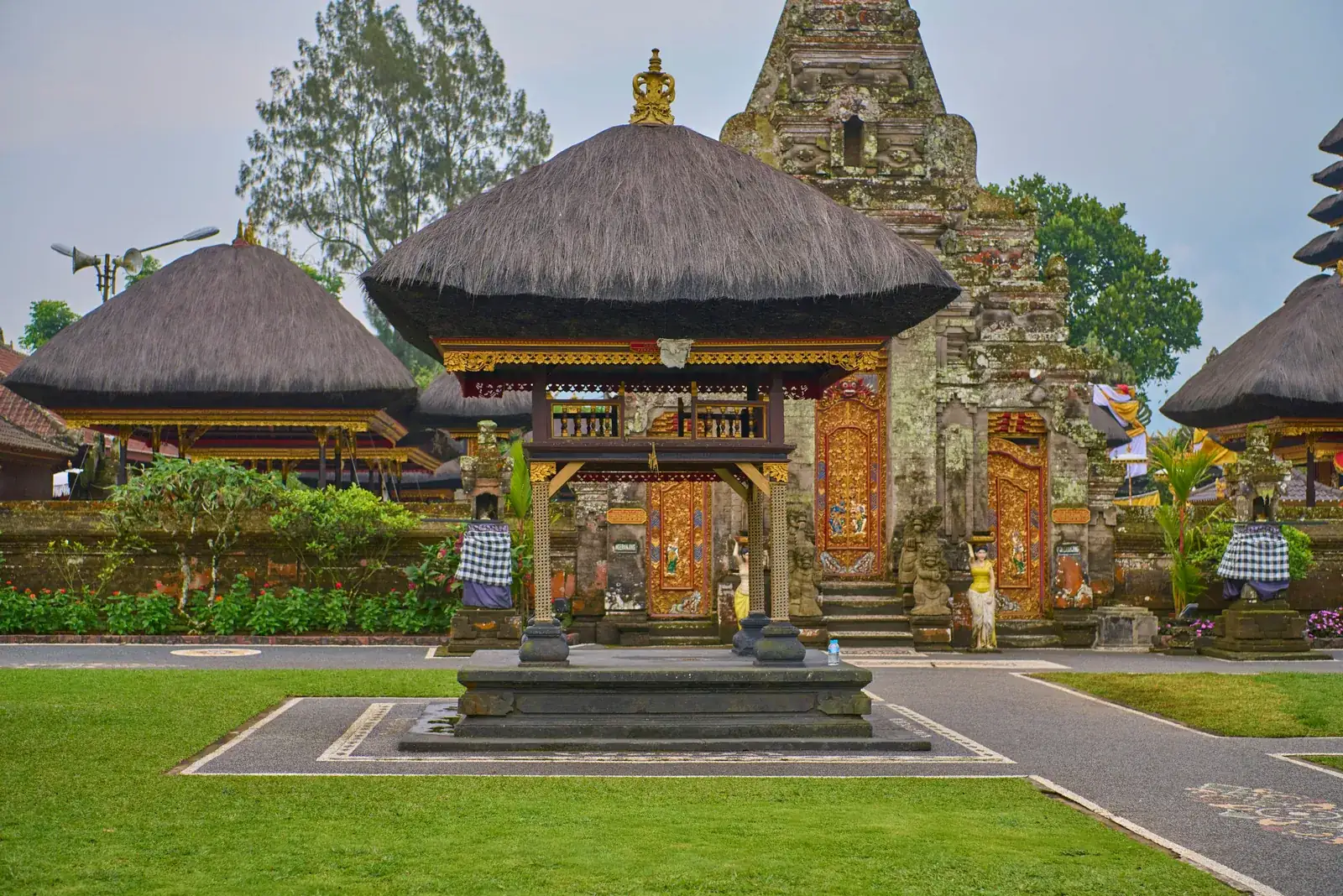
Like most Balinese temples it is laid out in three parts: an outer courtyard you walk through, a middle one holding the bathing pools, and the inner sanctum with the spring and the shrines. The pools are not the innermost part, which surprises people.
More than one pool
The photographs always show the same long pool, but there is a second bathing pool beyond it with fewer spouts and far fewer people. Groups on a schedule rarely reach it.
A palace on the hill
The building looking down over the temple is Istana Tampaksiring, a presidential retreat put up under Sukarno in the 1950s. It is not open to casual visitors, but it explains the manicured lawn above the spring.
How the melukat ritual works, step by step
Nearly every English-language page describes the pools and stops there. The rite has a shape, and knowing it is the difference between taking part and getting wet in a queue.
Leave your shoes, change into a bathing sarong
Two different sarongs are involved and people mix them up. The one handed to you at the ticket desk is the dry sarong you wear to walk around the compound. For the water you want a second one, rented for a small amount near the changing rooms, because you are going to be soaked in it. Wear swimwear underneath it, not a bikini alone.
Changing rooms and lockers sit right by the pools. Leave your shoes on the rack, and leave your phone in the locker or with whoever is not going in.
Pick up an offering, and set your intention
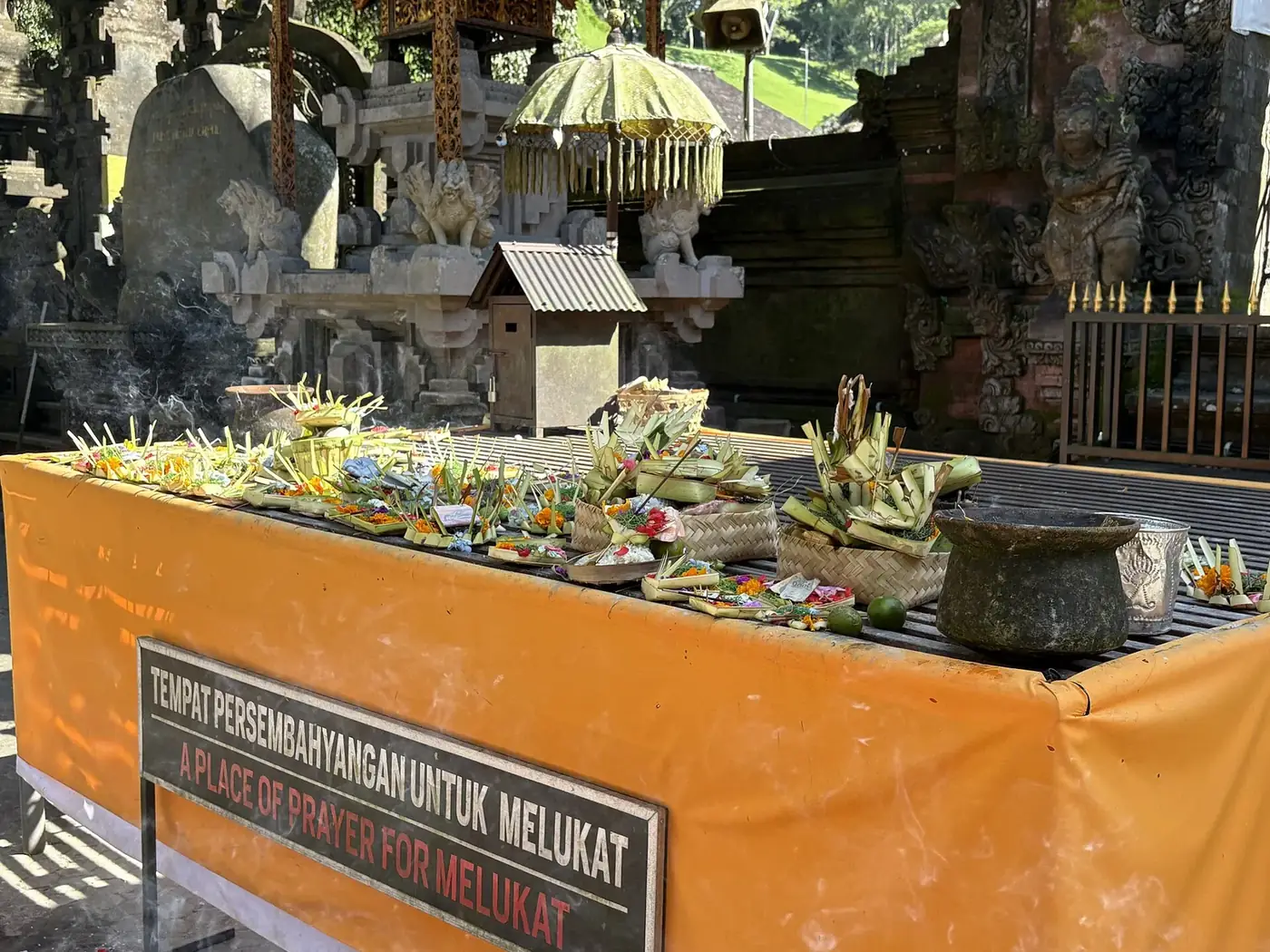
Melukat is a rite, not a swim, and the Balinese who queue beside you did not arrive empty-handed. Small canang offerings of flowers and folded palm leaf are sold at the entrance for pocket change. Place it on the offering table by the pools, marked in Indonesian and English as a place of prayer for melukat, before you go in. This is also the moment to fix what you are asking to be cleansed of, because the rite is repeated at every spout with that intention held in mind.
Enter the first pool at the near end, on the left
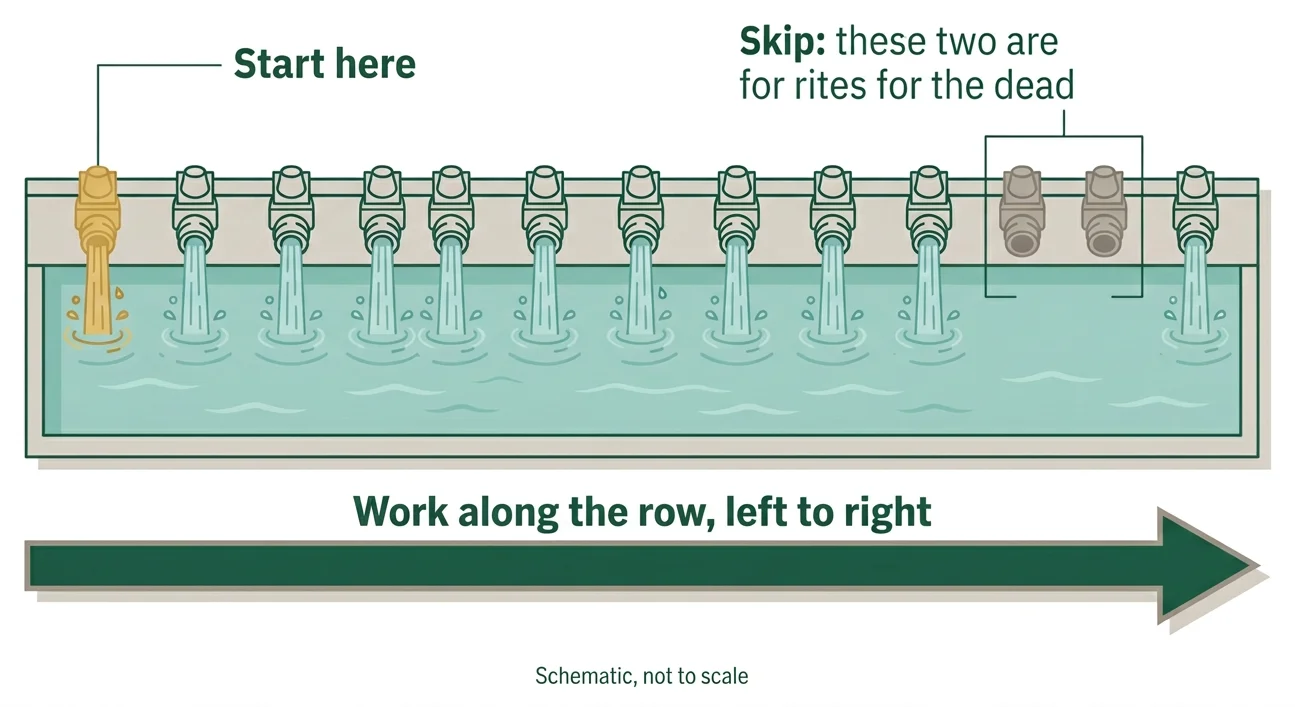
The steps down into the water are at one end of the main pool, and everyone starts there. The order is the whole point. You begin at the first spout on the left and work along the row to the right, one at a time. The pool is waist to chest deep, the bottom is stone and slightly slippery, and the water comes out of the mountain at around twenty degrees, colder than the air and briefly startling.
At the first spout: hands, face, then head
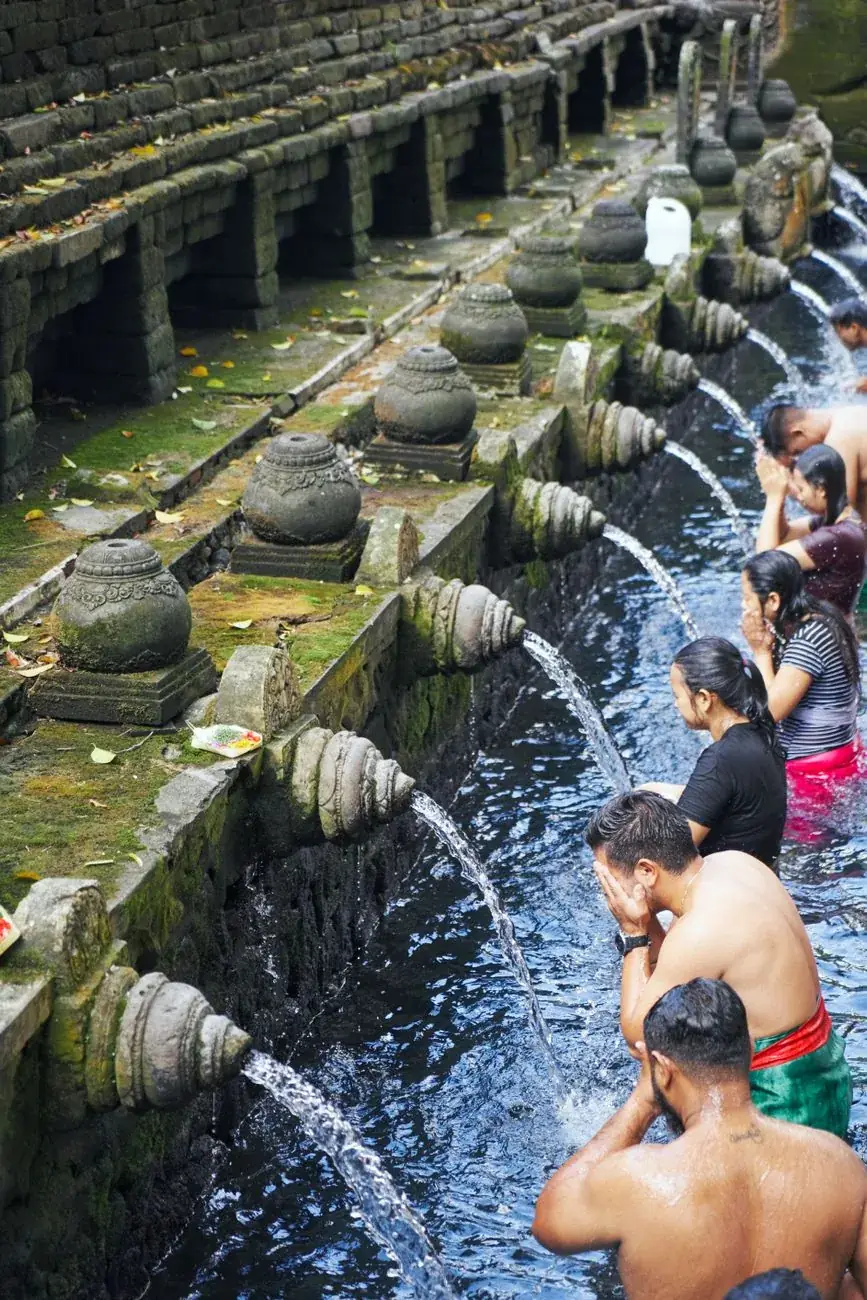
Watch the person in front of you and copy them, because the sequence is consistent. Hands together in front of the chest, a short silent prayer. Then cup the falling water and bring it to the face and to the mouth, three times. Then put the whole head under the spout and let the water run over the crown. It touches your lips, it does not go in the stomach. Some worshippers stay a few seconds, some considerably longer. Nobody is timing you.
Move one spout to the right, and repeat
Repeat the same sequence at every spout, moving steadily rightwards, one at a time and in order. Each spout is its own small cleansing, so the prayer resets each time rather than the whole thing being one long shower. On a quiet morning the whole row takes fifteen or twenty minutes. Behind a full temple group it takes considerably longer, and that waiting is part of it.
Pass the two funerary spouts without stopping
Two of the spouts in the main pool belong to the rites performed for the dead, not to the cleansing you came for, and Balinese worshippers walk straight past them. Watch where the person ahead of you stops and where they do not, and follow. More on spotting them below.
Continue into the second pool
There is more than one bathing pool at Tirta Empul, and the row does not end where the first one does. The second pool carries fewer spouts and fewer visitors, and it is where the temple stops feeling like a queue. Many day trippers never reach it because their guide has already turned round. Finish the row properly and you get the part of the morning that people remember.
Out, dry sarong, shoulders covered
Out of the water, back to the changing rooms, and into dry clothes with the temple sarong tied over them. Shoulders covered again from this point on. Bring a towel of your own and something waterproof for the wet sarong on the way home, because it will not dry in the car.
Finish in the inner courtyard, at the spring
The rite properly ends above the pools, in the jeroan, the innermost courtyard where the spring itself rises into a clear pond before the water is channelled out to the fountains. Balinese families sit here afterwards to pray, and the shrines around the edge are the actual religious heart of the site. It is also the quietest, most photographable corner of the compound, and most visitors skip it entirely on their way back to the car park.
The two spouts you walk past
This is the detail that matters most and the one the guidebooks leave out. Two of the fountains in the main pool are used for funerary rites, the cleansing performed in connection with a death, and they have nothing to do with the purification you came for. Balinese worshippers do not stop at them. Visitors who do not know often work along the whole row like a set of shower heads, which is not offensive so much as conspicuous.
They are usually marked with a sign, but signs weather and get moved. The reliable method is to watch the person in front of you. When the line steps around a fountain without pausing, step around it too. Following the queue is not just good manners here, it is the actual instruction.
Tirta Empul is not Tirta Gangga
People book the wrong driver over this, then spend three hours in a car arriving at the wrong side of the island.
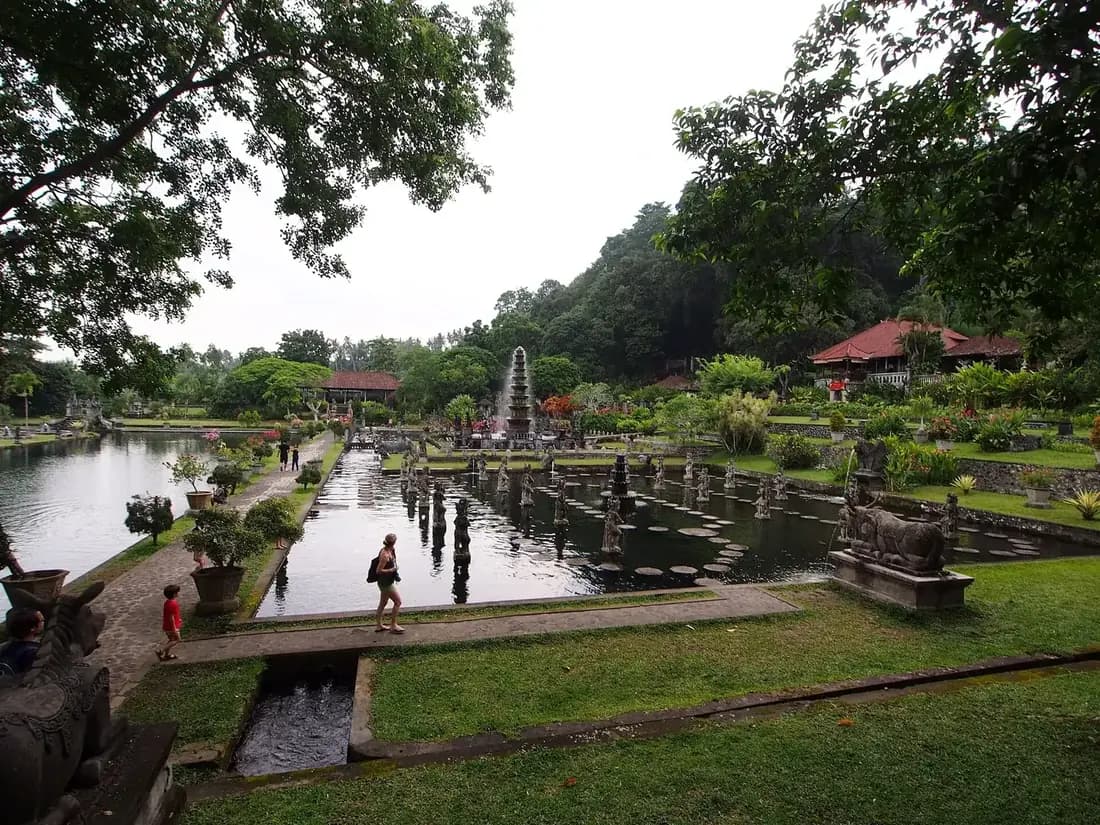
Both names begin with tirta, which simply means holy water, and there the similarity ends. One is a tenth century purification temple twenty five minutes north of Ubud. The other is a royal water garden from the 1940s in Karangasem, the far east of Bali, with the stepping stones over a koi pond that half the people searching for Tirta Empul actually have in mind. They are three hours apart by road and they are not a pair.
| You want | Go to |
|---|---|
| Take part in the water ritual | Tirta Empul |
| The stepping stones over a koi pond | Tirta Gangga |
| Based in Ubud, half a day free | Tirta Empul |
| Staying in Amed or Candidasa | Tirta Gangga |
| Calm, no crowds, no getting wet | Tirta Gangga |
| The oldest, most religiously important | Tirta Empul |
| Honestly, just water temples | Two separate days |
Choose Tirta Empul
It is the temple where melukat happens, in spring-fed pools that Balinese families use every day of the week, and it is twenty to thirty minutes north of Ubud. Tirta Gangga has water everywhere but no purification rite for visitors, and it is closer to two hours each way from Ubud, which turns a morning into a full day of driving for a garden.
Tirta Empul is also the older and more religiously important of the two by a thousand years. Its spring has been a place of worship since the tenth century and it is still in daily religious use.
Choose Tirta Gangga
The stepping stones cross an ornamental carp pond in a former royal water garden built by the local royal family in the 1940s, a pleasure garden rather than a sanctuary. It is the single image people most often attach to the wrong name, since Tirta Empul has no stepping stones at all. Tirta Gangga is on the doorstep of Amed or Candidasa, half an hour or so inland, and it pairs naturally with Lempuyang, while Tirta Empul sits well over an hour and a half away on the far side of the island.
It also suits a reader who wants somewhere calm to walk around, with no crowds and no getting wet. It absorbs visitors better and nothing is asked of you, while Tirta Empul in the middle of the day is a queue of people in wet sarongs.
If you just want to see water temples, do not try to combine these two in one day. Pair Tirta Empul with the sights north of Ubud, and pair Tirta Gangga with Lempuyang and the east coast on a separate trip.
When to go, and how bad the crowds get
The site does not change through the day. Everything that makes it worth visiting does.
Tirta Empul is close enough to Ubud to be on every day tour, and that is the whole problem with it. From around ten in the morning the car park fills with minibuses, and the main pool turns into a slow-moving line of visitors in green sarongs with a handful of worshippers trying to get through it. Nothing about that is unpleasant, exactly. It is just not what the place is.
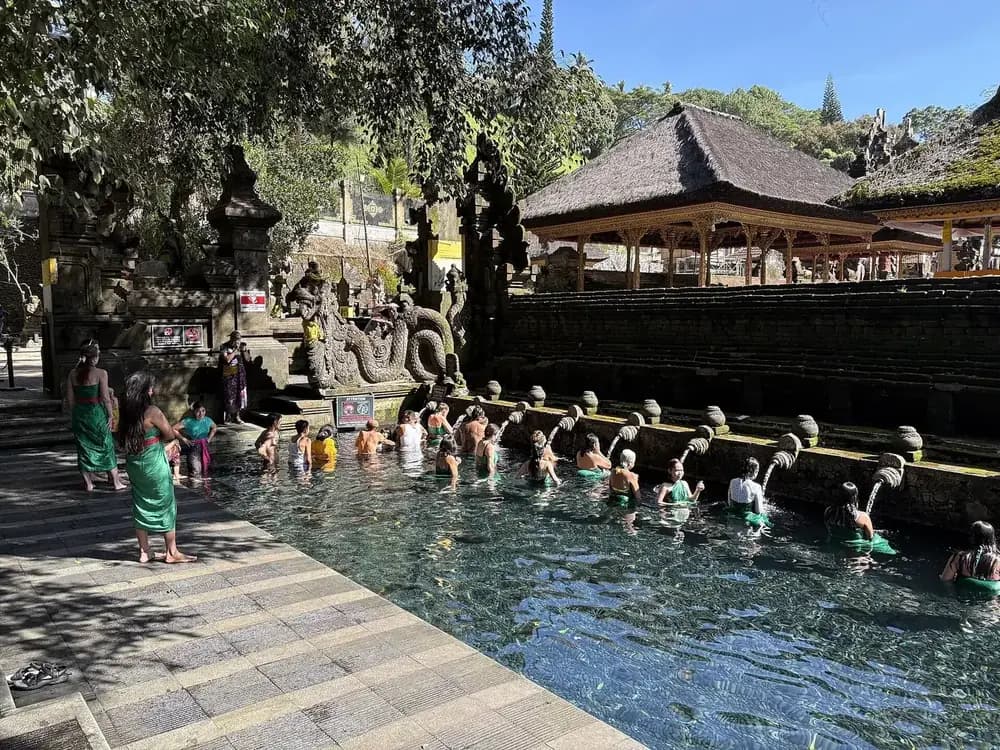
Come within the first hour of opening and you get the version people describe afterwards: mist on the surface, families arriving with offerings, and enough space in the row to take your time under each spout. The difference between eight in the morning and eleven is the difference between a ritual and a queue. Late afternoon is the second-best window, once the tours have moved on to lunch and the light drops behind the trees.
Balinese calendar days are a separate calculation. On full moon, purnama, and on other auspicious dates the temple fills with hundreds of worshippers in white, which is extraordinary to witness and hopeless if you wanted a quiet bathe yourself. Ask your driver or your hotel what the Balinese calendar says for the day you are planning, because no international calendar will tell you.
| Arrival window | Who is in the water | Wait for the row | Verdict |
|---|---|---|---|
| First hour of opening | Mostly Balinese worshippers | Little to none | The reason to come. Worth the early start out of Ubud. |
| Mid morning | First tour groups, mixed | Fifteen to thirty minutes | Still workable if you head for the second pool first. |
| Late morning to early afternoon | Coach parties, wall to wall | Up to an hour | The window that produces the bad reviews. Avoid it. |
| Last two hours before closing | Locals again, few tourists | Short | The overlooked slot. Softer light, cooler water, calm. |
| Full moon and ceremony days | Hundreds of worshippers in white | Long, or the pools are closed to visitors | Remarkable to watch, wrong day to bathe yourself. |
Getting there from Ubud, Canggu or the south
It sits at Tampaksiring, in the hills above Ubud, on the road that continues towards Kintamani and the volcano. That road passes Goa Gajah on the way up, which is a fifty minute stop and the easiest thing to add to this morning without lengthening it much.
| Coming from | Drive | Leave by, for opening | Sensible pairing |
|---|---|---|---|
| Ubud centre | 25 to 40 min | 07:00 | Gunung Kawi, then Tegallalang on the way back |
| Sanur | 1 h 15 | 06:30 | Add a waterfall south of Ubud on the return |
| Canggu, Seminyak | 1 h 30 to 2 h | 06:00 | Make it a full day with Ubud itself |
| Kuta, airport | 1 h 45 to 2 h 15 | 05:45 | Long day. Better done from an Ubud base |
| Kintamani, Mount Batur | 45 min | On the way down | Classic stop after a sunrise trek |
Private driver
The normal answer, and the reason is timing. A driver for a half day out of Ubud costs a few tens of euros for the car, not per person, and he waits while you queue and change. Ask for a seven in the morning start and be specific about it, because the default itinerary every driver runs puts Tirta Empul in the middle of the day.
Scooter
Genuinely fine from Ubud. The road north is sealed, reasonably wide and busy enough to be predictable, and there is proper parking at the temple. You will be carrying a wet sarong home, so bring a dry bag. Not something to attempt from the southern beaches on a whim.
Grab and Gojek
Works to get there from Ubud, works badly for the return. Coverage thins out at Tampaksiring and you can wait a long time for a car back, which is why most people who arrive by app end up negotiating with a driver in the car park at a worse rate.
Tickets, dress code and what it costs
Entrance fees at Balinese temples are set locally and revised without notice, so what follows is orders of magnitude rather than a price list.
| What you pay for | Detail | Order of magnitude |
|---|---|---|
| Entrance | Per adult, dry sarong and sash included. Children pay less. Cash. | A few dollars |
| Bathing sarong | Rented separately near the pools. Only if you are going in. | A euro or two |
| Locker | Worth it. There is nowhere dry to leave a phone otherwise. | Around a euro |
| Offering | A canang of flowers, sold at the entrance. Optional, and expected if you are taking the rite seriously. | Small change |
| Parking | Car or scooter, collected on the way out. | Small change |
| Driver, half day from Ubud | Per car, not per person, and usually covering two or three stops. | A few tens of euros |
The dress code, in practice
Shoulders and knees covered anywhere inside the compound, with the sarong and sash you are given at the ticket desk worn over whatever you arrived in. This is enforced at the gate, not as a formality. Sleeveless tops, short shorts and swimwear as outerwear are the three things that get people sent back.
For the water, the working combination is swimwear underneath and a rented bathing sarong over the top, with a t-shirt if you would rather. Women bathe in a sarong tied at the chest, which is what the green ones in every photograph are. Men wear a sarong at the waist and go bare chested, which is normal here and only here.
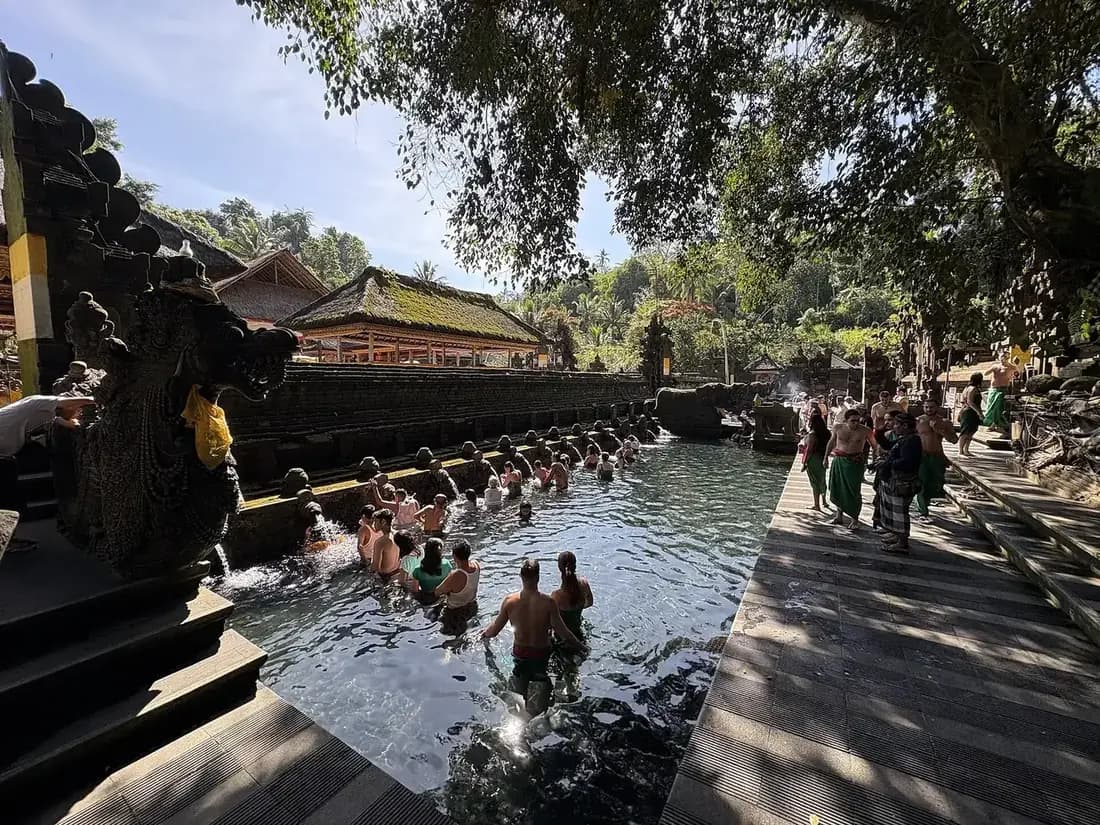
Bring a towel, a full change of dry clothes and a bag for the wet ones. Flip flops are fine and you will be carrying them at some point anyway. Leave anything valuable in the locker, because the pool floor is stone and things that go in do not come out.
The rest of the temple, which most visitors miss
Ninety percent of the photographs are taken at one pool. The compound is a good deal larger than that.
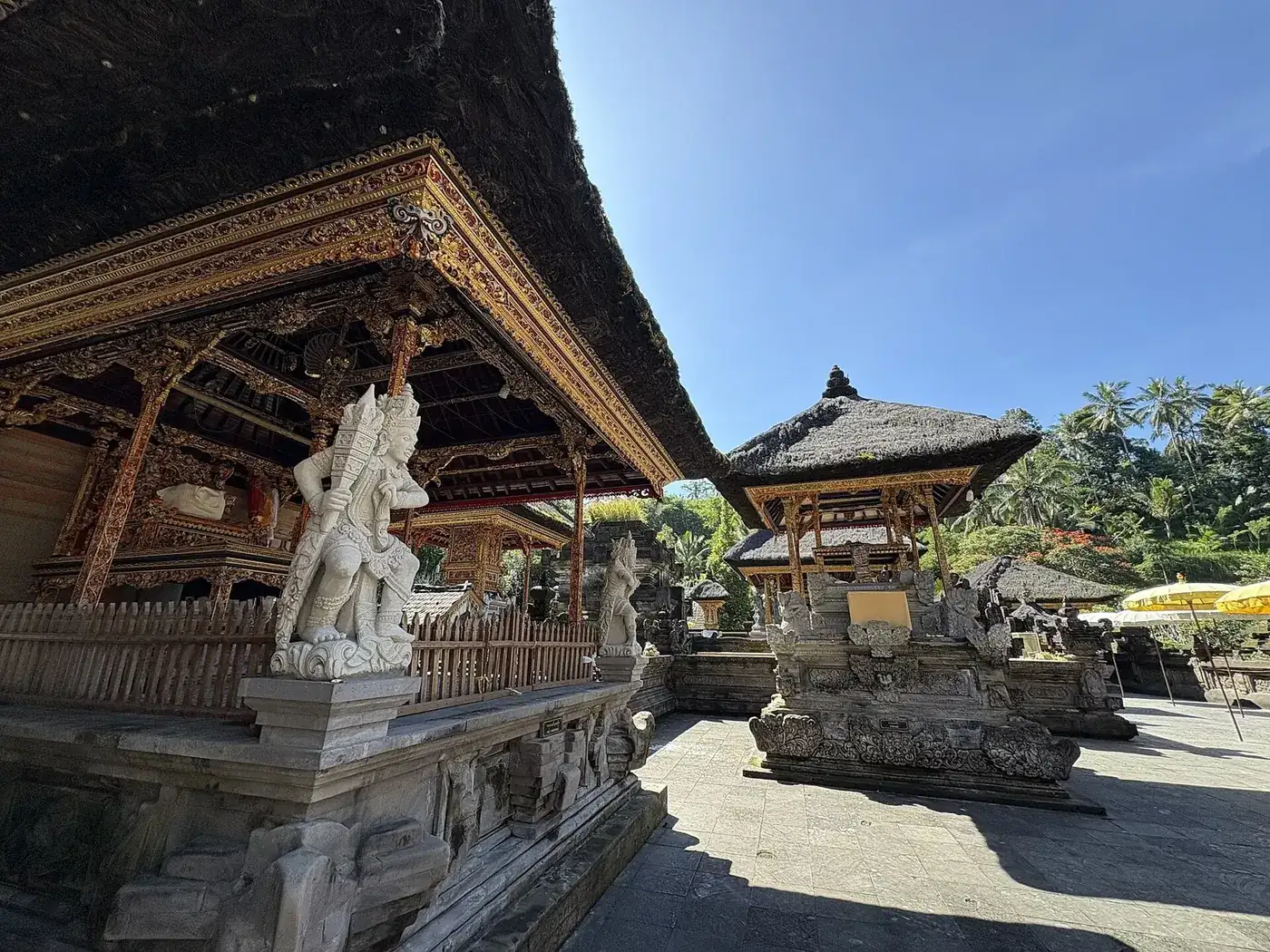
Above the pools, the jeroan holds the spring pond, the shrines and a row of gilded pavilions under enormous banyan trees. This is the religious heart of the site and it is almost always quieter than the water, because groups arrive on a clock and the clock says pools. Sit here for ten minutes after you have dried off and the visit reads completely differently.
On the way out you are funnelled through a souvenir market, which is unavoidable by design. Prices open high and nobody expects you to accept them. It is perfectly pleasant if you treat it as part of the walk rather than as an ambush, and a genuinely decent place to pick up a sarong of your own for the rest of the trip.
Facilities are better than at most Balinese temples: proper changing rooms, lockers, toilets, a warung or two and reliable parking. What there is not is shade over the queue, so a hat matters more than you would think for a visit that is mostly spent in water.
Tegallalang
The rice terraces are twenty minutes back down the road and pair with Tirta Empul on almost every driver's standard loop. Go to the terraces first if you want them before the coaches, temple second.
Gunung Kawi
Rock-cut royal shrines in a river valley, ten minutes away and from roughly the same century. Three hundred steps down and back, far fewer visitors, and the best companion piece to Tirta Empul on the island.
Waterfalls
Several sit between Tampaksiring and Ubud, so you can add one on the way back without doubling the day. You are already wet and already carrying a towel.
Campuhan Ridge
Back in Ubud, and the easy way to finish a morning that started at seven. Flat, open, and best in the same early light you used at the temple.
Where it sits among the other temples
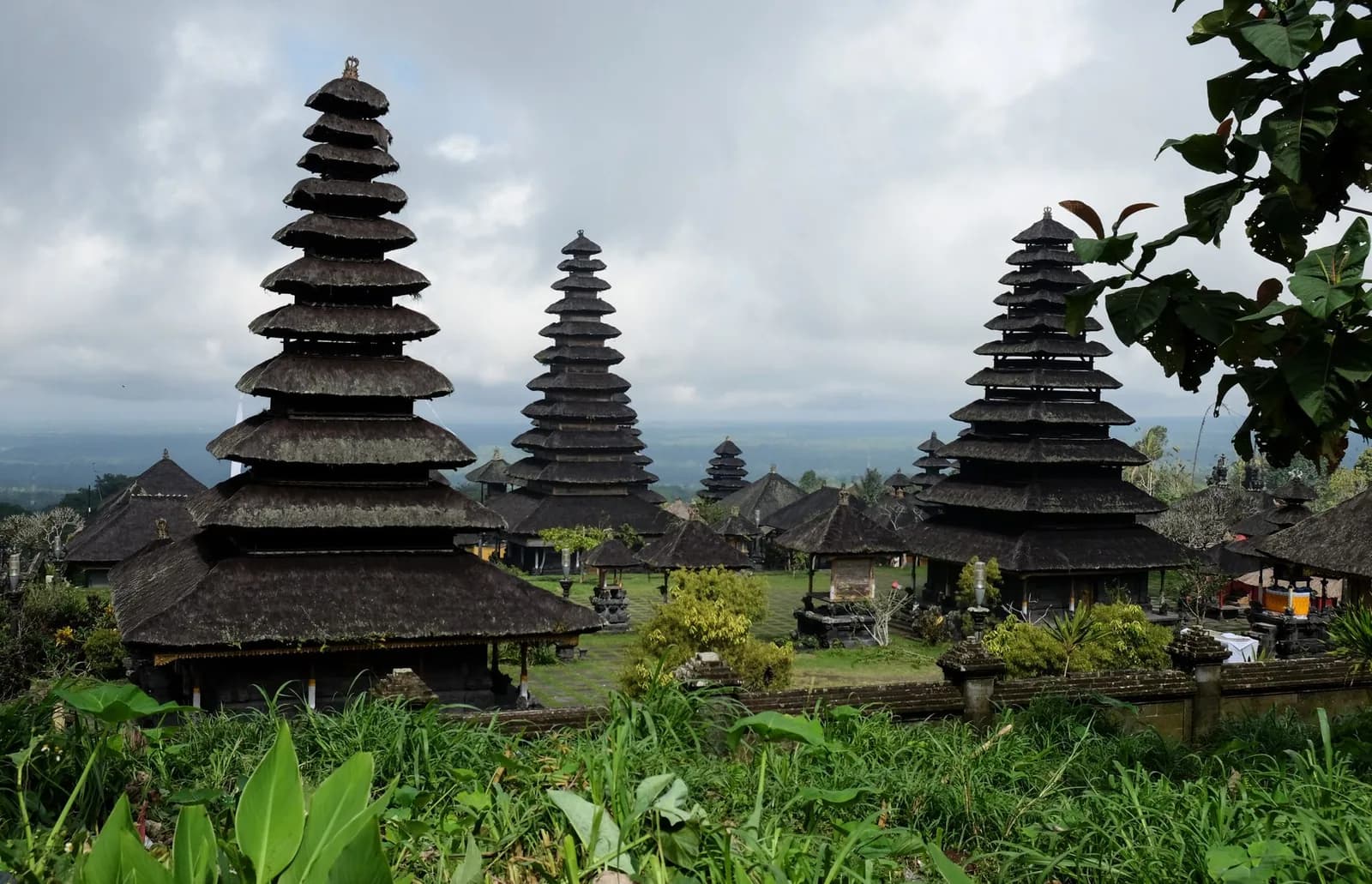
Tirta Empul is the one you take part in. That is what separates it from the rest of the island's big temples, and it is worth knowing what the others actually offer before you fill a week with them. At Besakih, the mother temple on the slopes of Mount Agung, you walk a vast complex of courtyards you mostly cannot enter, and the draw is scale and position rather than participation. Ulun Danu Beratan is a photograph you take from a lakeside garden, in highland air a good ten degrees cooler than here.
If you have one temple day, this one and Lempuyang pull in opposite directions: a ritual you join at dawn near Ubud, or two hours of driving east for a gate and a queue. The rest of the shortlist is on the temples guide.
So is it worth it?
Yes, with one condition attached, and it is the same condition as Lempuyang: the hour you arrive decides everything. Tirta Empul at eight in the morning is one of the few places on Bali where a visitor can step into something that has been happening continuously for a thousand years and be welcomed into it. Tirta Empul at noon in August is a wet queue and a souvenir market, and people write both of those reviews about the same temple in the same week.
It is also the rare temple that rewards preparation rather than photography. Knowing the order of the spouts, knowing which two to pass, carrying an offering and leaving the phone in the locker costs nothing and changes the visit entirely. Most people arrive knowing none of it, which is precisely why the ones who do stand out in the queue for the right reasons.
If you only have room for one temple near Ubud, make it this one. If you have room for two, add Gunung Kawi down the road rather than driving three hours east for a water garden with a similar name.