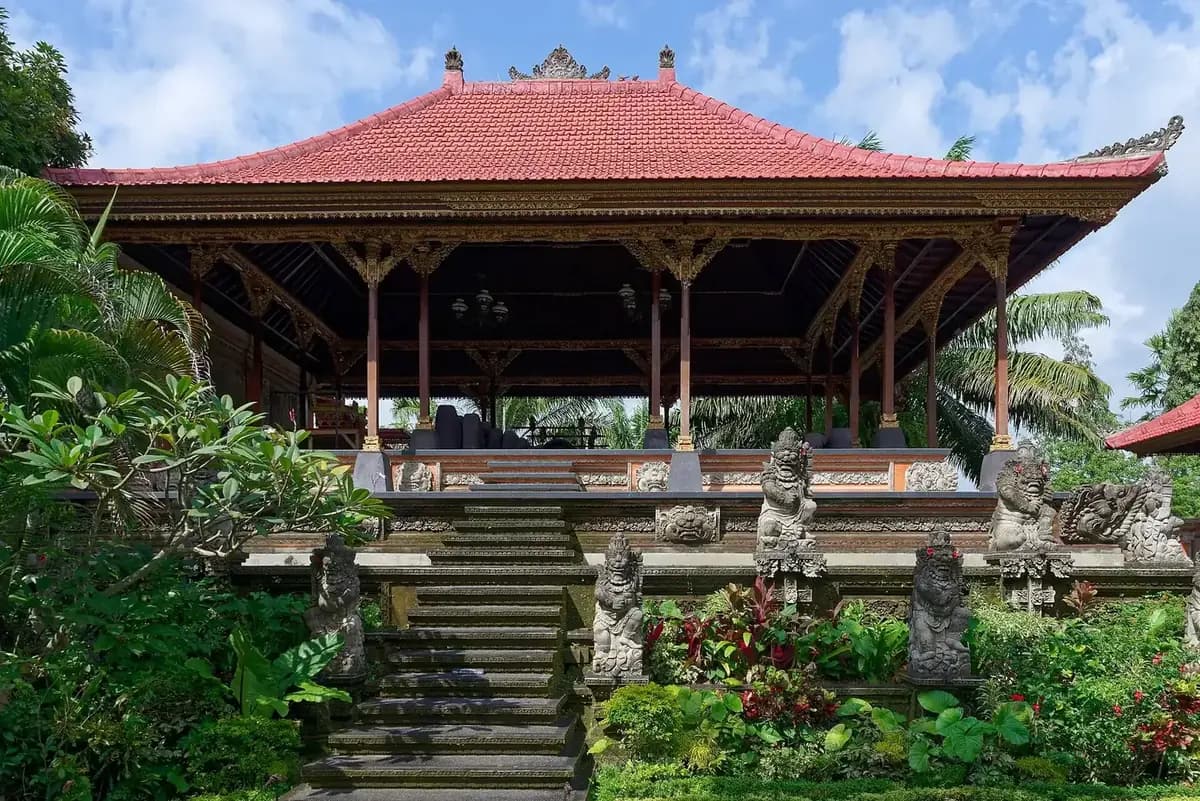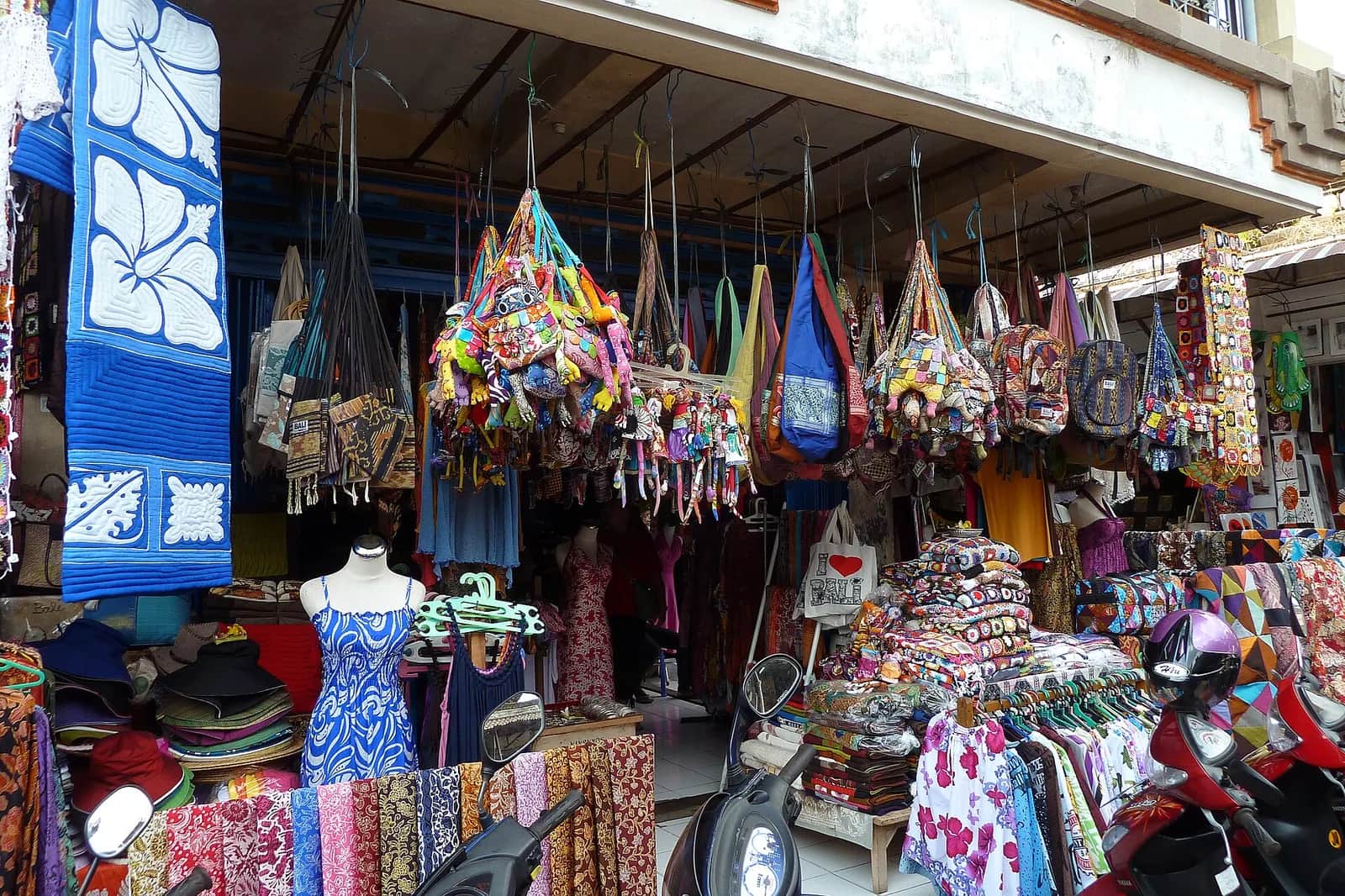
Ubud Art Market, Pasar Seni Ubud on the signs, faces Ubud Palace across the main crossroads of Ubud. Early in the morning the basement is a working produce market. From about nine the upper floors and the lanes around them are souvenir stalls, where nothing has a price tag and the first number you hear is two or three times the one the seller will accept.
On this page
Ubud morning market vs Ubud Art Market
People search for "Ubud market" and "Ubud Art Market" as if they were one thing. They share a building and an address, but they are two markets with different customers, different hours and different rules.
Ubud traditional market: what the morning market sells
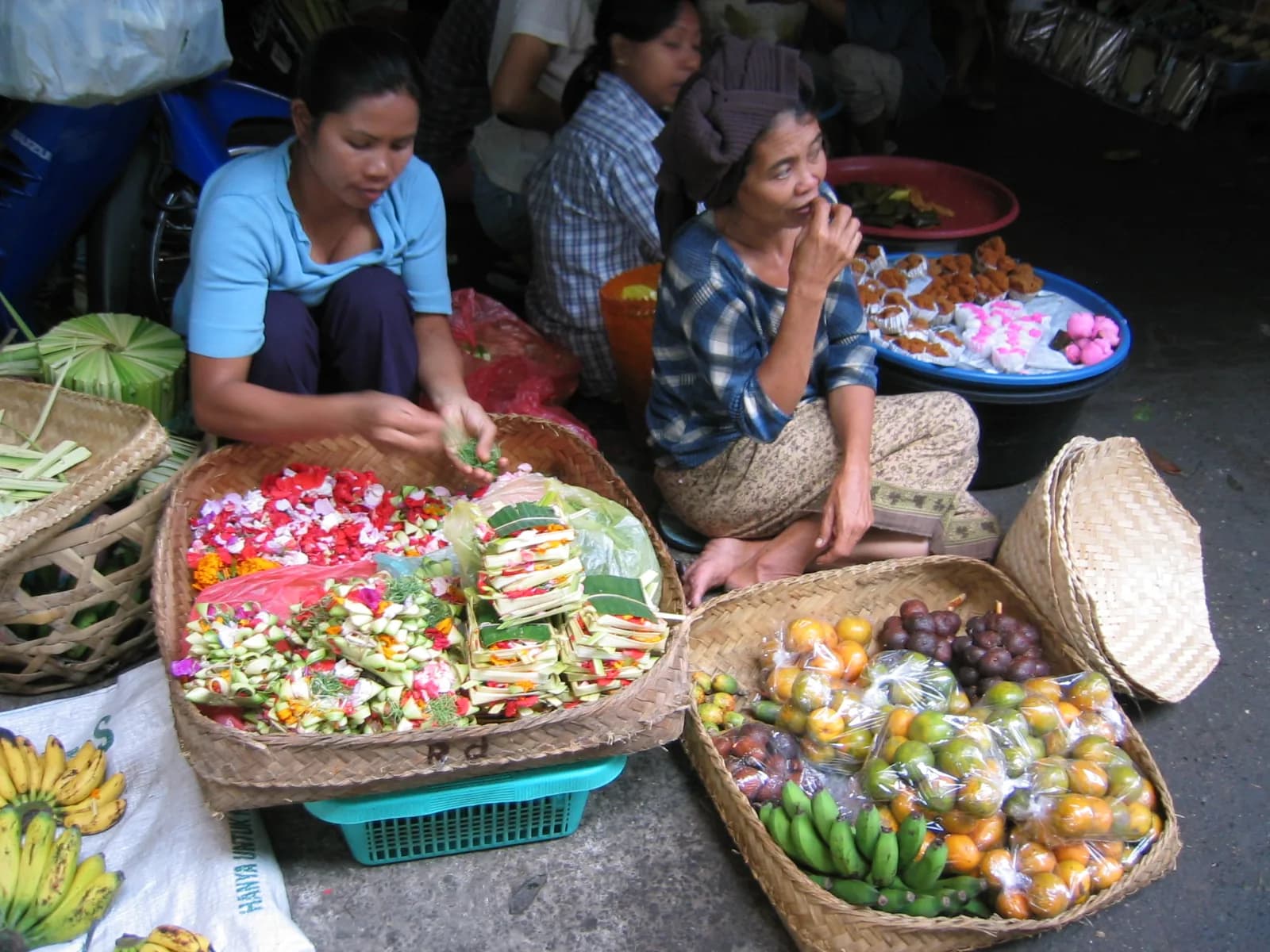
The morning market is a pasar in the ordinary Balinese sense. From before sunrise, women from the surrounding villages sell bananas, chillies, shallots, rice, coconut, palm sugar and, above all, the ingredients for daily offerings: marigolds, frangipani, pandan, and the small woven palm-leaf trays called canang. Buyers are cooks, temple helpers and families shopping for the day.
Nobody is selling to you here, which is the point. Prices are low and roughly fixed, nobody will chase you, and you can walk through, buy fruit, and watch a town's day start. It is at its fullest in the first hours after dawn and thins out by 8:00.
Ubud Art Market: what the souvenir stalls sell
The art market is the upper floors of the same complex and the stalls spilling out along Jalan Raya Ubud and the lanes behind. Sarongs, ata bags, carvings, masks, silver, paintings, dreamcatchers, soaps, kites. Here everything is negotiated, from a 20,000 rupiah keyring up.
Is Ubud market open after the 2024 fire?
The complex, officially Pasar Rakyat Tematik Wisata Ubud, was rebuilt between 2020 and 2023 into two blocks, east and west, each with a basement and two upper floors. It reopened in April 2023. On 17 August 2024, a fire broke out in the basement of one block around 13:00 and took roughly seven hours to put out, damaging the produce market below and the craft floors above. Several hundred traders lost their stalls. Nobody was killed.
The morning market moved into the basement of the undamaged west block, the old car park, with some sellers on the pavement until about 7:30. The east block was renovated from October 2025, blessed in a melaspas ceremony on 16 February 2026, and traders started moving back at the end of that month. Local press has not reported on it since, so expect a few stalls to still be settling in, and ask at the gate which floor the produce sellers are on that morning.
If you want the morning market explained
Free cancellationBalinese cooking class with a morning market tour
- ✓Starts with a local morning market, where the cook tells you what each ingredient is for
- ✓Then a walk through the rice fields before the hands-on class
- ✓The market visit is part of the morning session: check the start time when booking
- ✓Price, rating and reviews on the card are synced from GetYourGuide
Affiliate link. Booking through GetYourGuide costs you nothing extra and supports the guide. Price and rating checked October 2026. Both move with season and demand.
Ubud Art Market opening hours and best time to go
There are no official hours posted for the souvenir stalls, and the sources that print one disagree (8 to 6, 9 to 5, 10 to 5). What actually happens: stalls open one by one between 8:00 and 10:00, and pack up between 17:00 and 18:00. Some stay open later in the high season, some close early on a quiet day.
| Address | Jalan Raya Ubud 35, directly opposite Ubud Palace on the main crossroads. |
|---|---|
| Morning market | From before sunrise. Fullest in the first hours after dawn, thinning out by 8:00, mostly packed up by 9:00 or 10:00. |
| Souvenir stalls | Most open between 8:00 and 10:00 and close between 17:00 and 18:00. Nothing official is posted, so each stall keeps its own hours. |
| Entry | Free. Scooter parking around IDR 2,000, a car around IDR 10,000, where there is space. |
| How long | Thirty minutes for the morning market, one to two hours if you are actually shopping the stalls. |
| Payment | Cash in rupiah. A few stalls take cards, but bargaining only really works with notes of 20,000 to 100,000. |
The best time to visit Ubud Art Market
Between 8:00 and 10:00. The morning market is winding down, the first stalls are open, and the day trippers from the south coast have not arrived. Some sellers like to make a first sale early for luck, and you will meet less resistance on price.
From about 10:00 to 15:00 the lanes are at their most crowded and the midday heat sits in the covered aisles. The last hour, around 16:00 to 17:00, is the other good window: quieter, and some sellers would rather sell than carry stock home.
Ubud Art Market prices in 2026: first price vs what you should pay
These are opening prices and settled prices for the things people actually buy, from 2026 shopping reports. Conversions are at the rate of 7 October 2026 (US$1 = IDR 17,902, C$1 = IDR 12,588). Quality moves every one of them, but if you end up far above the right-hand column, you paid tourist rate.
| Item | Detail | Order of magnitude |
|---|---|---|
| Sarong (printed batik or rayon) | Opening ask around IDR 150,000 (US$8.40 · C$11.90). Hand-drawn batik or real ikat costs more and is rare here. | IDR 50,000 to 80,000US$2.80 to 4.50 · C$4 to 6.40 |
| Round ata or rattan bag | Opening ask around IDR 350,000 (US$19.60 · C$27.80). Tight, even weave and a leather clasp push it up. | IDR 150,000 to 250,000US$8.40 to 14 · C$11.90 to 19.90 |
| Small wood carving | Opening ask around IDR 250,000 (US$14 · C$19.90) for a figure that fits in your hand. | IDR 100,000 to 150,000US$5.60 to 8.40 · C$7.90 to 11.90 |
| Carved wooden mask | One mask priced by a 2026 shopper: IDR 600,000 at Ubud Art Market, 250,000 at Sukawati, 100,000 at a carver's workshop in Mas. | Ubud ask IDR 600,000US$33.50 · C$47.70 |
| Dreamcatcher or macramé hanging | Sold by the dozen on the upper floors. Size decides most of the price. | IDR 50,000 to 100,000US$2.80 to 5.60 · C$4 to 7.90 |
| Painting on canvas | Rolled, unframed, mostly copies of popular styles. Original work is in galleries, not here. | From IDR 200,000US$11.20 · C$15.90 |
The mask line is a single comparison, not a market survey, but it shows the pattern well. The same carved mask cost 100,000 at a workshop in Mas, 250,000 at Sukawati, 600,000 at Ubud Art Market and 1,200,000 in a shop in Seminyak. The closer you buy to where it was made, the less rent is in the price.
How to bargain at Ubud Art Market
Haggling is expected here and nobody is offended by it. A seller who opens at 350,000 for a bag knows you are not going to pay 350,000. What decides the final price is mostly your patience.
- Look first, ask later. Walk one full floor before you ask a price. The same ata bag hangs on twenty stalls.
- Let them name the price. Then counter at roughly 40 % of it. A 150,000 sarong gets an offer of 60,000.
- Aim for the middle. Most deals land at 40 to 60 % of the opening price. If the seller drops straight to half, you can still go lower.
- Walk away, politely. It is the strongest move you have. If your price was fair, you will hear it called after you before you reach the next stall.
- Buy several from one stall. Three sarongs from one seller get a better unit price than one sarong from three.
- Carry small notes. Handing over 100,000 for a 60,000 deal and waiting for change undoes the negotiation. Bring 20,000s and 50,000s.
What to buy in Ubud Art Market?
The stalls repeat each other more than they differ, so this is less a list of finds than a list of what is worth buying here and what is better bought elsewhere.
Sarongs and batik at Ubud Art Market
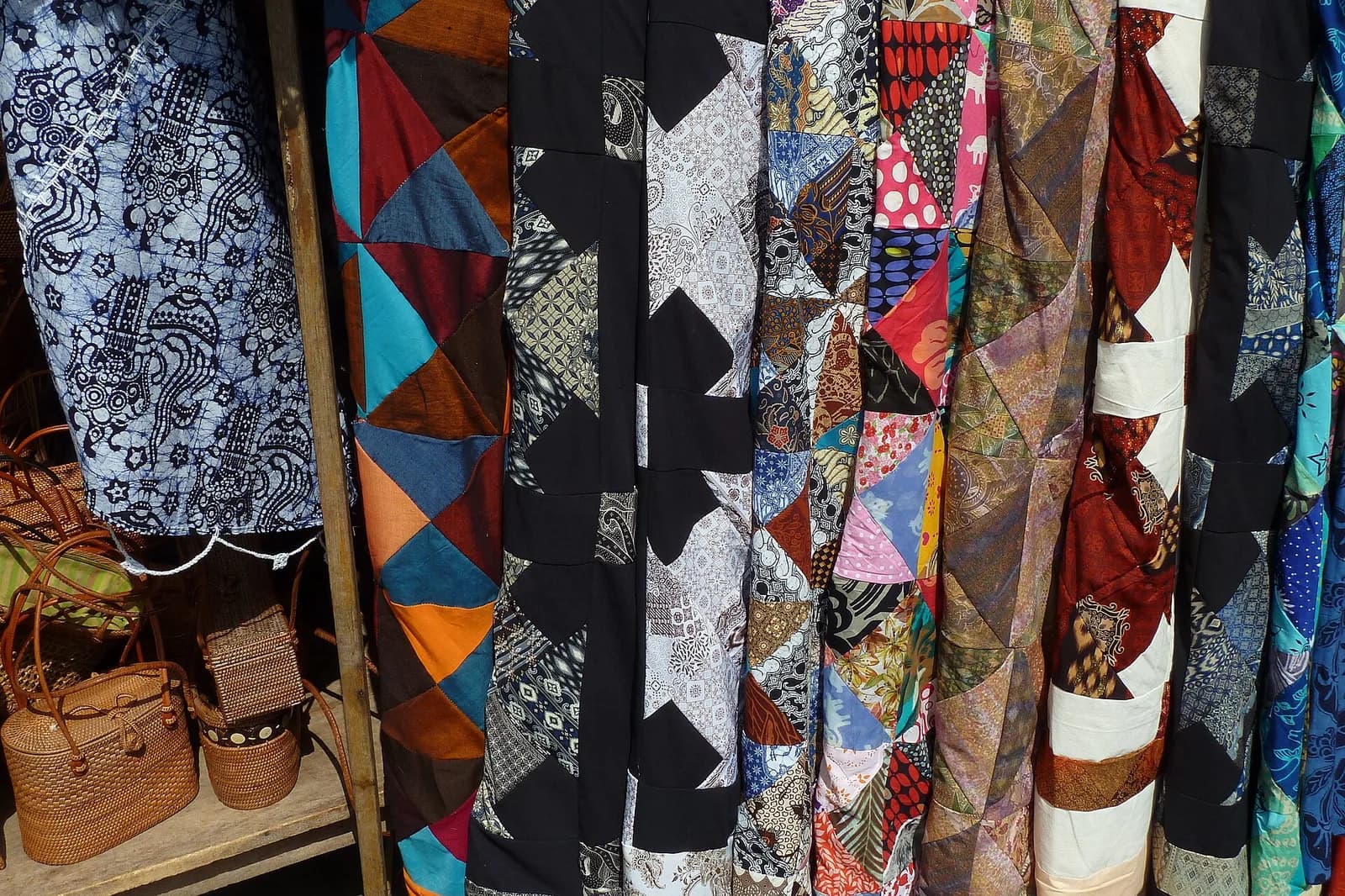
Photo Schnobby, CC BY-SA 3.0
The cheapest useful thing in the market: you need one for every temple in Bali, and it doubles as a beach throw. Most are machine-printed rayon, which is fine at 50,000 to 80,000. Hand-drawn batik (wax lines slightly irregular, pattern equally strong on the back) and woven ikat cost several times more and are thin on the ground here. For real textiles, Tenganan in the east is the place.
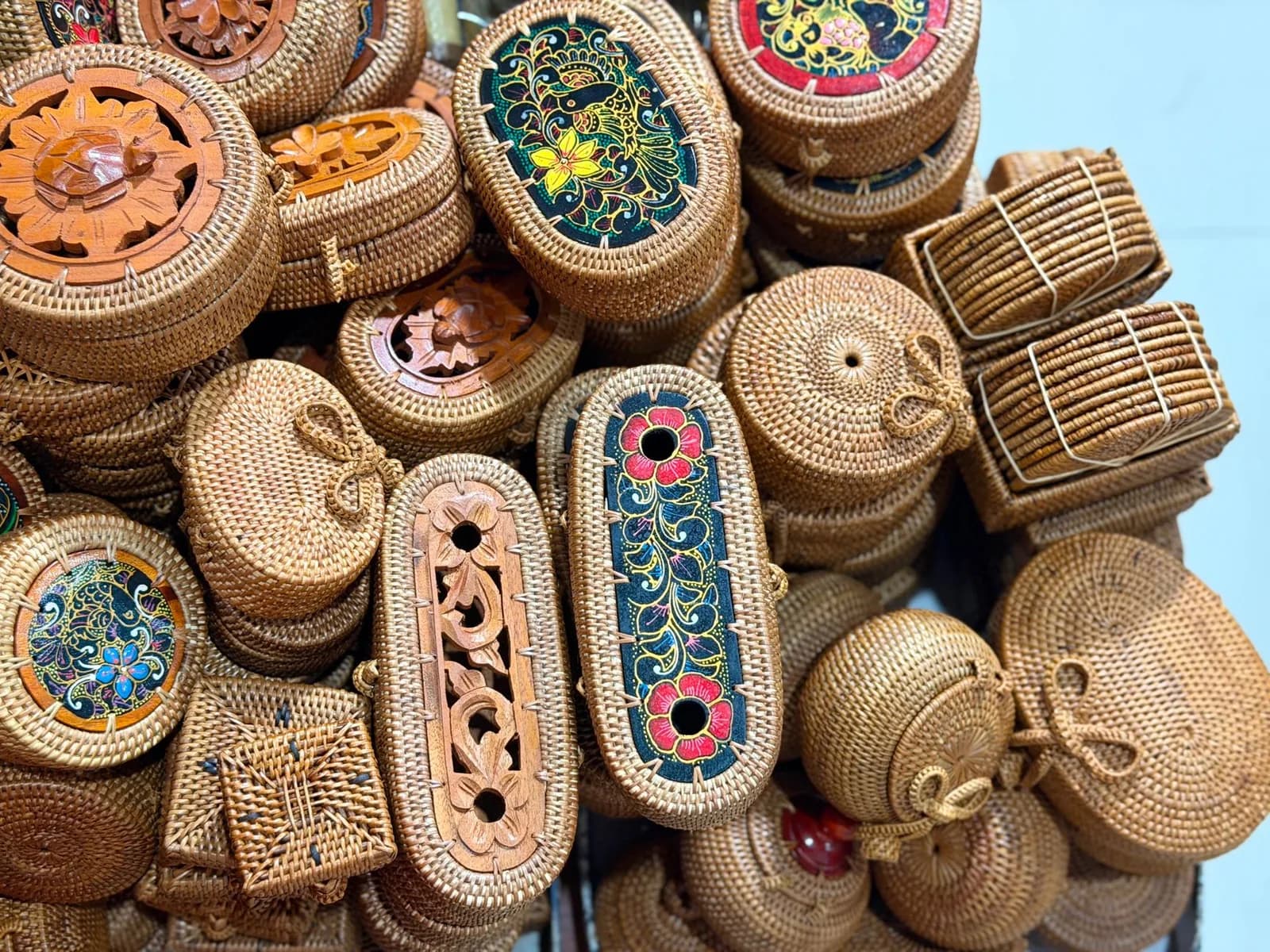
Ata and rattan bags at Ubud Art Market
The round woven bag with a leather strap is what most people leave with. Ata grass, woven mainly in the villages of Karangasem, is darker, finer and more rigid than rattan, and a tight ata weave takes days of work. Check the weave is even all the way round, the clasp is stitched rather than glued, and the lining is not already coming loose. 150,000 to 250,000 for a decent one.
Wood carvings and masks at Ubud Art Market
Figures, Garuda, frogs, Buddha heads, and the painted Barong and topeng masks. Good value at the small end, expensive at the big end compared with the carving villages: the whole Ubud price list sits well above Mas, 15 minutes south, where you can buy from the person holding the chisel.
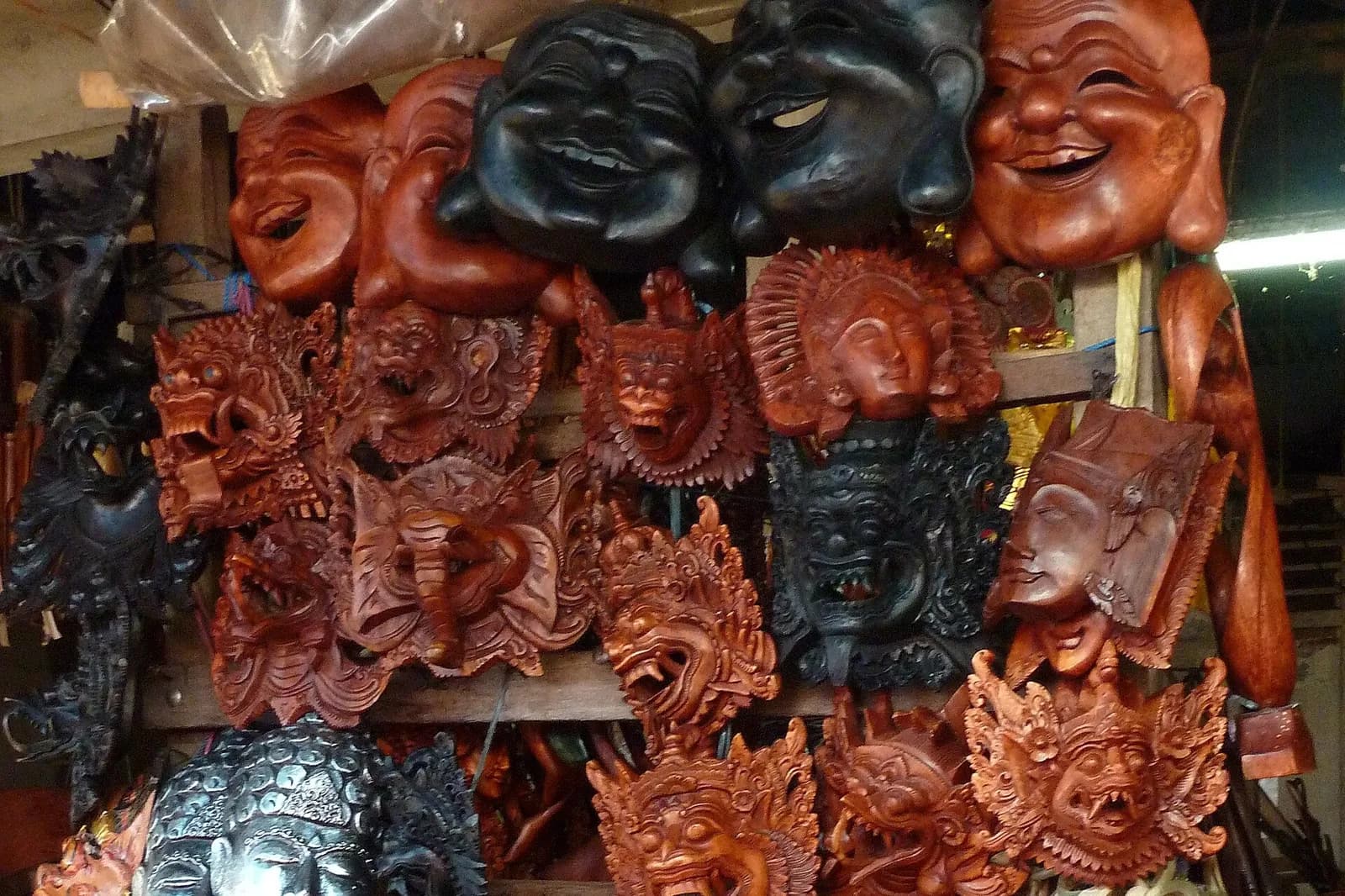
Photo Schnobby, CC BY-SA 3.0
Where is the best place to buy paintings in Ubud?
The canvases on the art market walls are mostly decorative copies of a handful of popular styles: rice fields, dancers, Buddha heads, herons. Fine as a souvenir from about 200,000, rolled in a tube. For cheaper and larger canvases, Sukawati has more choice. For an original by a named Balinese painter, skip the markets and go to Ubud's galleries, where the price is set by the artist and not by your haggling.
Silver jewellery at Ubud Art Market: is it real?
Sold on several stalls, but this is the riskiest purchase in the building, because plated brass looks like sterling under fluorescent light. Look for a 925 stamp, and know that a magnet should not stick to it. For serious silver, Celuk village, 20 minutes south, is where Bali's silversmiths work.
Cheap souvenirs at Ubud Art Market: soaps, dreamcatchers, kites
Frangipani and coconut soaps, incense, dreamcatchers and macramé, bamboo wind chimes, wooden toys, small kites. Cheap, light, easy to pack, and the right thing to buy in bulk from a single stall for a better price.
How to spot mass-produced crafts at Ubud market
Much of what is sold here is not made in Ubud, and some of it is not made in Bali at all. That is not a scam in itself: a printed sarong is a printed sarong. It becomes one when a factory item is sold at handmade prices. A shopper in 2026 reported finding a "made in China" label inside a macramé cushion cover sold as the seller's wife's work. These checks take ten seconds each.
- Twenty identical pieces. A stall with the same frog, the same mask, the same painting in twenty identical copies is selling stock, not craft.
- Carving or casting. Real carving shows chisel marks and the wood grain runs irregularly through the piece. Moulded resin or stone has a seam line and the same fine detail on every copy.
- Sandalwood that only smells on the surface. Fake sandalwood is ordinary wood rubbed with oil. Ask to scratch the underside: real sandalwood smells all the way through.
- Silver without a 925 stamp, or that a magnet sticks to, is not sterling.
- "Antiques". Artificially aged masks and statues are a craft in themselves. A genuine antique would not be on a market stall at market prices.
- Check inside. Labels, linings and the underside of bags and cushions tell you more than the seller does.
Sukawati Art Market vs Ubud Art Market
If you are shopping in quantity, or you want lower prices more than a nice morning, the markets south of Ubud are the better trip.
Sukawati Art Market: prices, hours and distance from Ubud
About 12 km south of Ubud, 20 to 30 minutes by car depending on traffic. Pasar Seni Sukawati dates from the 1980s and was rebuilt in 2020 to 2022 into three blocks, reopened by the President in February 2023: block A alone holds 779 stalls, block C another 525 plus 64 kiosks. Much bigger than Ubud, under cover if it rains, and cheaper, because many stall holders also sell wholesale to shops across Bali. Open roughly 8:00 to 18:00, with some stalls from 6:00. Less charming, more choice, and the bargaining rules are the same.
Guwang Art Market, the quieter alternative to Sukawati
About a kilometre from Sukawati and quieter. Block A sells wood carvings and souvenirs, block B textiles, sarongs and beachwear, block C offering flowers. Open roughly 8:00 to 18:00, entry free. Good if Sukawati feels like too much.
Mas woodcarving and Celuk silver villages near Ubud
On the same road south, Mas is the woodcarving village and Celuk the silver village. Workshops sell directly, often with the carver or silversmith at work behind the counter. Fixed prices are more common and quality is visible. This is where the 100,000 rupiah mask came from.
Gianyar night market from Ubud
Not a craft market: Pasar Senggol Gianyar is a food market, about 20 minutes east of Ubud, open every day from around 16:00 to 23:00, with parking around IDR 5,000. Babi guling, ayam betutu, klepon and laklak from stalls where Balinese families eat. The good way to end an afternoon at Sukawati.
Is the Ubud Art Market worth it?
Yes, as part of a morning in central Ubud. The morning market is one of the few places in town where you see daily Balinese life without anyone performing it for you, and it costs nothing. The stalls are the most convenient place in Ubud to pick up sarongs, bags and gifts, at prices well below shops in Seminyak.
Not as a destination in itself. If you are staying on the south coast and coming up only for shopping, Sukawati is on the way, bigger and cheaper. And if you want a handmade carving or real silver, the villages are a better use of the drive than the market.
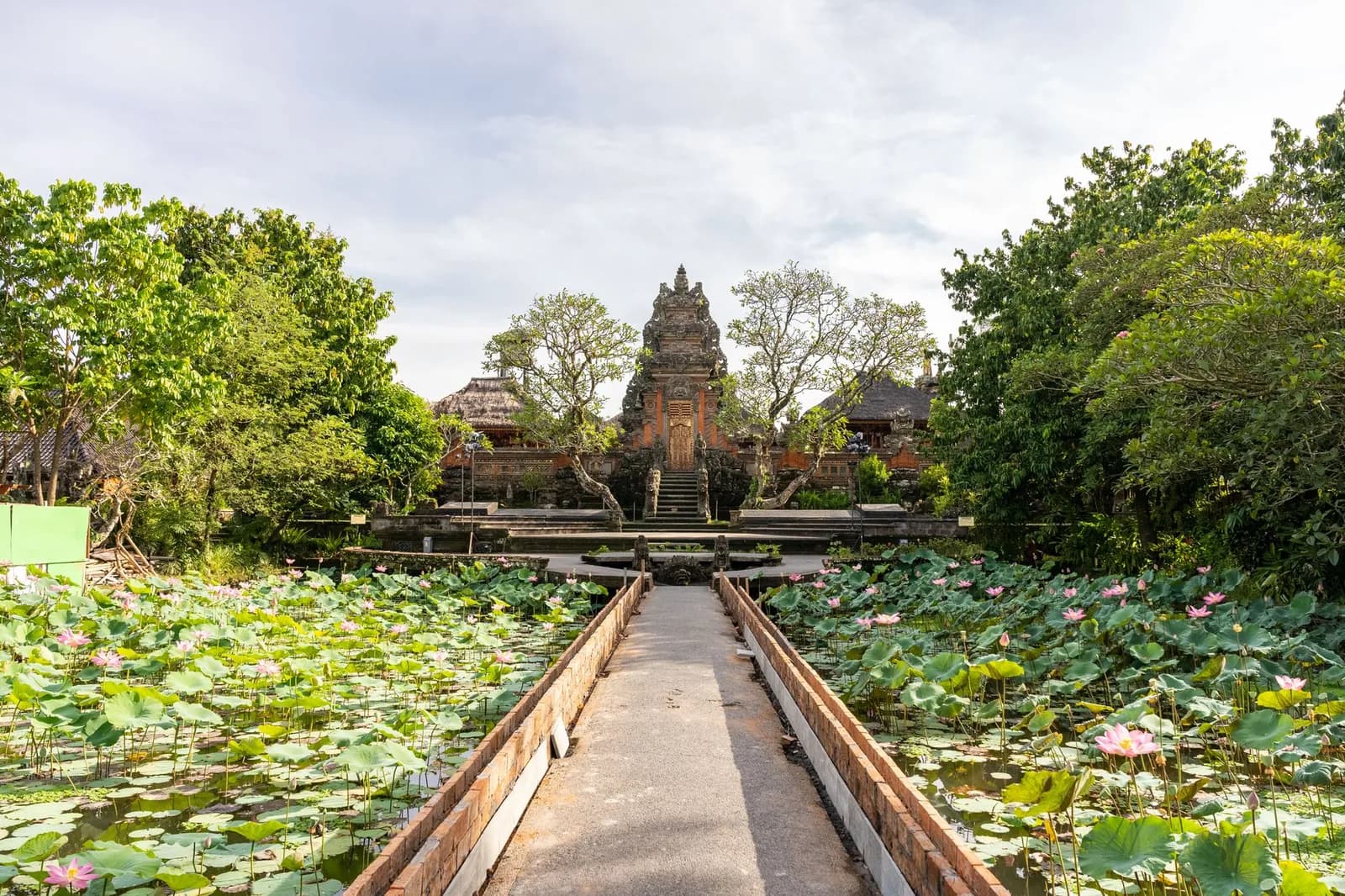
Plan it as an hour on the same crossroads as the palace: the market at 8:00, the palace courtyards next, then Pura Taman Saraswati, the lotus pond temple two minutes' walk west of the palace.
How to get to Ubud Art Market
The market is at Jalan Raya Ubud 35, on the corner opposite Ubud Palace, in the very centre of town. If you are staying in Ubud, walk: almost everything in the centre is within 15 minutes on foot.
Getting to Ubud Art Market from Seminyak, Kuta or Sanur
One to one and a half hours by car from Seminyak, Kuta or Sanur, longer on a weekend afternoon. Drivers drop you on the crossroads and need to wait elsewhere: there is no visitor car park on site, and the junction jams at the end of the day. Combining the market with Sukawati and the villages on the way up makes the drive worth it.
Getting to Ubud Art Market by scooter: where to park
Attendants run small parking areas in the side streets, around IDR 2,000 a scooter. Park before you reach the crossroads and walk the last few minutes.