Bali has temples in an order of magnitude nobody has ever properly counted, somewhere in the tens of thousands. Every village maintains three by religious obligation, every family compound has its own shrine in the north-east corner, and every irrigation cooperative in the rice terraces has one too. Almost none of them are visitor sites, and that is the part the listicles skip when they promise you the thirty best.
What separates the handful worth driving to is not architecture, which is remarkably consistent across the island, but setting: a lake, a cliff, a spring, a volcano. Choose on that basis and two temples will stay with you for years. Choose from a top-thirty list and you will see the same courtyard six times, in a car, in the heat, and wonder why everyone raves about them.
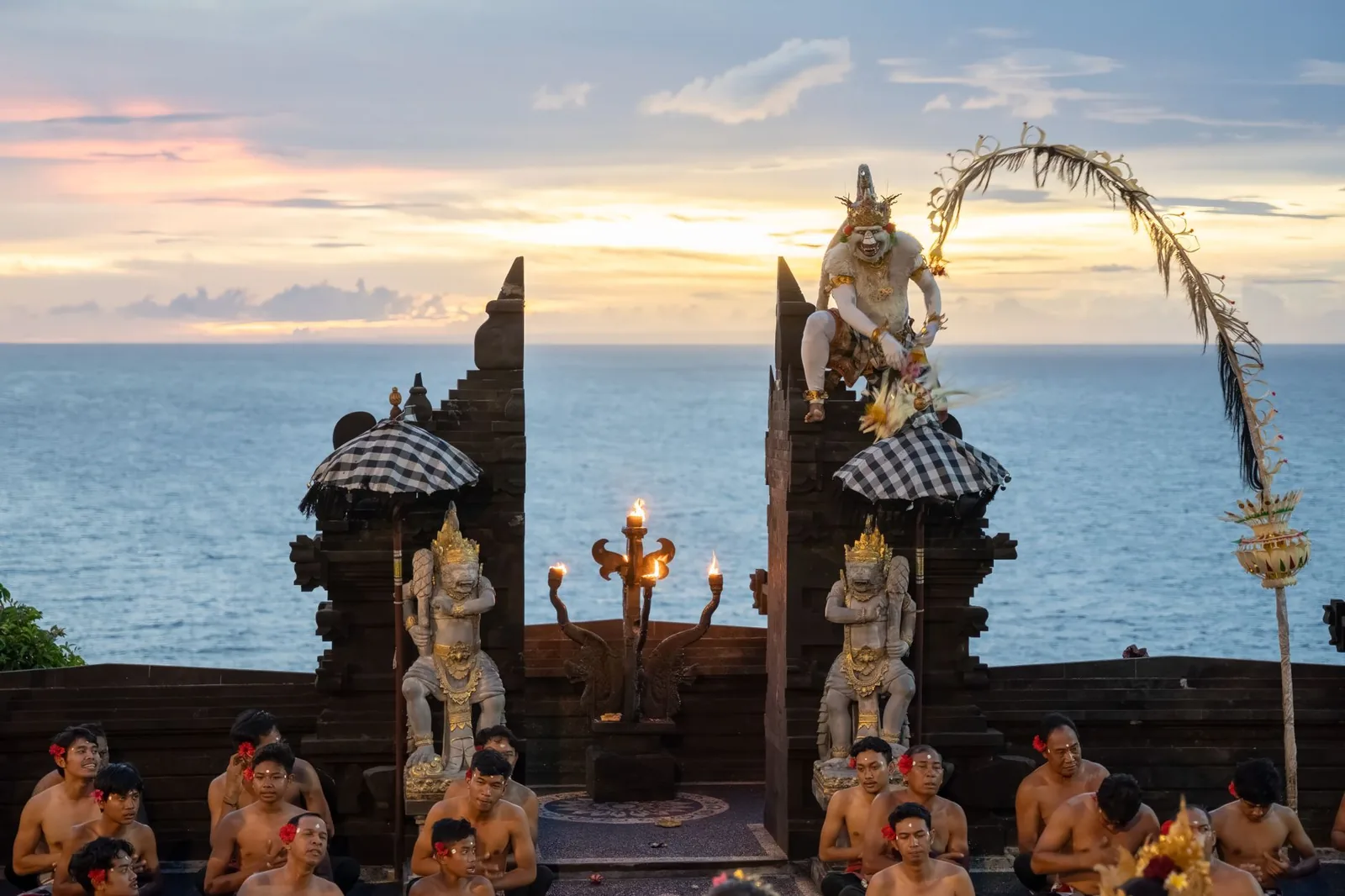
The clearest illustration is Uluwatu, on the cliffs at the southern tip of the island. The temple itself holds you for twenty minutes. What people actually drive ninety minutes for is the kecak dance staged on the cliff beside it at sunset, which is a different proposition from visiting a temple at all.
This page is the transversal half of the subject: what to wear and who lends it to you, the rules printed on the entrance signs, how a Balinese temple is actually laid out so that you can read one when you are standing in it, and how to group the good ones geographically. The individual verdicts live on the guides further down.
The driving is the hard part
Bali temple tours with a driver
- ✓A driver who waits, which is what actually makes two temples in a day possible
- ✓Hotel pickup, including the pre-dawn starts that the east coast sites require
- ✓Sarong and entrance fees bundled on most listings, so no cash scramble at the gate
- ✓Free cancellation on most options if the weather turns, which in the highlands it does
Affiliate link. Booking through GetYourGuide costs you nothing extra and supports the guide. Price and rating checked September 2026. Both move with season and demand.
On this page
Why there are so many, and what a pura actually is
Understanding the system takes five minutes and changes every temple you subsequently walk into. Most visitors never get told any of it.
Indonesia is the largest Muslim-majority country on earth, and Bali is the one province where Hinduism stayed. Roughly nine islanders in ten practise Agama Hindu Dharma, a version that absorbed Buddhist elements and a much older Austronesian ancestor worship on the way through, which is why a Balinese temple looks nothing like a temple in India. There is no enclosed hall and no central statue of a god. A pura is a walled open-air compound: courtyards, gateways, pavilions and empty shrines that the gods are invited into on festival days and that stand vacant the rest of the time.
That is also why there are so many. Every traditional village is obliged to maintain three, together called the kahyangan tiga: a pura puseh at the upstream end for origins and Vishnu, a pura desa in the middle for the living community and Brahma, and a pura dalem at the downstream end, associated with Shiva, the cemetery and the dead. Overlay on that a shrine in every family compound, a temple for every clan, every market, every irrigation cooperative, and the number stops being surprising.
Above all of those sit the island-wide sanctuaries. The sad kahyangan, the six great temples regarded as the spiritual pillars of Bali, are the ones that make an itinerary: different sources list them differently, but Besakih and Lempuyang appear on all of them, and Uluwatu and Goa Lawah on most. Their religious weight is why they look after themselves regardless of the tourism, and why a ceremony there can close the gates to you at an hour's notice.
The last category is the one nobody sells tickets for and it is arguably the most interesting. The water temples administer subak, the thousand-year-old irrigation network that shares river water between rice cooperatives across a whole watershed, priest by priest rather than office by office. UNESCO listed that system as a cultural landscape. You can see its downstream end in the terraces around Ubud without ever noticing the temples that run it.
How to read a Balinese temple
Every pura on the island, from the mother temple down to a village compound, uses the same handful of parts in the same order. Learn them once and you can walk into any of them and know where you are.
Three courtyards, from the world to the gods
A temple is laid out along an axis running from the sea, which is impure, towards the mountain, which is holy. You move through three walled courtyards in increasing order of sanctity. The outer one, jaba pisan or nista mandala, is a public space: markets set up here, gamelan groups rehearse, cockfights used to be held. The middle one, jaba tengah or madya mandala, holds the kitchens where offerings are prepared, the granary and the drum tower. The inner one, jeroan or utama mandala, holds the shrines, and it is the one you will usually be asked to look into rather than enter.
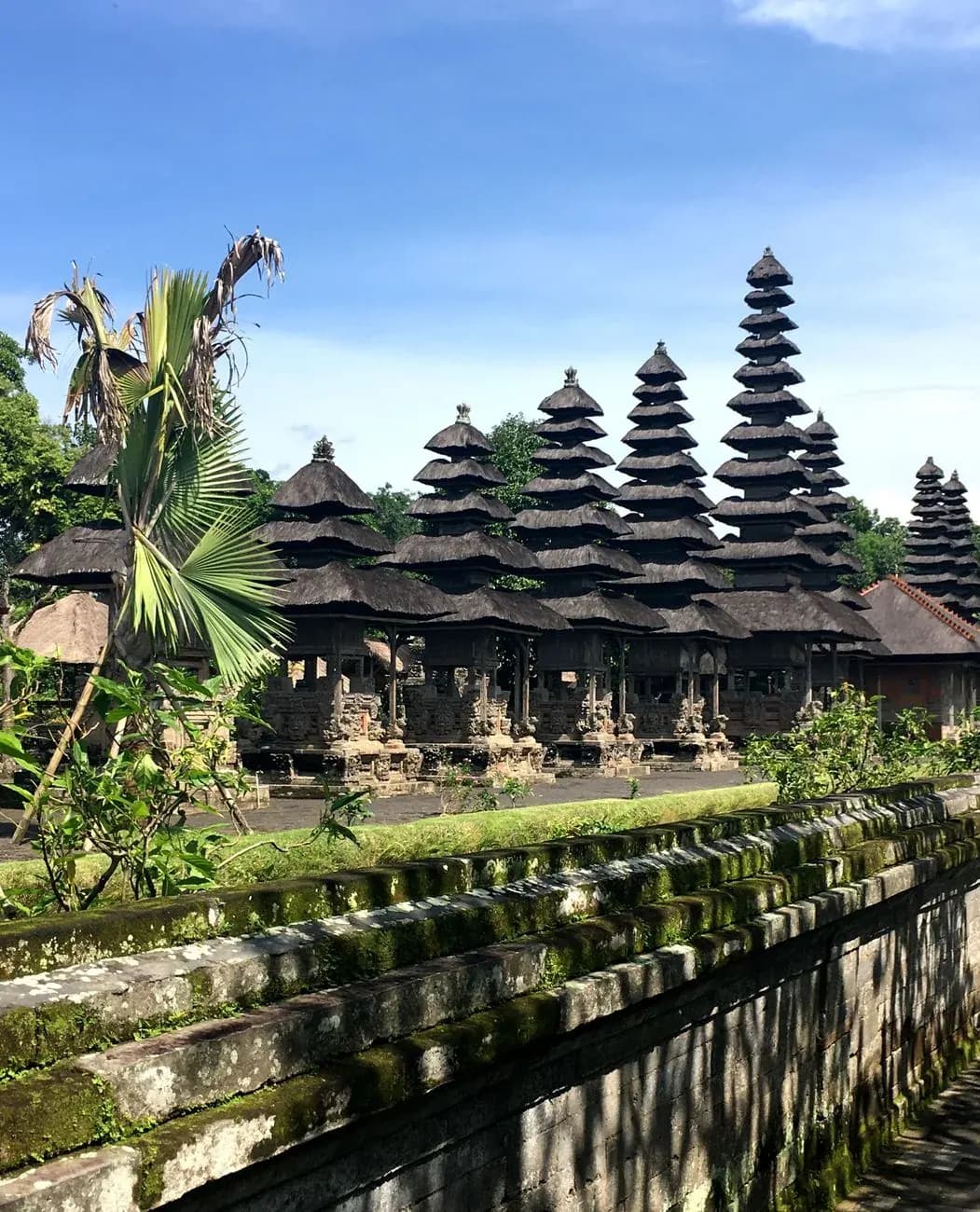
That last point causes more confusion than anything else on a temple visit. Being stopped at the third gate is not a scam, an upsell or a slight. It is the difference between a monument and a working sanctuary, and it applies to Balinese people too if they are not there to pray. Taman Ayun is the clearest case: you walk a path around the outside of the inner court and get a better view of it than you would standing inside.
The two gates, and why one is split
Between the first and second courtyards stands the candi bentar, a gate that looks like a single tower sliced vertically in two and pulled apart. Nobody is certain what it originally meant. The readings you will hear are the splitting of Mount Meru, the balance of opposites, or a threshold you pass through rather than a door you open. It is the shape on the cover of every book about Bali and the one at Lempuyang is the most photographed object on the island.
The gate into the inner court is a different animal: the kori agung, roofed, closed with a door, usually with a grotesque protective face carved above it and a pair of guardian statues below. Directly behind it you will nearly always find a short free-standing wall, the aling-aling. It exists because malevolent spirits are held to travel in straight lines, so the wall forces a turn. It also, entirely practically, stops anyone outside seeing straight into the sanctuary.
The meru, and counting its roofs
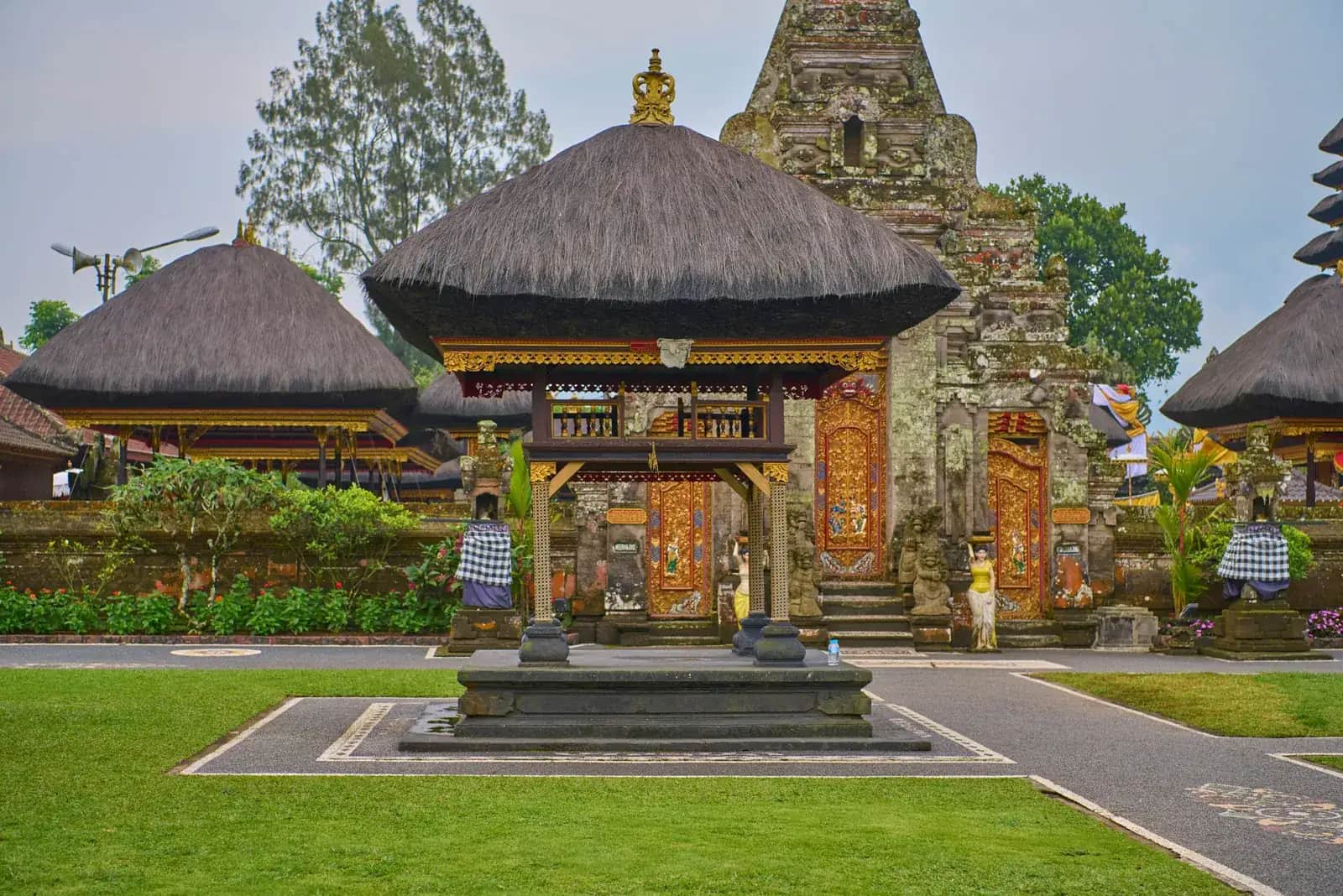
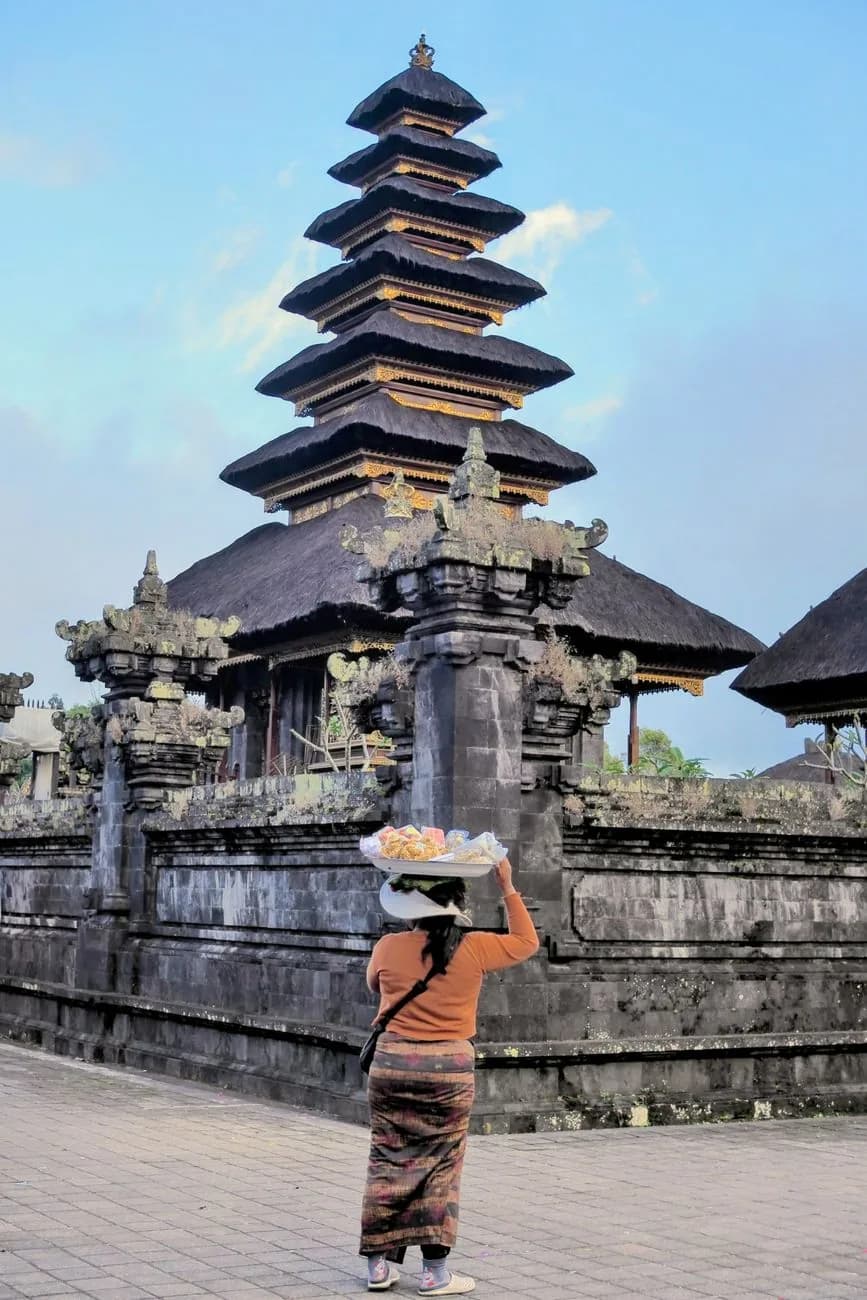
The black thatched pagodas rising over the inner wall are merus, named for the cosmic mountain of Hindu cosmology, and their roofs are stacked in a diminishing tower of sugar palm fibre. The number of tiers is always odd, running from three up to eleven, and it encodes the rank of whatever is honoured beneath it. Eleven is the highest and is reserved for the most senior deities and for deified royal ancestors of the first order.
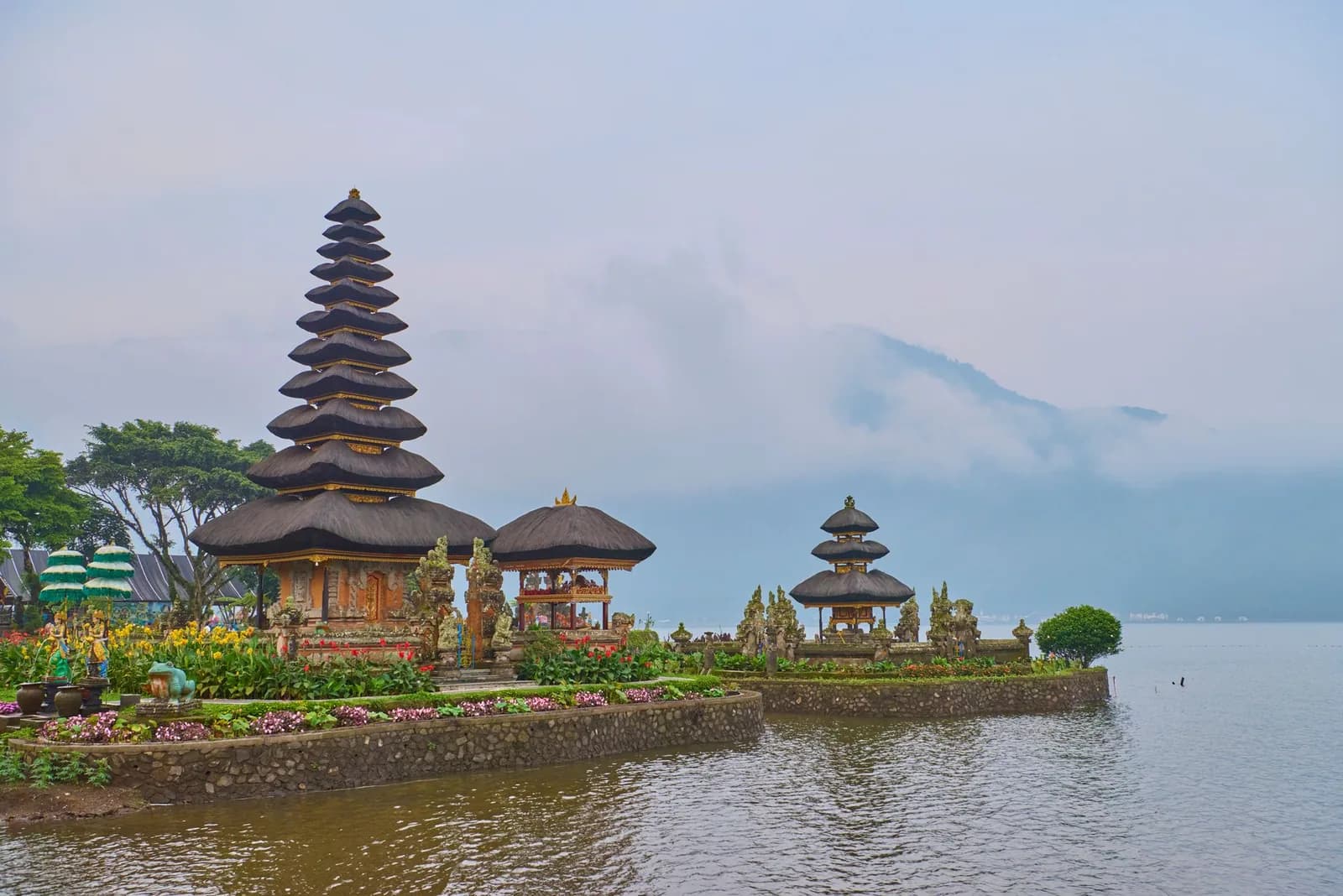
This is the single most useful thing you can carry into a Balinese temple, because it converts a row of similar-looking towers into a readable hierarchy. At Taman Ayun the merus step down in height across the court in a deliberate order. At Besakih there are dozens of them across a whole hillside.
Two other structures repeat everywhere. The padmasana is a tall stone throne standing empty in the north-east corner of the inner court, dedicated to the supreme god Sang Hyang Widhi Wasa. It is empty because he is not depicted. The bale kulkul is the tower at the corner of the outer wall holding a hollowed wooden slit drum, whose rhythm calls the village to a ceremony, to a meeting or to an emergency, each with its own pattern.
The rest of the compound is bale, open pavilions with no walls, used for gamelan, for preparing offerings and for sitting out of the sun. When a temple looks half empty to you, that is because it is: the gods are only in residence during a festival, and for the other two hundred days the compound is a set of beautifully maintained empty rooms waiting for one.
Which temple is actually yours
Every list ranks temples as though everyone reading it were staying in the same hotel with the same amount of time. These are the three variables that decide it in practice.
Staying in the south: Seminyak, Canggu, Kuta, Uluwatu
| Time you have | The photograph | Religion practised | Architecture and calm |
|---|---|---|---|
| One temple, 2 to 3 h | Uluwatu | Tirta Empul | Taman Ayun |
| Half a day | Tanah Lot | Tirta Empul | Taman Ayun |
| Full day with a driver | Ulun Danu Beratan | Besakih | Tirta Gangga |
For a single temple, Uluwatu is the only one in the south worth the trip on its own: the cliff does most of the work, the monkeys are professional thieves, and the kecak at sunset is why most people stay. There is no living temple worth walking into meaningfully in the far south itself, so for a real ceremony the honest answer is to go north to Tirta Empul, where Balinese families queue at the spouts every day. For architecture without the crowd, Taman Ayun on the way north takes about three hours from Seminyak and needs nothing added.
With half a day, pair Tanah Lot with Taman Ayun twenty-five minutes inland, doing the sea temple second for the sunset light. With a full day, Ulun Danu Beratan on Lake Bratan rewards an early start for the mist on the water before nine, and sits forty minutes above Taman Ayun on the same road, the one genuinely efficient pairing on Bali. Besakih, the mother temple on the slopes of Agung, is a full day of driving each way with the upper courts reserved for worshippers, best combined with Tirta Empul or lunch in Sidemen on the way back. Tirta Gangga and its water gardens are the quiet full-day option, worth twenty extra minutes south to Taman Ujung if you want the rest of the story.
Staying in Ubud and the centre
| Time you have | The photograph | Religion practised | Architecture and calm |
|---|---|---|---|
| One temple, 2 to 3 h | Pura Saraswati, in town | Tirta Empul | Goa Gajah, the Elephant Cave |
| Half a day | Tegallalang, then a temple | Tirta Empul, then Gunung Kawi | Taman Ayun |
| Full day with a driver | Lempuyang, alarm at four | Besakih | Ulun Danu Beratan |
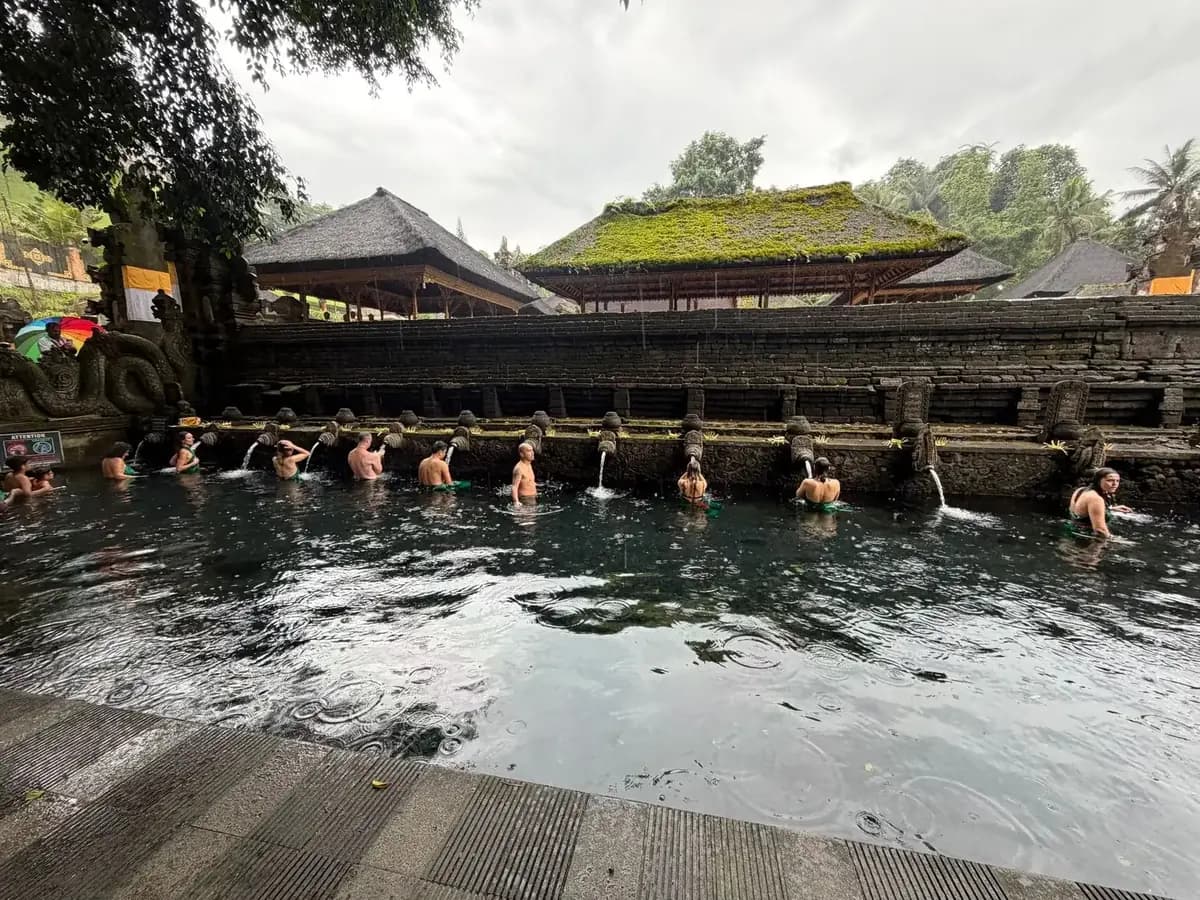
For one temple, Tirta Empul at opening shows a purification ritual queued by Balinese families rather than a photo queue, and by ten the coaches arrive and the atmosphere goes. Pura Saraswati is a lotus pond two minutes from the main street, lovely at seven and not a day out. Goa Gajah, the Elephant Cave, is fifteen minutes from Ubud, takes about forty-five, and pairs with Tirta Empul on the same road north if you have the morning.
With half a day, do Tegallalang first, since the terraces beat every temple within reach of Ubud at the same early hour, then pick up Tirta Empul twenty minutes on. Or run Tirta Empul at opening into Gunung Kawi ten minutes up the road, rock-cut shrines reached by three hundred steps through rice terraces. Taman Ayun, forty minutes out, is the calm architecture option and almost never crowded because it has no photograph attached to it.
A full day from Ubud is about two hours to Besakih, against three from the beaches, with Sidemen on the way back for the loveliest valley on the island. Lempuyang needs a four o'clock alarm for the Gates of Heaven framing Agung, and Tirta Gangga twenty minutes down the hill makes a good second stop, but the mountain is often in cloud with no refund for weather. Ulun Danu Beratan north into the crater highlands is the clearest textbook example of a tiered meru, cool at fourteen hundred metres, and it rains up there often.
Staying on the east coast: Amed, Candidasa, Sidemen
| Time you have | The photograph | Religion practised | Architecture and calm |
|---|---|---|---|
| One temple, 2 to 3 h | Lempuyang | Goa Lawah, the bat cave temple | Tirta Gangga |
| Half a day | Lempuyang, then Tirta Gangga | Besakih | Tirta Gangga and Taman Ujung |
| Full day with a driver | Lempuyang, Tirta Gangga, Besakih | Besakih, then Tirta Empul | The Karangasem circuit |
The east coast is the only base from which Lempuyang is under an hour away, so you can be at the gate at opening without a three in the morning departure, the difference between the visit people rave about and the one they complain about. For a working site, Goa Lawah is built against a cave genuinely full of bats, tied to Balinese funeral rites and visited by far more worshippers than tourists, fifteen minutes from the Padangbai ferry. Tirta Gangga's stepping stones and carp pond reward a slow visit and pair naturally with Taman Ujung twenty minutes south.
With half a day, Lempuyang at dawn into Tirta Gangga is the one arrangement on Bali where two very different sites sit close enough to do both well. From Sidemen or Candidasa, Besakih is a comfortable drive rather than an expedition if you go before the cloud closes on Agung, terrace after terrace of black thatched roofs, best finished with lunch in Sidemen.
A full day can run the whole eastern circuit, gate at opening, water garden mid-morning, mother temple in the early afternoon, roughly 06:00 to 17:00 with a driver, which the east coast is the only base from which this is not punishing. Or pair Besakih with Tirta Empul, scale and ceremony against the water ritual, finishing in Ubud rather than driving back east. The Karangasem circuit, Tirta Gangga, Taman Ujung and the old palace at Amlapura, is the same royal house shown three ways and nobody sells it as a tour, which is why it stays empty.
Staying by the lakes and in the north: Bedugul, Munduk, Lovina
| Time you have | The photograph | Religion practised | Architecture and calm |
|---|---|---|---|
| One temple, 2 to 3 h | Ulun Danu Beratan, before nine | Pura Ulun Danu Batur, crater rim | Ulun Danu Beratan |
| Half a day | The lake temple, then waterfalls | The subak temples nobody stops at | Ulun Danu Beratan and Taman Ayun |
| Full day with a driver | Down the lake road to Tanah Lot | Batur, then the road east | Pura Beji, north coast |
You are already up here, which solves the hard part. Ulun Danu Beratan before nine gives the tiered shrine with mist off the lake, gone by the time the coaches arrive from the south, and its eleven-tiered meru is the clearest example of the form on the island, always an odd number of tiers, rank encoded in the count. For a working site, Pura Ulun Danu Batur on the crater rim above Lake Batur, rebuilt after the 1926 eruption buried the original, is the second most important water temple on the island with almost no tour buses in the car park.
With half a day, run Ulun Danu at opening into the Munduk hills, where the waterfalls come one after another off the same ridge, the best half day in the highlands and mostly downhill. The small subak water temples along the irrigation network are not set up for visitors: look from the road, and go in only if invited, then continue to the Jatiluwih terraces downstream of the same system.
A full day can run the whole lake road, Ulun Danu at dawn, Taman Ayun mid-morning, Tanah Lot for sunset on the coast, always the last stop of the day. Or go to Pura Ulun Danu Batur and down the eastern side towards Besakih, two mountain temples with active ceremonial calendars and no photo stop between them. For architecture, a detour near Singaraja to Pura Beji shows sandstone carved into foliage and naga so dense the wall almost disappears, best paired with the Gitgit or Sekumpul waterfalls on the way back over the pass.
The big nine, side by side
Time on site is time inside the gate and excludes the drive, which on this island is usually the larger number. Crowd levels assume the dry season.
| Temple | Where | Time on site | Crowds | Guide worth it | Combine with |
|---|---|---|---|---|---|
| Besakih | East, on Mount Agung | 2 to 3 h | Heavy from 10:00, orderly | Useful | Sidemen, Tirta Empul |
| Lempuyang | Far east, Karangasem | 2 to 4 h, mostly queue | Severe after 09:00 | No | Tirta Gangga |
| Tirta Empul | Central, north of Ubud | 1 h 30 to 2 h | Heavy from 09:30 | Yes, for the ritual | Gunung Kawi |
| Ulun Danu Beratan | Highlands, Lake Bratan | 1 to 2 h | Heavy from 10:00 | No | Taman Ayun, Munduk |
| Taman Ayun | West, Mengwi | 1 h | Light all day | No | Ulun Danu Beratan, Tanah Lot |
| Tirta Gangga | East, Karangasem | 1 to 2 h | Moderate | No | Lempuyang, Taman Ujung |
| Tanah Lot | South-west coast | 1 h 30 | Severe at sunset | No | Taman Ayun |
| Uluwatu | Far south, the cliffs | 1 h 30, plus kecak | Severe at sunset | No | Jimbaran, the southern beaches |
| Goa Gajah | Central, near Ubud | 45 min | Moderate | Optional | Tirta Empul, Ubud |
Read down the crowd column and the pattern is obvious. Taman Ayun and Tirta Gangga are the two quiet ones, and they are quiet for the same reason: neither has a single famous photograph attached to it. Everything with an image in circulation has a queue behind that image, and the queue is the actual product being distributed on social media, cropped out.
The temples worth the drive
The temples worth the drive
Each with a straight verdict, the real cost of getting in, and what it is like at the hour you will actually arrive.
Temple
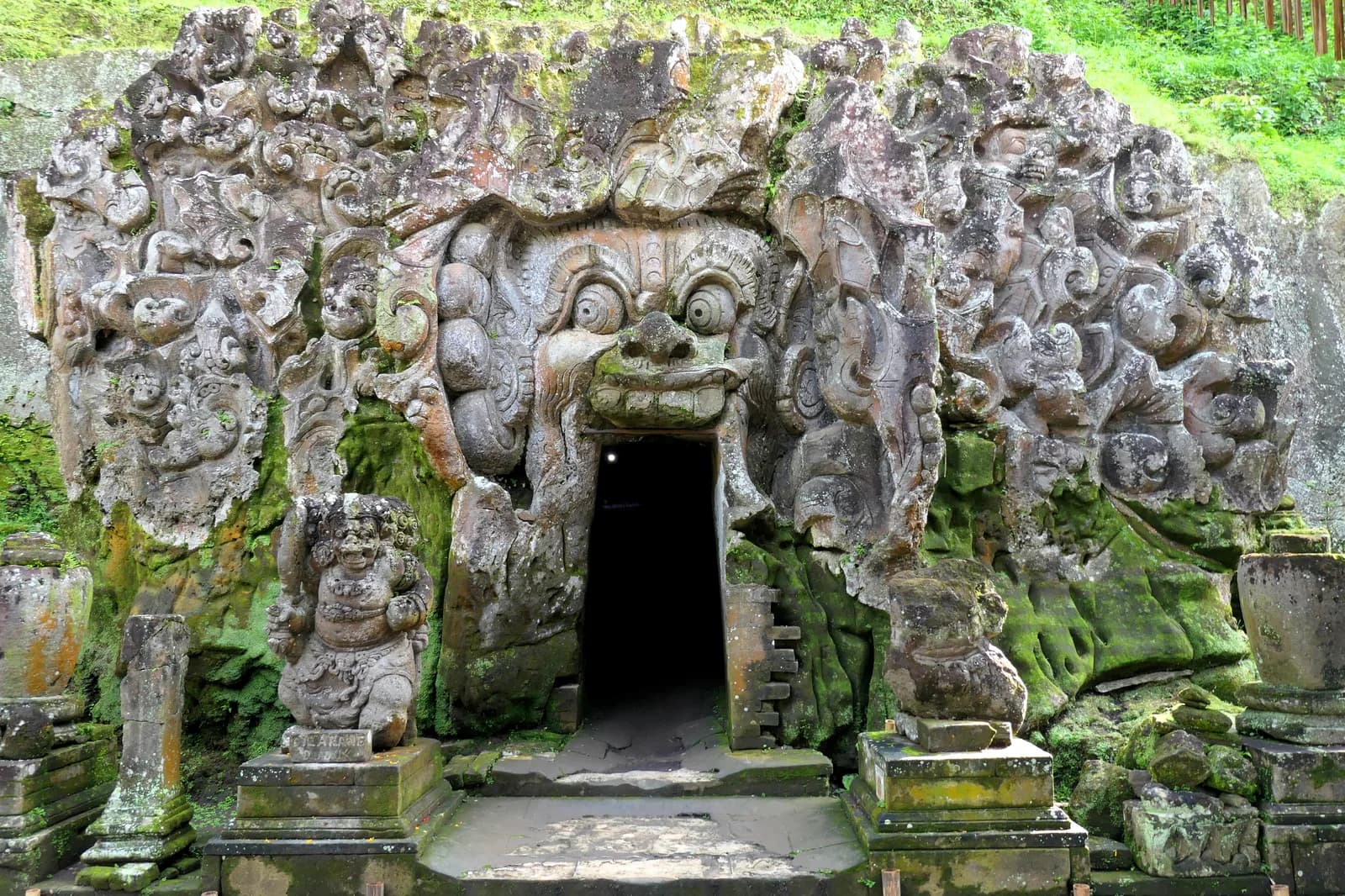
Goa Gajah, Ubud: An Hour, Not a Morning
There are no elephants at the Elephant Cave. The carved mouth, the pools dug out of the ground in 1954, the Buddhist ruins nobody walks down to, and where the hour fits in your day.
Read the guide →Temple
Taman Ayun Temple, Mengwi: Full Visitor Guide
The royal temple of Mengwi, ringed by a moat and rarely crowded. What you actually see, why the inner court is closed, and how it fits the western loop.
Read the guide →Temple
Tirta Empul Temple: The Purification Ritual, Explained
Tirta Empul near Ubud is a working purification temple, not a photo stop. How the melukat ritual works spout by spout, the two you skip, and when to go.
Read the guide →Temple
Ulun Danu Beratan Temple: When It Floats, and When It Does Not
The lake temple at Bedugul only floats when Lake Bratan is high. Water levels month by month, the best hour to arrive, and whether it earns the drive.
Read the guide →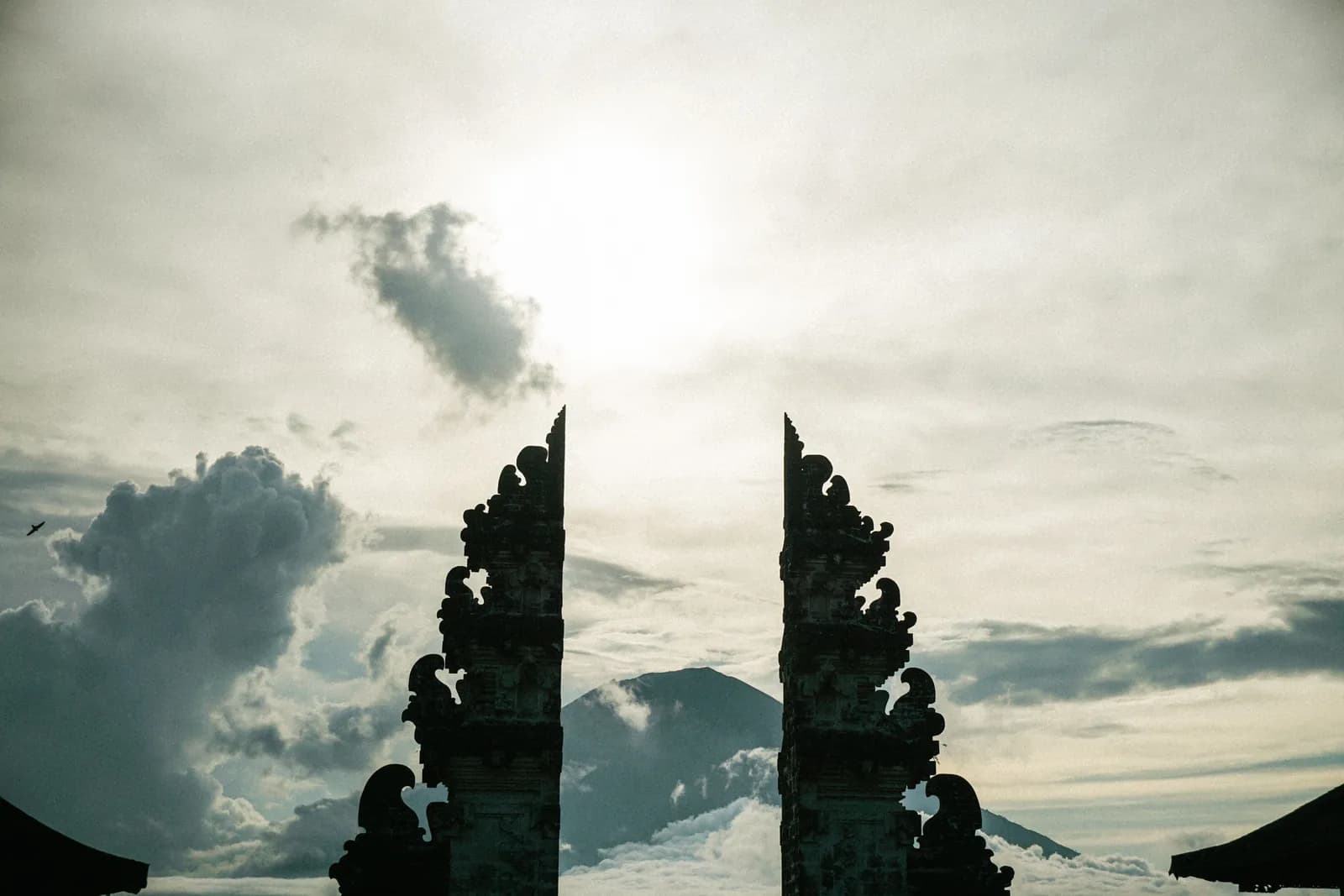
Temple
Lempuyang Temple: The Gates of Heaven and the Mirror
There is no lake at the Gates of Heaven. How the reflection is made, how long the queue runs, when Mount Agung shows, and whether Lempuyang earns the drive.
Read the guide →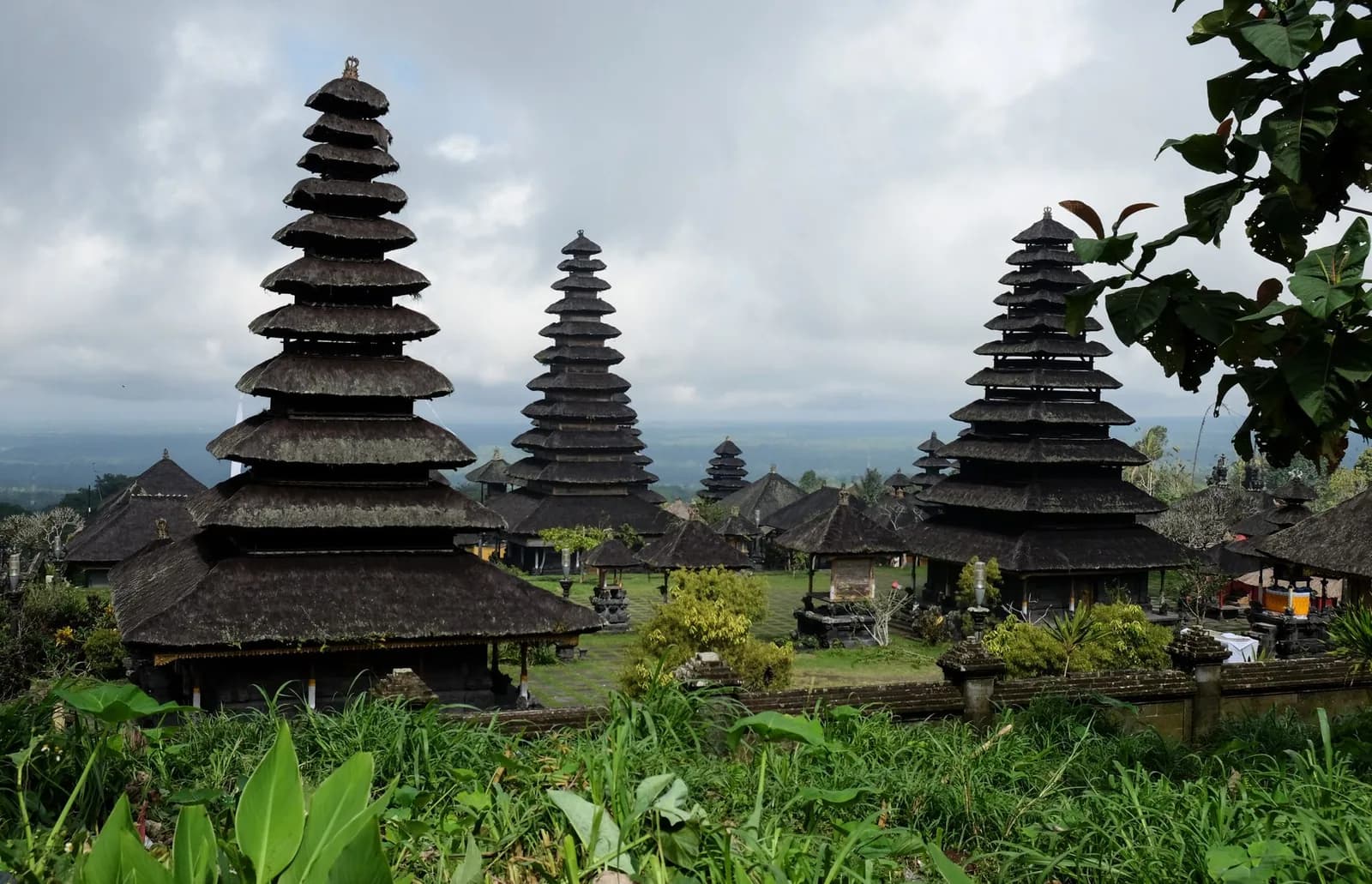
Temple
Besakih Temple: Bali's Mother Temple, Decoded
More than twenty temples terraced up an active volcano. What each one is, whether you need a guide, what it costs in time, and how Besakih survived 1963.
Read the guide →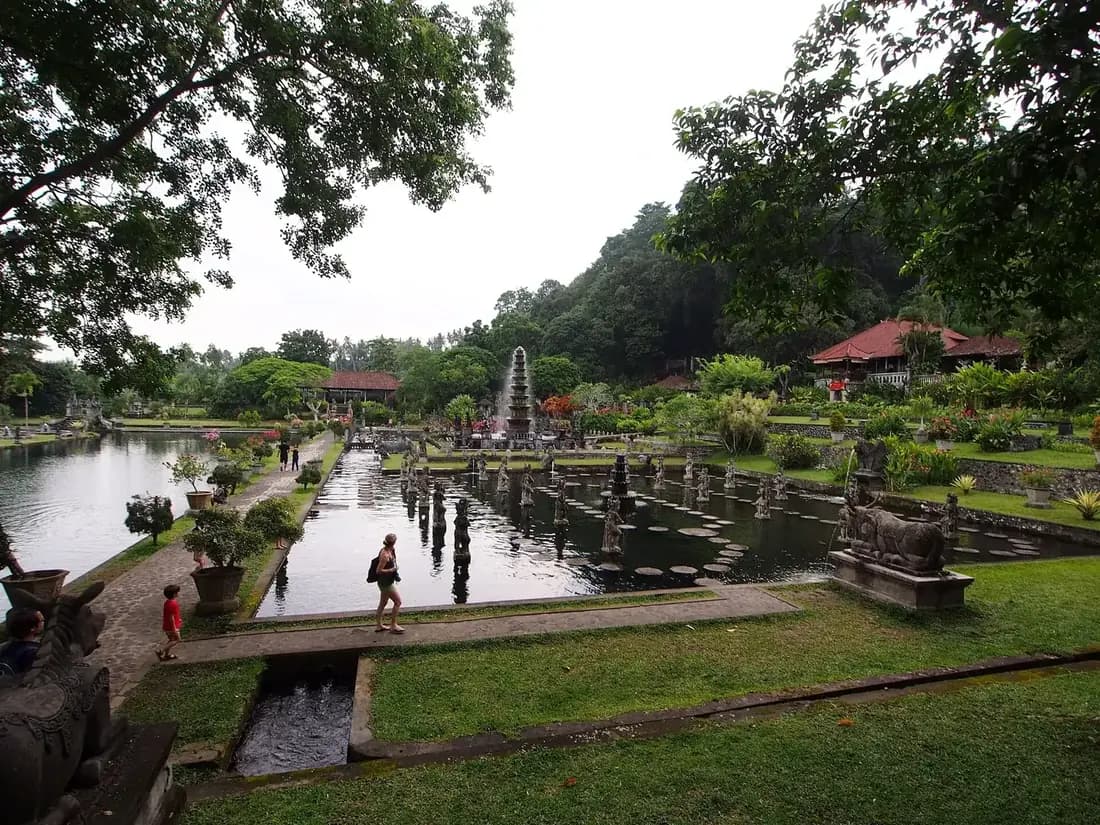
Temple
Tirta Gangga: The Water Palace With the Stepping Stones
Tirta Gangga is a royal water garden in east Bali, not a temple and not Tirta Empul. The stepping stones, the koi, the pools, and how to plan the day.
Read the guide →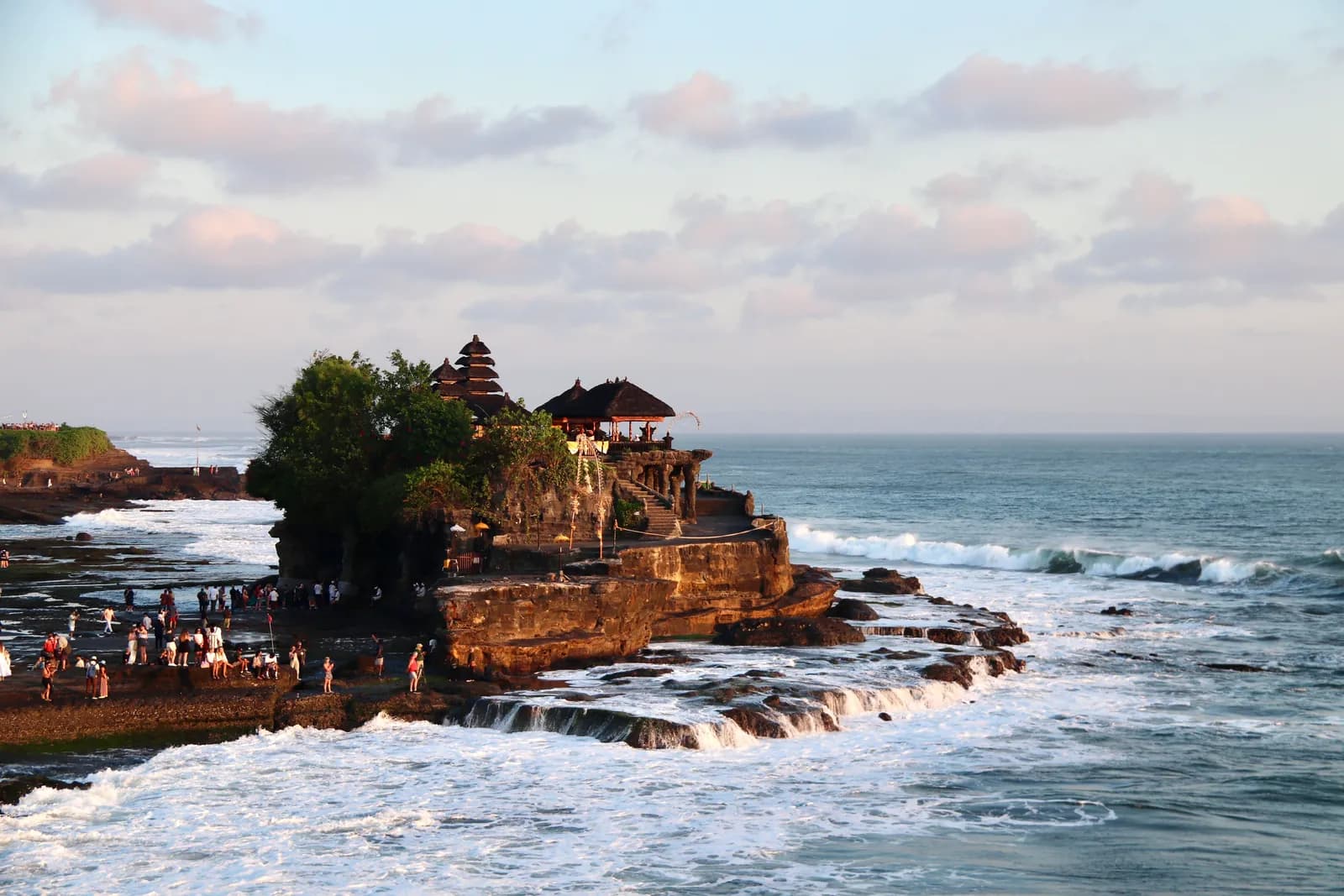
Temple
Tanah Lot Temple: Time Your Visit to the Tide
The tide decides everything at Tanah Lot: walk out to the rock at low water, photograph it stranded at high. How to read it, when to arrive, and what the site is really like.
Read the guide →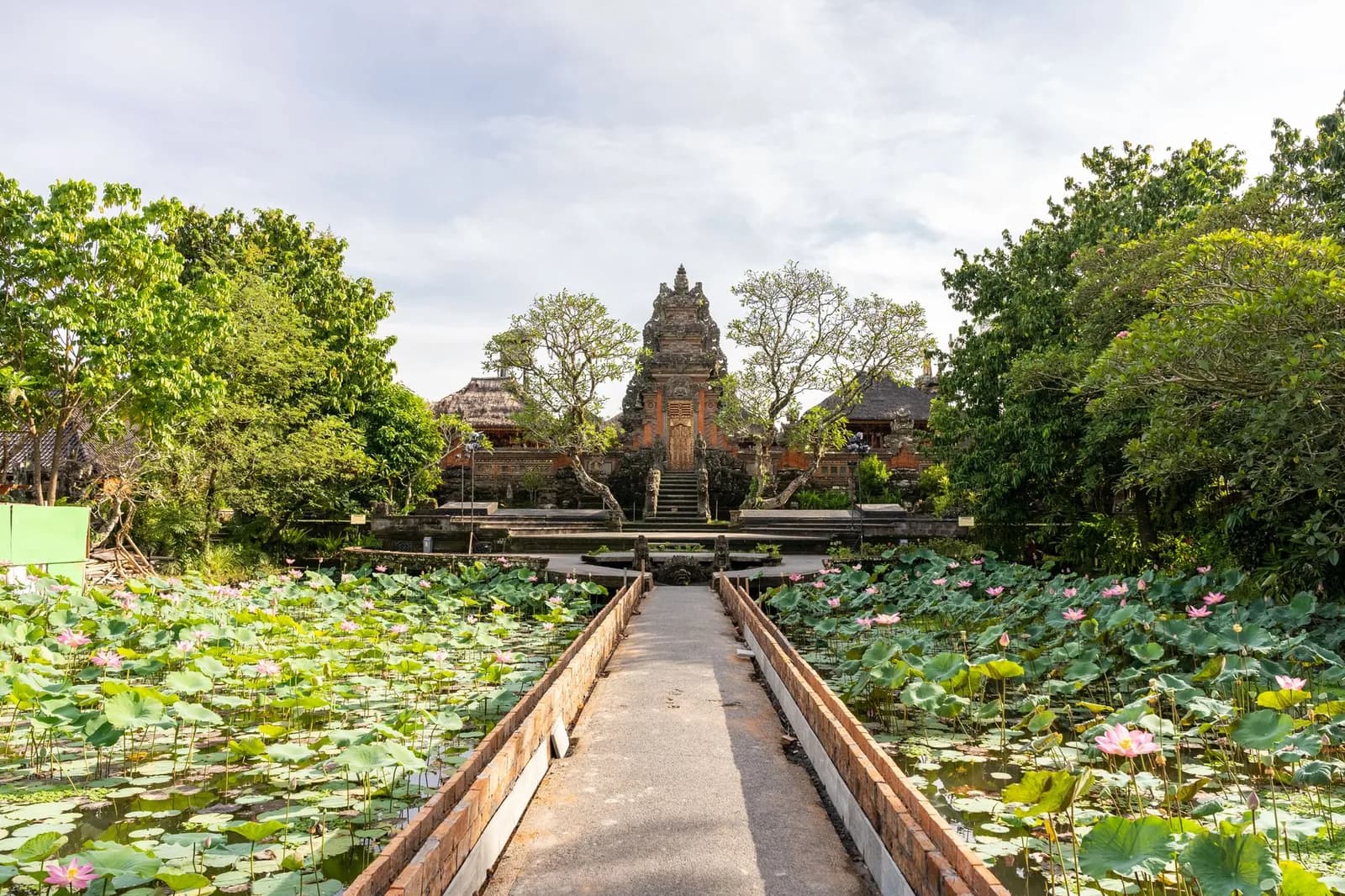
Temple
Ubud Water Palace (Saraswati Temple): Fee, Hours, Dances
The Ubud Water Palace is no longer free. The 2026 ticket prices, the real opening hours, which dance plays on which night, and how it differs from Ubud Palace.
Read the guide →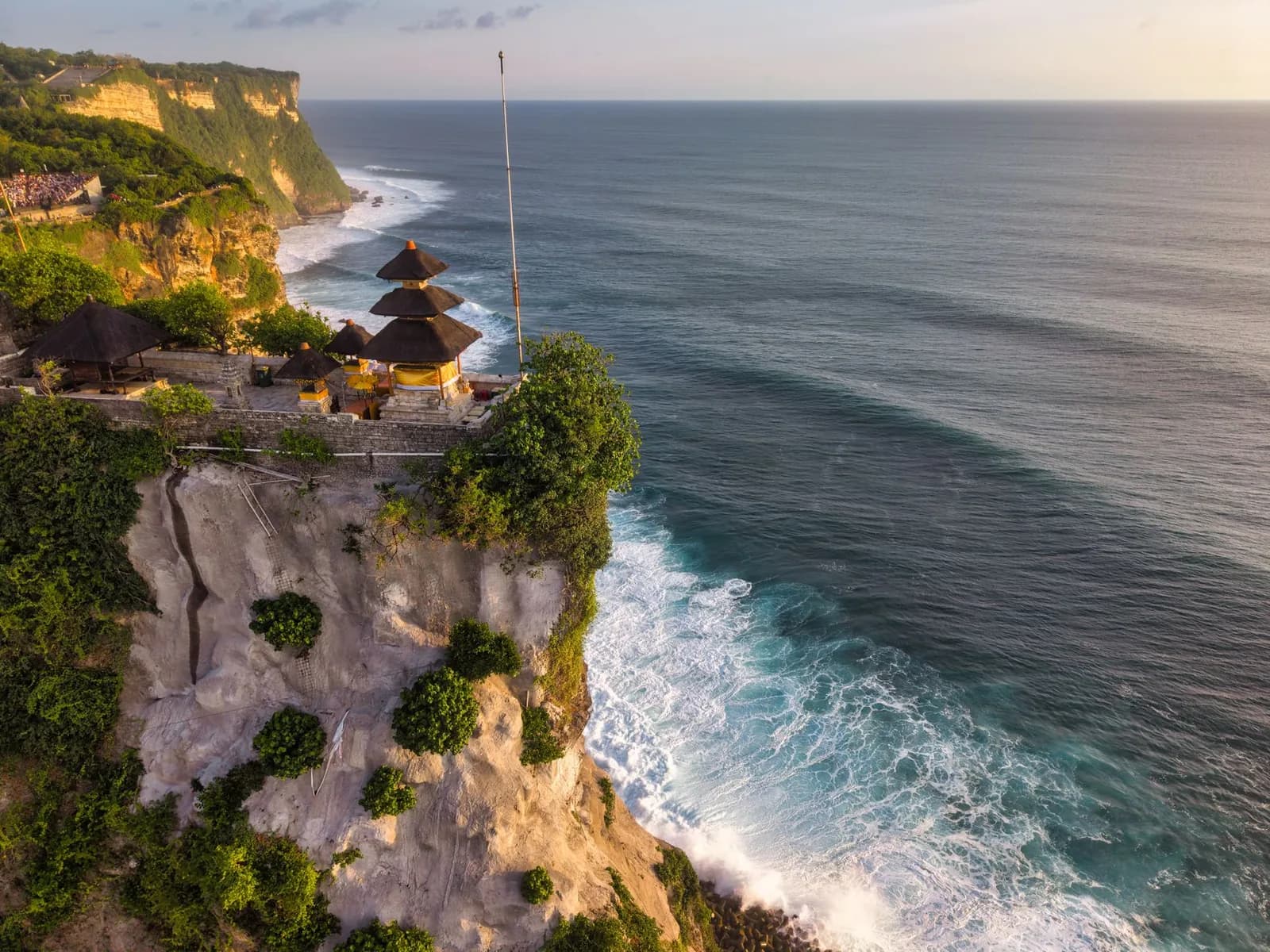
Temple
Uluwatu Temple: Fees, Hours and the Monkeys
What Pura Luhur Uluwatu costs in rupiah and dollars, when it opens, why the morning beats the sunset, and how not to lose your sunglasses on the cliff path.
Read the guide →The dress code, the sarong and the rules on the sign
These are working places of worship with a ticket desk attached, not monuments. Almost everything expected of you costs nothing and takes about four seconds to arrange.
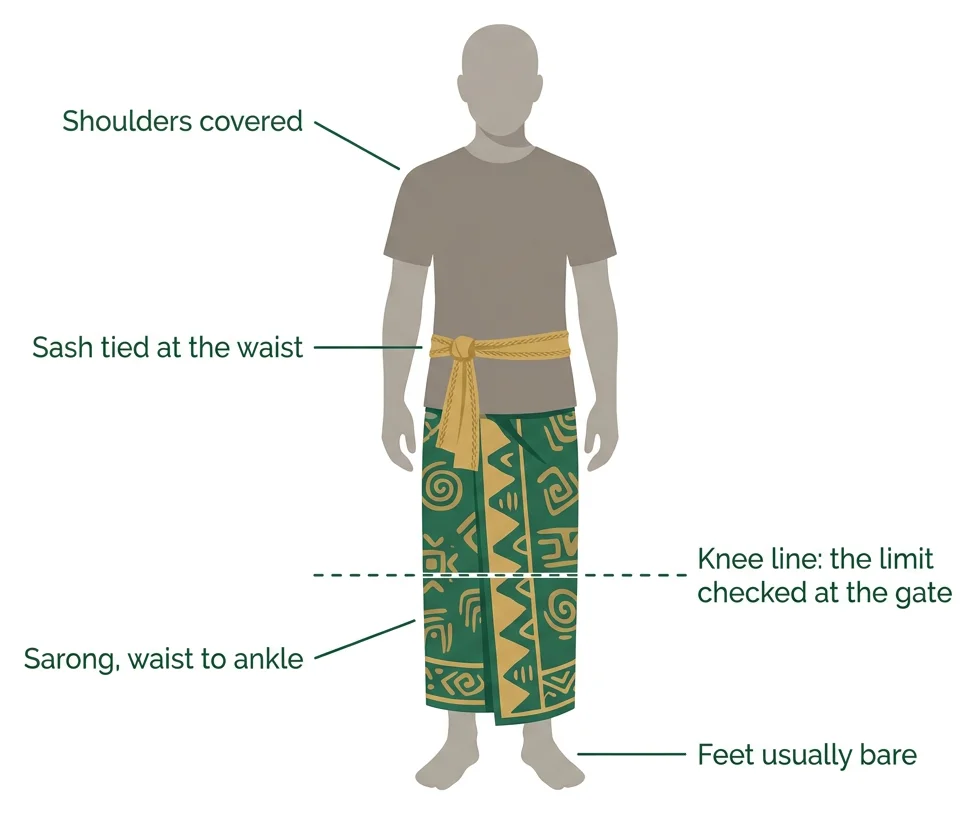
Nothing here is complicated, and getting it right costs nothing. Four parts of the body are covered, and each one is either lent to you at the gate or worth carrying yourself.
The sarong, for everyone
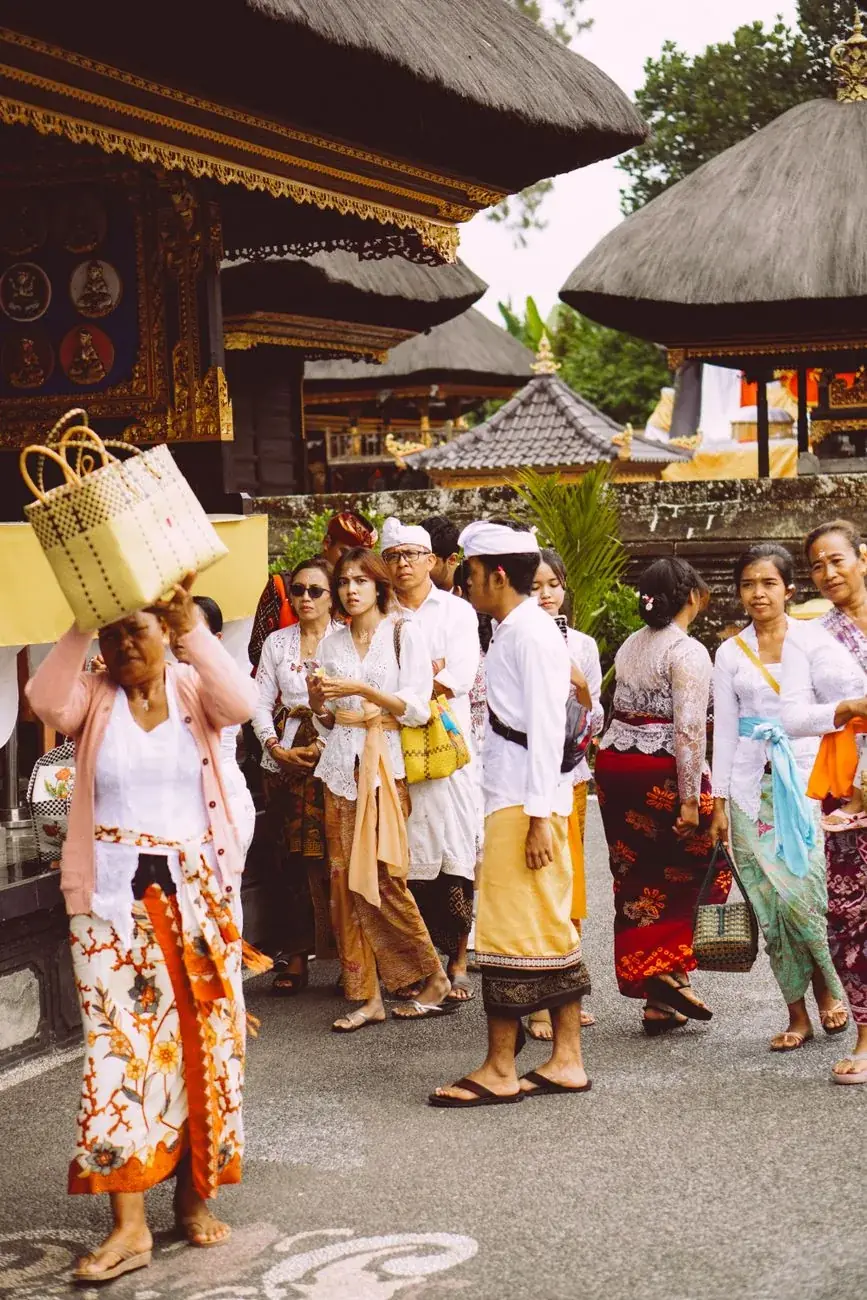
A rectangle of cloth wrapped around the waist and falling below the knee, worn by men and women alike and worn over whatever you already have on. Shorts underneath are fine, and nobody minds. What is not accepted is bare legs, and that is the one rule enforced at the gate rather than merely printed on a sign. It is lent or rented at the entrance of practically every visitor temple, and included in the ticket at most of them.
The sash, or selendang
A narrower band tied around the waist on top of the sarong. It is not decoration: in Balinese thinking it marks the line between the upper, pure half of the body and the lower half, which is why it is worn at the waist and never higher. Balinese men and women wear one to enter their own village temple. It is handed over with the sarong, and any market stall sells both together for the price of a coffee.
Shoulders and chest
A t-shirt is enough. Vests, singlets, bikini tops and anything strappy will get you stopped at the more observant temples and quietly disapproved of at the rest. A light long-sleeve layer weighs nothing in a bag, settles the question everywhere, and doubles as sun cover on the drive. This is not provided: it is the part you have to bring yourself, and the part people get caught out by.
Footwear
Unlike Buddhist temples across the rest of Asia, Balinese temples do not generally ask you to take your shoes off in the outer courts. Sandals are normal and comfortable. Where a site involves stairs, a gorge or a wet stone path, closed shoes are simply the sensible choice. Nothing is provided to borrow, and water shoes are worth having at Tirta Empul, where the pool floor is stone and slippery.
The rules on the entrance sign
| Rule | Status |
|---|---|
| Women who are menstruating do not enter temple grounds | Firm |
| Never walk in front of somebody who is praying | Firm |
| Do not put yourself higher than a priest or an offering | Firm |
| Do not step on or over the canang sari on the ground | Manners |
| The inner court is usually not for you | Manners |
| If a ceremony is running, you are a guest, not an audience | Manners |
| Drones are restricted, and banned outright during ceremonies | Manners |
Three of these are genuine religious rules rather than formalities. Women who are menstruating do not enter temple grounds, which surprises almost every visitor and is written in English on the entrance sign at most major temples. It follows from the Balinese concept of sebel, a state of ritual impurity that also applies to anyone with an open wound, to a woman who has recently given birth, and to a family in mourning. Nobody checks and nobody asks, and knowing it exists is the point. A worshipper sitting cross-legged facing a shrine has a line of prayer between them and it, so never walk in front of somebody who is praying: go behind them, even if it means a long detour around a courtyard, and wait if you find yourself boxed in. Height carries meaning here too, which is why the sash sits at the waist and why the shrines are raised: do not climb on walls or shrine platforms for a photograph, and if a priest is seated while blessing people, crouch rather than stand over him. During a ceremony, stay low and stay at the back.
The rest are manners rather than rules. The little palm-leaf trays of flowers and rice on pavements, dashboards and doorsteps are daily offerings placed fresh every morning across the island, so walk around them, and if you tread on one by accident nothing happens except that you should be seen to be sorry. Most temples let visitors into the outer and middle courtyards and stop them at the gate of the innermost one, which is not a ploy to sell an upgrade: at Taman Ayun you view the whole inner court from a path around the moat, and it is a better view than you would get from inside it. If a ceremony is running and you are allowed to stay, sit or stand at the back, keep the shutter quiet, do not use a flash, and do not photograph faces at close range, since dressing properly matters ten times more on those days than on ordinary ones. Several major temples prohibit drones permanently and the rest prohibit them whenever anything religious is happening, which on Bali is often, so ask at the ticket desk rather than launching and finding out. Ordinary cameras and phones are fine essentially everywhere.
Who actually gives you the sarong
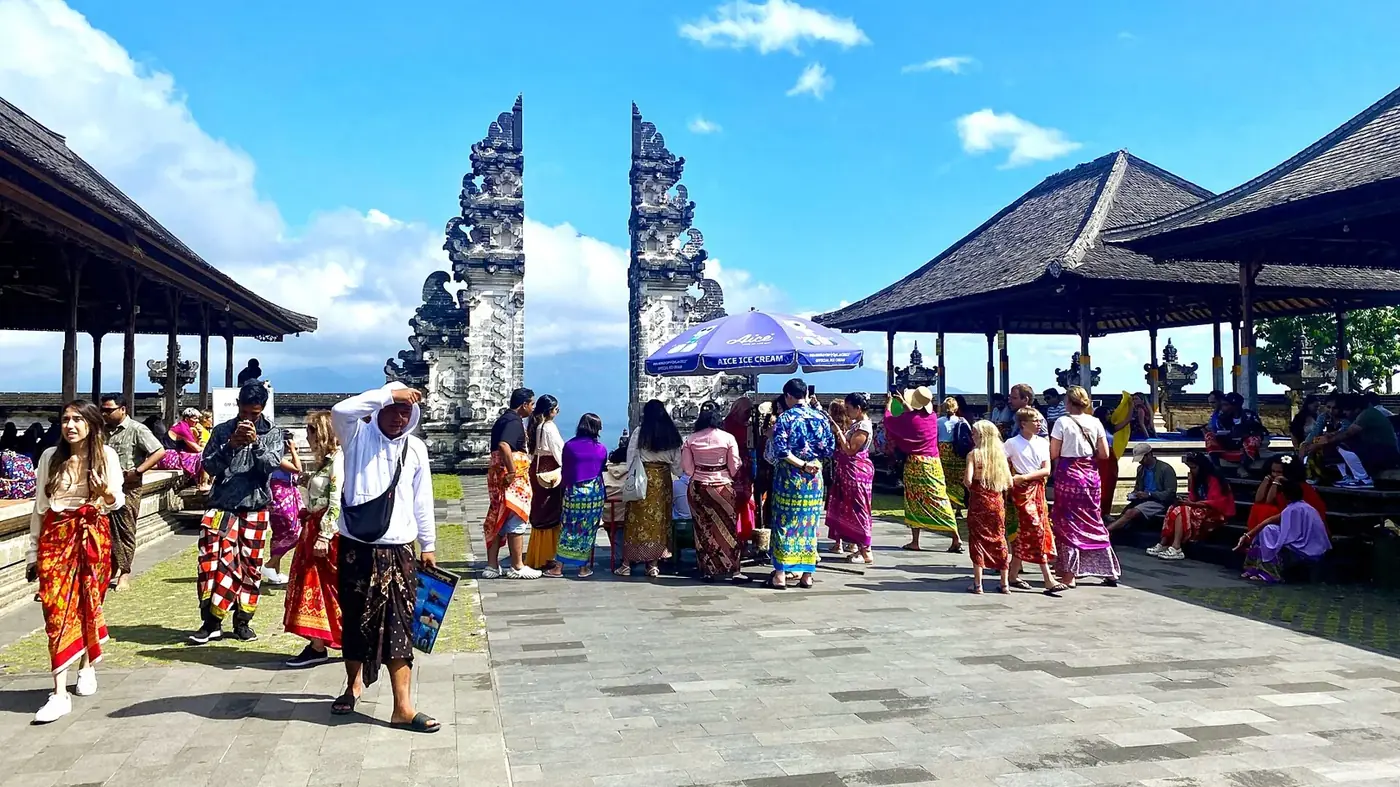
At practically every temple set up for visitors, the sarong and sash are handed to you at the entrance, and at most of them the cost is already inside the ticket. Where it is not, the rental is small change and the cloth comes back on the way out. Nobody is going to turn you away for arriving in shorts. They are going to hand you a piece of fabric and point at the changing area.
Buying your own is still worth doing if temples are a theme of your trip. A sarong and sash from any market cost roughly what a coffee does, they dry in ten minutes, they save you the queue at the borrowing desk, and they do not look like the fluorescent one-size-fits-nobody cloth every other visitor in the courtyard is wearing. It also removes the small awkwardness of wearing something a hundred strangers wore that week.
One caveat on the borrowed cloth. At sites where thousands pass through daily, the rental sarongs come back damp and are reissued immediately. If that bothers you, bring your own. If it does not, nobody has ever come to harm from a temple sarong.
Living sanctuaries and photo sets
Every temple on an itinerary sits somewhere on a line between a place where people pray and a place where people queue. Knowing which you are walking into is most of the difference between a good visit and a disappointed review.
At the living end sits Besakih, where more than twenty temples share one enclosure on the flank of Mount Agung and ceremonies run most weeks of the year. It is the mother temple, the holiest site in Balinese Hinduism, and when the volcano erupted in 1963 the lava passed within metres of the complex without touching it, an event most Balinese read as unambiguous. If you have heard that Besakih is a gauntlet of aggressive fake guides, that reputation is out of date: the site has been reorganised around a proper visitor centre with official guides, and the old car park hustle has largely gone with it.
Also at that end, Tirta Empul, where the purification ritual at the spouts is performed by Balinese families continuously, not as a demonstration. Foreigners may join, and it is genuinely moving to do so, provided you go in the first hour and enter the water in the right order rather than treating a thousand-year-old spring as a swimming pool.
At the other end is the Gates of Heaven. Lempuyang is one of the six great sanctuaries of the island and deeply important, and yet the overwhelming majority of people up there are queueing for a single photograph in front of a single gate. The mirror-still lake in that image does not exist: a temple photographer holds a piece of mirrored glass a few centimetres under the lens. Nothing is concealed about it, and nothing is ever mentioned about it in the captions either.
Tanah Lot and Uluwatu sit in the middle and lean towards spectacle. Both were founded in the sixteenth century and both are real, but you approach Tanah Lot through a long commercial arcade and Uluwatu is organised around a nightly kecak performance in a clifftop amphitheatre. That is not a criticism. It is simply a different evening out from the one Besakih offers on a Tuesday morning.
Entrance fees, donations and the guide question
Small amounts of money change hands at several points, and knowing in advance which of them are official removes essentially all of the friction.
At the ticket desk: a few dollars, sarong included
Official, printed, and normally covering the cloth. Rates are set locally and revised without warning, so treat every figure you read online as an order of magnitude.
In the car park: parking, and sometimes a shuttle
A token amount for the car nearly everywhere. At Lempuyang and at Besakih a shuttle over the last stretch is a genuine, non-optional part of how the site is run.
The donation box: real, and genuinely optional
Village temples with no ticket keep a box and a book. A small note is normal and adequate. Where somebody stands over the book pointing at large figures other visitors supposedly gave, ignore the figures.
Guides: worth it twice out of nine
Besakih, because the complex needs explaining, and Tirta Empul, because the ritual has an order. Everywhere else you are buying company, and the price should be agreed before you set off.
The honest summary is that Bali temples are cheap. The entrance to the most sacred site on the island costs less than a beer at a beach club in Seminyak. What costs real money is the car: a driver for a full day east or north is several times the sum of every ticket you will buy, which is why grouping temples geographically matters far more than comparing their fees.
Bring cash in small notes. Card readers exist at the larger ticket offices and fail regularly, the shuttle drivers and the car park attendants are cash only, and nobody at any temple on Bali has change for a large note first thing in the morning.
How to group them without wasting the day
Bali is small on a map and slow on the road. The temples that look close together often are not, and the ones nobody pairs sometimes sit twenty minutes apart. Plan by direction: pick one bearing out of your base and stay on it.
Around Ubud: a half day
Tirta Empul first thing, before the coaches, then Gunung Kawi ten minutes up the same road or Goa Gajah on the way back. The Tegallalang terraces sit on the same axis if you want scenery rather than a third temple.
East Bali: a long day
Lempuyang at dawn for the gate and the mountain, Tirta Gangga mid-morning, then Besakih on the way back west. From the south this is twelve hours. Sleeping in Amed or Candidasa the night before turns it into a good morning.
West and the lakes: on the way north
Taman Ayun and Ulun Danu Beratan sit on the same road up to Bedugul, about forty minutes apart. This is the one genuinely efficient temple pairing on the island, and the Munduk waterfalls are the natural third stop.
The south: an afternoon
Uluwatu on the cliffs for the sunset and the kecak, or Tanah Lot on the coast for the same hour in a different register. Do one or the other, never both: they are ninety minutes apart and the sun sets once.
When to go, down to the hour
The hour matters more than the month, and the Balinese ritual calendar matters more than either if your dates happen to collide with it.
The hour
Doors open around six. The first two hours are cooler, emptier, and the light comes in low across the courtyards instead of straight down into them. Organised tours arrive between nine and eleven, which is also when the highland cloud closes in and when the queue at Lempuyang reaches three hours. The sunset temples invert all of this.
The season
The dry season, roughly April to October, gives you the clear mornings that make Agung visible from the eastern temples. The wet season brings afternoon downpours rather than all-day rain, and the sites are emptier and greener. Mountain temples make their own weather in any month.
The calendar
Bali runs a 210-day ritual year alongside the Gregorian one. Every temple celebrates its own odalan, its anniversary, on that cycle, and Galungan and Kuningan come round roughly twice per calendar year and fill the island with decorated bamboo poles.
A ceremony is the best and worst thing that can happen
Arriving at a temple during its odalan is the version of Bali people spend a fortnight hoping to stumble into: the compound full, the gamelan going, offerings stacked a metre high, everyone in white and gold. It is also the day access can be restricted or closed entirely at an hour's notice, which is expensive if you have driven three hours for it.
There is no reliable public calendar for this. Your driver will know, or will ring somebody who does, which is one of several arguments for hiring one rather than a scooter for temple days in the east.
Nyepi, the one date that stops everything
The Balinese new year, in March in most years, is a full day of silence. No flights land, no vehicles move, no lights show after dark, and nobody leaves their accommodation, visitors included. Every temple is shut and so is everything else.
The evening before is the opposite: the ogoh-ogoh parades, enormous demon effigies carried through every village and then burned. If your dates include Nyepi, plan a hotel you are happy to be confined to and treat the day as part of the trip rather than a day lost from it.
Bali temples: common questions
Dress code, fees, etiquette and how to choose between them.