Gunung Kawi temple is a set of shrines carved into the cliffs of the Pakerisan valley at Tampaksiring, five minutes from Tirta Empul and about 40 minutes north of Ubud. You pay at the top, walk down roughly 300 steps through rice terraces, cross the river, and the stone walls rise on both sides of you.
Of the old sites around Ubud it is the one that makes people stop talking, and it gets a fraction of Tirta Empul's crowd. It is also not the same place as Gunung Kawi Sebatu, a water temple fifteen minutes away that Google often shows first for the same search.
The two Tampaksiring temples on one morning
Free cancellationTirta Empul and Gunung Kawi half day from Ubud
- ✓Hotel pickup in Ubud and a driver who waits while you do the stairs
- ✓Entrance tickets and sarongs handled at both gates
- ✓Gunung Kawi first, before the valley loses its shade, then the pools
- ✓Free cancellation on most dates
Affiliate link. Booking through GetYourGuide costs you nothing extra and supports the guide. Price and rating checked October 2026. Both move with season and demand.
On this page
What is Gunung Kawi Temple?
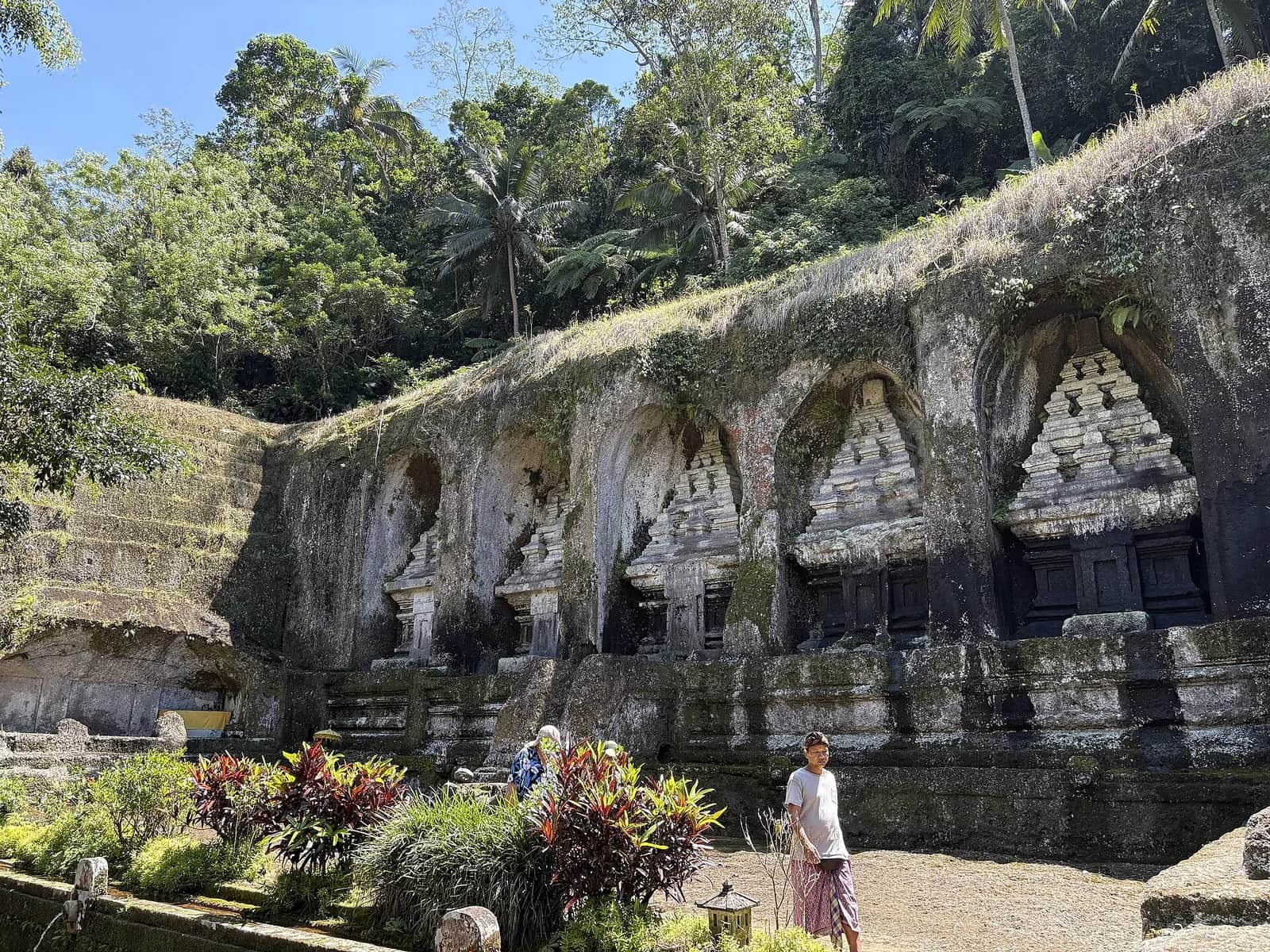
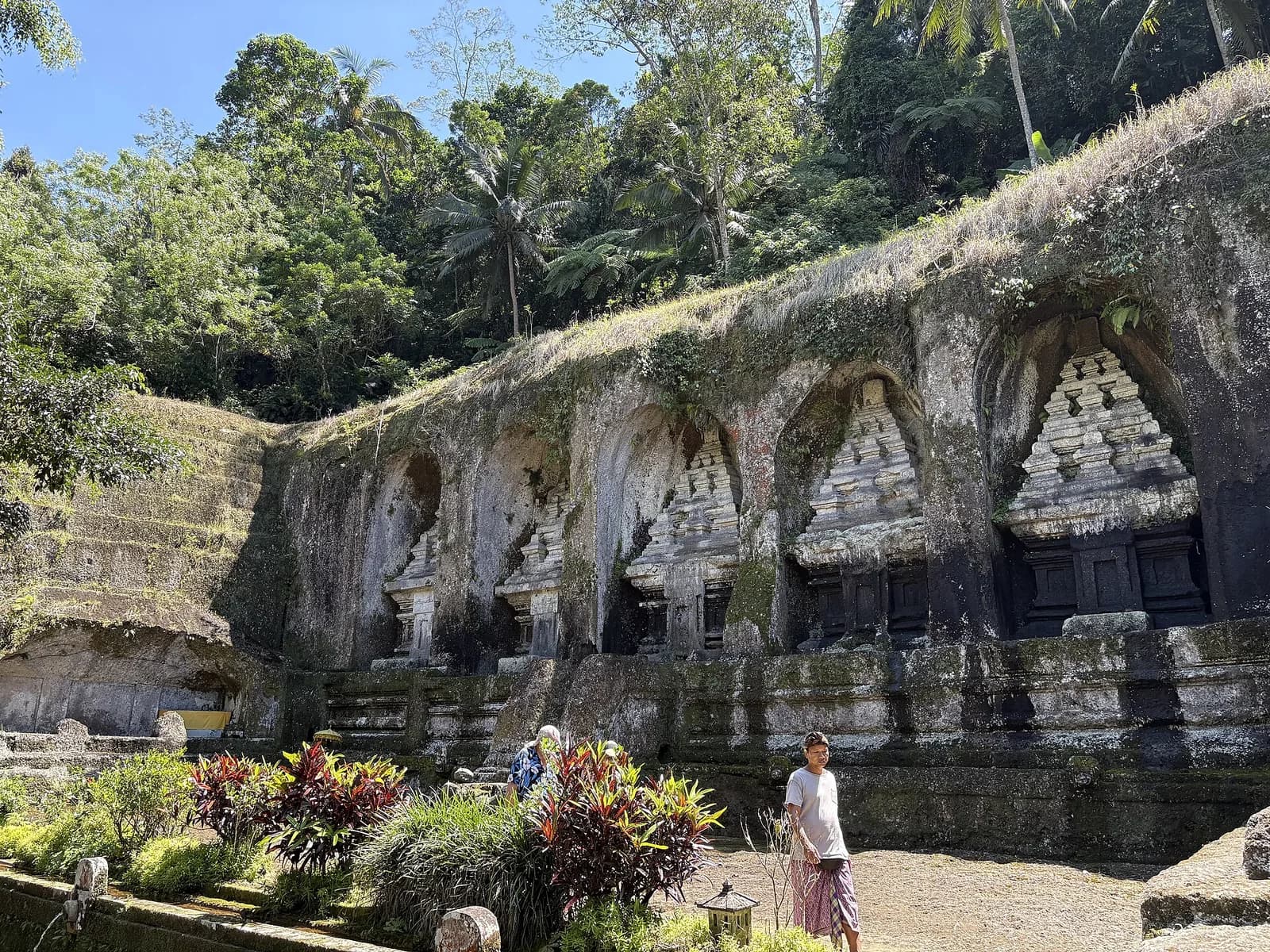
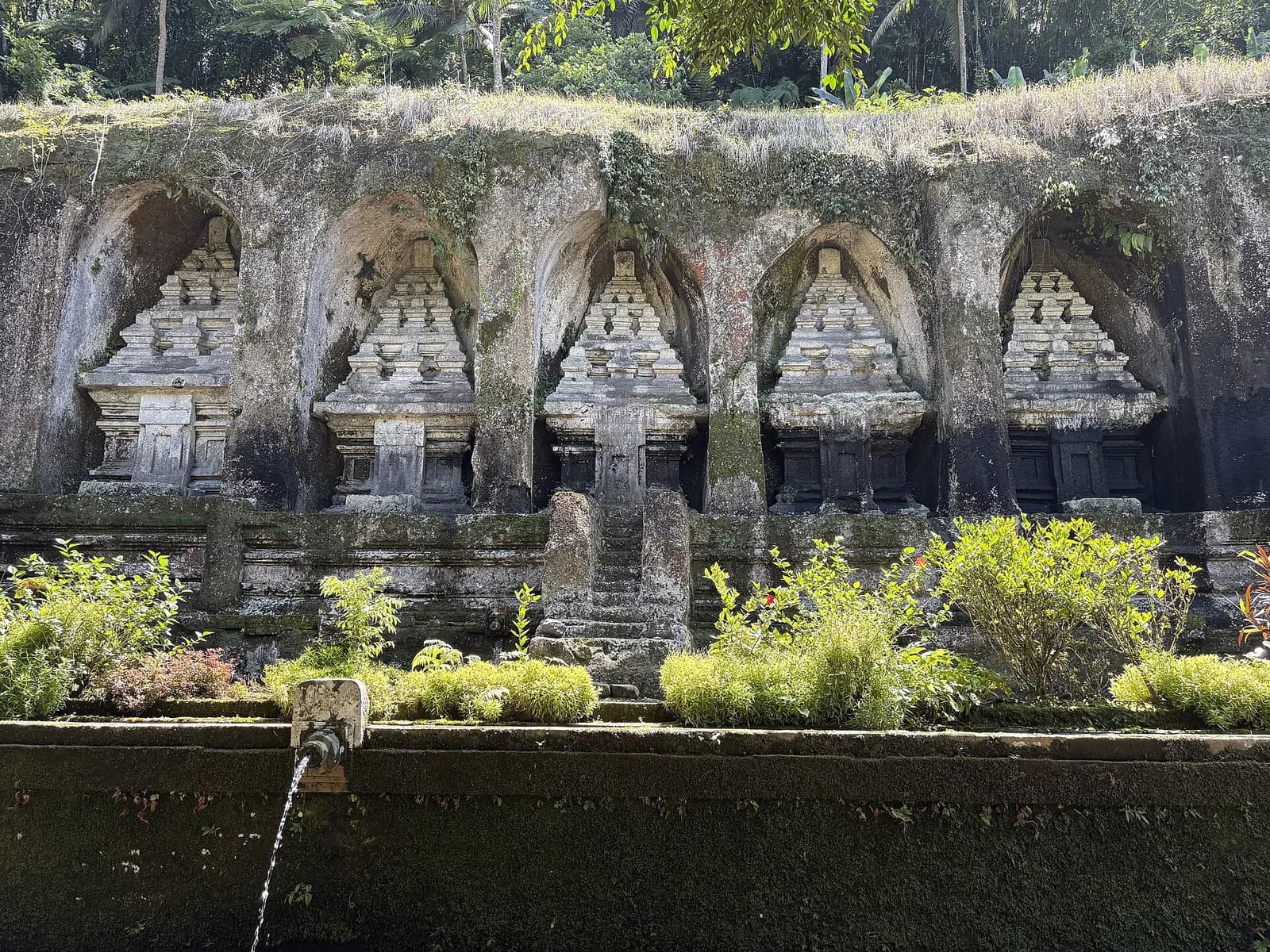
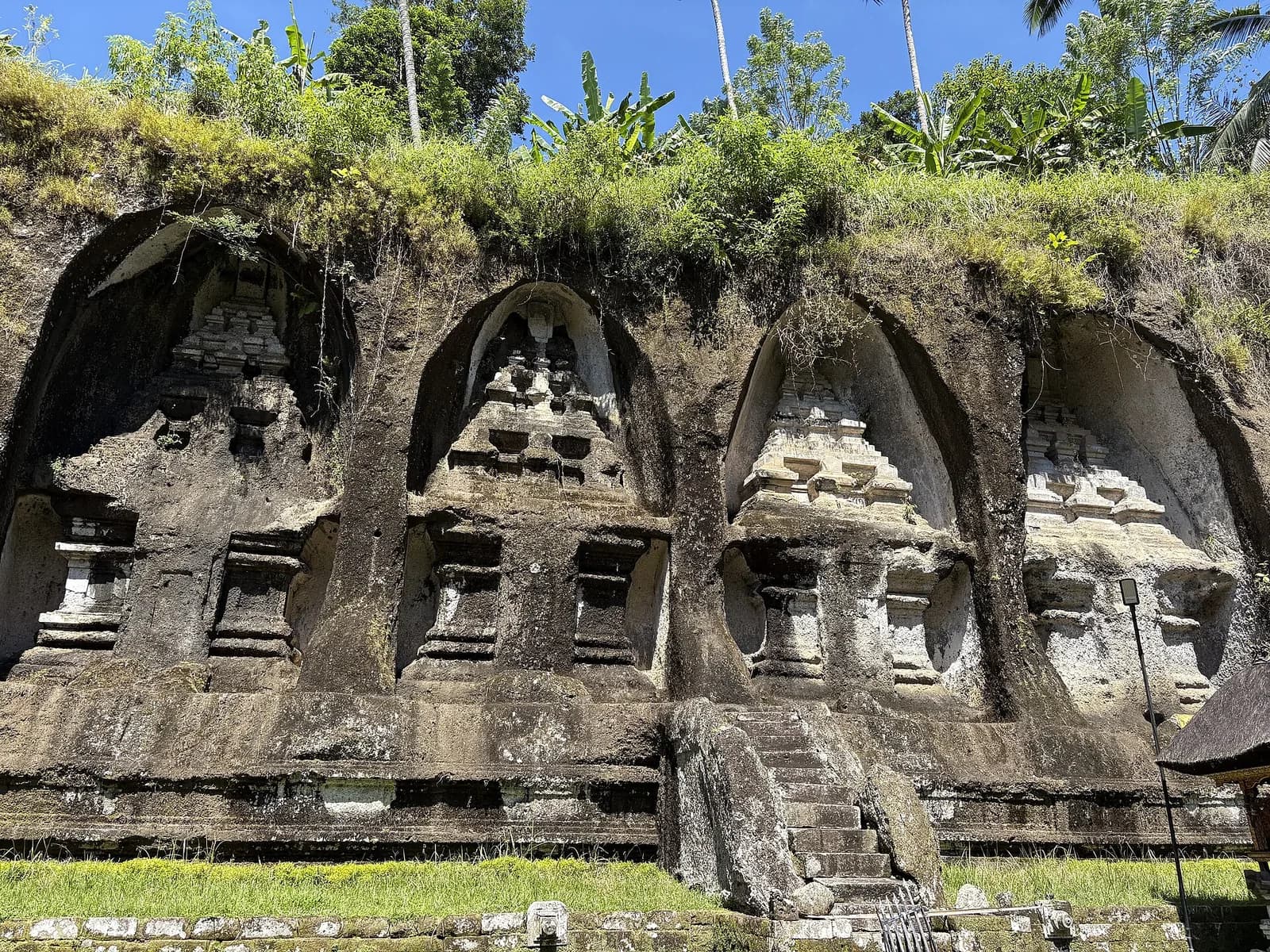
Gunung Kawi is a group of ten candi, shrine facades shaped like temples, cut in relief into the rock of the valley. They are not built: each one was carved out of the cliff, along with the niche around it, which is roughly seven metres high. Four stand on the west bank of the river, five on the east bank, and a tenth sits alone further south.
They date from the eleventh century and are linked to King Anak Wungsu, of the Warmadewa dynasty that ruled Bali from this valley, who died around 1077. The usual reading is that the five eastern shrines honour the king and his close family, and the four on the west his queens or concubines. An inscription in Kawi script above one of the eastern doorways, read as Haji Lumahing Jalu, is the main evidence for the attribution.
The site belongs to the UNESCO-listed Pakerisan watershed, part of the Cultural Landscape of Bali Province inscribed in 2012, together with Tirta Empul a little upstream. Local legend skips the dynasty and credits the giant Kebo Iwa, who is said to have carved the whole valley with his fingernails in a single night.
Is Gunung Kawi a tomb?
Every sign calls it the royal tombs, and it is not one in the literal sense. No human remains have been found in or behind the shrines, and the facades have no chamber behind them. They are best understood as memorials, places where the dead king and his family were honoured as deified ancestors, which is how the Balinese still treat them.
What does Gunung Kawi mean?
Gunung is mountain in Indonesian. Kawi is the old literary language of Java and Bali, and the script used on the inscription here. The word itself comes from the Sanskrit for poet, which is why the name is often given as the mountain of the poets. Locals mostly call the site Candi Tebing Gunung Kawi, the cliff shrines of Gunung Kawi.
Gunung Kawi entrance fee and opening hours in 2026
The ticket booth is at the top of the lane, before the stairs. Prices below were checked on 19 October 2026 and converted at that day's rate (Rp 18,053 to US$1, Rp 12,775 to C$1). Bring cash in rupiah: the booth, the parking and the stalls do not take cards.
| What you pay for | Detail | Order of magnitude |
|---|---|---|
| Entrance, foreign adult | The figure published by Indonesia's tourism ministry, paid in cash at the booth at the top of the lane. Some guides quote 75,000, so take a little more than you need. | Rp 50,000 (US$3 · C$4) |
| Entrance, Indonesian visitor | The domestic rate on the same official listing. Residents may be asked for ID. | Rp 30,000 (US$1.70 · C$2.30) |
| Sarong and sash | Lent at the gate if your legs are showing, and usually counted in the ticket. Where a separate rental is asked for, it is a few thousand rupiah. | included |
| Parking | Paid to the attendant on the lane, by vehicle. | Rp 2,000 scooter · Rp 5,000 car |
| Bali tourist levy | Paid once for the whole trip, not at each temple. Spot checks happen at the big sites. | Rp 150,000 (US$8 · C$12) |
Is the Gunung Kawi fee 50,000 or 75,000 rupiah?
Both figures circulate. Indonesia's tourism ministry lists Rp 50,000 for foreign visitors and Rp 30,000 for Indonesians, and two recent visitor reports paid the same. One of the most read Bali blogs gives Rp 75,000 for adults and Rp 50,000 for children aged five to eleven. Rates here are set by the village and change without notice, so the safe plan is to carry Rp 100,000 per person and pay what the board at the booth says.
Gunung Kawi opening hours
The site is open every day from 8 am to 6 pm. The last useful entry is around 5 pm, because you need half an hour to get down, look and climb back before the light goes in the gorge.
The Gunung Kawi steps: how many, and how hard
The famous figure is 300 steps, and it is roughly right. The ministry's own page says 300 to 400, and one local guide counts 371. The difference is where you start counting: the souvenir lane slopes gently before the real staircase begins.
Going down is easy and takes about seven minutes. Coming back up is the part people underestimate. It is a steady climb in a valley with little wind, and most visitors stop two or three times. Allow ten to fifteen minutes, more at midday.
- There is no lift, no ramp and no other exit. If stairs hurt your knees, Tirta Empul and Sebatu are both flat.
- Children manage it from about five. Leave the pushchair in the car and bring a carrier for a baby.
- The stone is worn smooth and turns slippery after rain. Wear shoes with grip and hold the handrail going down.
- Buy water on the lane, because there is nothing to buy at the bottom.
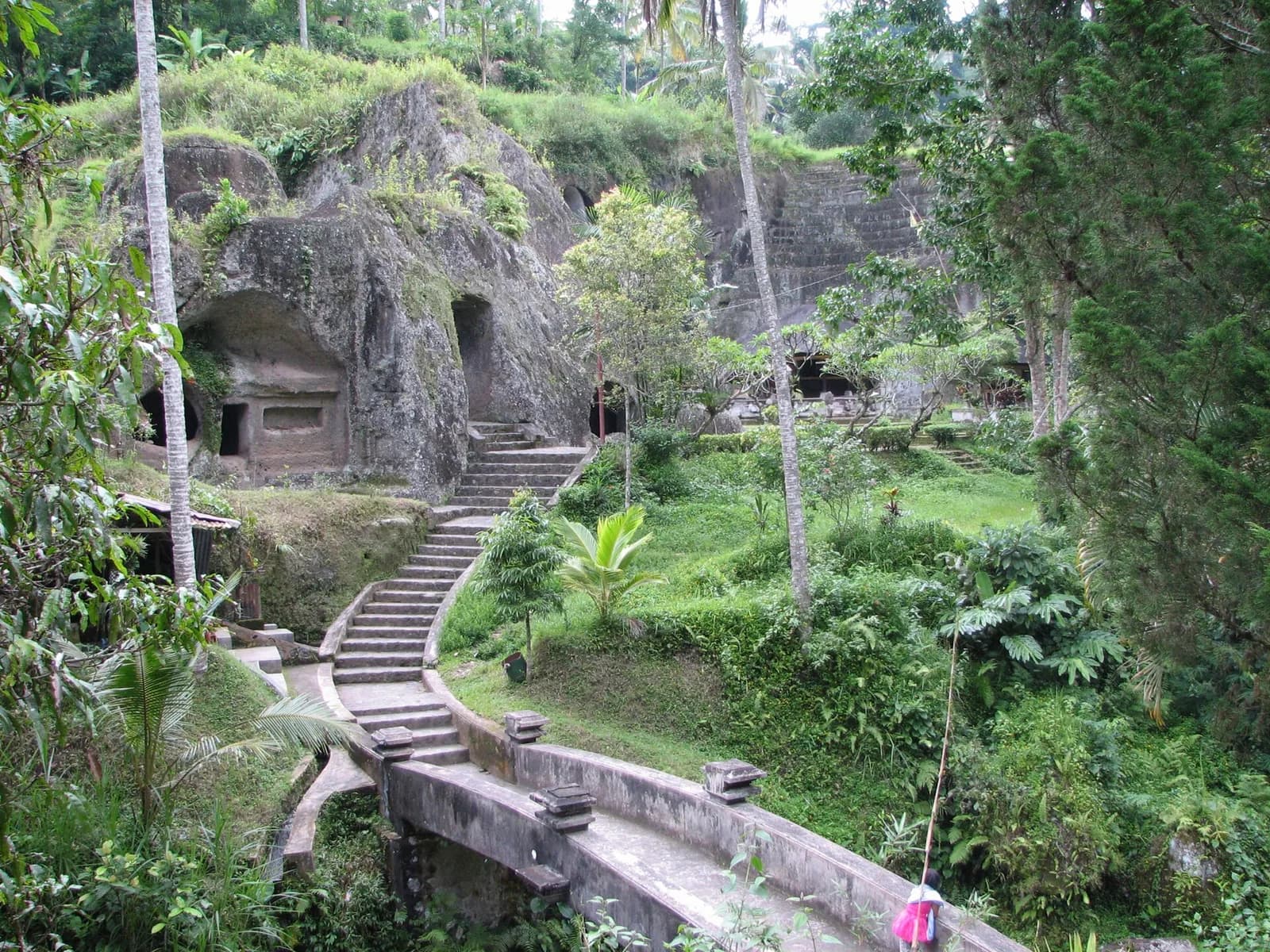
Photo Eric Bajart, CC BY-SA 3.0
Gunung Kawi dress code: sarong and temple rules
Gunung Kawi is an active temple, and the dress code is the standard one for Bali. Legs are covered with a sarong, lent at the entrance along with the sash tied at the waist, so there is no need to bring your own. Cover your shoulders too: a T-shirt is fine, a vest top is not.
The rules are the ones that apply at every temple on the island. Do not climb on the shrines or step over offerings, keep your voice down where people are praying, and women who are menstruating are asked not to enter, as at all Balinese temples. Nobody checks, but it is a request you are expected to respect.
At the stone gateway near the bottom, two jars of holy water stand on either side of the path, and an attendant may offer to sprinkle you. It is optional. A small donation is welcome if you accept.
What to see at Gunung Kawi, in the order you meet it
The lane and the rice terraces
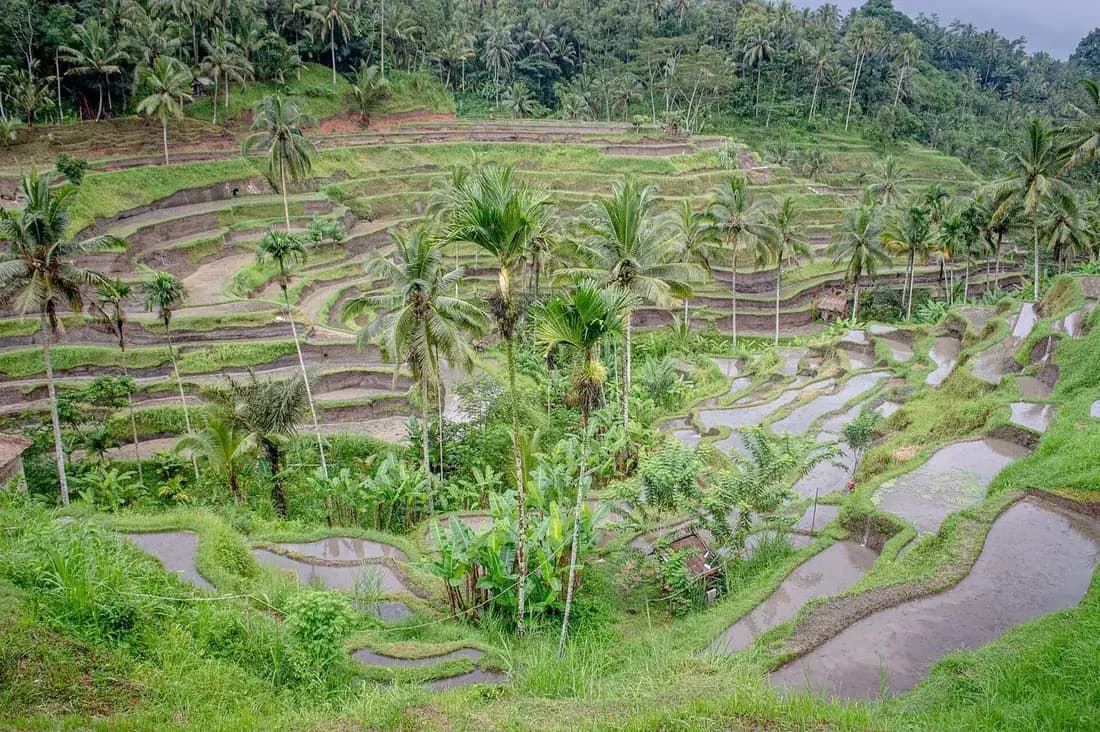
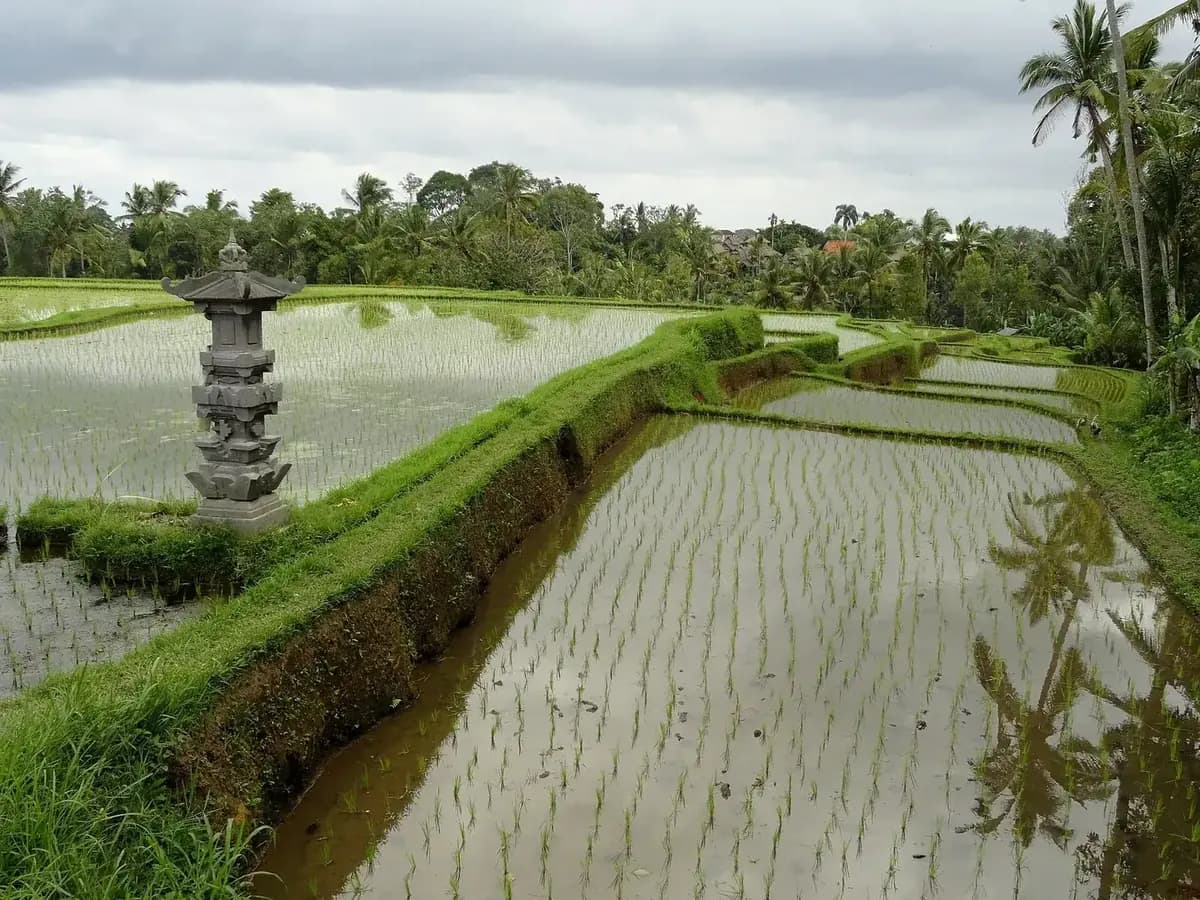
From the car park, a lane of souvenir stalls and warungs leads to the booth and then to the staircase. The stairs drop through terraced rice fields that are worked, not kept for photos, so expect farmers and irrigation channels rather than swings.
This is the only place to eat. A handful of warungs just past the entrance serve nasi goreng, coffee and cold drinks, and the ones on the valley side look out over the terraces. Buy your water here before you go down.
The rock-cut gateway
Near the bottom, the path passes through an arch cut through the rock, the moment you enter the sacred part of the valley. Just past it you reach the river and the first view of the shrines.
The five shrines on the east bank
Cross the bridge over the Pakerisan and turn to the main group: five facades in a row inside a temple courtyard where offerings are laid every day. This is the group linked to Anak Wungsu himself, and the one with the inscription. Next to it, small chambers and a courtyard cut into the rock are usually described as hermits' cells, where priests or monks once lived.
The four shrines on the west bank
Back across the river, the four western facades face the first group across the water. They get the morning light and are the best photograph on the site before 10 am. Most visitors see both groups and turn back here.
The tenth shrine in the rice fields
The one almost everybody misses is the tenth candi, alone about a kilometre to the south, reached by a path along the irrigation channels. It is often said to honour a minister of the king. The walk takes 15 to 20 minutes each way and is the best part of the site if you want it to yourself. Ask at the bottom for the path, which is not signposted.
Gunung Kawi and Tirta Empul: five minutes apart
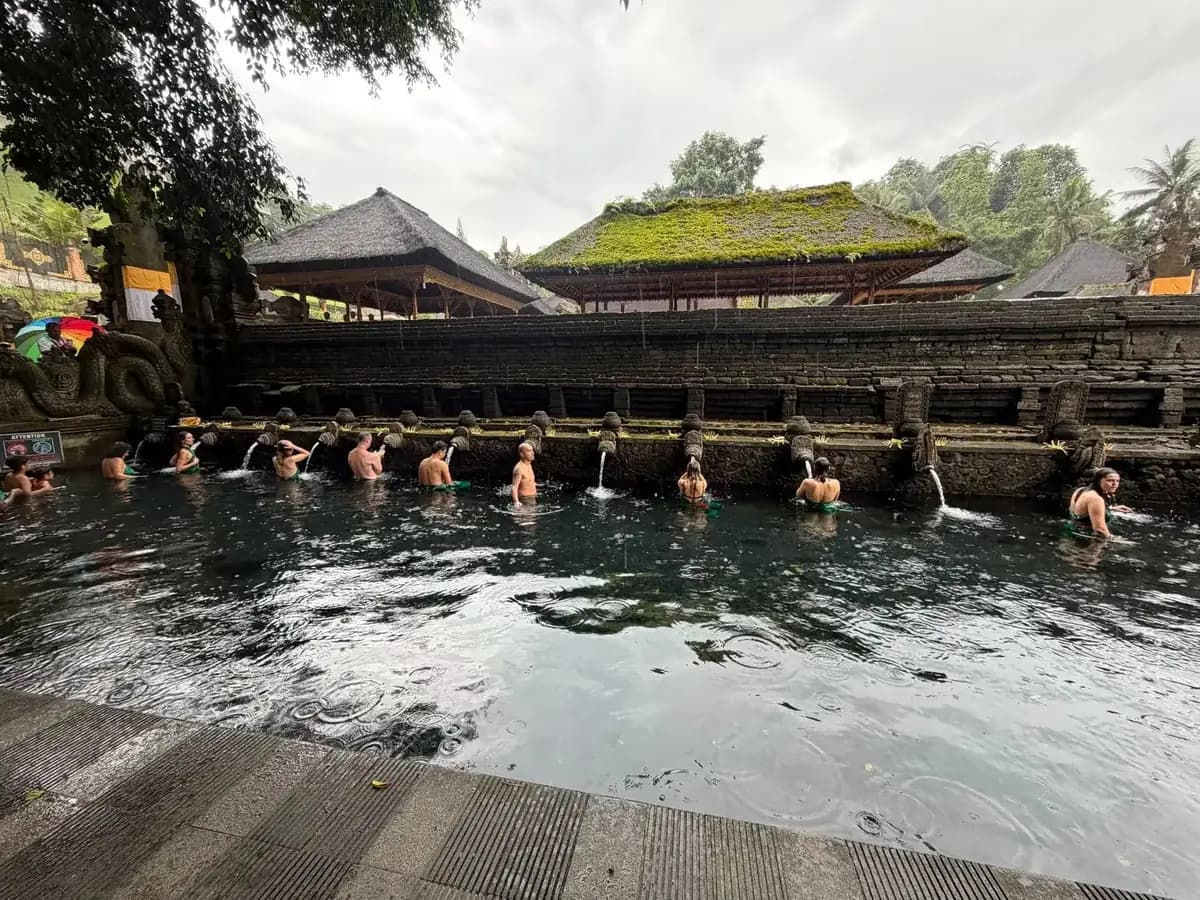
The two temples sit in the same village on the same river, 1.6 to 2 km apart, and nearly every driver combines them. At Tirta Empul you get into the water with the Balinese. At Gunung Kawi you stand in a gorge and look up, usually with very few people around. Read how the purification ritual at Tirta Empul works before you go, so you know which spouts to skip.
Do Gunung Kawi first. The stairs are easier before 10 am, and arriving at the pools hot and tired makes the cold water feel earned rather than a chore.
How to get to Gunung Kawi from Ubud
Tampaksiring is about 20 km north east of Ubud, 30 to 40 minutes by car. A driver for the morning is the usual choice and the easiest: they wait at the car park and take you on to the next stop. By scooter the road is straightforward, through Tegallalang or Pejeng. Grab and Gojek will drop you, but getting a ride back from Tampaksiring is hit and miss, so agree a return pickup before you let the car go.
A half day loop: Tegallalang, Sebatu, Gunung Kawi, Tirta Empul
All four sit within a few kilometres of each other north of Ubud, and this order keeps the walking for the cool hours and the water for the hot ones. Start at Tegallalang rice terrace before the crowds and you are back in Ubud for a late lunch.
| What you pay for | Detail | Order of magnitude |
|---|---|---|
| 08:00 · Tegallalang | The terraces before the coaches. An hour is enough to walk down into the bowl and back. | start |
| 09:15 · Gunung Kawi Sebatu | The water temple, mostly flat, thirty to sixty minutes. About 4 km from Tegallalang. | ≈ 10 min drive |
| 10:30 · Gunung Kawi | The cliff shrines and the stairs, before the valley loses its shade. An hour on site. | ≈ 15 min drive |
| 12:00 · Tirta Empul | The purification pools last, when you are hot enough to want the water. Same village. | ≈ 5 min drive |
Gunung Kawi Sebatu is a different temple
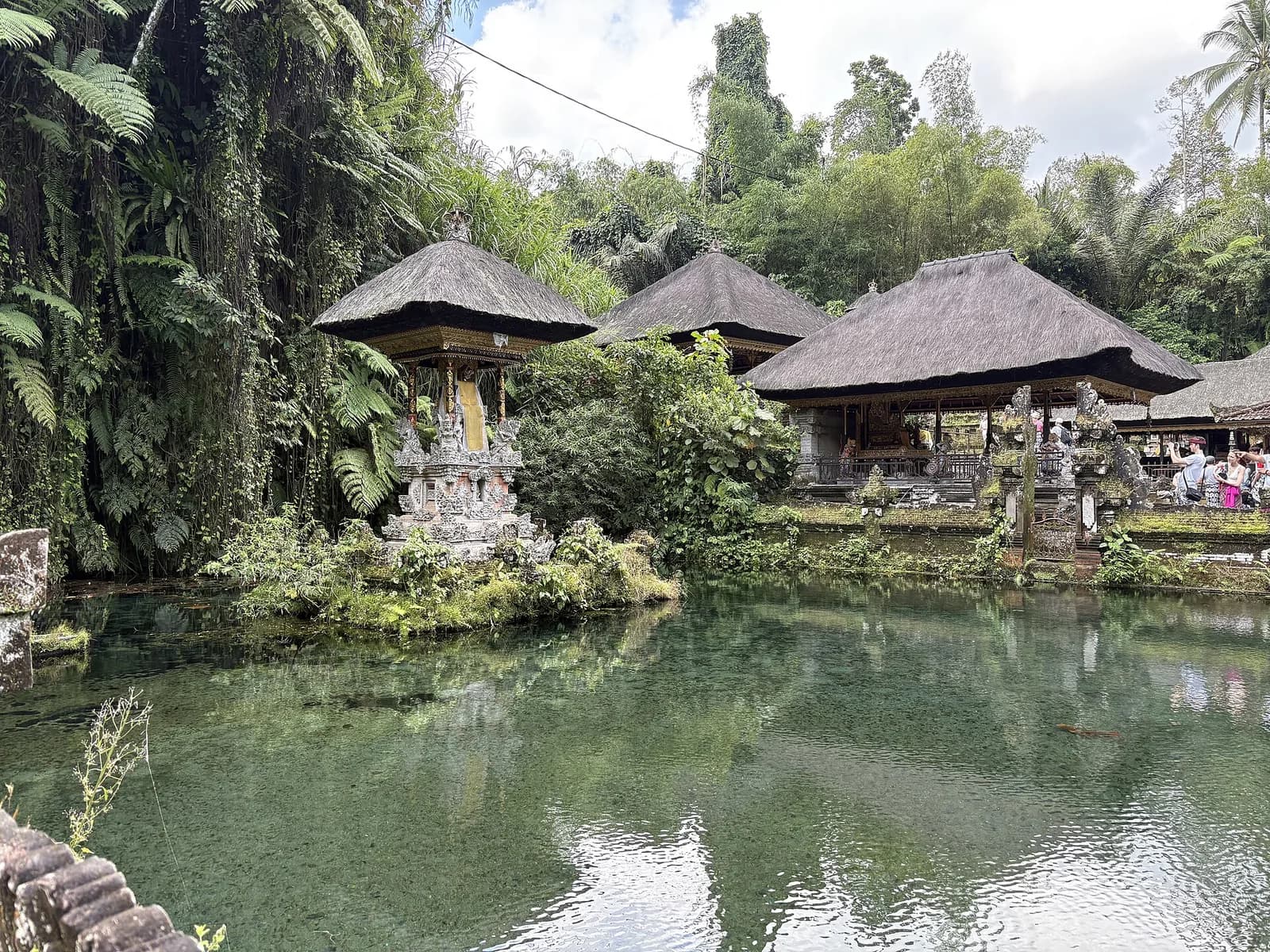
Pura Gunung Kawi Sebatu shares half its name and nothing else. It is a water temple in the village of Sebatu, about 4 km from both Tegallalang and Tirta Empul, built around a spring that feeds koi ponds and a set of purification pools. There are no carved cliffs and almost no stairs.
It costs about Rp 50,000 for an adult and Rp 25,000 for a child (US$3 · C$4 and US$1.40 · C$2), sarong included, with the same 8 am to 6 pm hours. Thirty minutes to an hour is enough. It is greener and calmer than Tirta Empul, and many people prefer it for that.
It is not a swimming spot. The large pond with the statue of Saraswati on a swan is for the koi. The smaller spring-fed pools are for the melukat purification ritual, which you can join in a bathing sarong with a change of clothes, and which is quieter here than at Tirta Empul.
Choose Gunung Kawi Tampaksiring if
You want the history and the scale: eleventh century shrines in a gorge, and you are fine with 300 steps back up.
Choose Gunung Kawi Sebatu if
You want a calm water temple with no stairs, or a quieter place than Tirta Empul for a purification ritual.
The water temple on a day north of Ubud
Free cancellationGunung Kawi Sebatu, waterfall and rice terrace tour
- ✓Sebatu combined with a waterfall and the Tegallalang terraces
- ✓Pickup and a driver for the whole day
- ✓Entrance fees handled at each stop
- ✓Free cancellation on most dates
Affiliate link. Booking through GetYourGuide costs you nothing extra and supports the guide. Price and rating checked October 2026. Both move with season and demand.
Best time to visit Gunung Kawi
Arrive at 8 am. The valley is still in shade, the western shrines catch the light, and the climb back up is far easier before the heat. Tour groups that start with Tirta Empul usually reach Gunung Kawi around 11 am. The late afternoon, after 4 pm, is the other quiet window.
In the rainy season, from November to March, the rice is at its greenest and the river is loud. Go in the morning, since rain tends to arrive after lunch, and take the steps slowly. The temple also holds its anniversary ceremony once a year on the Balinese calendar. The courtyard fills with worshippers in white, which is worth seeing, though not if you came for empty photos.
Is Gunung Kawi worth visiting?
Yes, if you are already going to Tirta Empul. Five minutes away, it adds an hour and gives you the oldest monument of the trip, in a setting that has barely changed. It is less crowded than every other big name near Ubud, and the scale of the carved cliffs surprises most people.
It is a harder sell as a trip of its own from the south coast: two to three hours in the car for an hour on site. And if stairs are a real problem, skip it and see Sebatu instead.
How long to spend at Gunung Kawi
One hour covers the descent, both groups of shrines and the climb. Add half an hour for the tenth shrine in the rice fields. To see how it compares with Goa Gajah and the other temples around Ubud, start from the guide to Bali's temples.