Waterfalls are the part of Bali that most reliably beats its photographs, because a photograph cannot carry the noise, the cold, or the twenty minutes of steps down through wet jungle to reach one. They are also the easiest thing on the island to get wrong. Turn up at the wrong hour and the light is gone. Turn up after a night of rain and the clear pool you drove for is the colour of tea.
Every list of the best waterfalls in Bali ranks the same ten sites in a slightly different order, and none of them answers the question you actually have, which is which one, from where you are sleeping, in the month you are travelling, given how many steps you are prepared to climb back up. Those four variables change the answer completely. A visitor based in Seminyak with a spare morning and a bad knee and a visitor based in Munduk with a whole day are not looking for the same waterfall, and there is no version of a top ten list that serves them both.
This page is the transversal part: the geography, the season, the money, the risk and the kit. Each waterfall with its own page goes deeper on the site itself, and this is what you need before you pick one.
On this page
The driving is the hard part, not the walking
Bali waterfall day trips, driver included
- ✓A driver who knows which gate is open, which is the whole game in the wet season
- ✓Two or three falls in one run, in an order that works geographically
- ✓Hotel pickup, so the day does not start with a scooter in the rain
- ✓Free cancellation on most listings if the forecast turns overnight
Affiliate link. Booking through GetYourGuide costs you nothing extra and supports the guide. Price and rating checked September 2026. Both move with season and demand.
Where Bali's waterfalls actually are
They are not scattered evenly. They sit in three groups, and which group you can reach is decided the day you book your hotel, not the day you look at a map.
The Bangli and Gianyar cluster, reachable from Ubud
This is the group most visitors will actually see. Tukad Cepung, Tibumana and Kanto Lampo sit within about twenty minutes of one another in the hills east and northeast of Ubud, with Tegenungan closer in, on the southern edge of the same river system. From Ubud none of them is more than forty minutes away. From the southern beaches, add an hour to ninety minutes each way and the traffic between Denpasar and Ubud, which is the real variable.
What makes this cluster valuable is not any single fall in it, it is that they are genuinely different from each other. A narrow gorge you wade into, a clean vertical drop into a swimmable pool, and a wide curtain over a stepped rock wall. Doing all three in a morning is not repetition, which is exactly what a fourth one would be.
These are also small catchments. That is why they clear quickly after rain and why they thin out at the end of a long dry season, and it is the mechanical reason a photo from May and a photo from September of the same fall can look like two different places.
The north: Buleleng, Munduk and the lakes
Sekumpul, Gitgit, Banyumala, Munduk and Melanting, Aling Aling. This is where the biggest and least crowded falls are, and it is on the far side of the mountains. From the south you are looking at roughly two and a half to three hours each way through the passes, which turns any northern waterfall into a full day at minimum.
The honest advice is to sleep up there. A night in Munduk or Lovina costs less than the extra driver hours and turns three separate day trips into one comfortable morning each.
The scattered ones: Badung, Tabanan and the east
Nungnung sits on the road from the south towards Bedugul, which makes it the one waterfall that costs almost no detour if you are already driving north. Leke Leke is in Tabanan and pairs naturally with the rice terraces and the west coast temples. Neither is a destination in itself, and both are excellent as the second stop on a day built around something else.
In the east, around Sidemen and Karangasem, the falls are small and mostly local. Worth a stop if you are already staying there for the volcano views, not worth a drive from anywhere else.
Which waterfall is right for you
Four inputs, one answer. Where you sleep sets what is reachable, the time you have sets how far you can go, the swimming question eliminates about half the list, and the steps question eliminates most of the rest.
If you want a real swim, not just a look
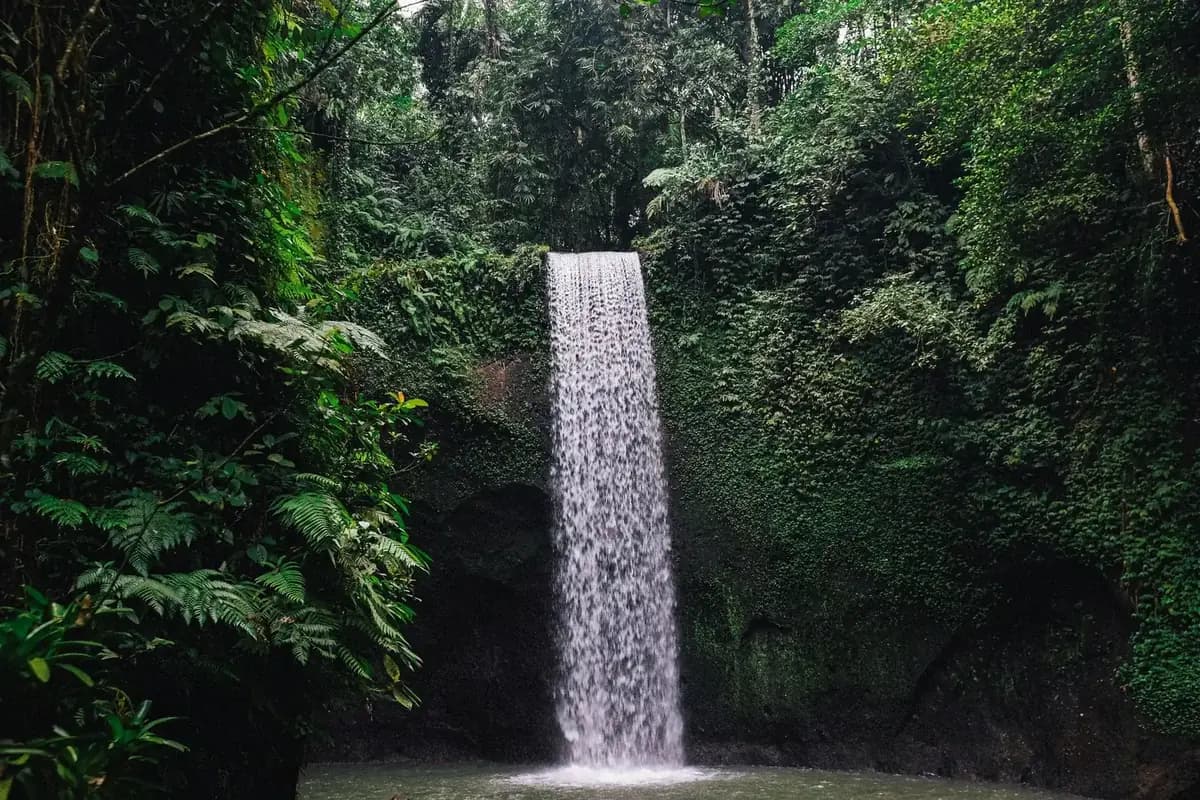
Tibumana is the easiest genuine swim on the island: one clean drop into a shallow pool you can stand up in, at the end of a short walk down. Banyumala Twin, in the hills above Lake Buyan in the north, is the other real option, with a clear pool where swimming is the point rather than a bonus. Tukad Cepung is a wade in shin deep water through a gorge, not a swim.
If you are staying in Ubud or only have a half day
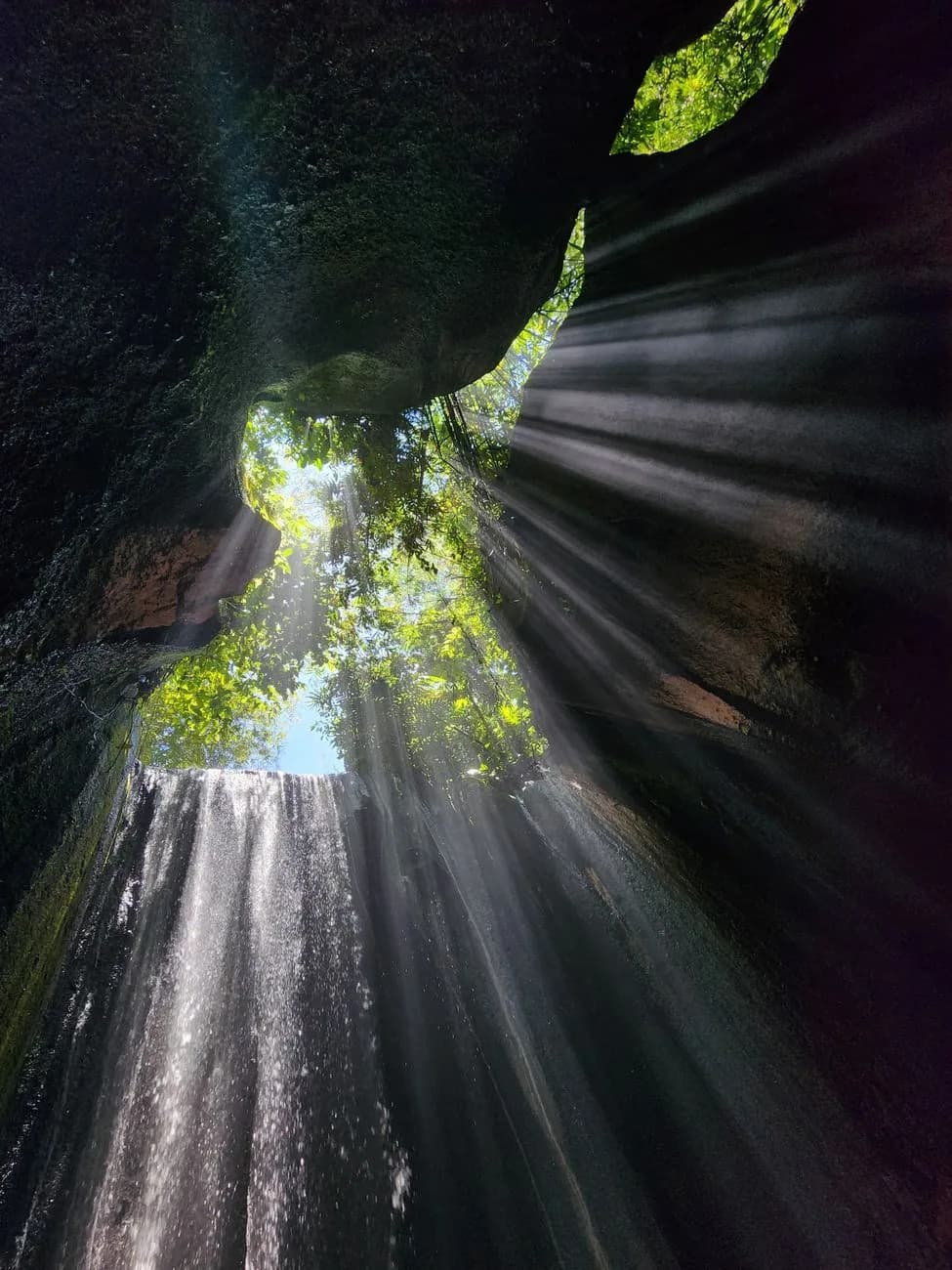
Kanto Lampo, Tegenungan, Tibumana and Tukad Cepung all sit in the Bangli and Gianyar cluster, within about twenty minutes of one another and of Ubud. Tegenungan is the closest and most developed, with warungs and viewpoints and the least wild feel of the four. Kanto Lampo is a wide curtain over a stepped rock face, five minutes from the car and the most photogenic, though the rock everyone poses on is as slippery as it looks. Tukad Cepung is the one that looks like nothing else on the island: a gorge you wade into in shin deep water, with a shaft of light through the roof around the middle of the day.
If you are already up north
Sekumpul, Gitgit, Munduk and Melanting, and Banyumala Twin cluster around Buleleng, well beyond a half day trip from the south. Sekumpul is widely rated the most spectacular on the island and makes you earn it: a long drive, a steep descent, a river crossing and the climb back out, worth three to four hours on site. Gitgit is the northern waterfall that asks the least of you, a tall single drop on a paved path above Singaraja. Munduk and Melanting link two or three falls through coffee and clove plantations at altitude, the pick if you want a hike more than a photograph.
If your legs will not take many steps
Kanto Lampo, at around 60 steps, and Tibumana, at around 100, are the easiest descents on this list. Leke Leke in Tabanan adds around 150 steps on a managed path with a bamboo bridge, and pairs naturally with a stop at Jatiluwih. Nungnung, on the road to Bedugul, is the other end of the scale at roughly 500 steps down to a heavy vertical drop that stays loud, cold and almost empty.
The ones worth the walk
Each with what the descent is really like, whether you can get in the water, and the hour that makes the difference.
Waterfall
Tukad Cepung Waterfall: The Light Beam, Odds and Timing
Tukad Cepung's shaft of light needs sun, season and the right hour. Honest odds by month, the route in gate by gate, and the waterfall most people miss.
Read the guide →Waterfall
Tibumana Waterfall: The Easy One You Can Swim In
A ten minute walk down to a single clean drop and a pool shallow enough to stand in. Getting there from Ubud, when it is swimmable, how it beats Tegenungan.
Read the guide →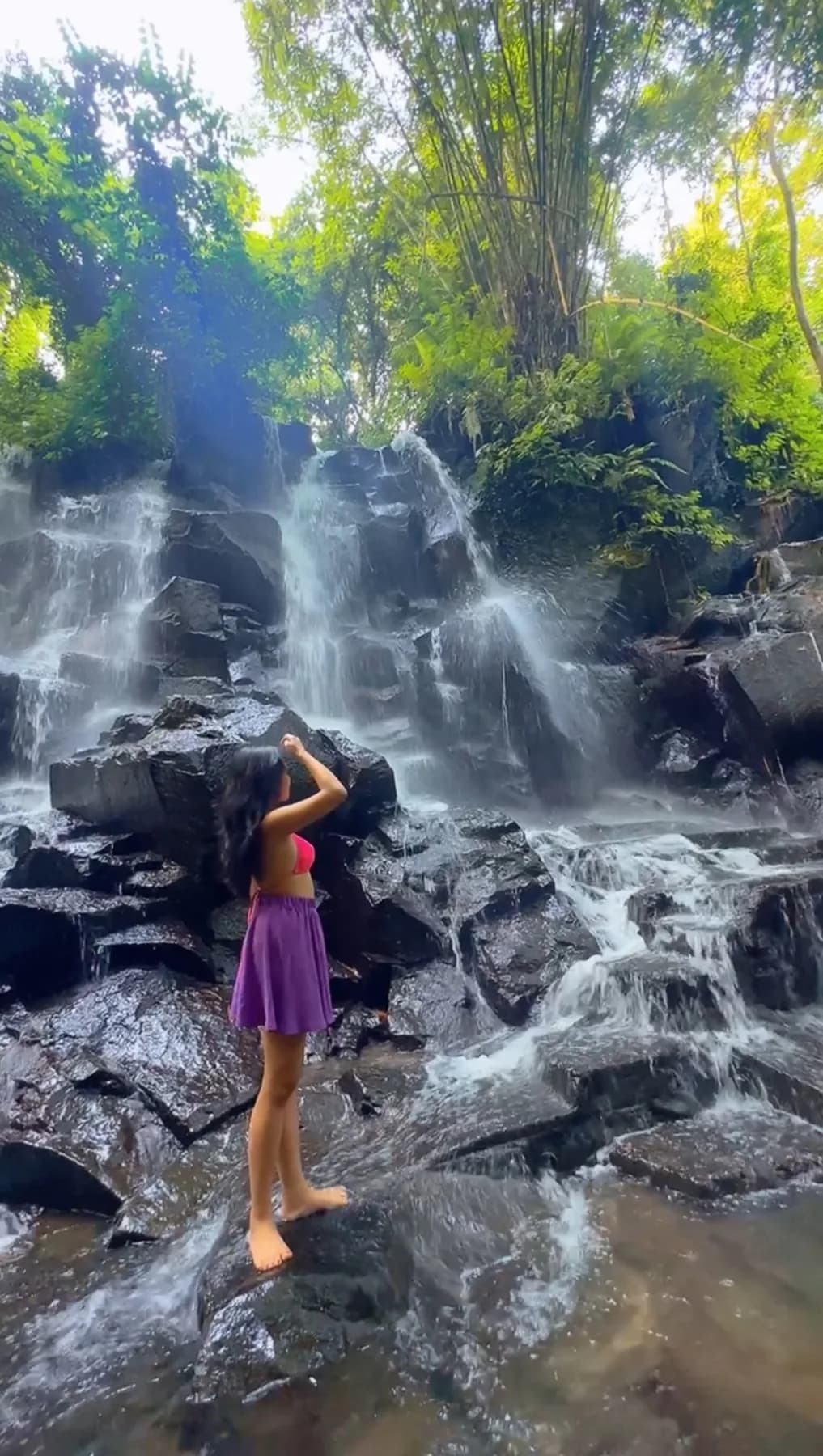
Waterfall
Kanto Lampo Waterfall: The Photo, the Rock and the Tip
Kanto Lampo is a sheet of water over stepped rock, and the famous photograph means standing in it. Where to stand, when the light works, what rain does.
Read the guide →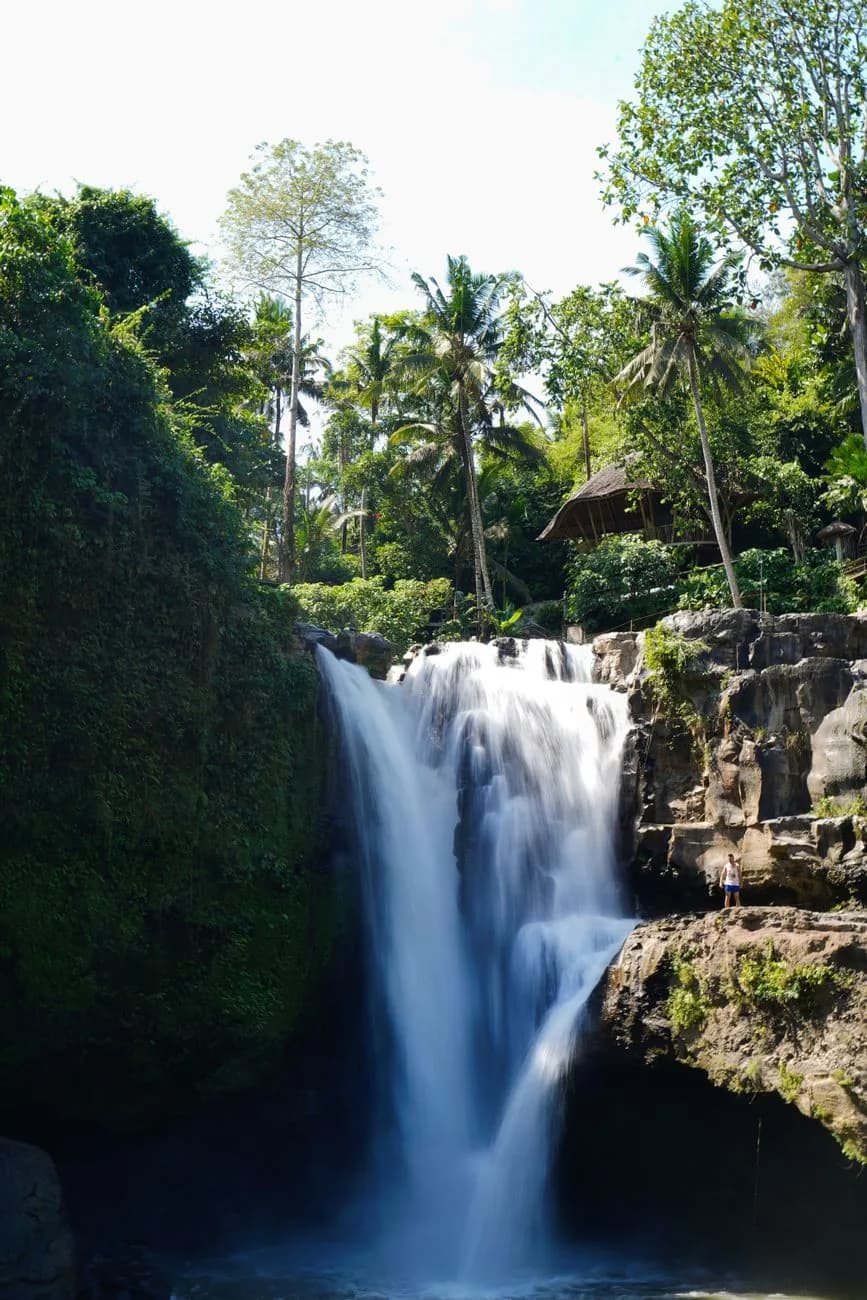
Waterfall
Tegenungan Waterfall: Worth It, or the Easy One?
The closest waterfall to Ubud and the busiest. How many steps down, whether the water is clean enough to swim, the Blangsinga side, and who should skip it.
Read the guide →Ten waterfalls, side by side
Time on site excludes the drive, which on this island is usually the larger number. Step counts are the orders of magnitude people report on the ground rather than surveyed figures, and several sites have rebuilt their stairways recently.
| Waterfall | Zone | Steps down | Swimming | Crowds | Time on site | Combines with |
|---|---|---|---|---|---|---|
| Tibumana | Bangli, east of Ubud | Around 100, easy | Yes, shallow pool | Moderate | 1 h to 1 h 30 | Tukad Cepung, Kanto Lampo |
| Tukad Cepung | Bangli, east of Ubud | Around 130, then a river | Wade only | Heavy at midday | 1 h to 1 h 30 | Tibumana, Kanto Lampo |
| Kanto Lampo | Gianyar | Around 60, short | No, current and rock | Heavy | 45 min to 1 h | Tibumana, Tirta Empul |
| Tegenungan | Gianyar, near Ubud | Around 160 | Not advisable | Heaviest on the island | 1 h to 2 h | Ubud, Kanto Lampo |
| Sekumpul | Buleleng, north | Several hundred, steep | No | Light, by distance | 3 h to 4 h | Gitgit, Munduk |
| Banyumala Twin | Buleleng, above Lake Buyan | Around 300 | Yes, clear pool | Light | 1 h 30 to 2 h | Munduk, the lakes |
| Munduk and Melanting | Buleleng, north | Around 250, spread out | Limited | Light | 2 h to 3 h | Banyumala, the lakes |
| Gitgit | Buleleng, above Singaraja | Around 200, paved | No | Moderate | 1 h to 1 h 30 | Sekumpul, Lovina |
| Nungnung | Badung, on the Bedugul road | Around 500, brutal | No | Very light | 1 h 30 to 2 h | The lakes, on the way north |
| Leke Leke | Tabanan | Around 150 | No | Moderate | 1 h | Jatiluwih, Tanah Lot |
Read down the swimming column and the pattern that matters appears: only three of the ten are a real swim, and two of those three are the ones with the fewest photographs in circulation. The waterfalls that dominate the search results are dominated by the ones you look at, because a viewing platform photographs better than a pool. If swimming is the reason you are going, the popular list is close to the wrong list.
The three-in-one morning east of Ubud
Tukad Cepung, Tibumana and Kanto Lampo sit within about twenty minutes of one another in Bangli and Gianyar. Most people visit one, because most itineraries treat waterfalls as interchangeable. Doing all three takes a morning, and the order is not obvious.
Tukad Cepung
Around 10:00, first, and not at dawn. The light beam through the gorge needs the sun high, so this one sets the clock for the whole morning. Everything else can move around it.
Tibumana
Around midday, ten minutes away and the one you actually swim at. A short easy walk down, a single clean drop, and a pool shallow enough to stand in. This is the stop people remember.
Kanto Lampo
Early or late, a wide curtain of water over a stepped rock face, closer to Gianyar. The famous photograph involves standing on wet rock in the flow, and the rock is as slippery as it looks. Twenty minutes from Tibumana, and the first stop to drop if the morning runs short.
The morning also combines outside the waterfall silo. Kanto Lampo is twenty minutes from Tirta Empul and the purification spring, and half an hour from the Tegallalang rice terraces. A day that runs two waterfalls, one temple and a late lunch in Ubud is a better day than four waterfalls, and it is the itinerary almost nobody builds because the silos on every travel site are organised by category rather than by geography.
The north, and why it costs a day
Everything above is a half day out of Ubud. The waterfalls that people who have seen them all rank highest are in Buleleng, on the far side of the mountains, and they are a different proposition entirely.
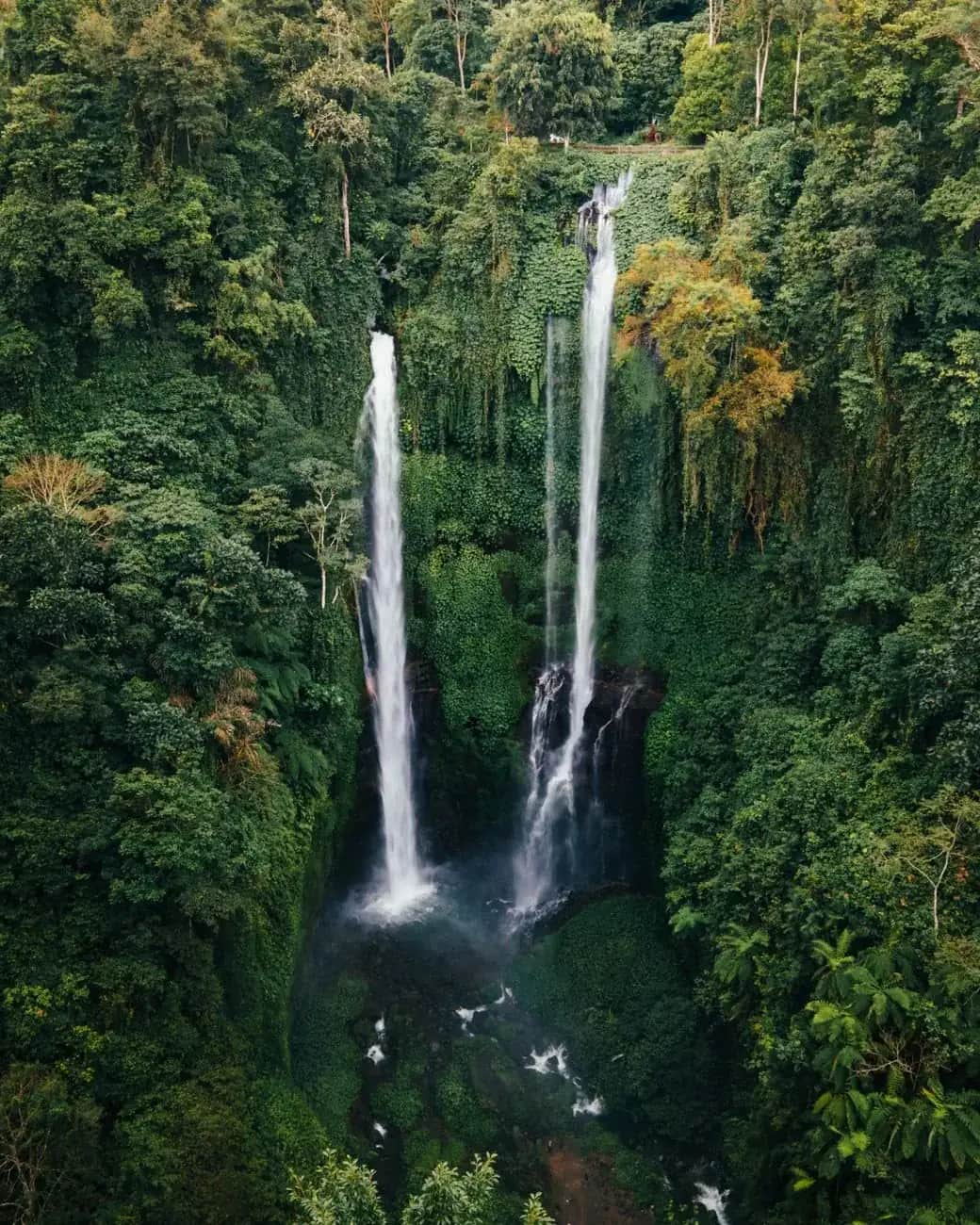
Sekumpul is widely considered the most spectacular waterfall on Bali, and that reputation survives contact with the place, which is unusual. It is not one fall but a group of them dropping into a green amphitheatre, and the viewpoint over the valley is only the introduction. Getting to the base means a long, steep descent on steps and dirt, a river crossing, and the same climb in reverse in the heat. A local guide fee is collected at the village and is effectively compulsory rather than optional.
From Seminyak, Canggu or Kuta this is three hours each way through the central passes, and from Ubud around two and a half. Add three or four hours on site and you have used the entire day, in the car for six of them. That is a fair trade for what is probably the best natural sight on the island, and it is a bad trade if you try to bolt it onto an afternoon.
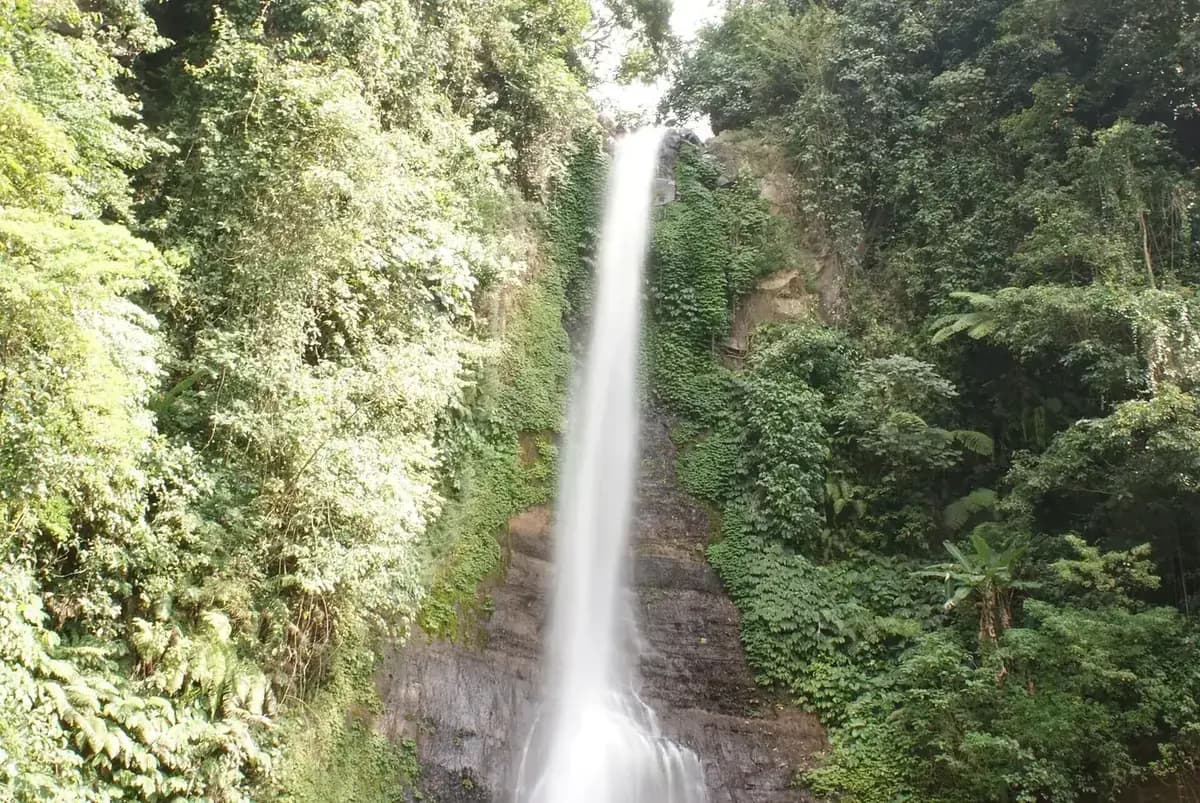
Photo elvranharris, CC BY-SA 2.0
The rest of the north is gentler. Gitgit above Singaraja is a tall single drop reached on a paved path, the easiest serious waterfall in the region. Banyumala Twin, in the hills above Lake Buyan, is one of the few northern sites where the pool is the reason to go rather than a bonus. Munduk and Melanting are linked by a walk through coffee and clove plantations at altitude, which is a different pleasure from a waterfall photograph and better for it.
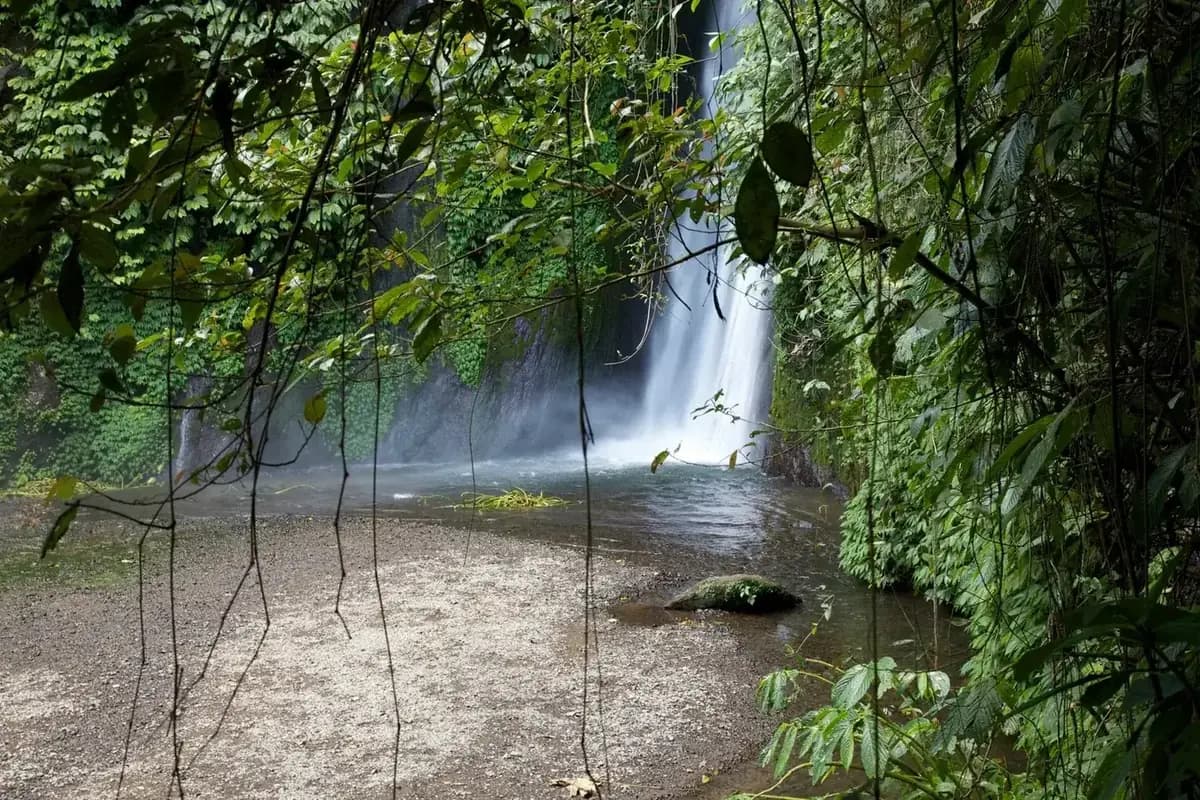
Photo Jean-Marie Hullot, CC BY 3.0
The case for sleeping up there
Two nights in Munduk or Lovina changes the maths completely. Sekumpul becomes a morning rather than a day, Banyumala and the Munduk walk fill the second morning, and you get the lakes and the north coast for the same driving you would otherwise spend on the pass twice. The accommodation up there costs less than in the south for the same standard, and the nights are cool enough that air conditioning stops being a requirement.
The counter argument is honest: the north is quiet, the food scene is thin, and if the cloud sits on the ridge for two days you will see very little. It is a trip for people who want the island rather than the resort, which is roughly the same audience that wants waterfalls in the first place.
Season, flow and water clarity, month by month
The standard advice is to visit in the dry season, and it is half right in a way that costs people their best month. The wet season gives you volume: falls at full power, jungle at its greenest, minor cascades that barely exist in September running hard. It also gives you brown water, closed gorges and afternoons written off.
The dry season gives you clarity, safe footing and the light beams that make the gorge sites famous, at the cost of flow that keeps dropping until October and, in July and August, the heaviest crowds of the year. The sweet spot is the shoulder in both directions, and it is not where the crowds are.
These three do not move together. The months with the most water are the months you can see the least of it, and the months with the clearest pools are the months some falls run thin.
| Month | Water volume | Water clarity | Risk |
|---|---|---|---|
| January | High | Low | High |
| February | High | Low | High |
| March | High | Low | Mixed |
| April | High | Mixed | Mixed |
| May | High | High | Low |
| June | Mixed | High | Low |
| July | Mixed | High | Low |
| August | Mixed | High | Low |
| September | Low | High | Low |
| October | Low | High | Low |
| November | Mixed | Mixed | Mixed |
| December | High | Low | High |
January to March: the most water and the least of it to see
Everything runs at full volume in January and February, including falls that are usually a trickle, but the water is brown most days and clears again within hours of any rain, and swimming is off. Photographs look dramatic, but sudden rises in narrow gorges are a real event here, not just a caution, and the month gorge sites such as Tukad Cepung close at short notice. Rain tends to arrive as heavy afternoon bursts, so a morning start matters more now than at any other time of year, and it pays to keep the day flexible: accept that one of three planned stops may be cancelled by the weather. By March the trade starts to tip: volume is still high and the jungle around the falls is at its greenest, with clear windows of two or three days between storms. Steps and rock stay permanently wet and greasy. Watch the sky rather than the calendar, and treat any afternoon plan as optional.
April and May: the two best months
April carries wet season volume into dry season skies. The water clears properly after two or three dry days, isolated storms still push water down the gorges, the crowds have not arrived, and the pools are swimmable most days. May keeps the volume, only just starting its slow decline, and turns the pools clear and green on most days with low risk. If you can pick your month for waterfalls specifically, pick one of these two.
June to September: dry season, clear water, rising crowds
Flow drops from June, noticeably lighter than April but still substantial, and clarity is high with low risk through the whole stretch. The trade is now about crowds rather than conditions. June brings the first high season visitors, so go early rather than late: car parks empty in April can have three tour vans in them by nine in the morning. July and August are the clearest water of the year and also the busiest, with the famous sites genuinely crowded from mid morning, so arrive at opening or plan around the less known falls. The northern falls hold their volume better through these dry months than the small ones near Ubud. By September, flow reaches the lowest point of the year on the smaller sites. A big fall like Sekumpul is unaffected in any way you would notice, while a modest one can look disappointing next to its own photographs.
October and November: an underrated, unpredictable window
October keeps the clear, low risk water of the dry season, with the first storms of the month putting some life back into the smaller falls without wrecking the water. The high season crowds have gone and the light is still dependable. November is genuinely unpredictable, alternating clear days with brown ones as gorge sites start closing after heavy nights, but rain is usually short and heavy rather than all day, the island turns green again and prices have not yet risen. Build the day around the morning and treat anything after two in the afternoon as a bonus.
December: big water, poor visibility, holiday crowds
Full volume returns and the water runs brown more often than not, with the highest risk of the year alongside January and February that a canyon site will be shut on the day you drive to it. Pick falls with a viewing platform and a short walk, and keep the swimming for the coast.
Why the water goes brown when the sky is blue
Every one of these falls is fed by a catchment in the hills above it, and the rain that matters is the rain that fell up there, possibly hours ago and possibly ten kilometres away. This is why visitors who checked the forecast for Ubud arrive at a site under a clear sky to find fast, opaque, sediment loaded water and no explanation on offer.
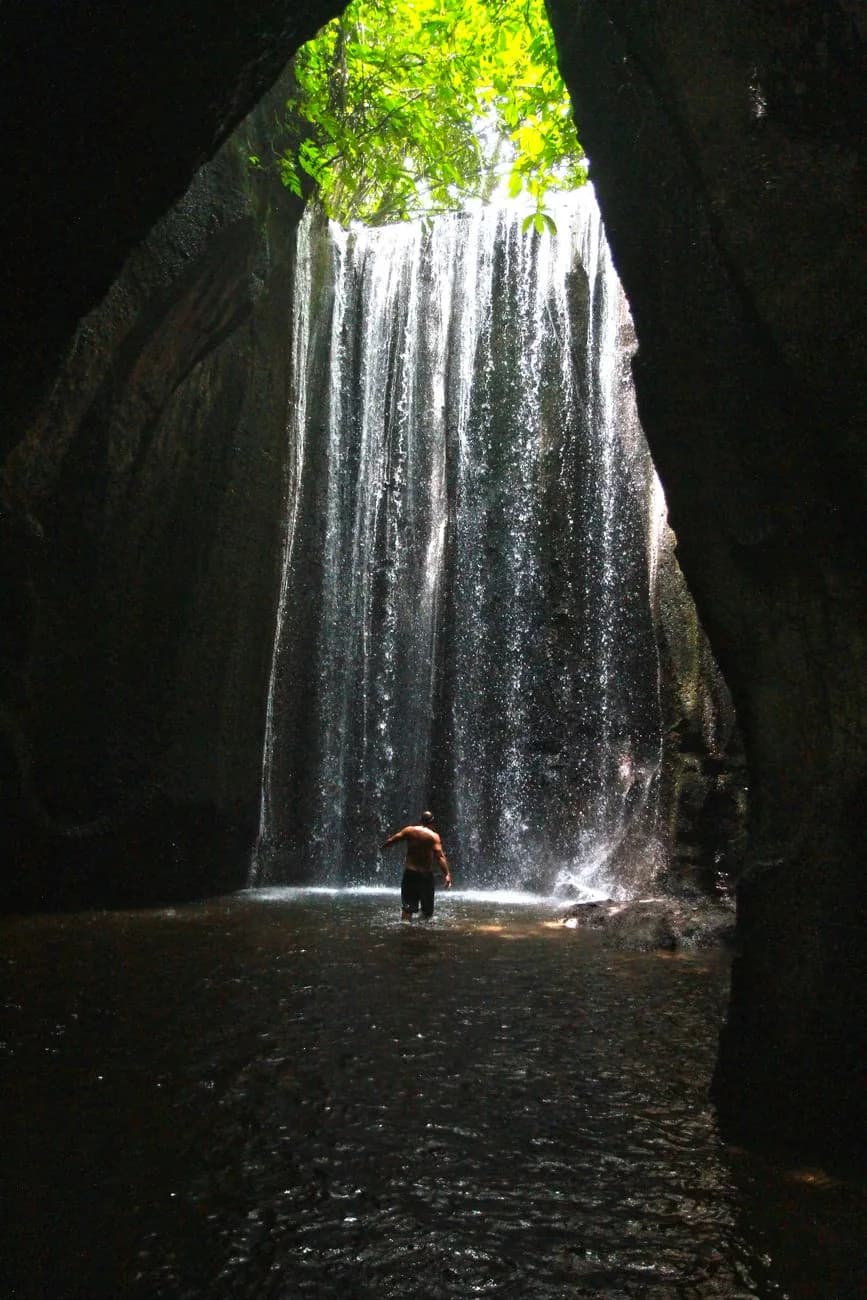
The practical rule is simple. If it rained anywhere inland in the last twelve hours, assume the water is loaded and pick a fall you look at rather than one you get into. Two or three dry days in a row is what it takes for the small catchments near Ubud to run properly clear again.
The risk that never makes the caption
This is not a warning against going. It is the short list of what actually goes wrong at these sites, because none of it appears next to the photographs and all of it is avoidable.
Rising water in narrow gorges
The gorge sites, Tukad Cepung above all, are slots a few metres wide with rock on both sides and one way out. When a catchment upstream takes a heavy burst of rain, the level in a slot like that can come up fast, and there is nowhere to go sideways. This is why staff close these sites at short notice and why a closure that looks arbitrary on a sunny morning is not arbitrary at all. If a gate is shut, that is the system working. Do not look for the path around it, and do not linger in a gorge when the water starts to colour or rise while you are in it.
The steps, which are the actual danger
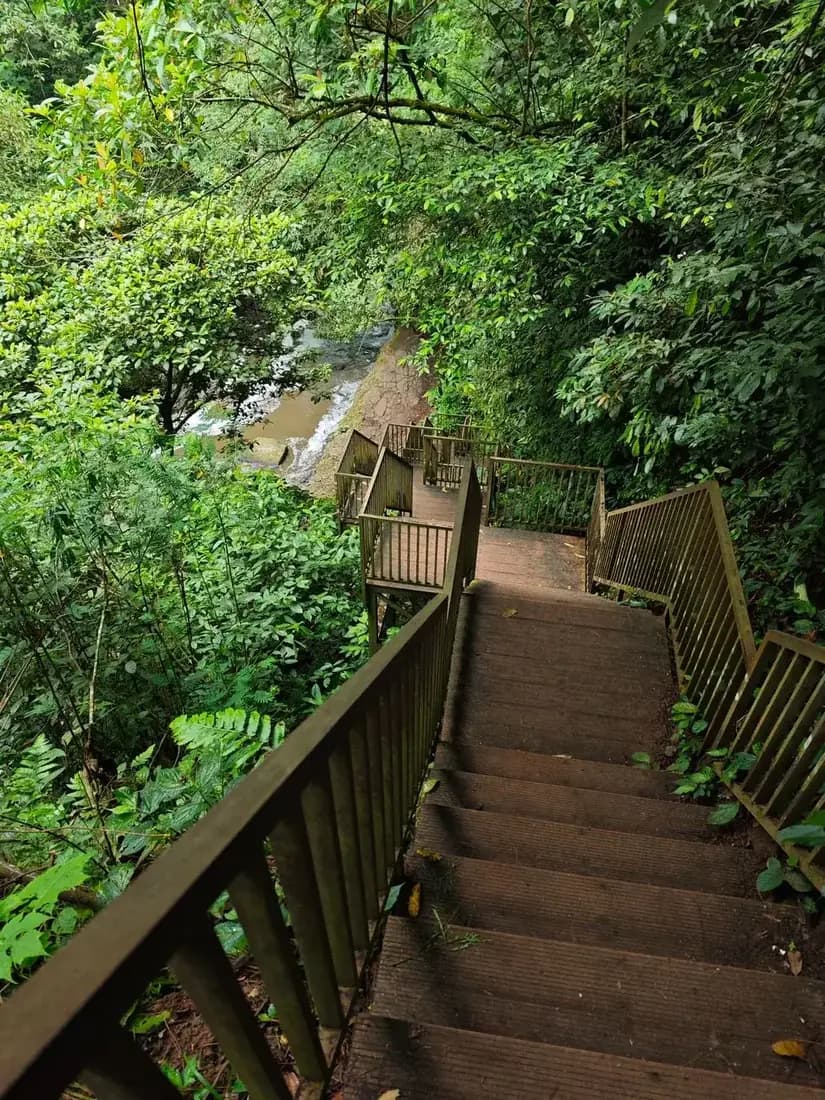
Injuries at Bali waterfalls are overwhelmingly slips, and they happen on the way down rather than in the water. The access paths are wet stone, wet concrete, moss, mud and improvised wooden stairs, in a climate where nothing dries. Flip flops are how people fall. Shoes with a grip you do not mind soaking, a hand free for the rail, and a phone in a pocket rather than in your hand eliminate almost the entire risk. Going down is when your legs are fresh and your attention is on the view, which is precisely why that is the half where it happens.
Plunge pools and currents
Drownings do happen at Bali waterfalls, and rarely in the ways people expect. A plunge pool under a heavy fall can hold a recirculating current that is invisible from the bank, the water is cold enough to shorten your breath on entry, and the bed is uneven rock rather than sand. None of the sites has a lifeguard. Swim where the guidance on the site says you can, stay out of the white water directly under a fall, and never get in when the flow is high or the water is opaque.
Jumping and the rope swings
Several northern sites, Aling Aling in particular, sell jumps and slides as an activity with local staff supervising. That is a supervised activity at a site set up for it. Improvised jumping anywhere else, into water whose depth changed with the last flood, is a completely different proposition and it is the source of the worst accidents. The depth of a plunge pool is not a fixed property of the place.
How the tickets actually work
There is no island wide waterfall pass and no consistent pricing. Each site is run by the village or the local community that owns the land, which is a good thing for the money and a confusing thing for the visitor.
One fee per waterfall, in cash
Expect the equivalent of a couple of euros a head at most sites, collected at a booth by the car park. Card payment is rare and change for a large note is often a problem, so carry small denominations. Rates are set locally and move without notice, which is why no honest page should print a number.
Sometimes a second gate further down
At several sites the path crosses land belonging to a different banjar and there is a second collection point partway down. It is not a scam, it is two communities sharing an access route, and it catches out visitors who brought exactly the entrance fee and nothing more.
Parking is usually separate
A small charge for a car, less for a scooter, paid at the entrance to the lot rather than at the ticket booth. Your driver will normally handle this without mentioning it. Budget for it as a matter of habit rather than expecting it every time.
Sekumpul is the outlier
The local guide fee at Sekumpul is collected at the village and is effectively part of the price of admission rather than a service you choose. It puts that site into a different bracket from every other waterfall on the island, and it is worth knowing before you arrive rather than at the barrier.
Two habits cover all of it. Carry more cash than you think you need, in small notes, and treat the posted fee as the floor rather than the total. Three waterfalls in a morning with parking and a second gate somewhere still comes to less than a single beachfront cocktail in Seminyak, so the amounts are trivial. It is the availability of the right notes that causes the friction, not the price.
What to bring, and the drone question
The packing list is short and every item on it earns its place. Shoes with grip that you accept will get soaked are the single item that matters, because they are the difference between a wet descent and a broken wrist. Trainers you do not care about, or proper sandals with a strap and a rubber sole. Not flip flops, and not anything with a smooth sole whatever it cost.
- A dry bag, or a sealed plastic bag. Spray reaches further than you expect and gorge sites are effectively a permanent fine rain. A phone in a pocket at Tukad Cepung will get wet.
- Swimwear worn under your clothes. Changing facilities range from a shed to nothing at all.
- A towel and a full change of clothes, left in the car. Nothing dries in this climate, and sitting in a car in wet clothes with the air conditioning on is how a good morning turns miserable.
- Small cash notes. Entrance, parking, sometimes a second gate, and a drink at the warung on the way out.
- Water and something to eat. The climb back up is the part nobody photographs, and at Sekumpul or Nungnung it is a genuine effort in the heat.
- Insect repellent for the northern sites in particular, where the forest is wetter and the shade is permanent.
Drones
Assume the answer is no until somebody at the gate tells you otherwise. Several waterfall sites ban drones outright, others charge a separate permit alongside the entrance fee, and a few sit inside restricted airspace or close to a temple where flying is not acceptable regardless of aviation rules. Enforcement is done by staff on the spot, and there is no process for appealing a decision made at a ticket booth.
Ask when you buy the ticket, not after you have walked down. Two hundred steps is a long way to carry equipment you are not allowed to use. Where a permit exists it is usually modest and paid in cash like everything else.
The wider point is that these are not parks, they are village land with a religious dimension that is not always visible to a visitor. The same courtesy that applies at Bali's temples applies at a waterfall on temple ground, and several of them are exactly that.
How many waterfalls in one day, and which ones pair
The honest ceiling is lower than the itineraries suggest, and the reason is not driving time.
Two, comfortably
Half day from Ubud. Tukad Cepung and Tibumana, in that order, with time to swim at the second. Back in Ubud for a late lunch. This is the plan that produces the fewest regrets.
Three, then stop
Full day from Ubud. Add Kanto Lampo, or better, add Tirta Empul instead and break the pattern. A fourth set of steps is when people start looking at their phones at the bottom.
One is a day
Anywhere in the north. Sekumpul on its own fills a day from the south. Staying in Munduk changes that to two mornings and two waterfalls, which is a fundamentally better trip.
The constraint is repetition, not logistics. Waterfalls saturate faster than almost any other kind of sight, because the sequence is identical every time: park, pay, descend, look, photograph, climb. By the fourth one in a day the descent feels like work and the fall at the bottom has to be extraordinary to compete with the two you have already seen. Two waterfalls and a temple is a more varied day than four waterfalls, and it costs the same in driving.
The pairings that work are geographic rather than thematic. The Bangli cluster pairs with Tirta Empul and the villages above Bangli. Tegenungan pairs with Ubud itself and an early Campuhan Ridge Walk before the heat. Nungnung pairs with anything on the road north. And the northern falls pair with the lakes, which is the case for giving that side of the island a night rather than a detour.
One thing not to plan around: Nusa Penida has no waterfalls worth the crossing. It is limestone, it drains underground, and the water you go there for is in the sea. Keep the two as separate days rather than trying to fold a fall into an island trip.
Tour, private driver, or your own scooter
Organised tour
Cheapest per head, and the group sets the clock. Fine for the northern falls, where the driving is the difficulty and the schedule is fixed anyway. Less good near Ubud, where these tours arrive at the busiest sites at the busiest hour by design.
Private driver for the day
The right answer for most people, and cheaper than visitors expect once split between two or three. You set the departure time, which is the only variable that matters, and a good driver will know that morning whether a gorge site is open.
Your own scooter
Excellent for the Bangli and Gianyar cluster in the dry season, and a poor idea for the north or in the rain. Wet mountain roads, a towel and a change of clothes strapped to the back, and a two hour pass to cross is not the trip anyone imagines.
The thing a booked tour genuinely buys you at a waterfall is somebody who knows which gate is open. In the wet season that is not a small convenience. Driving two hours to a closed barrier is a common enough experience that the drivers who run these routes daily check among themselves before they set off, and a private itinerary can be reordered on the spot in a way a self driven one usually cannot.
Bali waterfalls: common questions
Swimming, seasons, steps, fees, drones and safety.