The kecak dance at Uluwatu starts at six every evening in an open air amphitheatre cut into the clifftop beside Pura Luhur Uluwatu, and it is the best hour of performance on the island. That much every page on this subject will tell you.
What none of them tells you is that the seating is unnumbered, that the bowl fills more than half an hour before the chant starts, that the temple ticket and the show ticket are bought at two different windows, and that the macaques on the path in take sunglasses off heads. Those four facts decide the evening, and not one of them has anything to do with the dance.
On this page
What time to leave your hotel
Six o'clock is the only figure anyone prints. Getting there in a usable state means subtracting an hour of Bukit traffic, two ticket queues and a ten minute walk along a cliff from it.
Seating is open, unnumbered, and it fills from the middle out, which nothing on site tells you. Worked backwards from an 18:00 curtain, on the sunset sitting, which is the one that sells out and the one everybody wants. A second sitting is added around 19:00 on the busiest nights only, under stage light with the sea already dark: the fallback, not the choice. It shifts every time below by exactly one hour.
| Leaving from | Drive | Leave by |
|---|---|---|
| Uluwatu, Pecatu, Bingin | 20 to 30 minutes | 16:15 |
| Jimbaran, Nusa Dua, the airport | 45 minutes to an hour | 15:45 |
| Seminyak, Canggu, Kuta | An hour and a half, often two | 14:45 |
| Ubud | Two hours, the optimistic figure | 14:00 |
The Bukit road backs up from about four in the afternoon, every day, because every driver on the peninsula is going to the same place at the same time. These times already carry that.
Then, on the ground:
- 16:45, park and pay for the temple. The car park sits a few minutes’ walk below the temple. Temple entry and the show are two separate tickets bought at two separate windows, the single most common surprise here. The sarong and sash come with the temple ticket and are included, not hired.
- 17:00, stow everything before the cliff path. Sunglasses off your head and into a zipped bag, phone in a pocket that closes, hat in your hand or in the bag. Past this point you are on macaque ground and a loose object is a negotiable object.
- 17:10, walk the cliff path to the amphitheatre. Ten minutes along the clifftop, and worth doing now rather than at the last minute: this walk in low sun is the best part of the whole evening, and it is wasted if you are hurrying.
- 17:20, join the queue at the gate. Seating is open, unnumbered and first come. The queue forms well before the gate opens and moves in one push rather than steadily.
- 17:30, the last honest moment for a good row. Arrive by now and you still choose where you sit. Arrive after it and you take what is left, in practice the upper rim or the far end of one arm.
- 17:50, standing room, and the tall man in front. The bowl fills from the middle out. At ten minutes to curtain you are on the back rows, behind a rim of people who will stand up during the fire scene.
- 18:00, the chant starts. Roughly an hour, no interval, no amplification of any kind. The fire scene lands near the end, once the light has gone.
Worth booking on a peak night
Free cancellationUluwatu kecak and fire dance tickets
- ✓A guaranteed seat on the evenings the bowl actually sells out, which is most of July and August
- ✓Skip the ticket window queue, which is the slower of the two queues you would otherwise stand in
- ✓Combined listings pair the show with the temple entry and a driver from the south of the island
- ✓Free cancellation on most listings, which matters in the wet season when the show can be rained off
Affiliate link. Booking through GetYourGuide costs you nothing extra and supports the guide. Prices are indicative and vary by option and season.
Booking ahead buys certainty, not a discount: the online price sits at or a little above the gate price. Outside the peak months, paying cash at the window on the night is a perfectly good plan.
Where to sit, and which side the sun goes down
The amphitheatre is a stone bowl on the cliff edge with the ocean behind the stage. Every seat sees the performance. They do not all see the same sunset, and they do not all see the same dance.
Seating is open and unnumbered, so this is a decision made with your feet in about four seconds after the gate opens. Worth having made it beforehand.
| Zone | In short | What it takes to get it |
|---|---|---|
| Low centre | Rows two to five, dead centre. The chant splits into its parts up close, and the fire scene lands a few metres away | Through the gate the moment it opens |
| High centre | Middle rows, still centred. Looking down into the circle, the best angle for the pattern and for a photo | In the queue half an hour before |
| Left arm | Fine for the dance, compromised for the sunset. Watching at an angle, part of the choreography plays away from you | Usually still open fifteen minutes before |
| Right arm | The mirror of the left arm. What separates the two is only where the sun goes down that month | Fills last, along with the left arm |
| Back rim | The top of the bowl, standing or perched. The sound still carries, but the ground pattern and the fire get blocked | Always available |
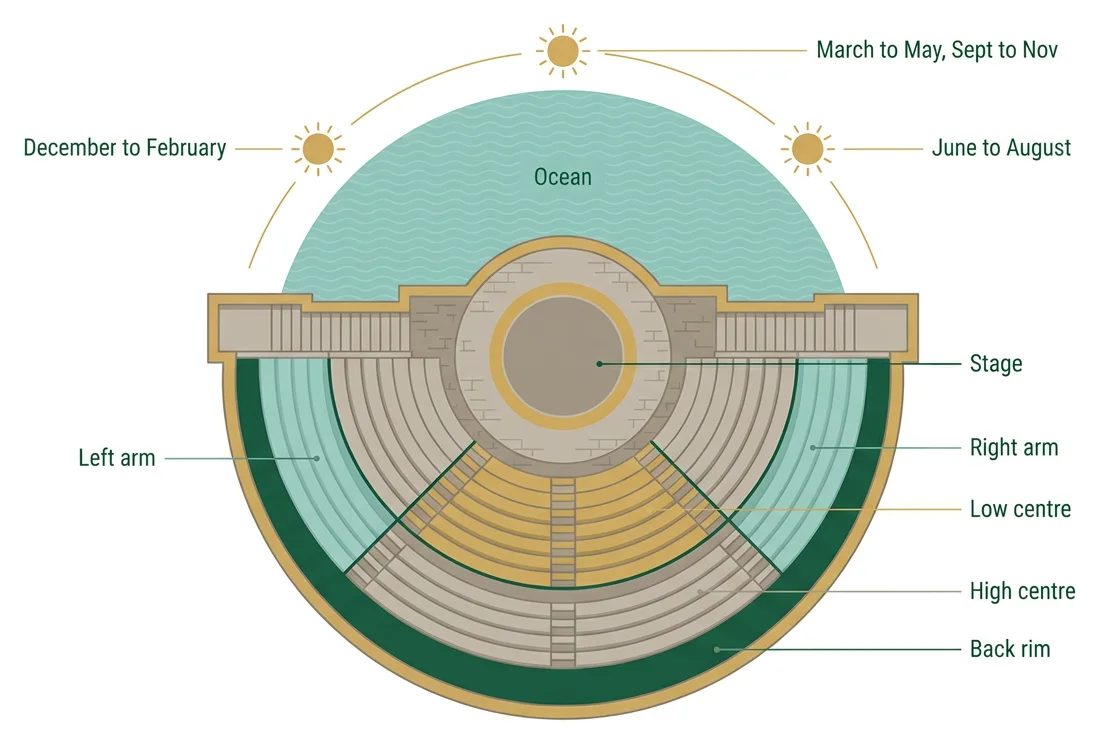
The bowl seats several hundred on tiered stone, with nothing to lean against anywhere in it. An hour is a long time on a step, so bring a sarong or a thin jacket to sit on rather than only to wear: the stone holds the day’s heat for the first twenty minutes and then goes cold quickly once the wind picks up off the water. Aisle seats are worth more than the seating plan suggests, because the show ends in full darkness with the whole audience standing at once on uneven stone, and the walk back along the unlit cliff path turns from a fifteen minute shuffle into a three minute walk if you are on the end of a row.
Which arm gets the sun changes with the month. In June, July and August the sun drops well north of due west and goes down off the right hand end of the stage as you face it: the right arm watches the second half of the show into the light, every photo of the circle has the sun in it, and by the time the fire starts it no longer matters, which is why photographers want that side and everyone else does not. Around the equinoxes, March to May and September to November, the sun sets almost due west, directly behind the stage, the version that ends up on postcards and the one evening where neither arm has an advantage. In December, January and February the sun sits south of due west and goes down off the left hand end, when the cloud lets it go down visibly at all, so the left arm takes the glare and the right one is the comfortable side. Either arm still sees the whole dance: kecak is performed in a circle, and a circle has no back.
The bowl seats several hundred on tiered stone, and there is nothing to lean against anywhere in it. An hour is a long time on a step, so the practical advice that nobody prints is to bring a sarong or a thin jacket to sit on rather than only to wear. The stone holds the day's heat for the first twenty minutes and then goes cold quickly once the wind picks up off the water.
Aisle seats are worth more here than the seating chart suggests. The show ends in full darkness with the entire audience standing up at once on uneven stone, and the walk back along the cliff path is unlit apart from what people are carrying. Being on the end of a row rather than in the middle of one turns that exit from a fifteen minute shuffle into a three minute walk.
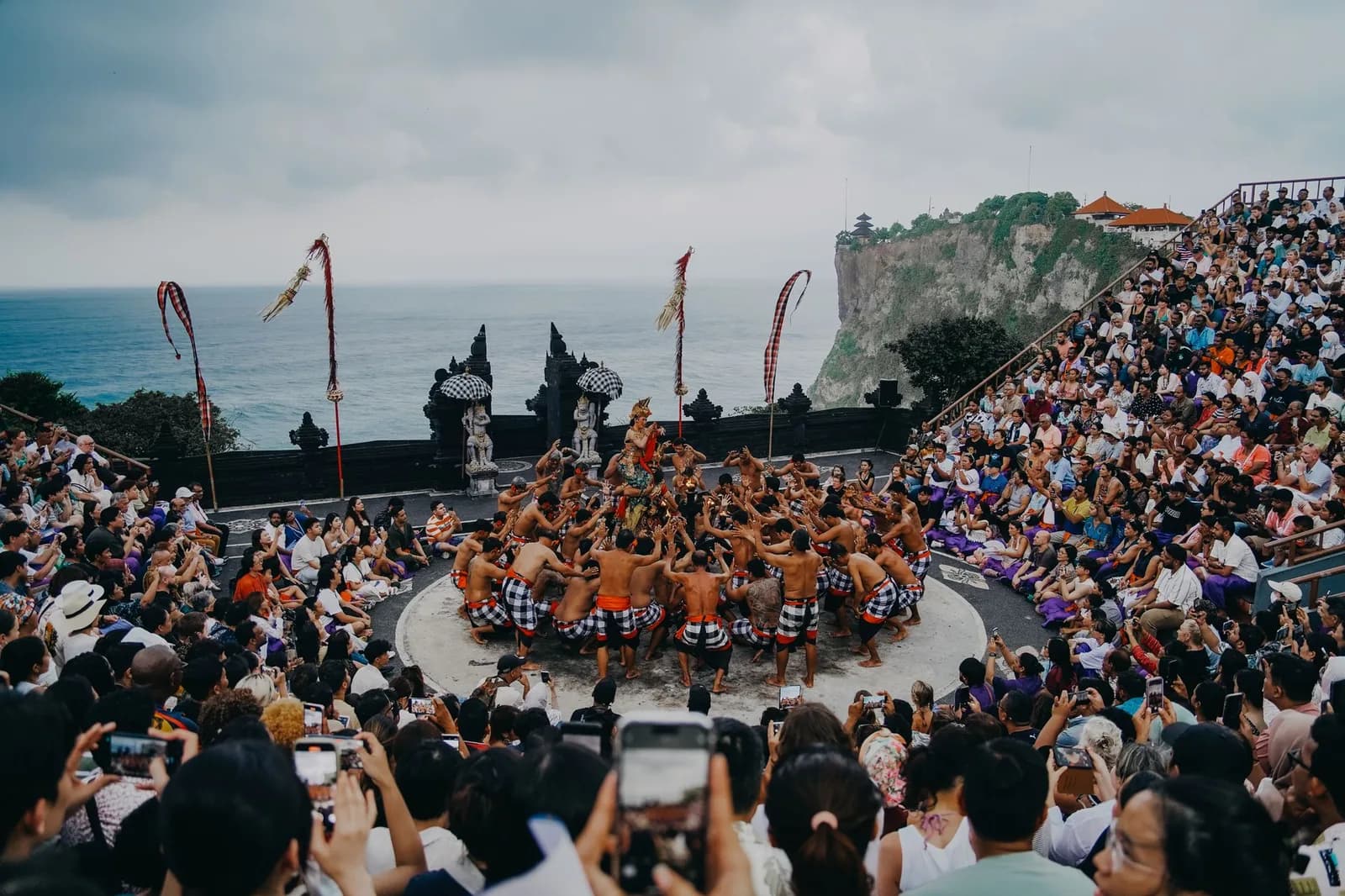
One thing to accept before you go: this is a full house of several hundred people with phones. There is no version of this evening where you are alone with it. What makes it work anyway is that the performance is loud and unamplified and entirely undistracted by the audience, and after about ten minutes of chanting the crowd stops mattering.
The monkeys, and the one stretch of path they work
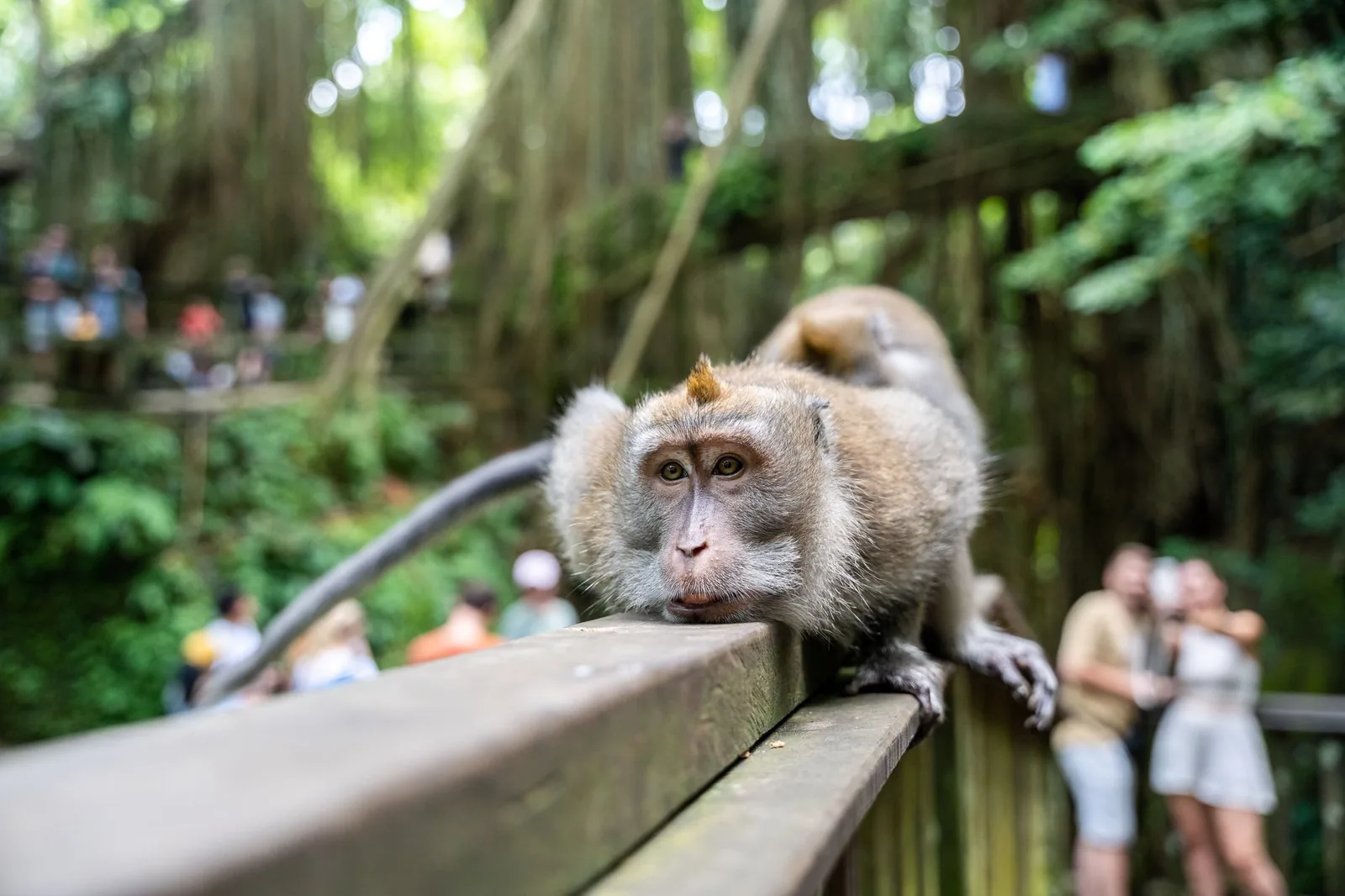
Uluwatu's macaques have a reputation that sounds like a travel anecdote until it is your sunglasses. They are not stealing at random: they take objects with no food value because objects get traded back for fruit, and that is a learned economy rather than mischief.
Where on the walk things actually get taken
The macaques at Uluwatu are not distributed evenly along the approach and they are not opportunists. They work one stretch of it, they take objects rather than food, and they hold what they take until somebody buys it back with fruit. Knowing which stretch is the whole of the advice.
| Station | Risk | What goes |
|---|---|---|
| The car park | Low | Anything visible in an open scooter box, food carried in hand |
| The two ticket windows | Low | Loose notes, a sarong carried rather than worn |
| The cliff path | This is where it happens | Sunglasses, caps, phones held at arm's length, water bottles, anything hanging off a bag |
| The gate and the queue | Watch it | Snacks bought at the stalls, phones held over a crowd |
| Seated in the bowl | Low | Very little, though the upper rim backs onto the trees |
Stow everything before the third station. There is no second chance to do it discreetly once you are on the path. Do the sorting in the car park itself, before you get out: it takes twenty seconds and it is the only calm moment on the whole approach. Put the sarong on rather than carrying it, since a folded cloth in a hand reads exactly like something worth taking. Empty every open pocket at the ticket windows, and on the cliff path take photos with both hands and the strap round your wrist. Nothing on your head, nothing in an outside pocket, nothing swinging from a strap. At the gate and the queue, eat nothing and keep the phone below shoulder height, since the queue stands still and that is what makes it worth their while. Once you are seated in the bowl, keep bags between your feet rather than on the step behind you, and you can stop thinking about it for the next hour.
If something has already gone
Do not pull it back and do not follow the animal. Holding one end of something a macaque has claimed turns a theft into a contest, and that is how people get bitten here. Find a member of staff instead. They carry fruit for exactly this, they know the individuals, and the trade takes two minutes. Sunglasses usually come back scratched. Phones usually come back.
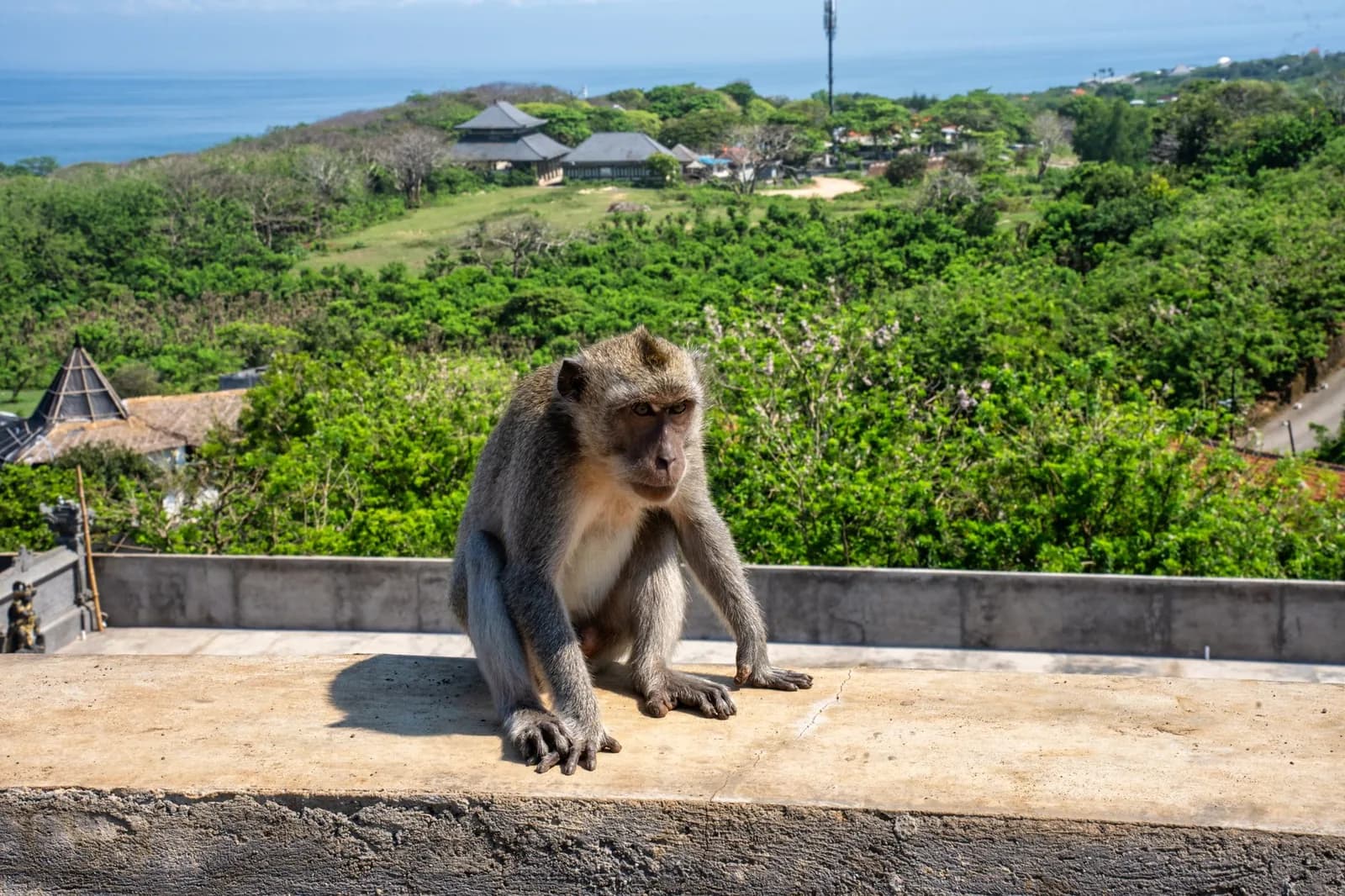
These are the same species you meet in the Sacred Monkey Forest at Ubud, and the behaviour is not the same. The forest is a managed sanctuary with staff every hundred metres and animals habituated to being close to people all day. Uluwatu is a temple with a cliff path running through it, the troop is smaller and warier, and the thefts happen in a narrow window on a narrow path rather than anywhere in a park.
What that means in practice is that the Uluwatu problem is easier to solve. There is a point on the walk before which you can put everything away calmly, and after which you cannot. The forest page covers the other half of this, which is what to do when an animal is already on you: that situation is common there and rare here.
Feeding them, buying the bananas sold near the entrance, or offering food to get a photograph all make the next visitor's problem worse and are the reason the trade exists in the first place. It is worth not being part of that, whatever the person selling the bananas says.
Which kecak are you actually booking
Kecak is performed nightly in at least five places on the island, at prices that differ by a factor of three, and the ticket sellers do not volunteer which one they are selling. They are the same choreography in genuinely different evenings.
| Where | Ticket | Sunset in the show |
|---|---|---|
| Uluwatu | ≈ $10 to $13 | Yes, built into the 18:00 start |
| Ubud | ≈ $7 to $10 | No, starts after dark |
| GWK cultural park | In park entry, ≈ $9 and up | No, and no horizon either |
| Tanah Lot area | ≈ $7 to $12 | Yes, with the temple silhouette |
| Batubulan | ≈ $7 | No |
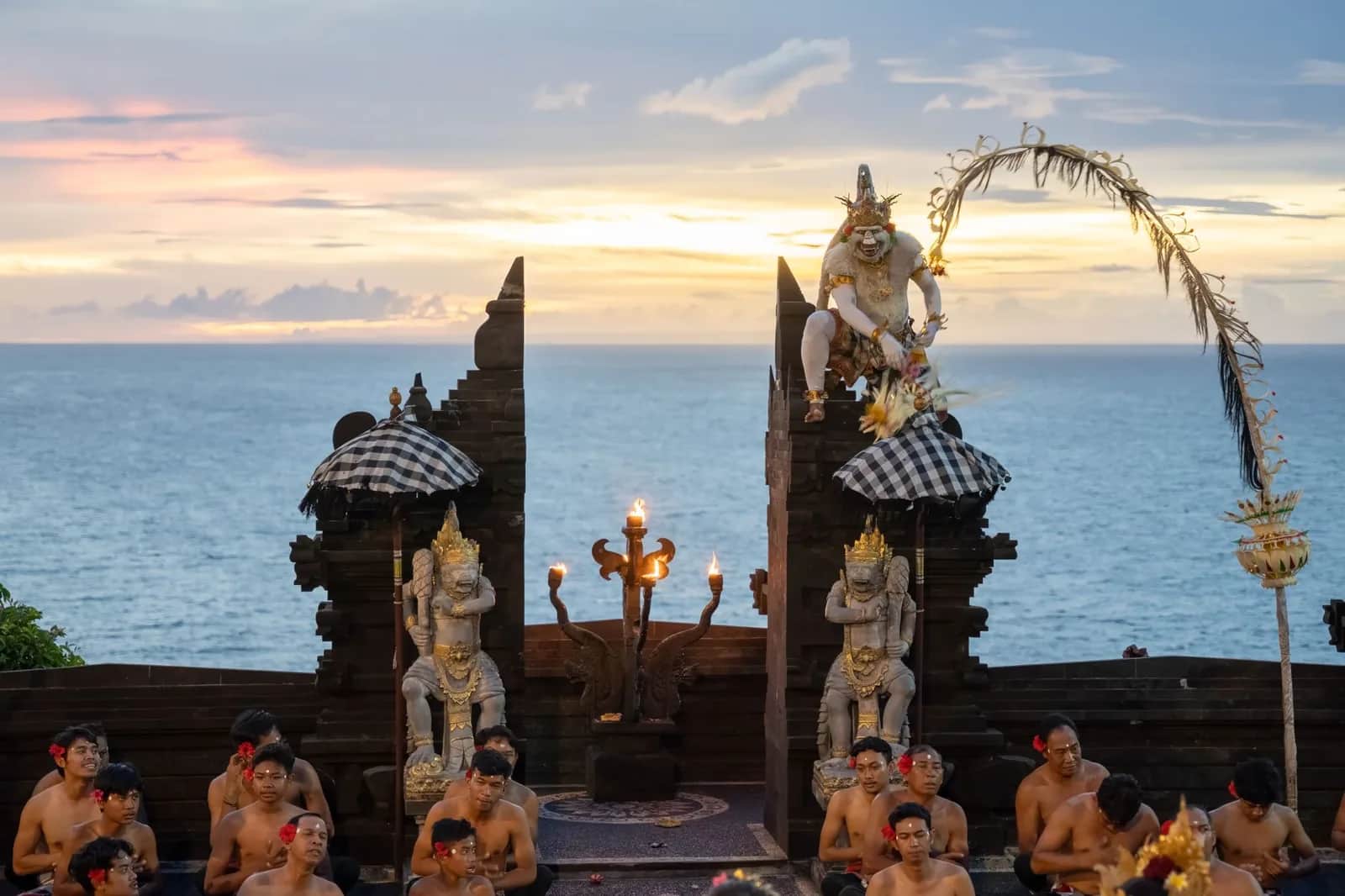
Uluwatu (Pura Luhur Uluwatu, the Bukit) is an open amphitheatre on a seventy metre cliff, ocean behind the stage, several hundred seats. It is the pick for anyone seeing one performance in Bali: the setting has no competitor.
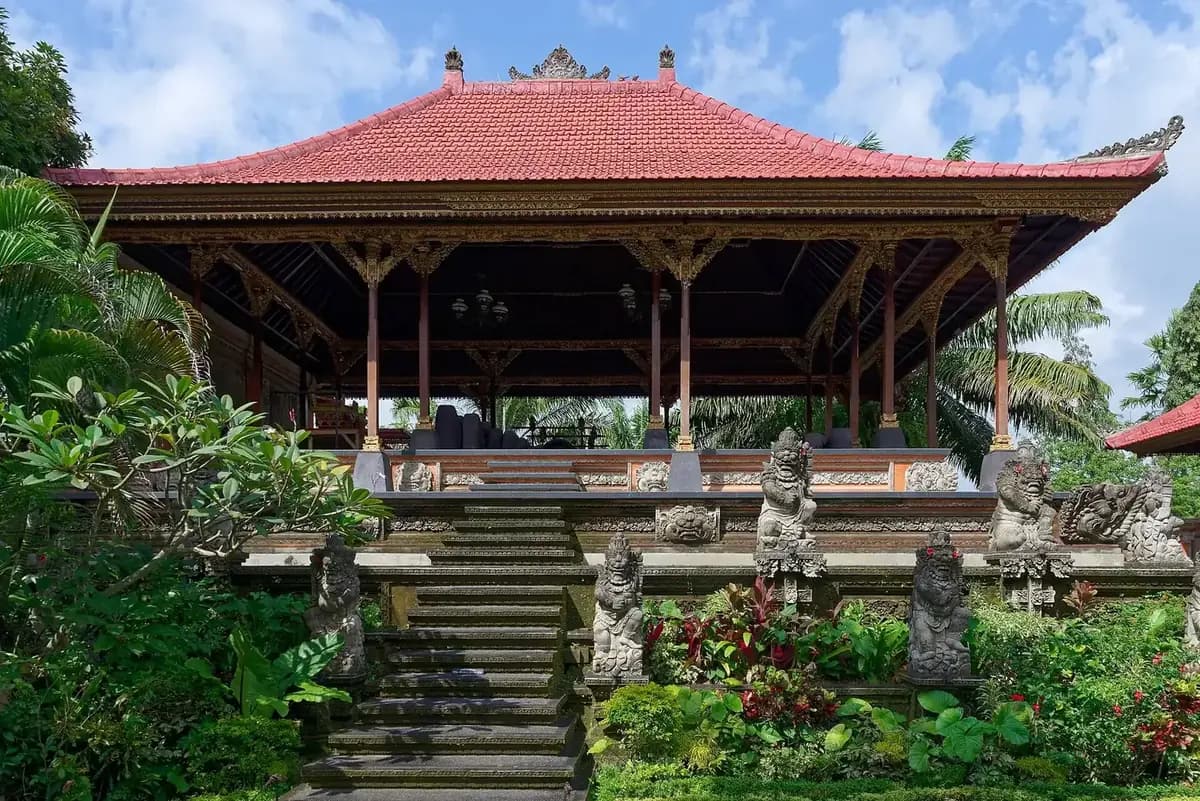
Ubud (Pura Dalem Taman Kaja and other temples) is a small temple courtyard, torchlight rather than stage lighting, a hundred or so seats. It suits people who would rather be close to it than high above it, and it sells out faster than Uluwatu does.
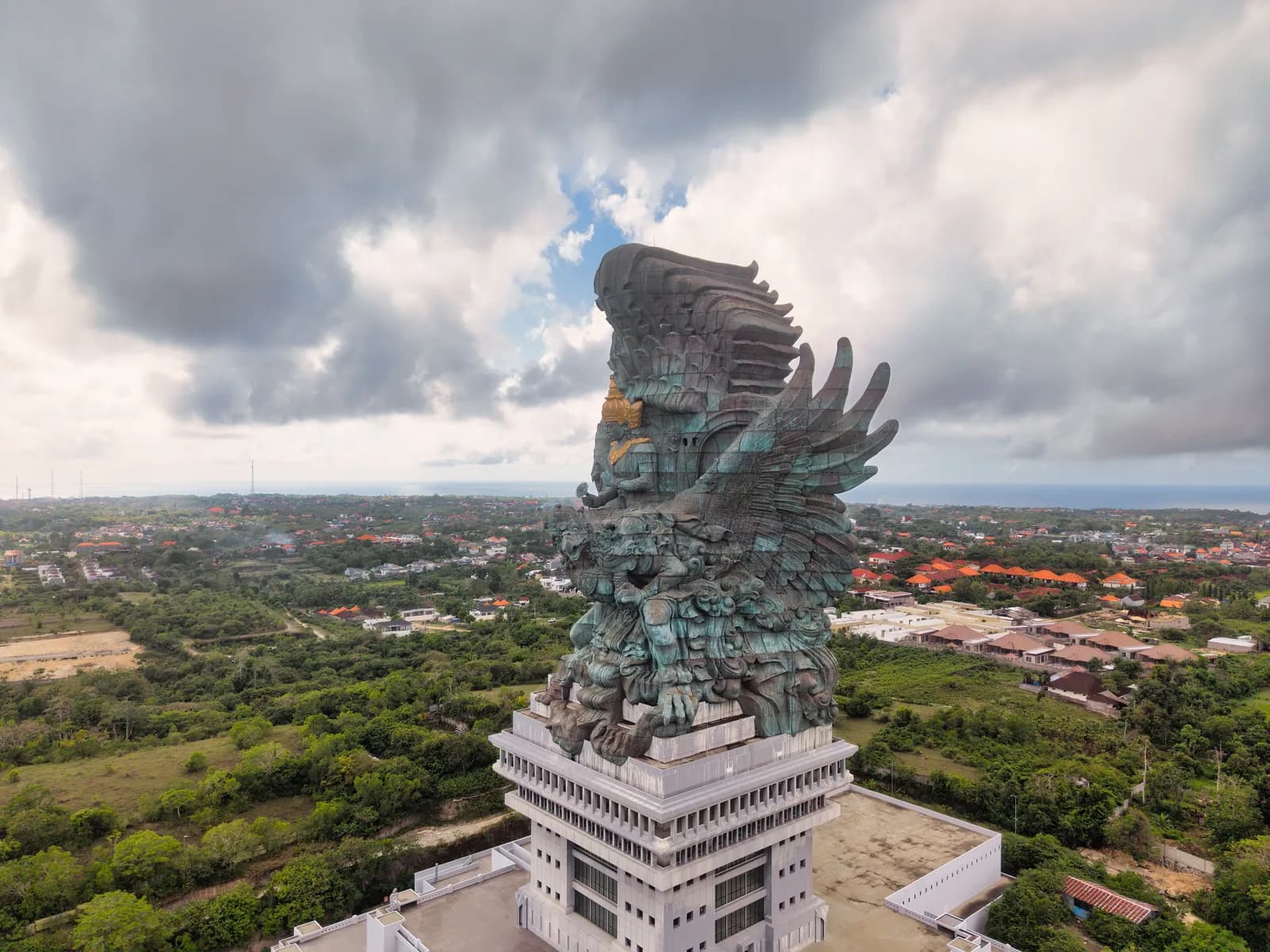
Garuda Wisnu Kencana (the GWK cultural park in Ungasan) has a purpose built theatre inside a ticketed park, seated and covered. It suits families already spending the day at the park, and is not a reason to go on its own.
The Tanah Lot area (Beraban, on the west coast) has an open stage near the sea temple, smaller and quieter than Uluwatu. It suits anyone staying in Canggu or Tabanan, for whom Uluwatu is a two hour drive each way.
Batubulan, on the road between Denpasar and Ubud, has village performance halls mostly known for morning barong. It suits people already on that road, and is rarely worth a dedicated trip.
The distinction that catches people out is between the venue and the genre. A seller with a laminated card in Ubud is offering five different dances, of which kecak is one, and they are not variations on a theme: legong, barong, the Ramayana ballet and the masked topeng pieces have different music, different lengths and different temperaments. If you are choosing an evening rather than a place, the breakdown of the five genres on the Ubud Palace page takes that decision apart properly.
The short version: kecak is the outlier of the five because it has no orchestra at all. Every other Balinese dance is built on a gamelan, the bronze percussion ensemble that gives the island its sound. Kecak replaces it with voices, and that substitution is why it survives being performed nightly to a paying audience without feeling thin.
What happens in the hour
Nothing is announced beyond a short summary at the start, and there is no programme. Knowing the shape of it beforehand is the difference between watching a story and watching a crowd of men shouting.
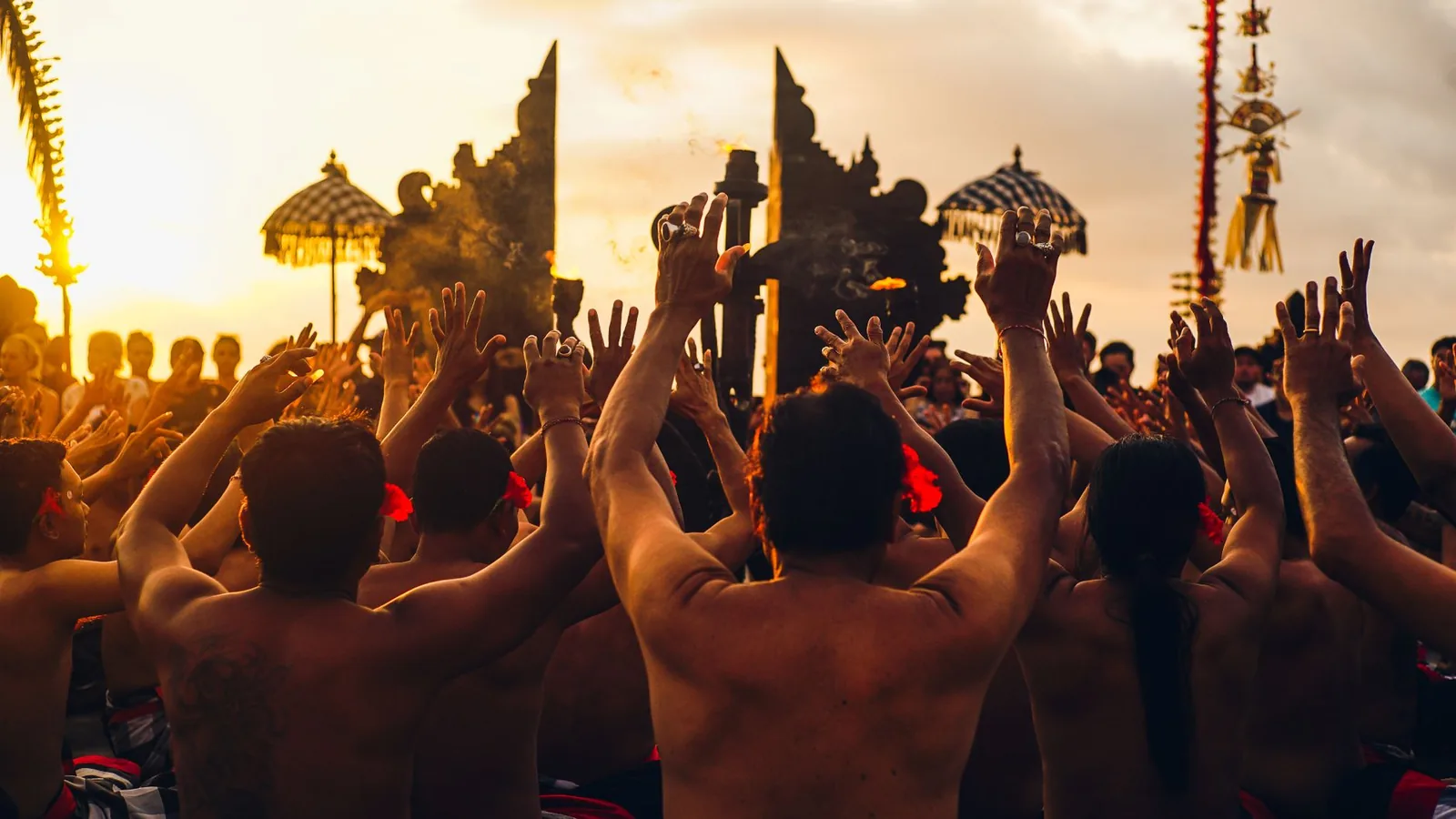
Around seventy men in checked cloth walk in and sit in concentric rings around a lamp. They chant one syllable, cak, and they are not chanting it together: the circle is split into parts that land on different beats and lock into each other, which is why the sound has a pulse that no single person in it is producing. That interlocking is a Balinese musical principle called kotekan, and it is the same idea that makes a gamelan work, done with throats.
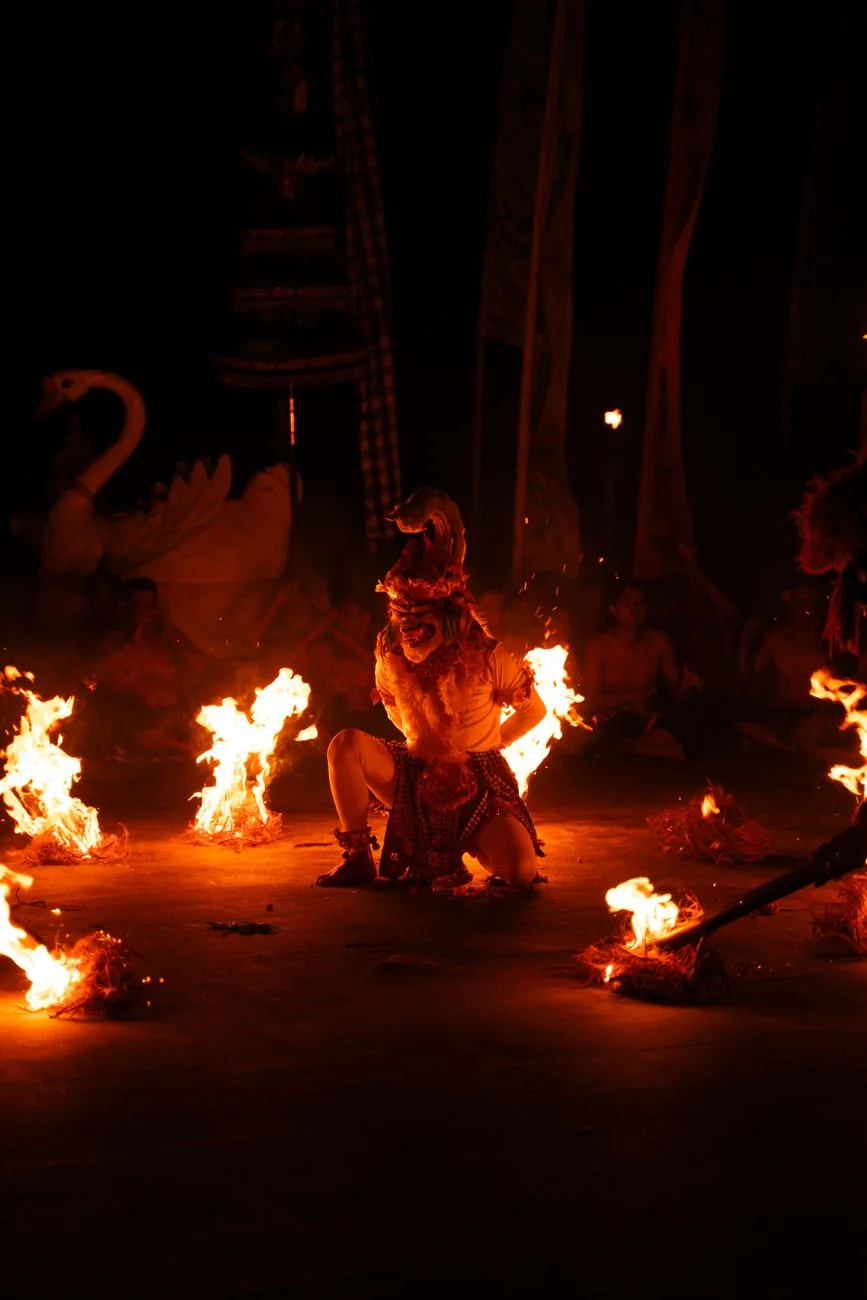
Inside the circle, an episode of the Ramayana plays out. Rama and his wife Sita are in exile, the demon king Ravana takes Sita by sending a golden deer to lure Rama away, Rama's brother Lakshmana is drawn off too, and the monkey general Hanuman eventually finds her. The performers who carry these roles are costumed and masked, and the chanting circle acts as the forest, the army and the fire around them by moving and by changing volume.
The fire scene comes at the end, and it is deliberately last because it needs the dark. Hanuman is captured and set alight, and a performer kicks his way through a burning pile of coconut husk, barefoot, sending embers several metres across the stone. It is closer to the front rows than most people expect. Nobody is put out by it, and the men with brooms who sweep the embers back are part of the performance rather than an interruption to it.
Tickets, temple entry and the sarong
Two purchases at two windows, and the order matters because the first one gets you onto the cliff at all. What that first ticket covers in daylight, sarong included, is on the Uluwatu temple page.
| What you pay for | Detail | Order of magnitude |
|---|---|---|
| Temple entry | Paid at the first window, before the show ticket. Includes the sarong and sash, which are lent rather than hired. | ≈ $3 per adult |
| Kecak performance ticket | A separate window, a separate ticket, cash. Unnumbered seat: it buys you entry to the bowl, not a place in it. | ≈ $10 to $13 |
| Booked online in advance | Roughly the gate price, occasionally a little above it. What you are buying is a guaranteed seat on a night that sells out, not a discount. | ≈ $12 to $18 |
| Parking | Attendant-run, paid on the way out. Scooters are a fraction of the car rate. | ≈ $0.30 to $1.50 |
| A driver for the evening | Half day rate from the south, waiting through the show included. The only sane option from Seminyak or Canggu. | ≈ $25 to $45 |
Buying at the gate
Cash, at the window beside the amphitheatre, from about an hour before the start. This is the normal way to do it and works on most nights of the year. The queue is slow rather than long, because every transaction is counted out by hand, and it is the second queue you stand in after the temple window.
Bring small notes. Change for a large note in the middle of a queue at dusk is a delay you have already budgeted against by arriving early, but it is an annoying way to spend that margin.
Booking ahead
Worth it in July and August, over the new year, and any evening falling in an Australian or Indonesian school holiday. The bowl fills on those nights, and the failure mode is standing on a clifftop at sunset having been turned away from the only thing you drove ninety minutes for.
Combined listings that pair the ticket with a driver from the south are the ones worth reading properly, because the transport is the expensive half of this evening if you are staying anywhere other than the Bukit.
Getting there, parking and the way out
Pura Luhur Uluwatu sits at the southwestern tip of the Bukit peninsula, the limestone tableland hanging below the rest of Bali. From Seminyak or Canggu that is an hour and a half in the middle of the afternoon and closer to two on a bad day, because the whole peninsula is served by a small number of roads and everybody is heading the same way at the same time. From Ubud, budget two hours and treat the evening as the entire day's plan.
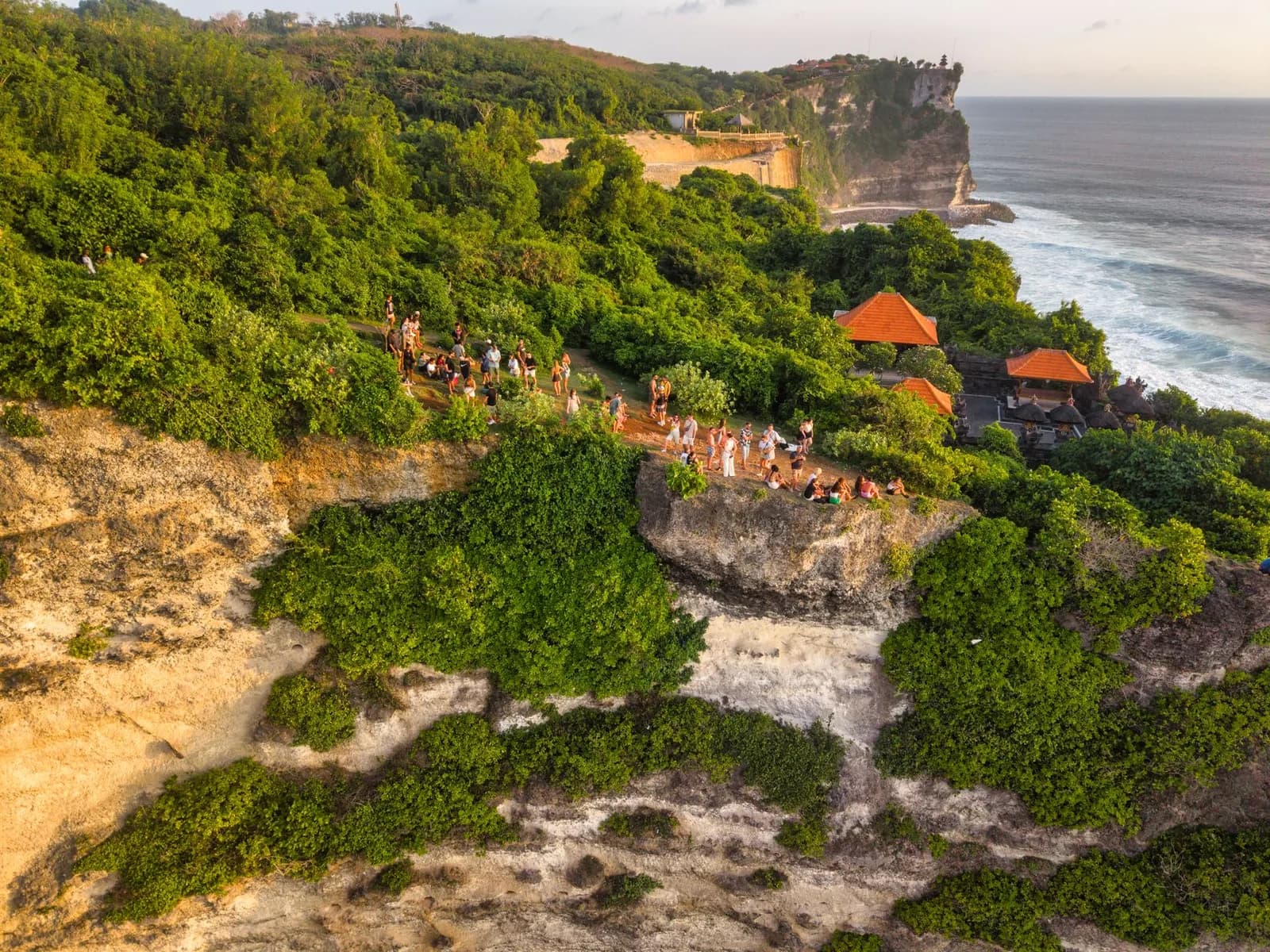
A driver waiting through the show is the sane arrangement from anywhere other than the Bukit itself. Riding a scooter back along unlit clifftop roads at seven in the evening, in a stream of traffic that has all just left the same car park, is the part of this evening that goes wrong most often. If you did ride out, leave during the applause rather than after it.
The car park empties in one push and takes twenty to thirty minutes to clear. Agreeing a meeting point with your driver before the show rather than after it saves most of that, because phone signal on the clifftop is unreliable and several hundred people are all calling at once.
Uluwatu kecak dance, answered
The questions that decide the evening, rather than the ones about the Ramayana.