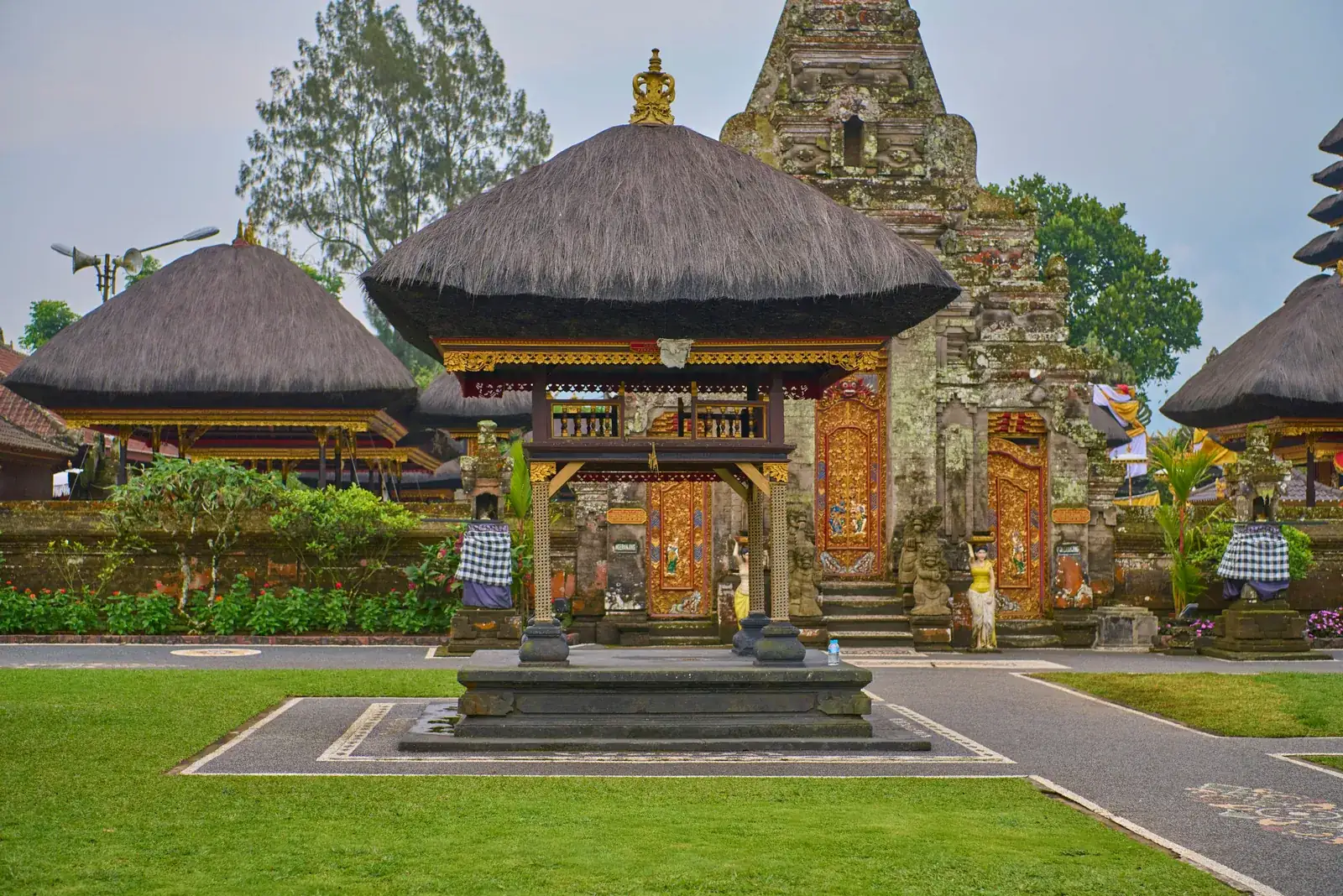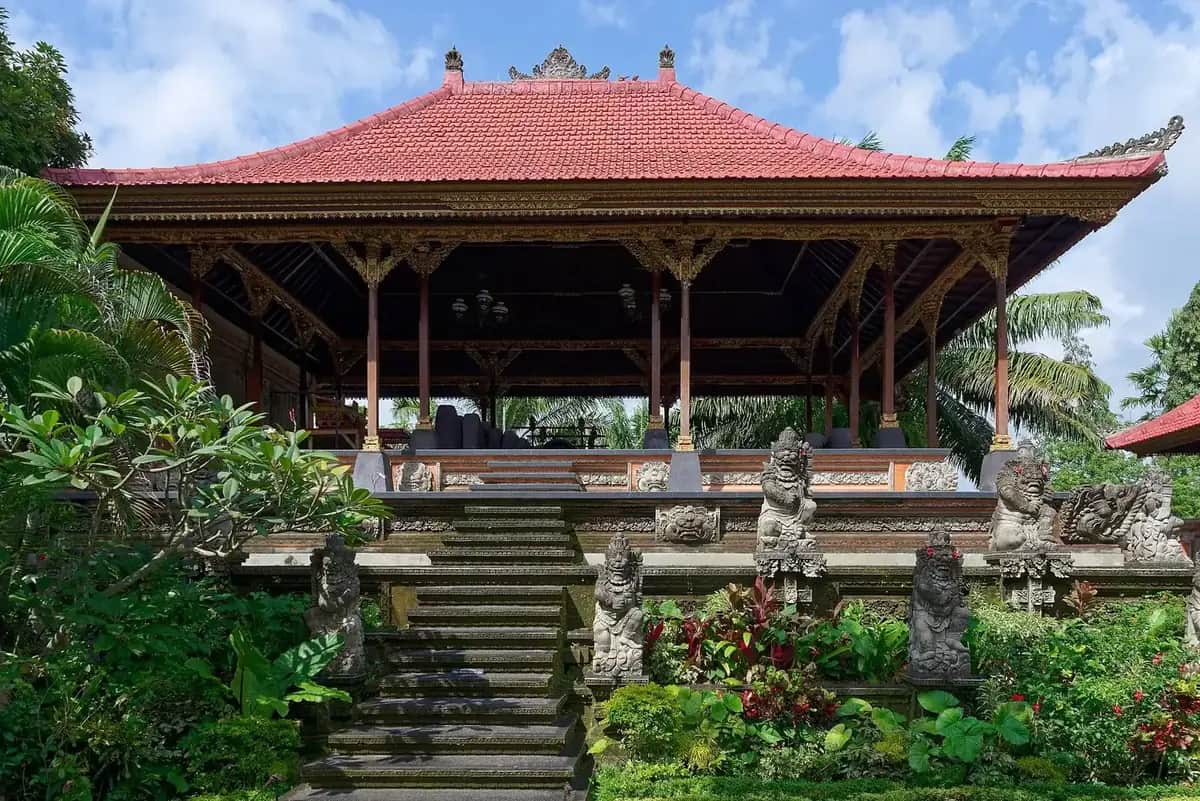
Puri Saren Agung stands on the main crossroads of Ubud, directly opposite the market, and it is still the home of the town's royal family. What visitors see is the front of it: two courtyards with carved gates, guardian statues in checked cloth and open pavilions, deep red brick against grey stone. What visitors do not see is everything behind the gilded door at the back, because that is a house with people living in it.
That is the single fact that decides whether you leave satisfied. Arrive expecting a palace tour and fifteen minutes later you will be back on the pavement wondering what you missed. You missed nothing. There is no upstairs, no state rooms, no audio guide, and no ticket either, which is a fair trade.
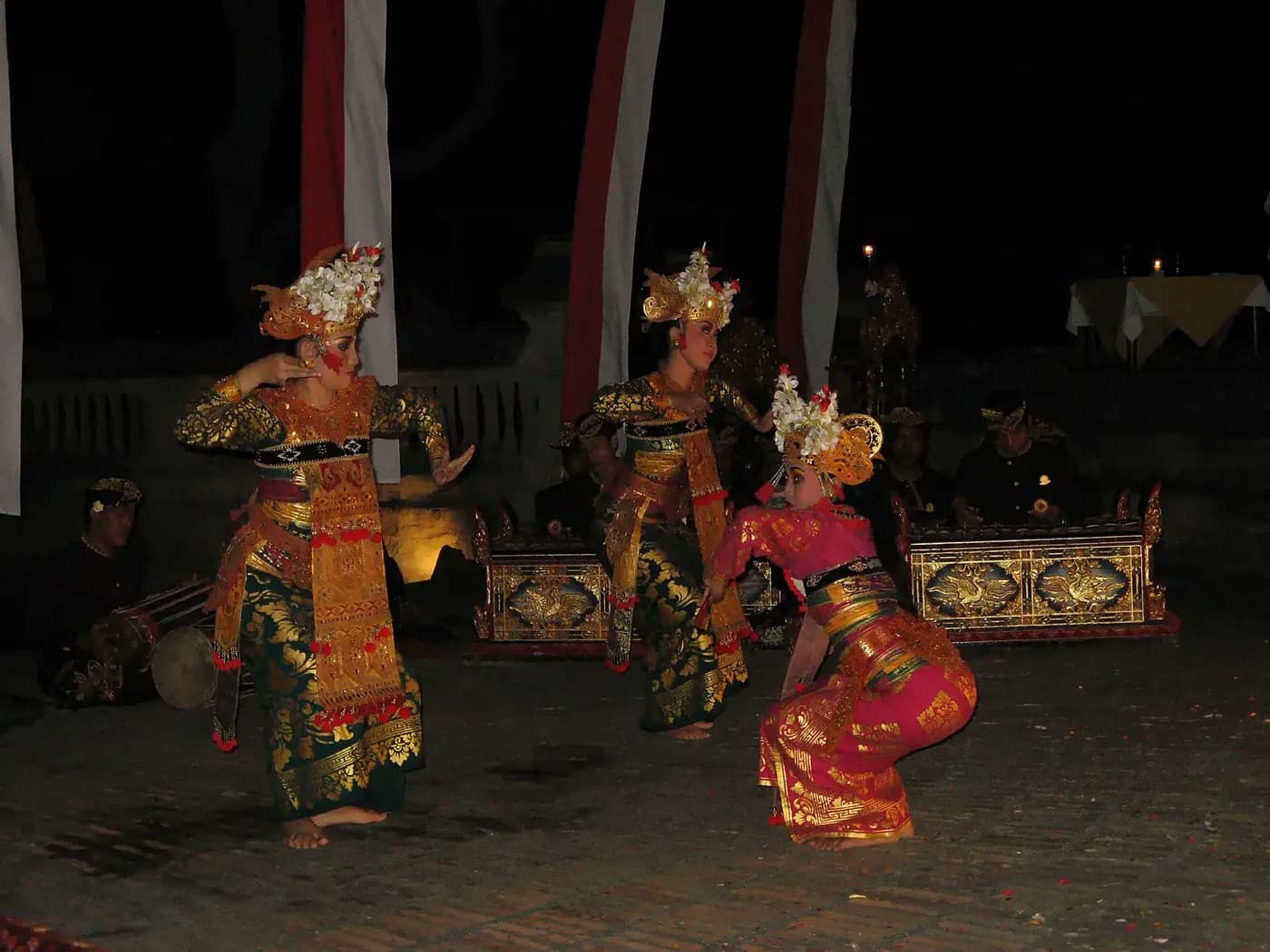
The reason to put this in your plans rather than simply walk past it is the evening. From around half past seven the courtyard fills with plastic chairs, a gamelan orchestra sets up under the pavilion, and dancers perform a few metres in front of you with the palace itself as the set. That hour is the thing people remember about Ubud, and choosing the right night is most of what this page is for.
The part of this that is worth booking
Ubud evening dance performances
- ✓Legong, barong, kecak and Ramayana programmes across the central Ubud venues
- ✓Booked ahead you know which genre you are getting, which the gate queue does not tell you
- ✓Useful in July and August, when the small temple venues fill before the palace does
- ✓Free cancellation on most listings if your day runs long
Affiliate link. Booking through GetYourGuide costs you nothing extra and supports the guide. Price and rating checked September 2026. Both move with season and demand.
On this page
What you actually walk into
Two courtyards, a pavilion, and a door that does not open. Knowing which is which turns a short visit into an interesting one.
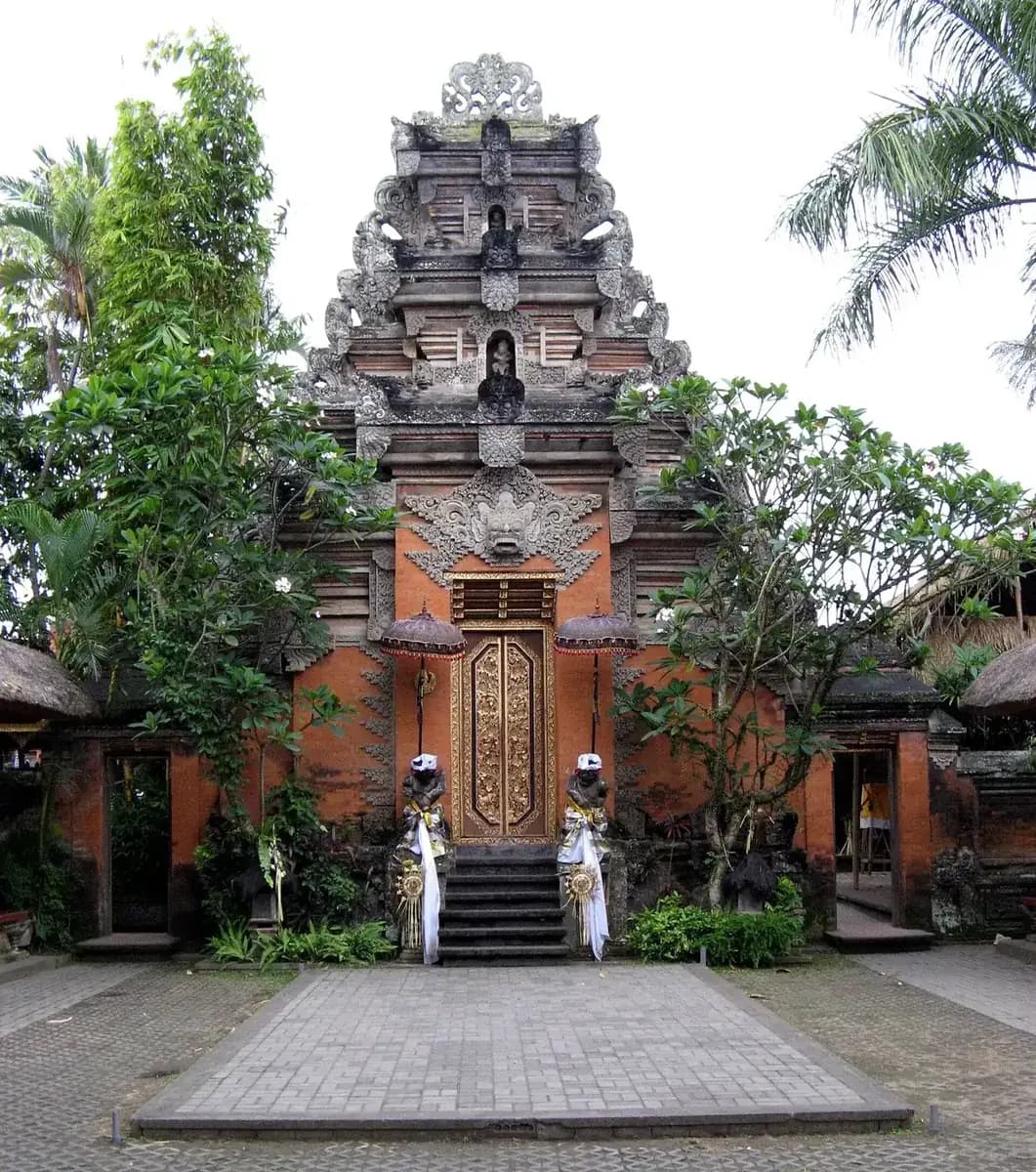
Photo Michael Gunther, CC BY-SA 4.0
A Balinese compound is not a building, it is a walled set of separate structures arranged by function and by direction, and a puri is that same logic scaled up for a royal household. You enter through a split gate from the street, cross an outer courtyard, and are stopped by a roofed gateway with a demon face over the lintel. That gateway is the boundary, and it is where the visit ends.
Inside that boundary the detail is worth slowing down for. The brick is soft red and carved directly, which is unusual, and the panels along the low walls carry scenes that most people walk straight past while photographing the gate. The stone guardians wear black and white checked cloth, the poleng, which stands for the balance of opposites rather than for decoration.
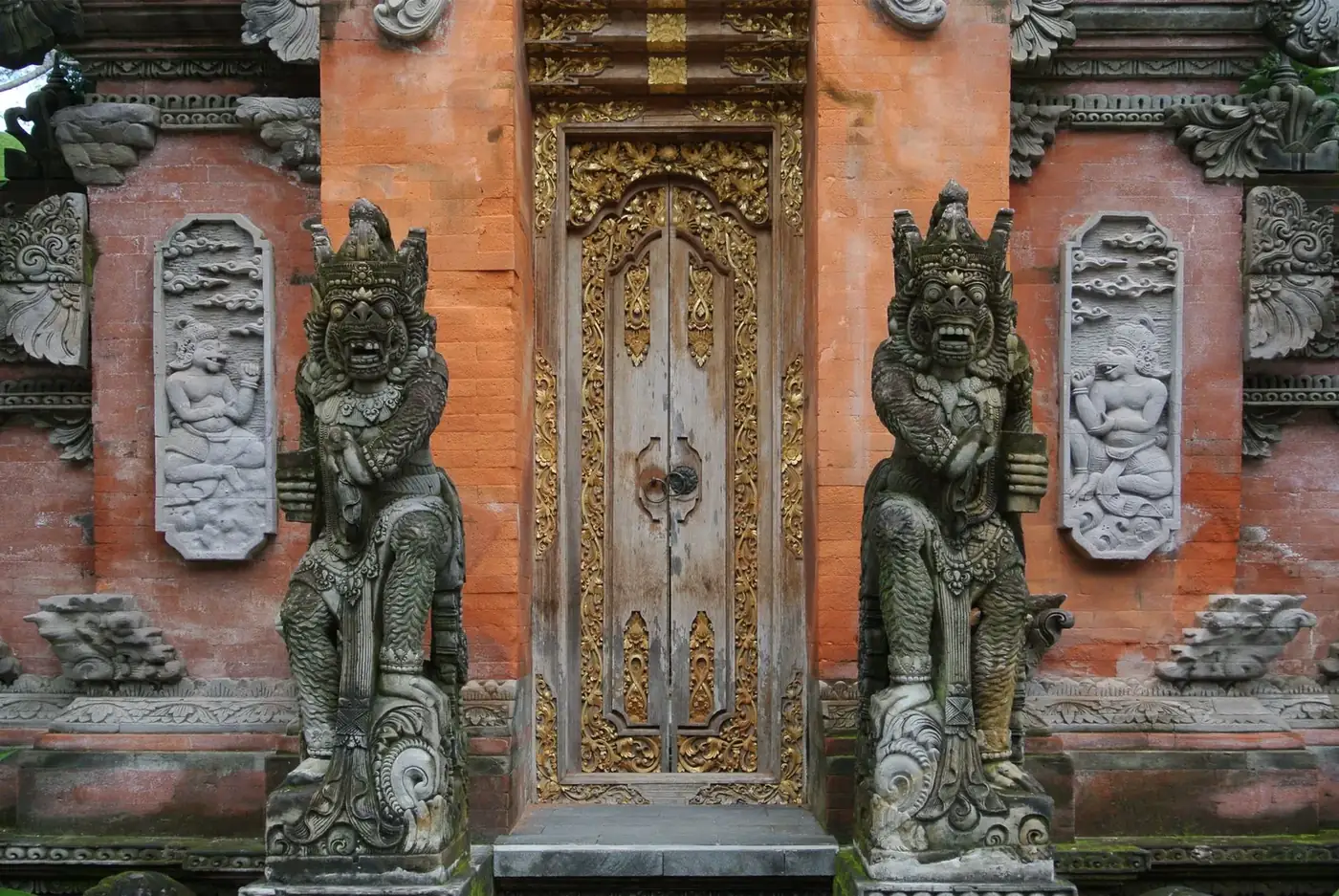
The pavilion on the left as you come in is the one you will be looking at all evening if you come back for the dance. In daylight it is empty except for a few instruments under covers, and it is easier to see the gilt work on the beams then than it will be at night under a couple of spotlights.
What you can and cannot walk into: seven parts of the compound, in the order you meet them coming in from the crossroads. Three of them are somebody's house, which is the thing to understand before you decide the visit was short.
| Part | Balinese name | Access |
|---|---|---|
| The split gate on the street | Candi bentar | Open to visitors |
| The outer courtyard | Jaba | Open to visitors |
| The open pavilion | Bale | Open to visitors |
| The gilded main door | Kori agung | Private, closed |
| The family temple | Pemerajan | Visible, not enterable |
| The living quarters | Puri dalem | Private, closed |
| The guest rooms | Puri Saren accommodation | Visible, not enterable |
The split gate on the street (Candi bentar)
The first thing you walk through, a single tower sliced vertically in two with a gap between the halves. It marks the boundary between the ordinary street and the compound, and it is the reason the palace reads as an entrance rather than a facade. On the Ubud crossroads it opens straight onto the traffic, which is why so many photographs of it have a scooter in them.
On the spot: Stand across the road by the market to see it whole. From inside the courtyard you only ever get half of it.
The outer courtyard (Jaba)
A paved rectangle with frangipani trees, low brick walls and a scatter of stone guardians in checked cloth. This is where you actually spend your visit, and it is also where the chairs go out in the evening for the performance. In the morning there may be offerings on the ground and somebody sweeping around them.
On the spot: The carved brick panels along the side walls are the best surviving work here and almost nobody looks at them.
The open pavilion (Bale)
A raised platform under a tiled roof carried on carved and gilded timber posts, with no walls at all. In a Balinese compound a bale is a room without a room, used for ceremonies, for laying out offerings and, here, as the backdrop to the evening dance. The gilt on the beams is the single most photographed thing in the palace.
On the spot: Look up at the underside of the roof. The joinery and the painted panels are more interesting than the front elevation.
The gilded main door (Kori agung)
The tall roofed gateway at the back of the courtyard, with a demon face carved over the lintel and gold leaf on the timber doors. It is the ceremonial entrance to the inner compound and it is not a door you walk through. It stands closed most days, opened for the family and for ceremonies.
On the spot: This is the photograph everyone takes. Shoot it straight on from the middle of the courtyard, early, before the light goes hard.
The family temple (Pemerajan)
Every Balinese compound has its own shrines, and a royal one has a substantial set. You can generally see the tiered roofs and the shrine towers over the wall from the visitor area. Entering is another matter: this is an active place of worship for the family, not an exhibit.
On the spot: If offerings are being carried in while you are there, step back and let them pass rather than photographing the procession from a metre away.
The living quarters (Puri dalem)
Behind the inner gate is a working home. The Sukawati family still lives here, which is the whole reason your visit is fifteen minutes rather than two hours. There is no ticketed tour of the private compound and no queue for one, and the people you see coming and going are not staff in costume.
On the spot: The rope and the polite sign are the whole security arrangement. It works because visitors respect it.
The guest rooms (Puri Saren accommodation)
Part of the compound has taken paying guests since the middle of the twentieth century, when the family began hosting the foreign painters and writers who made Ubud's reputation. Those rooms are still let. Staying in them is the only ordinary way to be inside the walls after the courtyard closes.
On the spot: Guests get the courtyard early in the morning, before the town wakes up. It is a genuinely different place at seven.
The evening dance, and how to choose one
Five genres are on sale in Ubud every night under names that mean nothing to a first time visitor. They are genuinely different from each other, and they do not all play here.
Sellers around town will offer five names on the same laminated card and explain none of them. Here is what is actually behind each one, and which of them play in the palace courtyard rather than somewhere else in Ubud.
| Genre | At the palace | Runtime | Best for |
|---|---|---|---|
| Legong | Regularly at the palace | Roughly 60 to 90 minutes | A first Balinese dance |
| Barong | Sometimes at the palace | About an hour | Children, first timers |
| Kecak | Usually elsewhere in Ubud | Around an hour | Just one show to see |
| Ramayana ballet | Regularly at the palace | Around 75 minutes | Kids, or a clear plot |
| Topeng and jauk | Sometimes at the palace | Ten to fifteen minutes per piece. You will rarely see a whole evening of it. | A bonus, unplanned |
Legong: The court dance the palace was built around
Two or three young women in gold brocade, moving in tiny precise increments: flicked fingers, snapped fans, and eyes that dart sideways on the beat. There is no plot you need to follow. The whole art is in control, and once you notice that the eye movements land exactly with the drum, the piece opens up.
Full gamelan, bronze keys and gongs, sitting in a line behind the dancers. Loud, metallic and completely unamplified. Roughly 60 to 90 minutes, usually a programme of five or six short pieces rather than one long story. The palace courtyard is the home ground for this one. Puri Saren Agung was a royal court, and legong is court repertoire.
Best for: A first Balinese dance, and anyone who wants the palace itself in the background of what they are watching. It is slow by design. If you are expecting spectacle in the first ten minutes you will misread it as boring rather than as difficult.
Barong: The lion creature, and the fight that never ends
A shaggy mythological beast worked by two men under one costume, against Rangda the widow witch. Between them, comic servants who play to the audience and a troupe of men with krises who fall into a trance and turn the blades on themselves. Nobody wins. That is the point of the story.
Gamelan again, faster and more percussive, with long stretches driven by the drums. About an hour, with a clear narrative arc that is easy to follow without a programme. Widely staged around Ubud and at temples in the surrounding villages. Batubulan, on the road down towards Denpasar, runs a well known morning version.
Best for: Children, and anyone who found the idea of a slow court dance unpromising. It is the most theatrical of the five. The trance sequence is genuinely intense at close range. Front row with a nervous child is not the seat to choose.
Kecak: No orchestra at all, just fifty men chanting
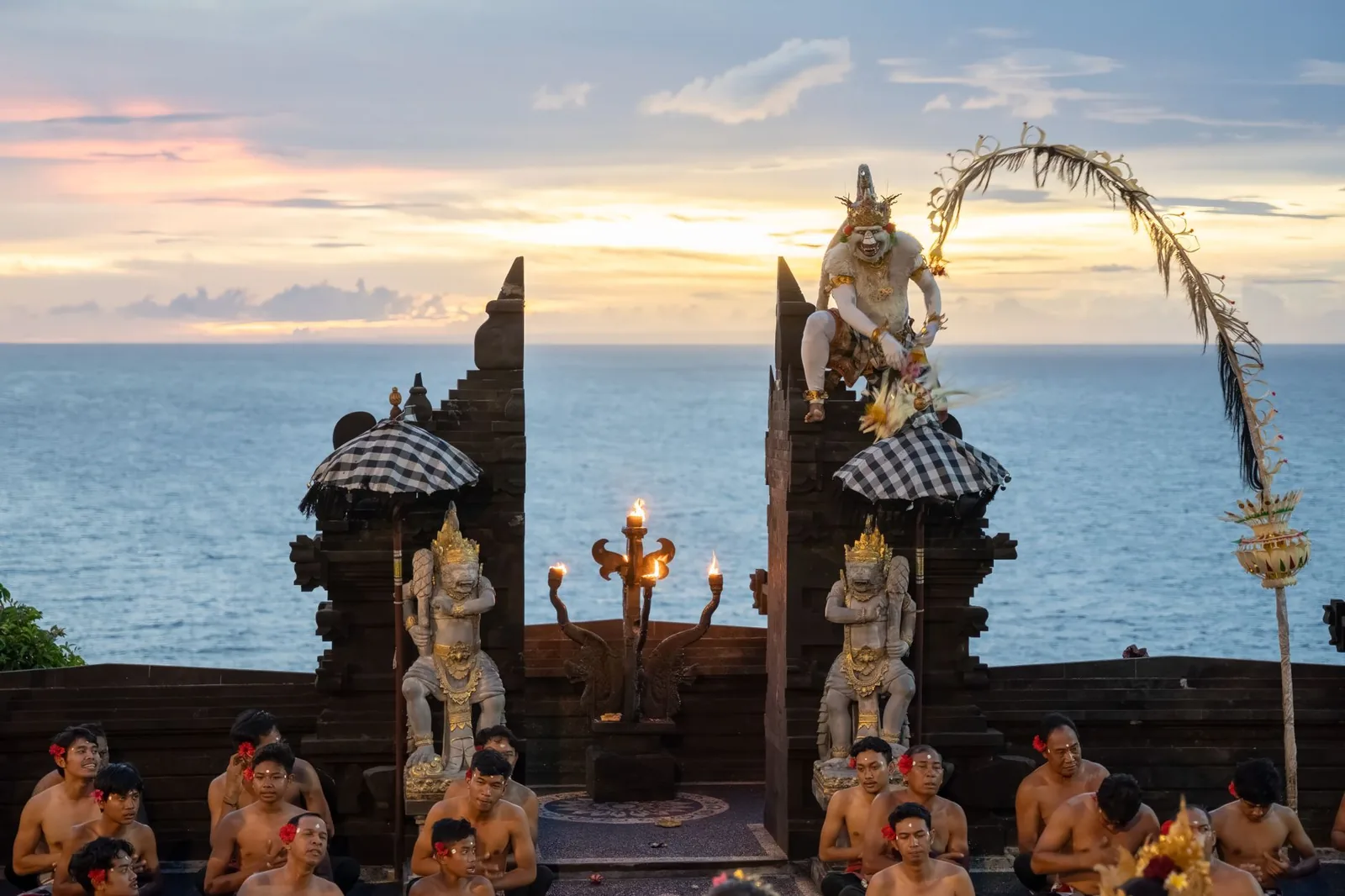
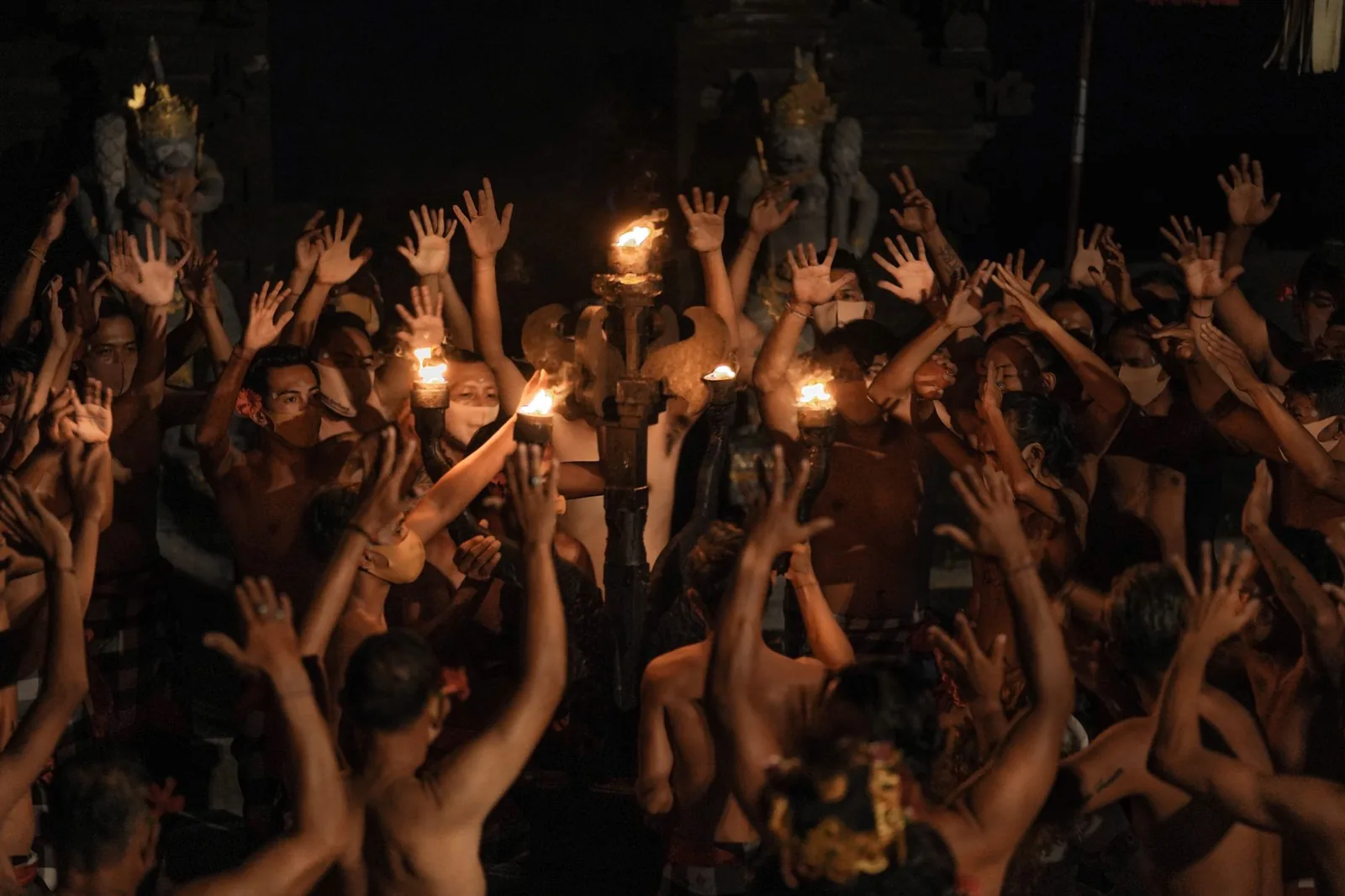
A circle of bare-chested men, sitting on the ground, chanting a rhythm in interlocking parts for an hour without stopping. In the middle, an episode from the Ramayana is acted out around a torch. Some Ubud versions end with a fire dance, where a performer in trance kicks through burning coconut husk.
Human voices only. There is no gamelan, which is exactly what makes the first thirty seconds so startling. Around an hour, usually starting at dusk so the torchlight does the work. Generally not the palace. In Ubud it plays at Pura Dalem Taman Kaja and other temple courtyards a short walk north or east of the centre, which is the version worth seeking out.
Best for: Anyone who is only going to see one performance on the island. It is the most memorable of them by a distance. The famous clifftop kecak at Uluwatu is a different evening entirely, an hour and a half south and sold out days ahead in season.
Ramayana ballet: A story with characters you can actually track
The abduction of Sita and the war to recover her, told through costumed characters: Rama, the monkey general Hanuman, the demon king Ravana. More movement across the stage than legong, and a narrative that the announcer will summarise in English before it starts.
Gamelan, with the tempo following the story rather than a fixed suite of pieces. Around 75 minutes, occasionally with an interval. Rotates through the palace and the other central Ubud venues. The programme boards around town list it by name.
Best for: A first evening with children, or anyone who would rather follow a plot than study technique. Quality varies more here than in legong, because the cast is larger and troupes differ. Ask which group is performing if you have a choice of night.
Topeng and jauk: Masks, and the one that gets laughs
Solo masked dances, often slipped in between longer pieces on a mixed programme. The jauk is a demon with long fingernails and a fixed grin. The topeng tua is an old man, and a good performer will get real laughter out of a wooden face and a walking stick.
Gamelan, in shorter sections built around each mask. Ten to fifteen minutes per piece. You will rarely see a whole evening of it. Turns up as part of the mixed programmes at the palace and at the Saraswati temple.
Best for: Nobody plans an evening around this, and it is very often the part people remember afterwards. It is not announced on the ticket. If a mixed legong programme is on, you are probably getting one of these inside it.
What makes the palace courtyard worth choosing over a smarter venue is that nothing is produced. The orchestra sits on the ground in a line, the dancers come out from behind a curtain hung across the pavilion, and there is no amplification whatsoever. A gamelan is loud enough that it does not need any, and hearing bronze at that distance without a speaker in the chain is most of the experience.
The trade is comfort. You are on a plastic chair on flat paving for ninety minutes, the courtyard has no rake, and if a tall person sits in front of you in row three that is your evening. Mosquitoes come out at dusk and the palace is not going to spray for them, so put repellent on your ankles before you leave the hotel rather than after the first bite.
One thing to set expectations on: these are commercial performances staged for visitors, not temple rituals you have been allowed to observe. The troupes are local, the standard is often high, and the money supports the banjar that fields them. But the sacred versions of these dances happen on ceremony days, in temples, with no chairs and no tickets, and you would need a very different kind of luck to see one.
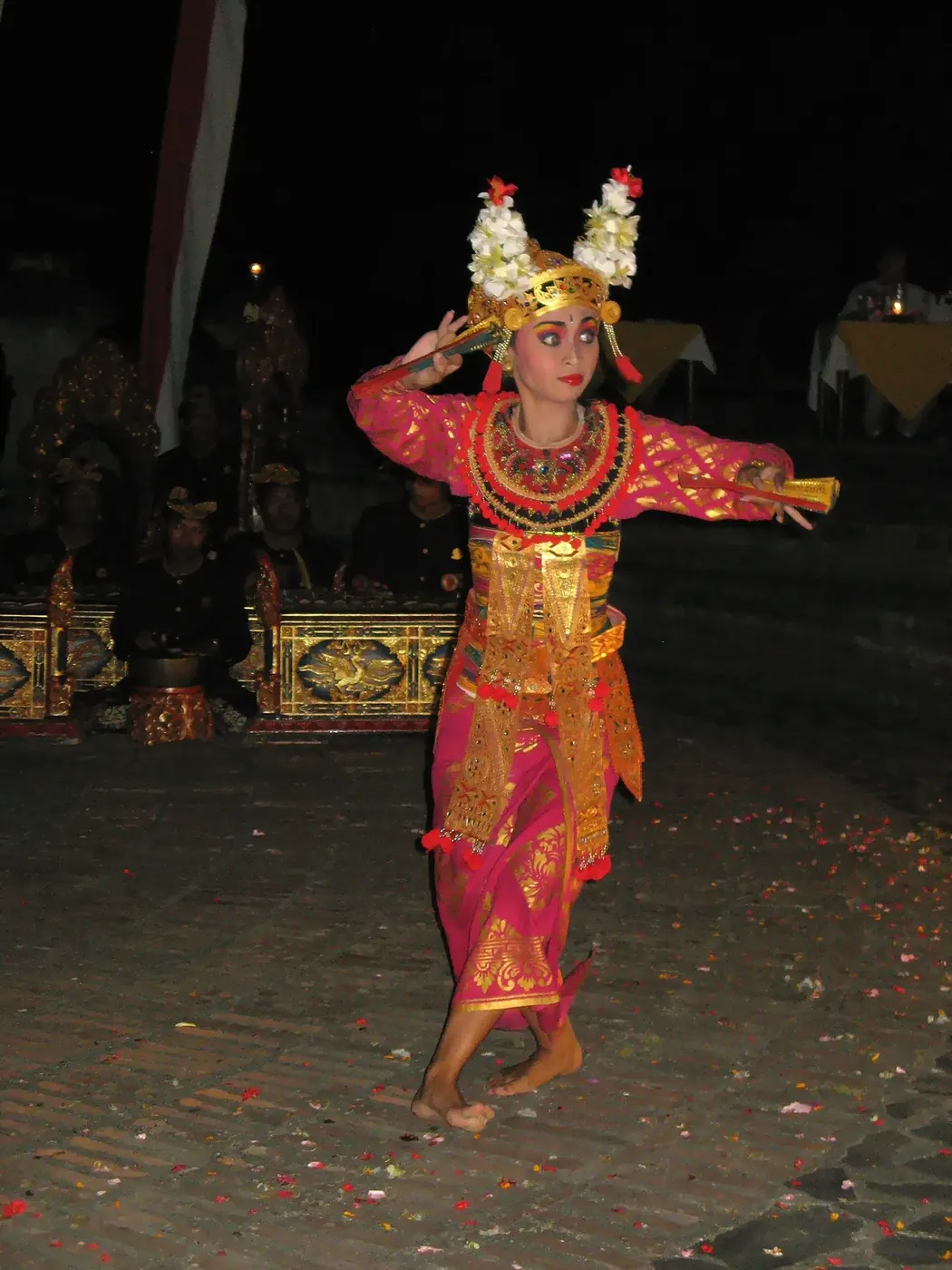
Photo Michael Gunther, CC BY-SA 4.0
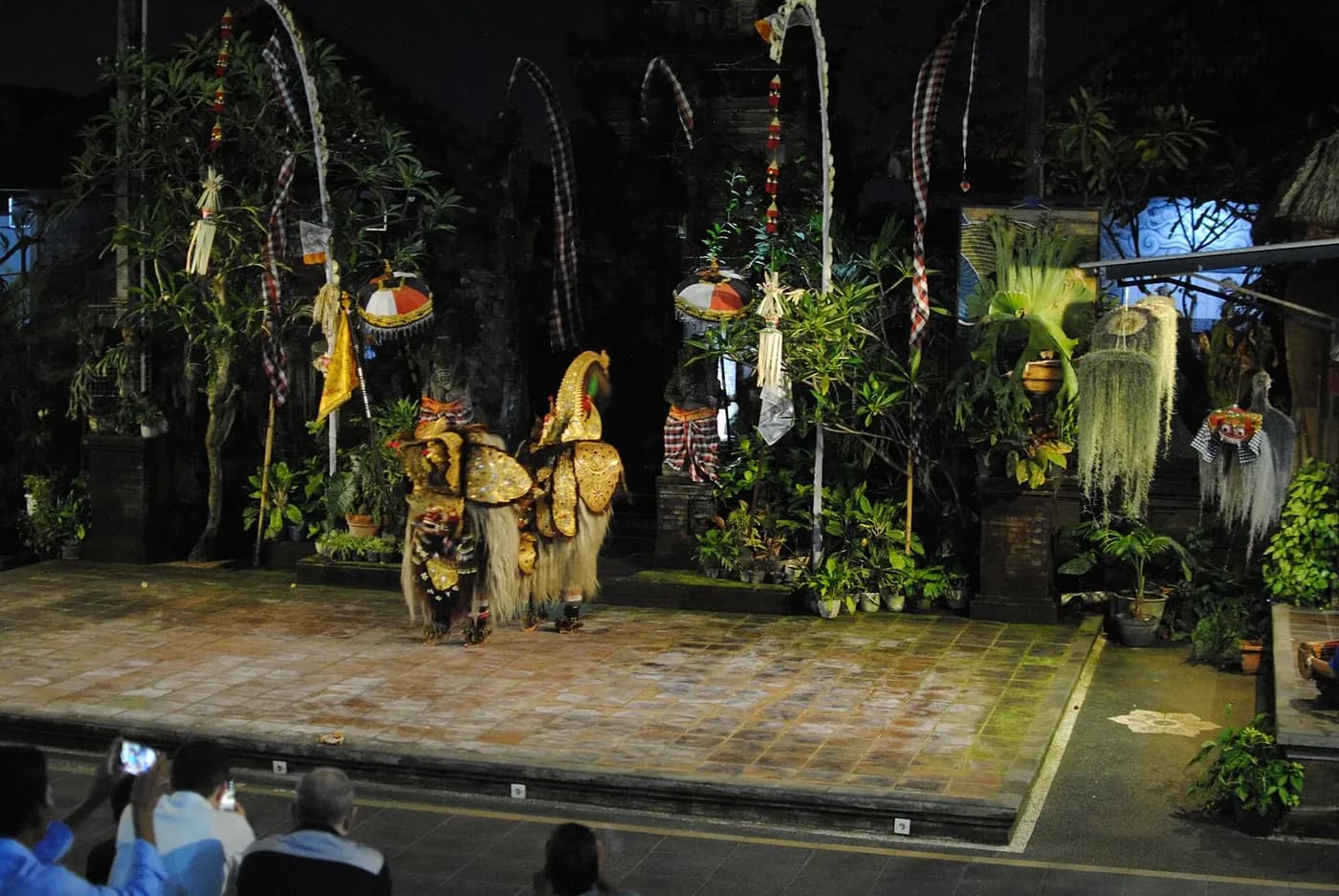
Photo Andy Mabbett, CC BY-SA 4.0
Where each show actually plays
The ticket seller on the street sells for several venues at once and will not necessarily volunteer which one you are walking to. Central Ubud has five that matter, all within about fifteen minutes.
| Venue | Where it is | What usually plays | The room |
|---|---|---|---|
| Ubud Palace, Puri Saren Agung | The main crossroads, opposite the market | Legong, Ramayana ballet, mixed masked programmes | Flat courtyard, plastic chairs, the gilded pavilion behind the dancers |
| Pura Taman Saraswati | Two minutes west, behind the lotus pond | A different programme each night: Joged, Ramayana, Barong, Legong, Janger. None on Friday | Raised temple stage across a lotus pond, the prettiest room in town |
| Pura Dalem Taman Kaja | About fifteen minutes north on foot | Kecak and fire dance | Temple courtyard, torchlight, no electric stage lighting at all |
| Padang Tegal and Peliatan halls | South and east of the centre, a short ride | Barong, kecak, village troupe programmes | Community pavilions, mostly local audiences alongside visitors |
| ARMA museum | Pengosekan, south of the centre | Legong and kecak on a set weekly rota | Museum stage, more comfortable seating, higher ticket |
The programmes rotate week to week and troupes swap venues, so treat that middle column as the tendency rather than a schedule. The boards outside the palace and along Jalan Raya Ubud carry the current week and they are kept up to date, because the people who print them are the people selling the tickets.
If you only have one free evening, the honest ranking is this: kecak at a temple courtyard first for sheer effect, legong at the palace second for the setting, and anything else third. If you have two evenings, do both of those, in that order, and the second one will be better for having seen the first.
Getting a seat worth having
Tickets are unnumbered, the courtyard is flat, and the chairs are set out in rows facing the pavilion. Everything about your evening is therefore decided by when you arrive rather than what you paid. Doors open around an hour before and the first twenty or so people in take the middle of rows two to four, which is the right answer.
Avoid the front row itself. It sounds like the prize and it is not: at that distance you are looking up, the dancers work the whole width of the space and you will spend the hour turning your head. Avoid the far left and right ends of any row for the same reason. The choreography is built for a frontal view because the court it was made for sat in one place.
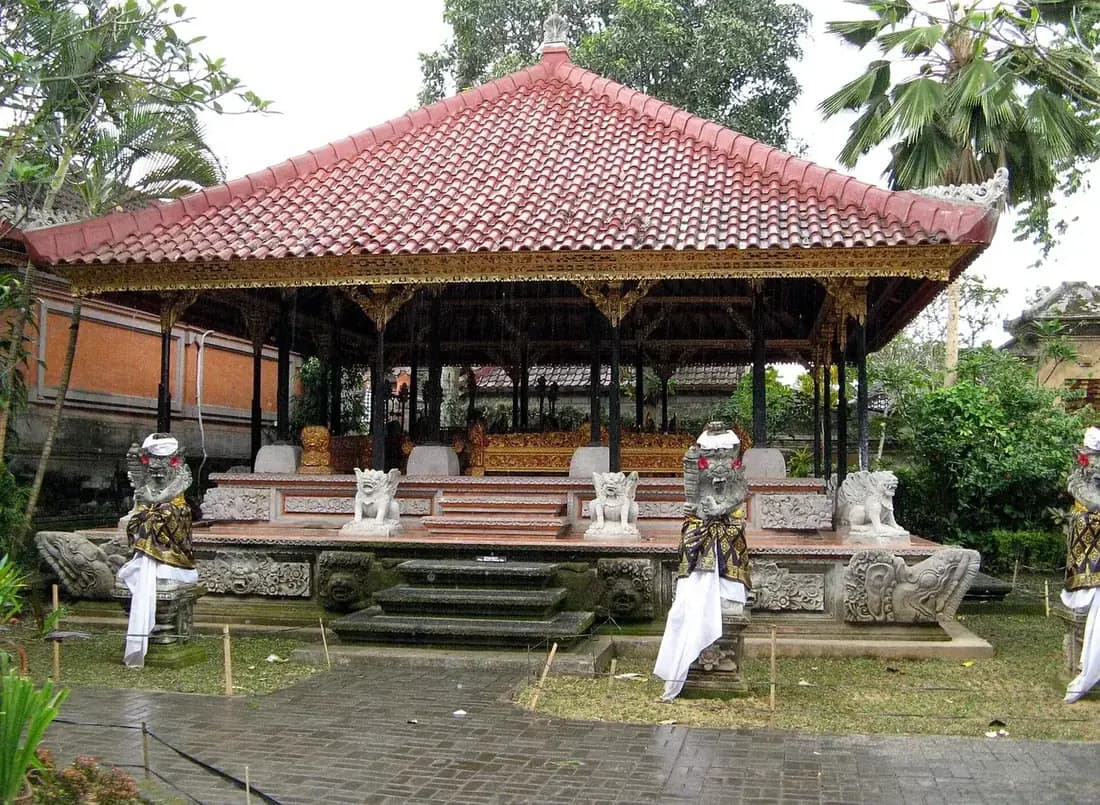
Photo Michael Gunther, CC BY-SA 4.0
Bring insect repellent, a layer if you feel the cool, and small notes. There is no bar, no interval service and no cloakroom. There is also, usefully, no rule against leaving quietly if you have had enough, and on a mixed programme of six short pieces plenty of people do.
Rain is the real variable. The audience seating is open to the sky while the performers are under a roof, so a wet season downpour at 19:20 either delays the start or moves everyone under the eaves. Shows are rarely cancelled outright, and nobody refunds for weather.
What it costs
One of the very few sights on Bali where the honest answer to the entrance fee question is that there isn't one.
| What you pay for | Detail | Order of magnitude |
|---|---|---|
| Daytime entry to the courtyards | No booth, no ticket, no sarong hire. You walk in from the pavement. | Free |
| Evening dance ticket | Same price at the gate or from a seller in the street. Cash, unnumbered seat. | ≈ $7 to $12 |
| Scooter parking nearby | Attendant-run spaces on the side streets. The palace has no visitor car park. | ≈ $0.25 |
| A driver waiting through the show | Only relevant if you are not staying in Ubud. Most people walk to this. | ≈ $12 to $22 |
Every figure there is an order of magnitude rather than a price. Nothing is posted on a board, the dance ticket moves with the venue and the season, and it is all cash. Carry small notes: the seller at the gate on a busy night will not have change for a large one, and nobody here takes a card.
Watch for the one soft sell that exists. Some street sellers offer the dance ticket bundled with a car to a rice terrace or a temple during the day, at a price that is fine but not a discount. If you want the show, buy the show. If you want the driver, negotiate the driver.
Why a small town has a palace at all
Bali was never a single kingdom. It was a set of rival principalities, and Ubud was one of the smaller ones, a branch of the house of Sukawati that established itself here at the end of the eighteenth century. The compound you are standing in was laid out in the early nineteenth, and the ruler credited with it is Ida Tjokorda Putu Kandel.
The building is not as old as it looks. A major earthquake in 1917 flattened much of southern Bali and did serious damage here, and a great deal of what you see is the rebuilding that followed. That is common across the island and it is why so many Balinese structures combine genuinely old carving with twentieth century masonry.
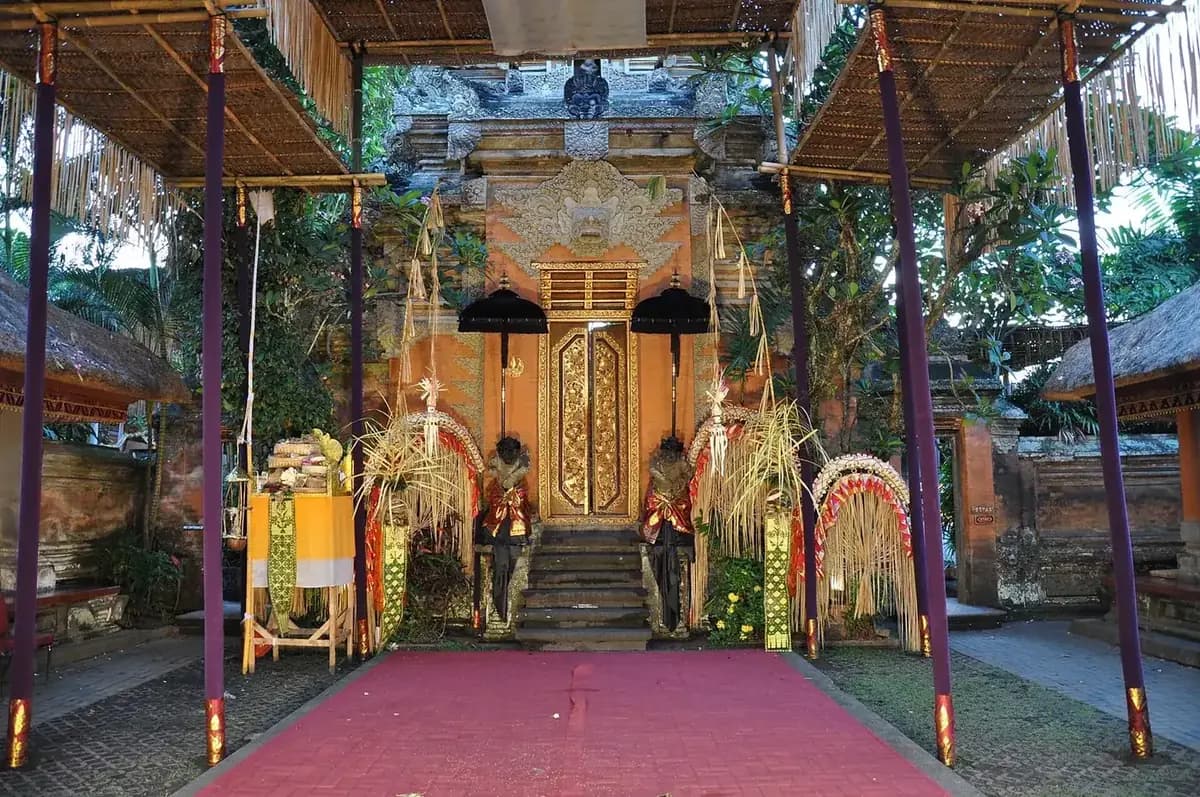
Photo Jorge Láscar, CC BY 2.0
The part that explains modern Ubud comes next. In the late 1920s and 1930s the family, and Tjokorda Gde Agung Sukawati in particular, deliberately opened the town to foreign artists, and hosted the painters and musicians whose work turned Ubud into the island's cultural address. Walter Spies and Rudolf Bonnet worked here under that patronage. The palace also began taking paying guests, which makes it one of the first pieces of tourist accommodation on Bali.
So the evening performance in the courtyard is not a recent bolt-on. A royal house sponsoring dance and music is what a puri did, and staging it for an audience of outsiders is a habit this particular family picked up roughly a century ago. That continuity is worth holding on to while you sit on the plastic chair.
The crossroads it sits on
Nobody comes to Ubud for the palace alone, and nobody should. It is the anchor of a walkable half day rather than a destination.
Across the road: Ubud market
A genuine produce and flower market before about nine in the morning, and a two storey souvenir hall for the rest of the day. The early version is worth setting an alarm for. The later one is worth ten minutes and firm haggling.
Two minutes west: Pura Taman Saraswati
The lotus pond temple beside Cafe Lotus, now ticketed at 65,000 IDR. This is the one people mean when they say the water palace, and it is the prettiest evening venue in town if the show you want is on there.
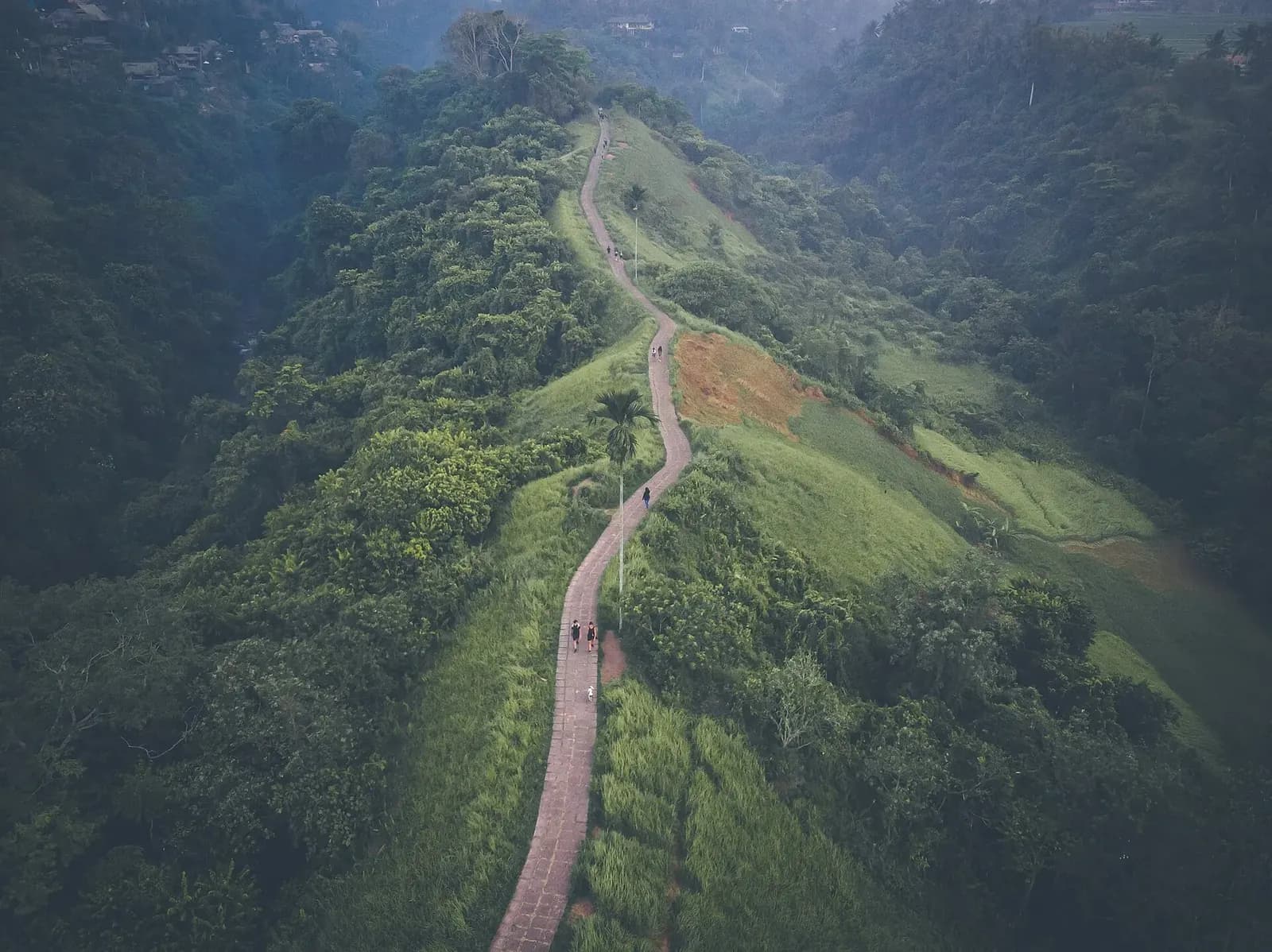
Ten minutes west: Campuhan ridge
The free ridge walk that starts inside town and is over by breakfast if you leave early enough. The natural first half of a day that ends at the palace.
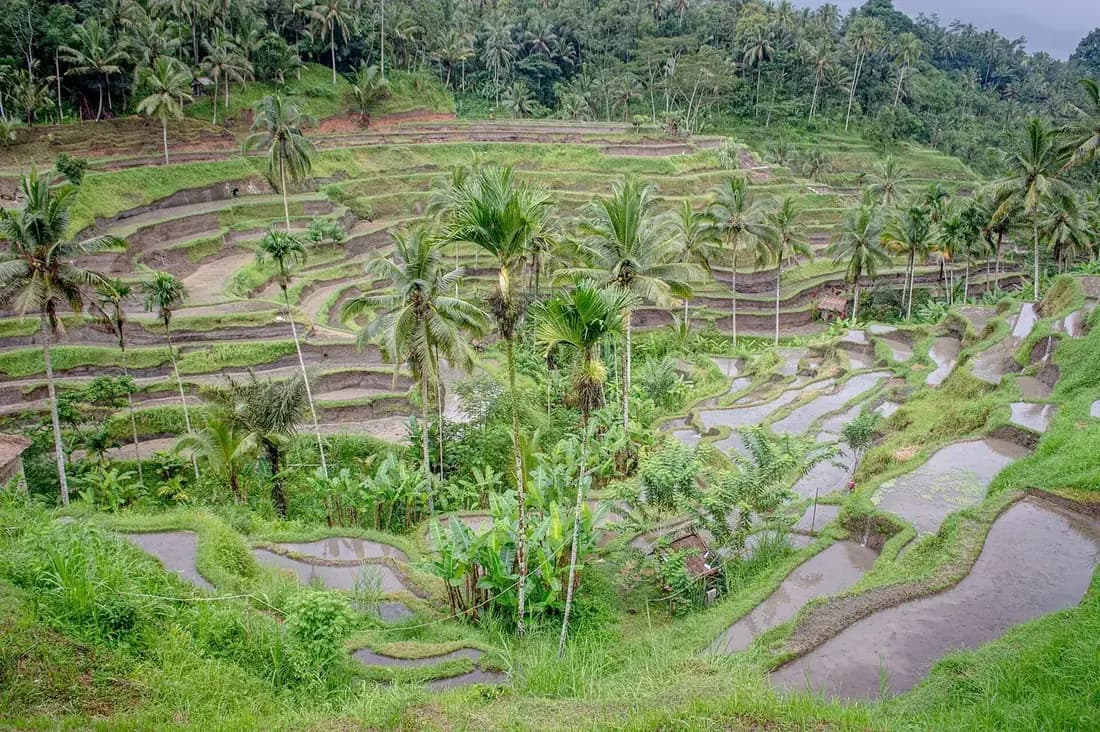
Twenty minutes north: Tegallalang
The terraces everybody photographs, and the donation posts on the path that nobody warns you about. A morning out rather than a stop.
A day that actually works, in the order it works in: the Campuhan ridge walk at first light, the market before nine while it is still a market, the palace courtyards on the way back through town, an afternoon out of the heat, and the dance here at half past seven. That is roughly free until dinner.
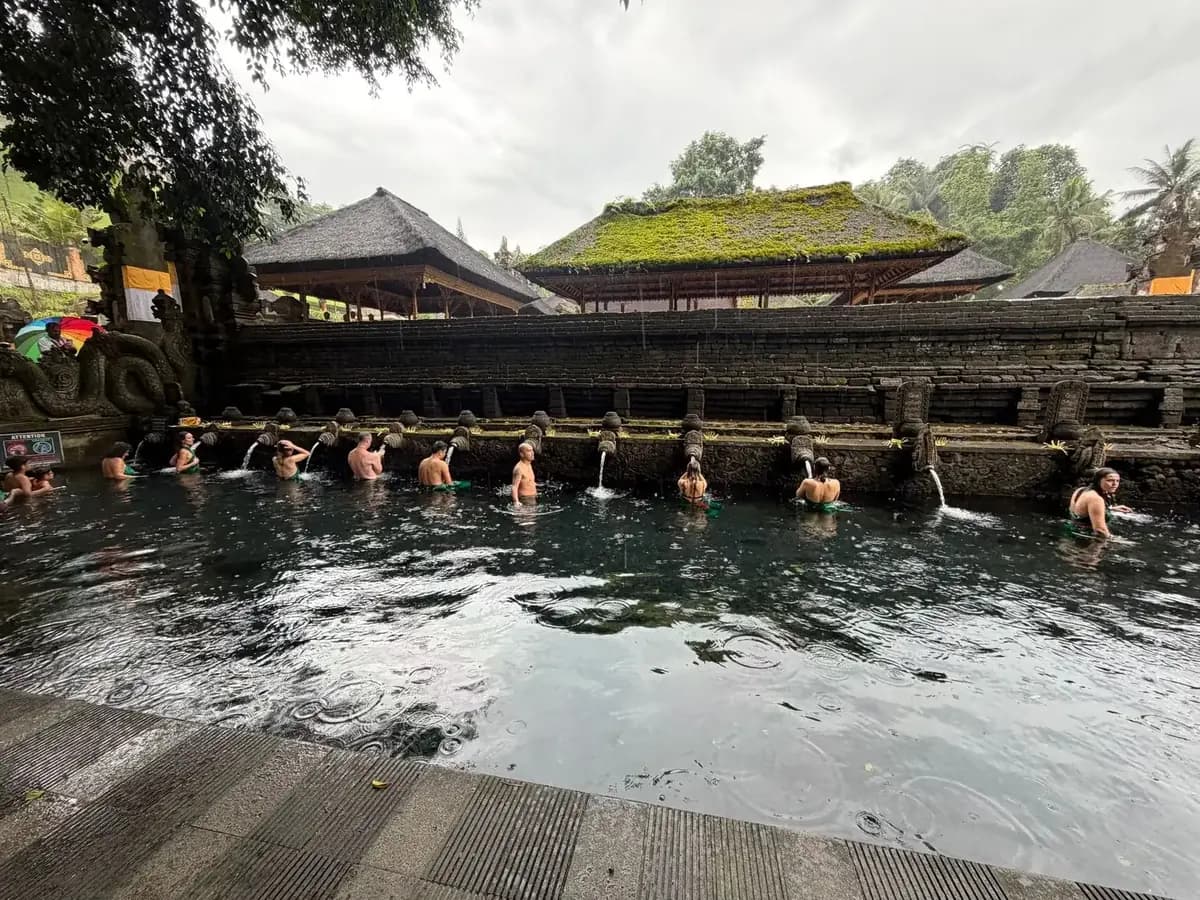
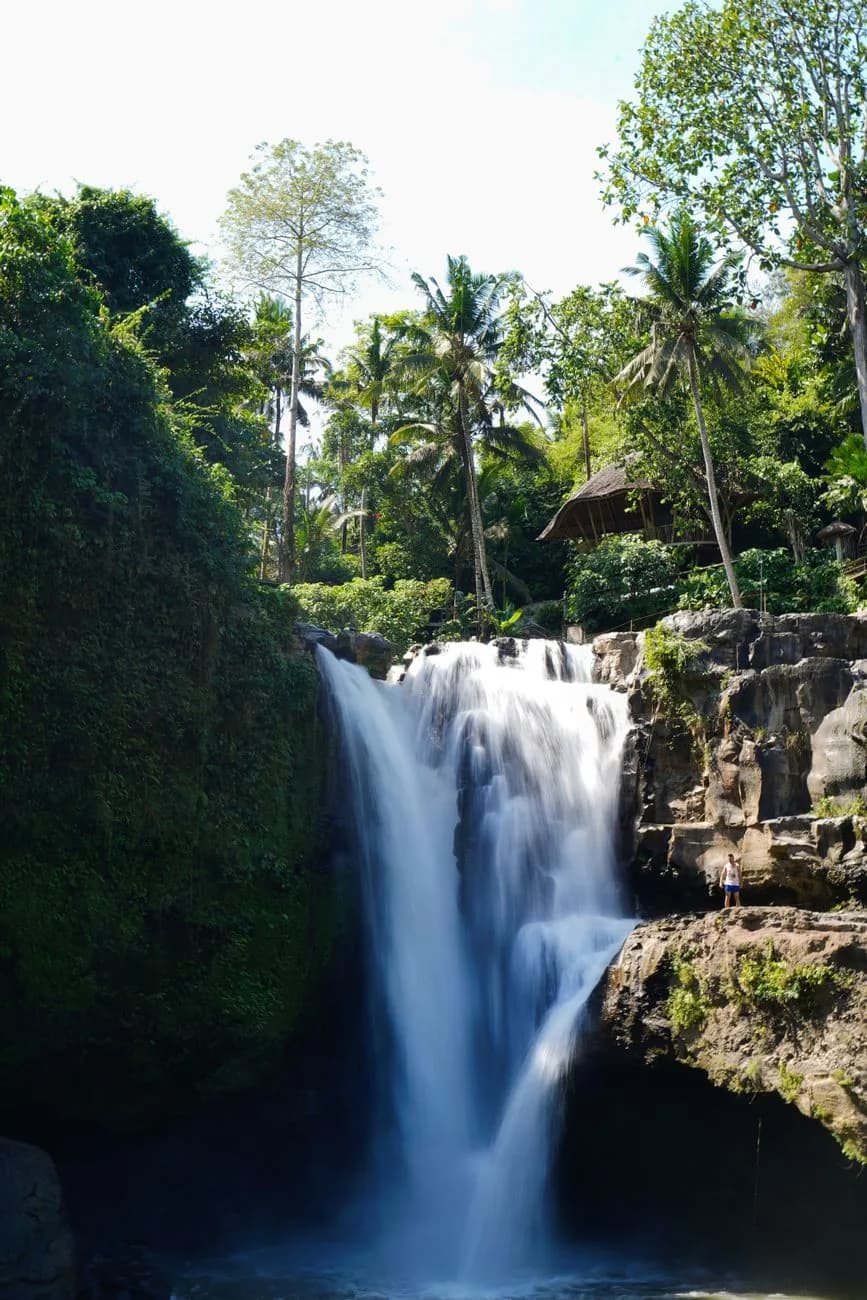
If you have a driver for the day instead, the palace slots in at the end rather than the start. Tirta Empul and the Tegenungan waterfall are both within half an hour, and both want the morning. Come back into town for the late afternoon, eat early, and walk to the courtyard. The one arrangement to avoid is arriving here at noon with a car waiting, because fifteen minutes of palace in full sun is nobody's good memory of Ubud.
Hours, dress code and getting there
| Hours | Courtyards open from roughly 08:00 to 18:00, then the chairs go out. Nothing is posted authoritatively and a family ceremony closes it without notice. |
|---|---|
| Dress | No sarong needed. This is a residence, not a temple. Shoulders covered and something past mid thigh is courteous and is all anyone expects. |
| How long | Fifteen to twenty minutes by day. Two hours door to door for an evening performance, including getting there early enough to sit well. |
| Getting there | On the junction of Jalan Raya Ubud and Jalan Suweta. Walk if you are staying in town. There is no car park, and the crossroads jams solid at dusk. |
Arriving by car or ride hailing
The palace has no visitor parking of its own and the crossroads outside it is one of the worst pinch points in Ubud, particularly between five and eight in the evening. A driver will drop you on the corner and then need somewhere else to be.
Ride hailing apps work in Ubud but pickups from the immediate junction are awkward and sometimes discouraged by local drivers' arrangements. Walking two or three streets out before ordering a ride home is faster than arguing about it.
Arriving by scooter, or on foot
Attendant-run scooter parking sits on the side streets within a minute of the gate and costs almost nothing. It is the practical choice if you are staying out among the rice fields north or east of the centre.
Otherwise walk. Central Ubud is small, the palace is the middle of it, and every road you would take passes something worth stopping at. The pavements are uneven and the drains are open in places, so bring a phone torch for the walk home after the show.
Is it worth it, by traveller
The answer genuinely depends on who is asking, which is why the reviews average out to a shrug.
Yes, clearly: staying in Ubud for two nights or more
You will walk past it several times whether you plan to or not, and the evening show is the best hour of culture available to you at this price, within walking distance of your dinner.
Yes, with children: families, on the right programme
Barong and the Ramayana ballet hold a child's attention because there are monsters and a plot. Legong will not. Free courtyards by day mean nothing is lost if a visit lasts four minutes.
Yes, for the room: anyone who cares about architecture
Carved soft brick, gilded timber and the whole logic of a Balinese compound, laid out at royal scale and available for nothing. Twenty slow minutes rewards you far more than fifteen fast ones.
Not really: day trippers from the south coast
If you have driven ninety minutes from Seminyak with a car waiting, the palace is the weakest item on your list. Spend the time at the terraces or a waterfall and skip this.
Not really: anyone expecting a palace tour
There are no rooms to walk through, no furniture, no guide and no interior. If that is what the word palace means to you, this will disappoint regardless of how good the carving is.
Depends: one night in Ubud only
Then choose the performance over the courtyards, and consider the kecak at a temple venue over the palace programme. The setting here is lovely, the chanting elsewhere is unforgettable.