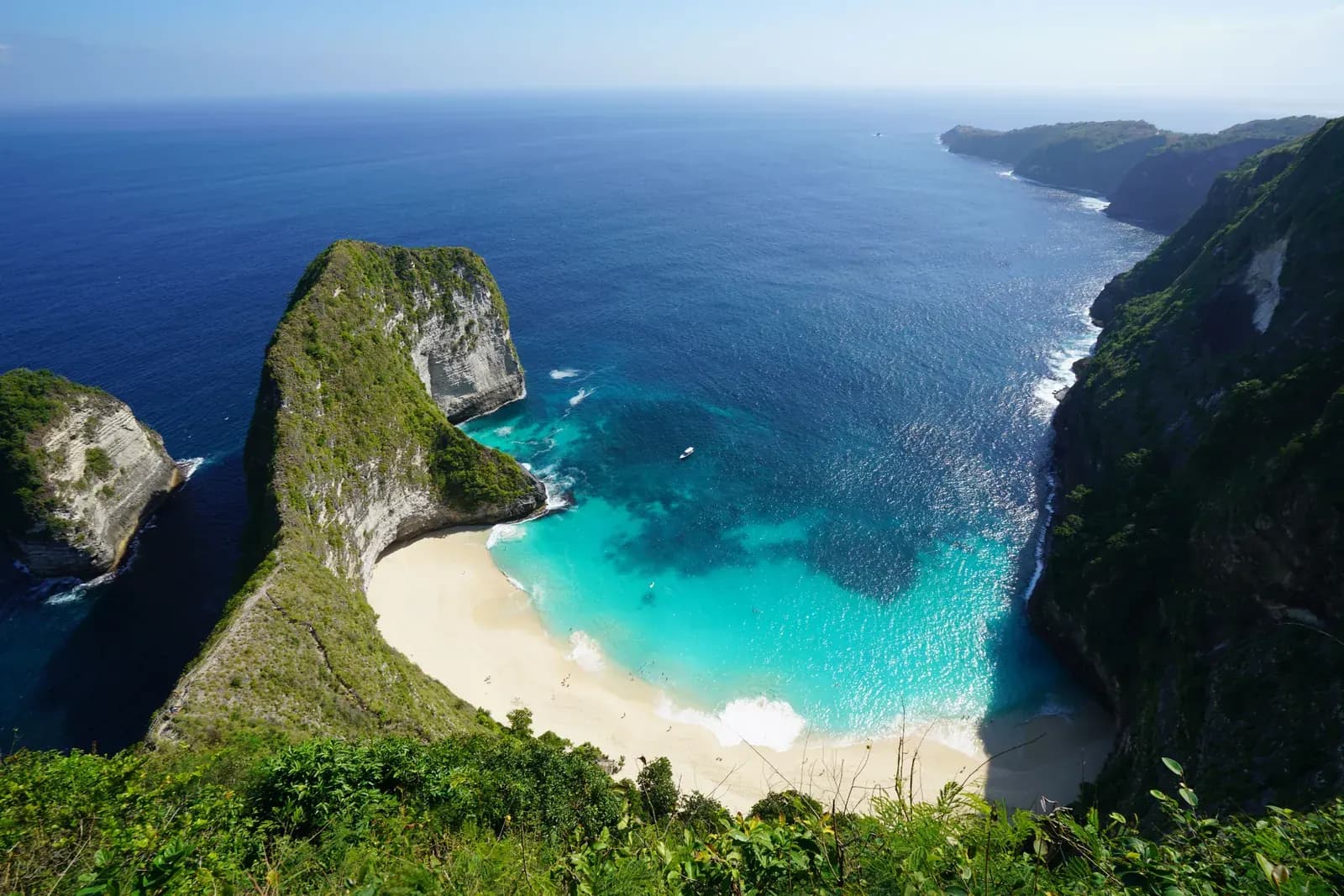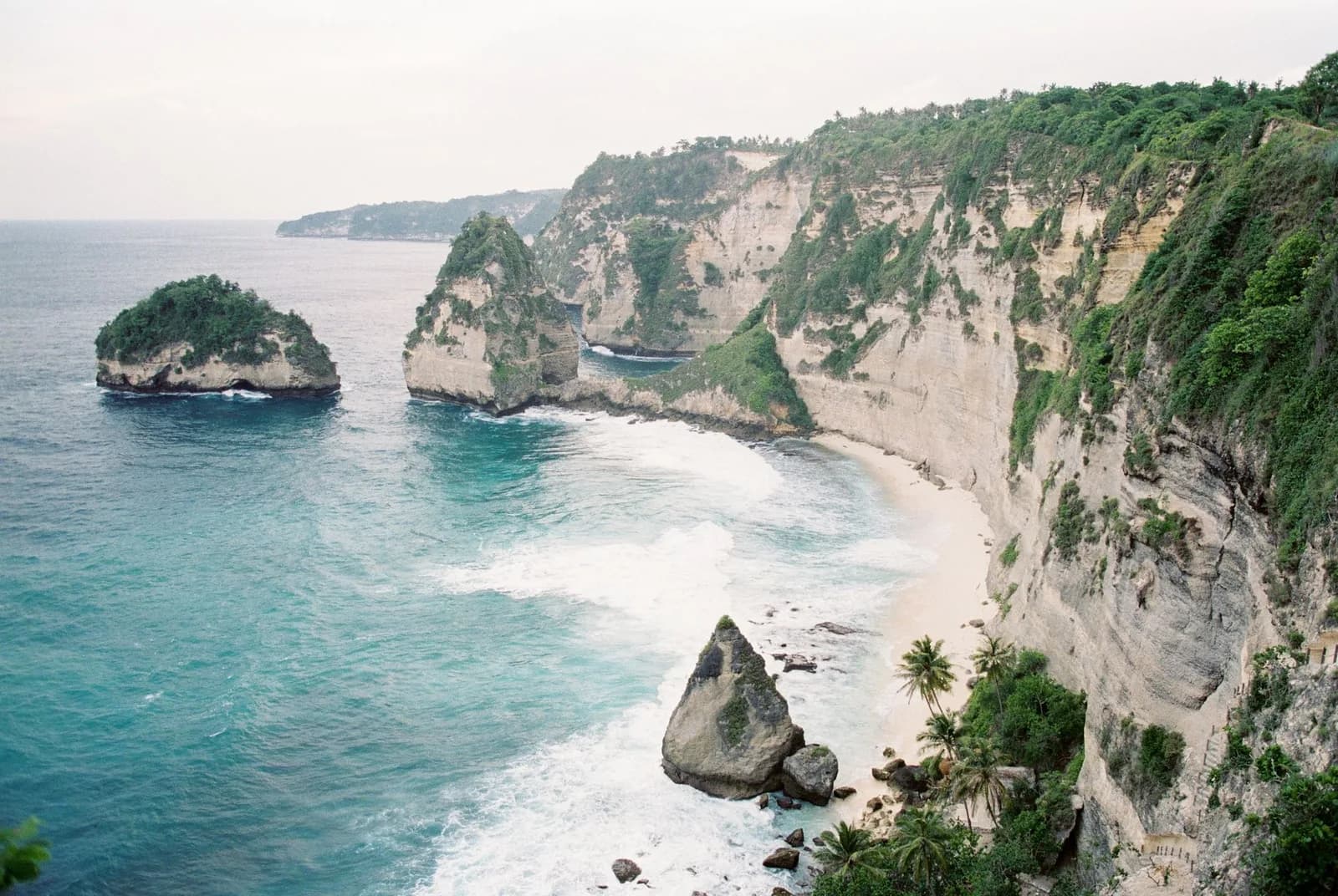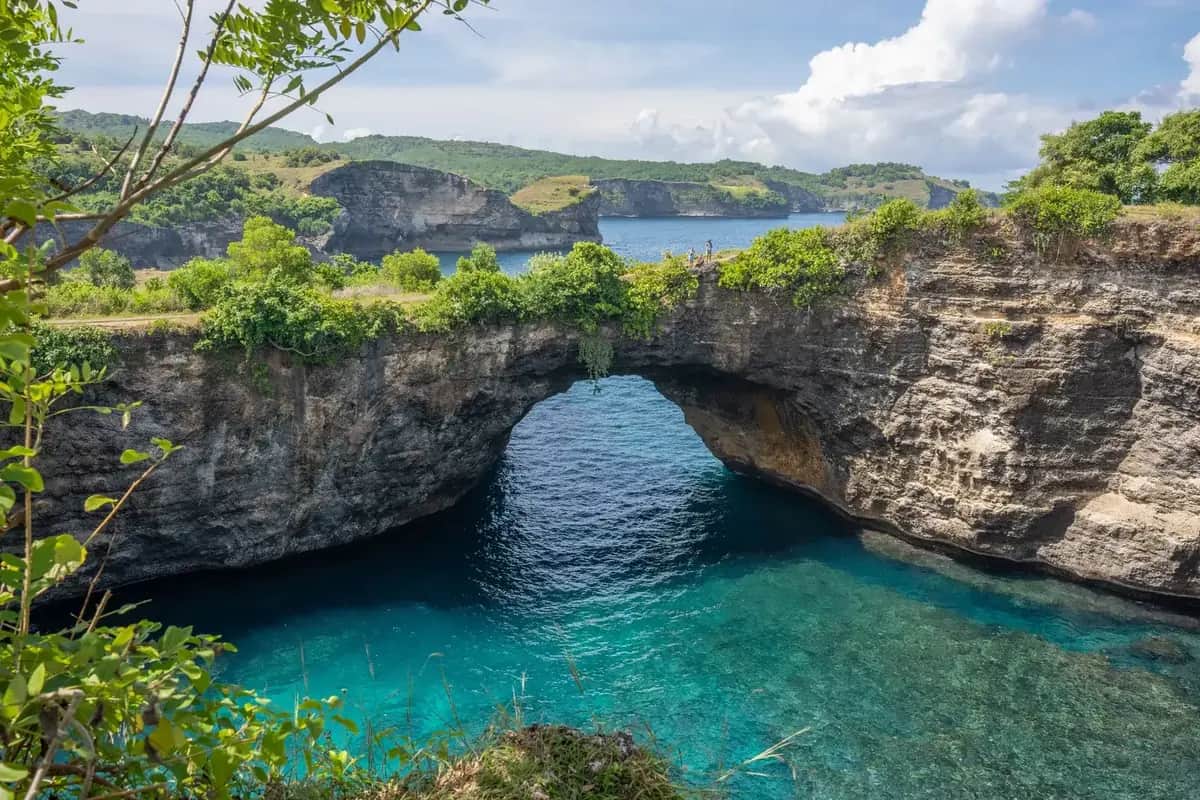
Somewhere on the west coast of Nusa Penida, the roof of a sea cave gave way. What it left behind is a near-circular cove punched into the cliff top, joined to the open ocean by a natural rock arch that the swell still runs through. The Balinese name is Pasih Uug, broken sea, and it is a literal description of what happened rather than a marketing invention. Broken Beach is simply the translation everyone uses.
The word beach is the problem. There is no sand, no swimming and no way down to the water: the cove is walled in on every side and the only thing you do here is walk the footpath around the rim and look into it. Which sounds like a let-down and is not, because the formation is genuinely unusual and the loop is the easiest headline sight on an island otherwise built out of staircases.
The complication is next door. Angel's Billabong shares the car park and the ticket, sits five minutes further along the path, and is a tidal rock pool rather than a viewpoint. People do get into it, and on the wrong tide that decision has gone very badly wrong more than once. Getting the two of them in the right order, on the right state of the sea, is what this page is for.
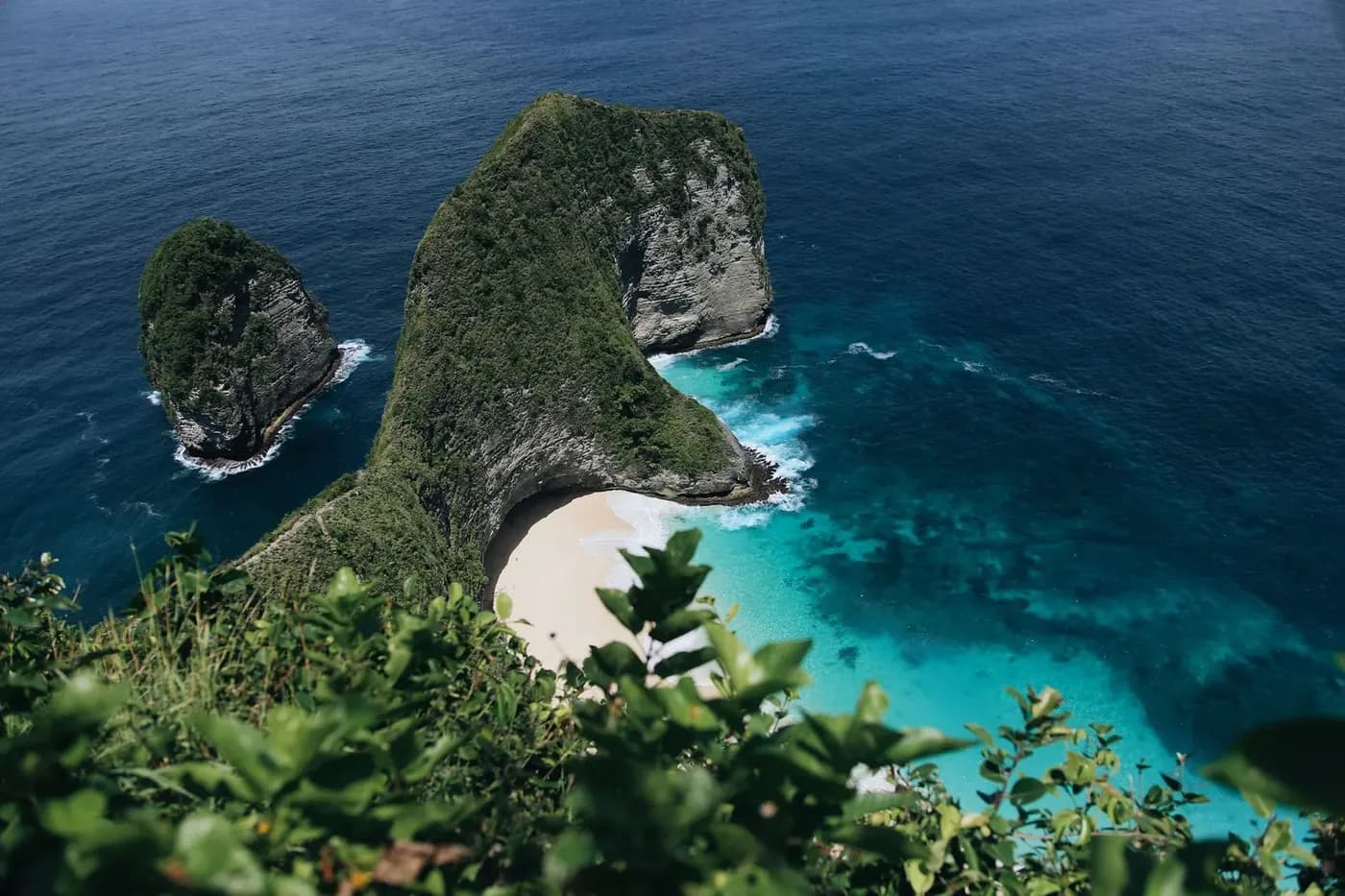
Boat, driver and the three west coast stops
Nusa Penida west coast day trips from Bali
- ✓Fast boat from Sanur and hotel pickup on the Bali side, which is the part people underestimate
- ✓Kelingking, Broken Beach with Angel's Billabong, and Crystal Bay in one loop
- ✓A driver who knows the west coast roads, instead of a scooter you rented an hour earlier
- ✓Free cancellation on most listings, useful when the crossing looks rough
Affiliate link. Booking through GetYourGuide costs you nothing extra and supports the guide. Price and rating checked September 2026. Both move with season and demand.
On this page
What you are actually looking at
Two formations, five minutes apart, produced by the same process and behaving in completely different ways.
Broken Beach, or Pasih Uug
The limestone that makes up this coast is soft, and the Indian Ocean has spent a long time working into it. A cave cut its way under the headland until the roof above it could no longer hold, and it fell. What remains is a cove roughly a hundred metres across, open to the sky, closed off from the land by a ring of cliff, and connected to the sea by the one section of cave roof that survived. That surviving section is the arch.
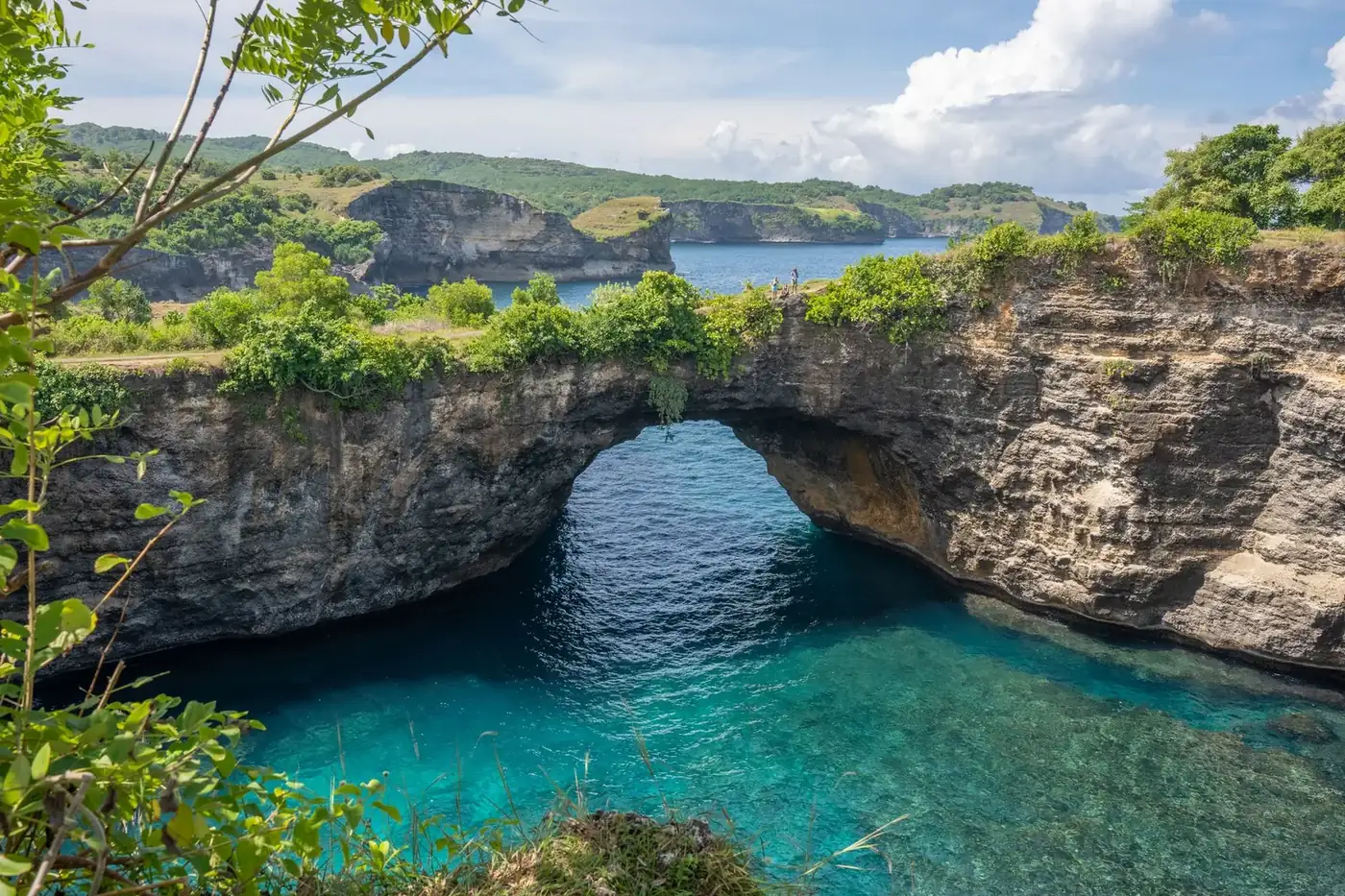
Stand on the rim and the arch is below and to the side of you, framing a slot of open ocean. Water moves through it constantly, in and out, so the cove is never still. On a bright day with the sun high the reef shelf inside shows through as turquoise against dark blue, which is the version of this place that circulates online.
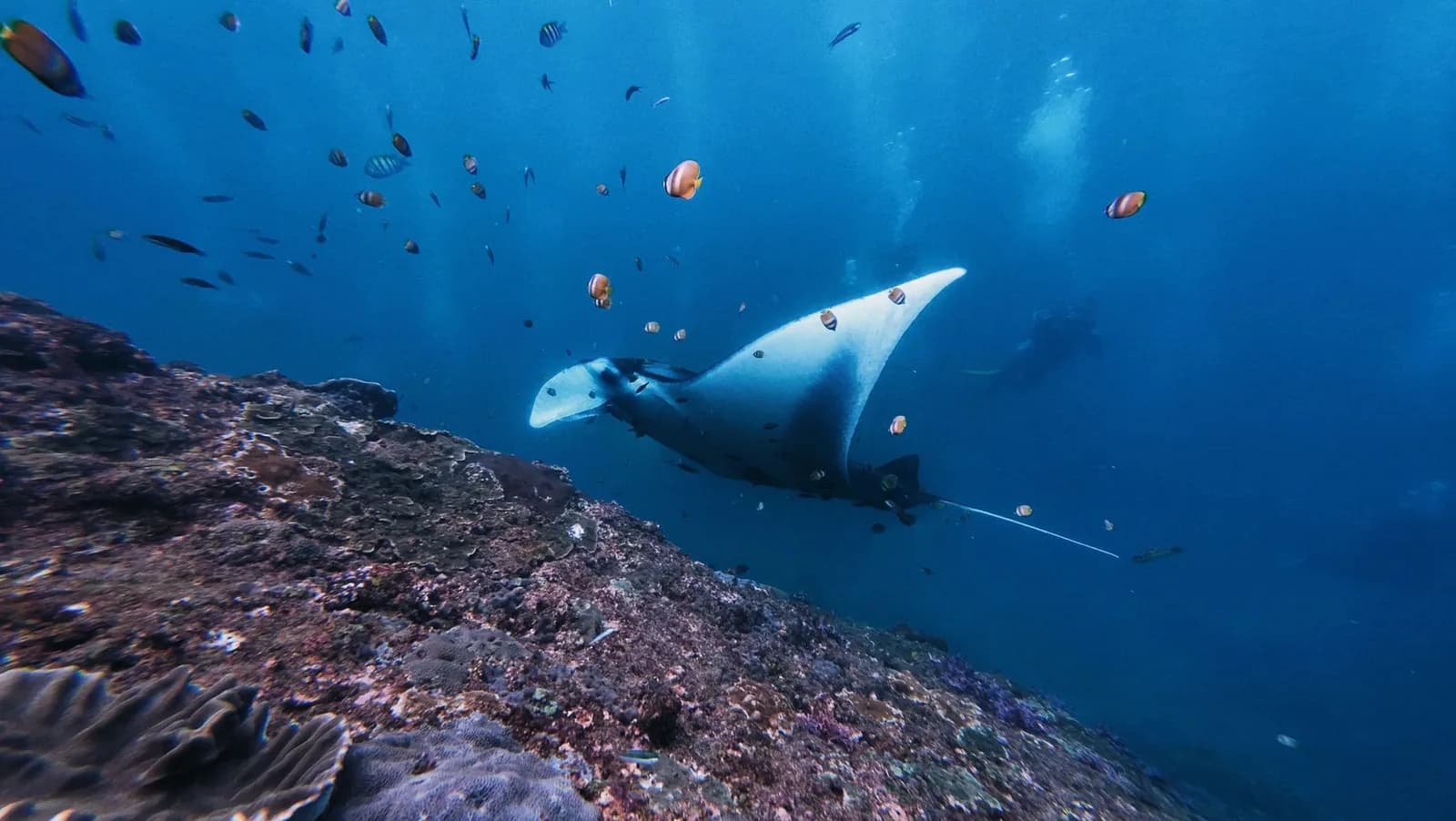
Manta rays are sometimes visible from up here, dark shapes moving slowly across the pale bottom of the cove. It is a genuine piece of luck rather than something to plan around, and it is worth two minutes of standing still with your phone in your pocket. If you actually want to see them, that is a boat trip to Manta Point on the same coast, not a cliff top.
Angel's Billabong
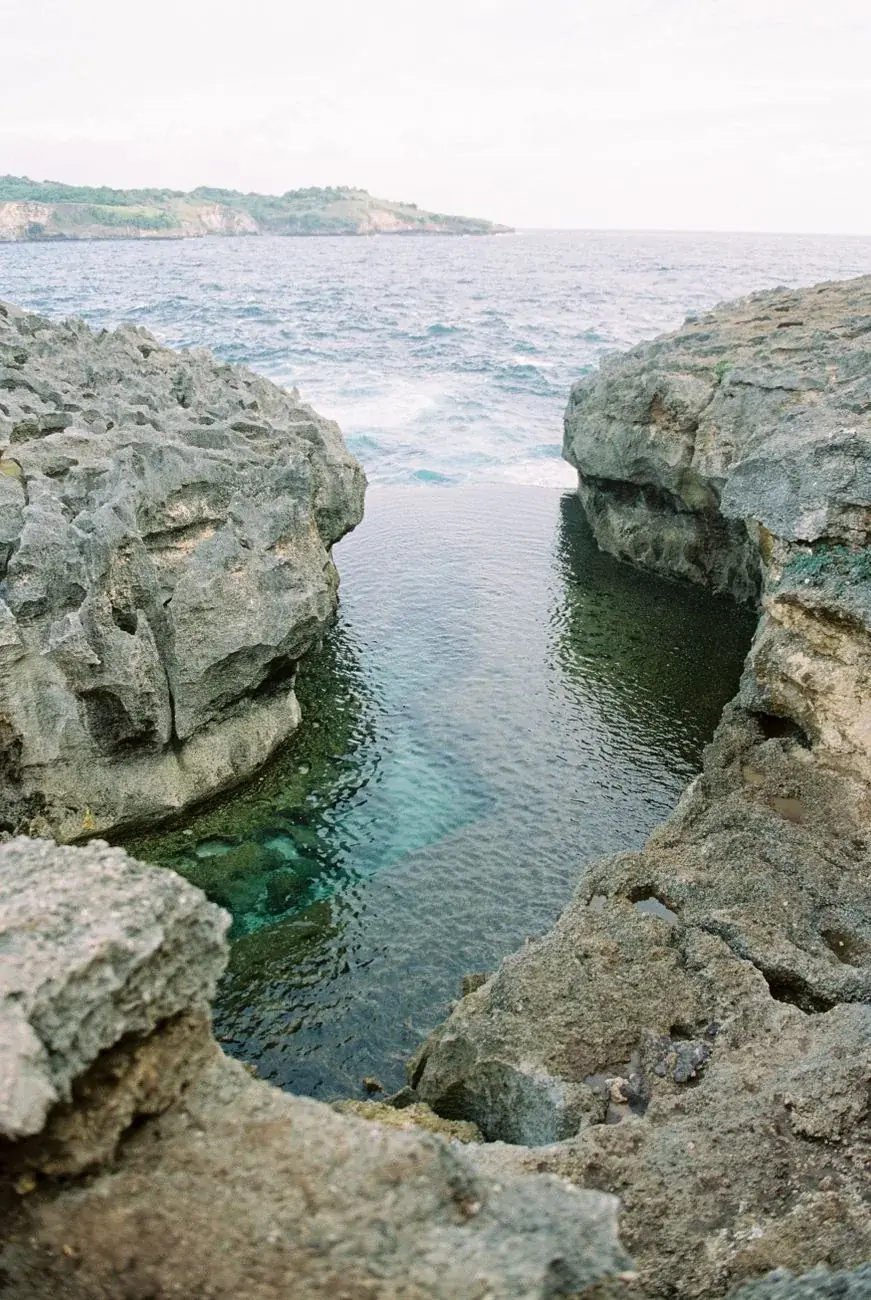
A natural rock channel that fills and empties with the tide, cut into a flat shelf right at the edge of the open ocean. At low water it settles into a clear green pool over pale stone, shallow enough to stand in, and that is the photograph. At higher tide, or when any swell is running, the sea comes over the outer lip and down the channel with a great deal of force.
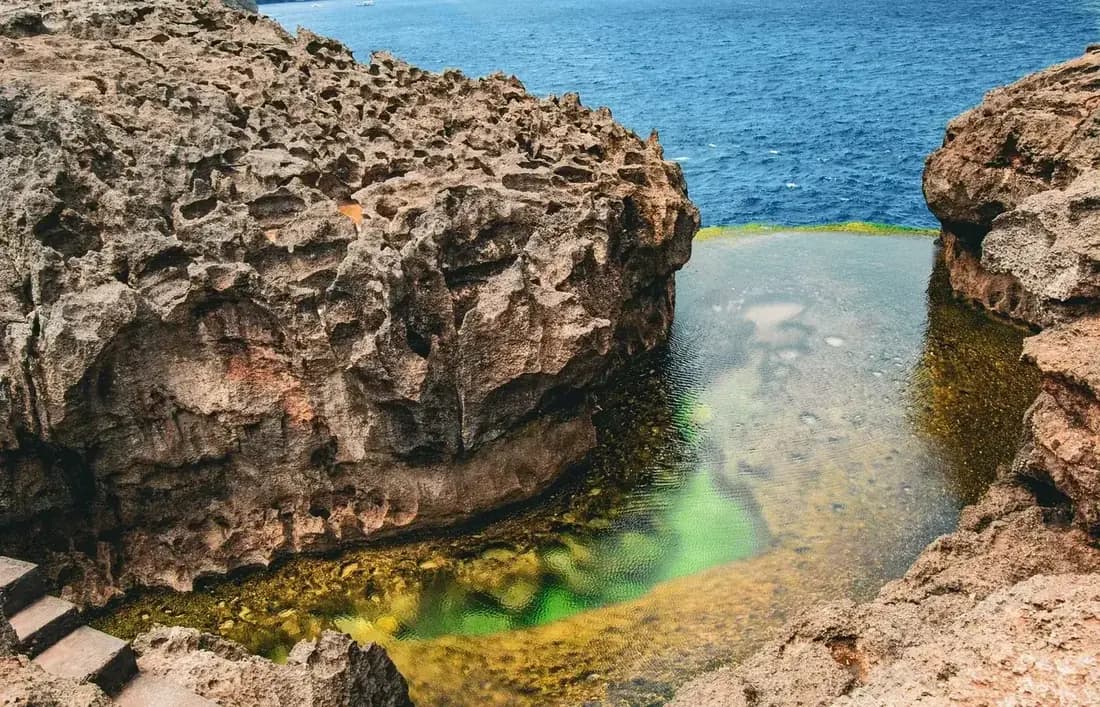
The whole risk fits in one sentence: the pool and the ocean are the same body of water, separated by a rock lip that stops working as a barrier the moment the sea rises. Serious accidents have happened here, and they have happened to people who were standing in an apparently calm pool a minute earlier.
None of which makes it a place to avoid. From the rock above, it is one of the more striking things on the island, it costs nothing extra, and the overwhelming majority of visitors look, photograph and leave without going near the water. That is the normal way to do it.
The tide decides one of them and not the other
This is the piece of planning that separates a good stop from a frustrating one, and it is the piece almost no guide bothers with.
| Sea state | Broken Beach | Angel's Billabong |
|---|---|---|
| Low tide, flat sea | Unchanged and excellent. No water access, ever. | Actually looks like a pool. Water access sometimes possible. |
| Mid tide, some swell | Same viewpoint, more white water. No water access, ever. | Filling and emptying, unpredictable. Look, do not get in. |
| High tide or real swell | Arguably better to look at. No water access, ever. | Pool and ocean become one body of water. Stay off the rock shelf. |
Low tide, flat sea: the postcard conditions
The cove sits well below you whatever the sea is doing. At low water the reef shelf inside the arch shows through and the colour goes from deep blue to turquoise, which is the version in every photograph. At the Billabong, the channel holds still green water over pale rock, the outer lip is dry, and nothing is washing in. This is the roughly two hour window either side of low water when people get in, and it is the only window worth considering.
Walk the Broken Beach loop first while the light is still low, then drop down to the Billabong. Even here, watch the outer lip for a full three or four minutes before deciding anything: a single set arriving out of a calm morning is exactly how the accidents at this pool have happened.
Mid tide, some swell: the most common arrival
Broken Beach looks darker and busier, with more white water pushing through the arch and against the base of the cliff, which some people prefer. At the Billabong, water is running in over the lip in surges rather than continuously. The pool looks calm between sets and then is not. This is the state that catches people out, because the danger arrives on a delay rather than being visible on arrival.
Do the loop, look at the Billabong from the rock above it, and treat the pool as scenery. Nothing about a photograph in the water improves on the one taken from the ledge, and the difference in risk between the two is not marginal.
High tide or real swell: often the afternoon
The sea comes through the arch hard and the cove churns. From the rim it is a more dramatic sight than the flat calm version, and it costs you nothing because you were never going down there. At the Billabong, waves break over the outer rock and pour through the channel. The lip that makes the pool a pool has stopped functioning as a barrier, and anything in the water can be pushed straight out into open sea.
Broken Beach is worth the trip on its own terms. At the Billabong, keep to the upper viewpoint and off the wet rock: the shelf is slippery, the edge is unfenced and the sets do not announce themselves. Plenty of people have been swept from ground they thought was dry.
There is a scheduling conflict built into the west coast of this island. Kelingking wants to be early, before the boats unload and the heat arrives on the exposed ridge. Angel's Billabong wants low tide, which falls whenever it falls. Some days those two things line up and the standard loop gives you both. Other days low water is at four in the afternoon and the pool you drove across the island for is full of moving sea.
Tides shift by roughly fifty minutes each day, so any guide that tells you to turn up at a specific hour is guessing, including the ones that sound confident about it. The fix takes thirty seconds: look up a tide table for Nusa Penida for your actual date before you set the order of the morning, then decide which of the two constraints matters more to you.
If low water lands in the morning, run the loop in the standard direction and you get everything. If it lands late, either accept the Billabong as a viewpoint, which is what most people do anyway, or flip the day and take Kelingking second. What does not work is arriving at whatever time the tour happens to get there and hoping.
Can you swim at Broken Beach?
Short answer: not at Broken Beach at any tide, at any time, in any conditions. And at Angel's Billabong only on low water in a calm sea.
There is no way down
The cove is ringed by vertical cliff with no staircase, no rope and no informal scramble. This is not a rule being enforced, it is the shape of the place. Anyone who tells you they swam at Broken Beach swam somewhere else.
The water is not calm
Swell funnels through the arch and rebounds off the walls, so the cove is a washing machine even on a flat day. It is beautiful from sixty metres up and would be unpleasant at sea level.
The rest of the island varies
Kelingking and Diamond Beach have their own bans because of the shore break, Angel's Billabong is tide-dependent, and Crystal Bay is a normal swimming beach. Nusa Penida is not closed to swimmers, it is just specific about where.
Walking the loop
The most forgiving walk on Nusa Penida, with two things worth knowing before you set off.
From the car park you walk a few minutes on a dirt track and the cove appears on your left, all at once. The path then makes a complete circuit of the rim, part packed earth, part rough concrete, mostly flat with a few gentle rises. Twenty to thirty minutes at a normal pace, and there is no stage of it that needs fitness, hiking boots or a head for scrambling.
The far side is the reason to do the whole loop rather than half of it. From there you look back across the hole with the arch below and the open ocean beyond, which is the composition everyone comes for, and it is the section furthest from the car park so it is consistently the least crowded. Twenty minutes of walking buys you a photograph without a queue in it.
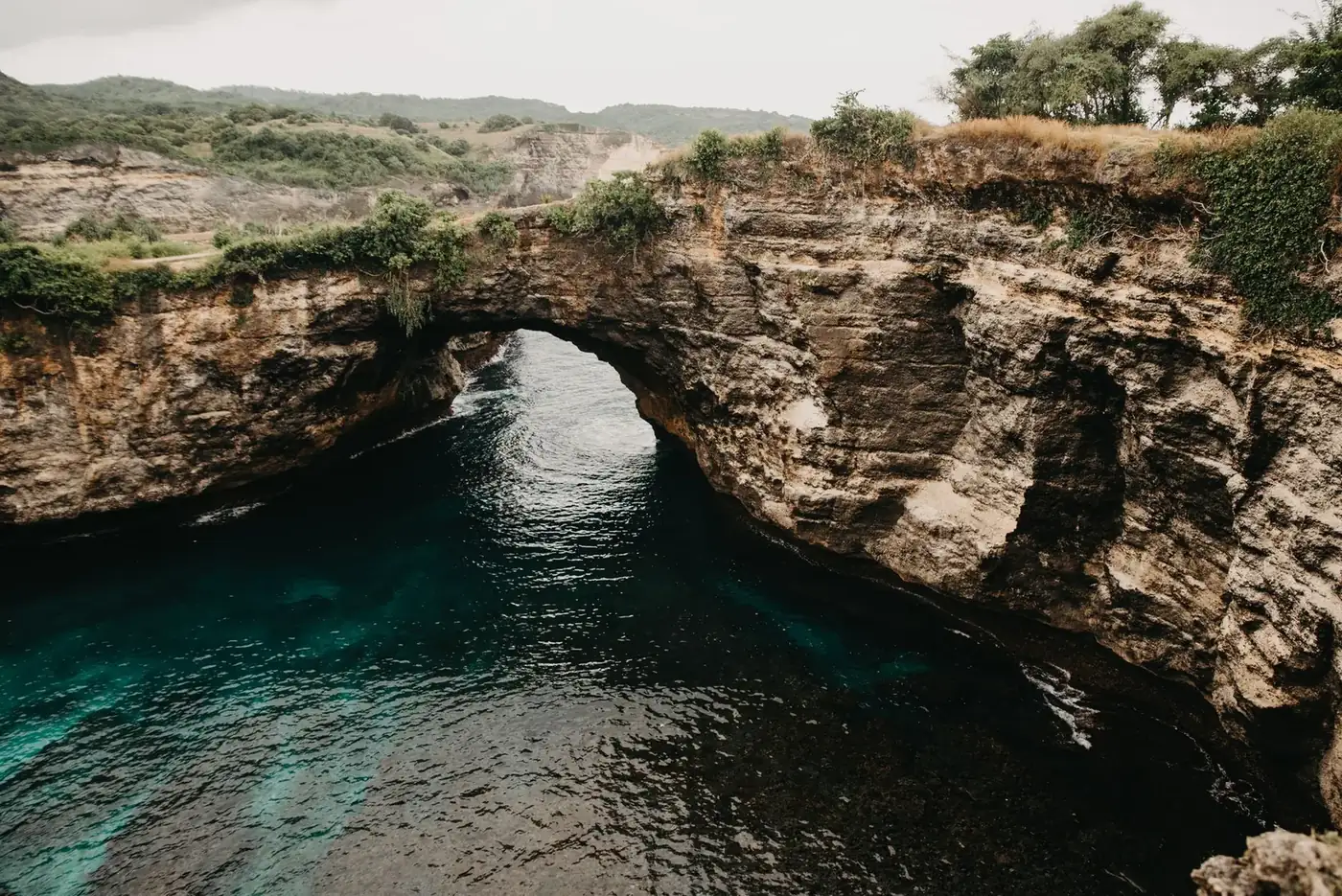
Two things to take seriously. First, there is no continuous fence. Sections of the rim have a low rail or a line of stones, and other sections have nothing at all between the path and a sixty metre drop into moving water. The ground is dry limestone dust that behaves like ball bearings on the sloped bits. Keep back from the edge, particularly if you are carrying a phone at arm's length or wearing flip-flops.
Second, there is essentially no shade. The headland is low scrub and exposed rock, and between about ten and two it is relentless. Water and sun cover are not optional extras here, they are the difference between an enjoyable half hour and a miserable one. Nothing is sold once you are past the car park.
Where it sits in the west coast circuit
Nobody drives to Broken Beach and back. It is the middle stop of a loop, and the order you drive that loop is the only real decision of the day.
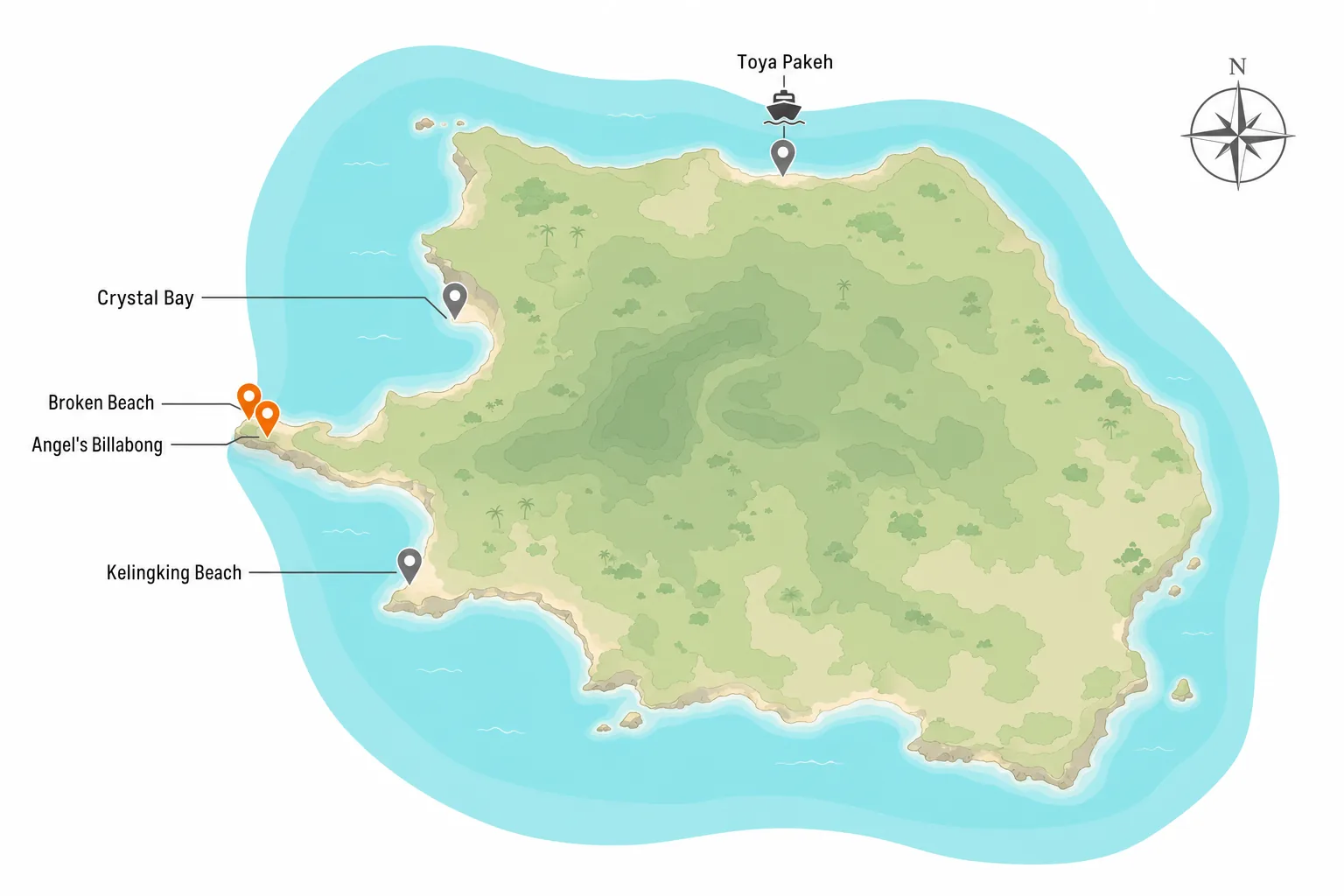
The geography is simple. Fast boats land at Toya Pakeh or Banjar Nyuh on the north coast. The road runs south-west to Kelingking, then north up the coast to Broken Beach and Angel's Billabong, then back north-east to Crystal Bay and the pier. Four stops, one loop, roughly two hours of driving spread across the whole day.
The roads have improved a great deal and most of this circuit is now sealed, but it is still narrow, steep in places and busy with tour vans between mid-morning and early afternoon. The twenty to thirty minutes between Kelingking and Broken Beach can stretch when two vans meet on a blind corner.
One thing not to attempt: pairing this with Diamond Beach and the east coast in a single day. Crossing the island each way eats three hours and you will end up rushing both halves. East and west are two separate days, which is the strongest argument for sleeping on the island rather than day-tripping from Bali.
The standard loop: Kelingking first, Broken Beach second
What almost every organised tour does.
| Time | Stop | Drive |
|---|---|---|
| 07:30 to 08:00 | Fast boat lands at Toya Pakeh or Banjar Nyuh | Crossing from Sanur, about 45 min |
| 08:30 to 09:00 | Kelingking Beach viewpoint | 45 min to 1 h from the port |
| 10:00 to 10:30 | Broken Beach and Angel's Billabong | 20 to 30 min from Kelingking |
| 12:00 | Warung lunch at the site or on the road east | On site or 10 min |
| 13:00 to 14:00 | Crystal Bay | 20 to 30 min from Broken Beach |
| 15:30 to 16:00 | Back at the pier | 20 to 30 min from Crystal Bay |
Your driver or your scooter is waiting at the pier. Allow twenty minutes to actually get moving, since the queue off the boat is longer than it looks. Kelingking at half past eight is empty enough to get the cliff without a crowd, and the separate descent to the sand is a two hour commitment that most people skip. By ten the sun is high enough for the cove at Broken Beach to read turquoise rather than grey, so nothing is lost by landing there mid morning: loop first, Billabong second, about ninety minutes for both. Lunch at the car park is simple nasi goreng and mie goreng, cash only.
Crystal Bay in the early afternoon is a real beach where you can actually swim, with shade under the trees, the one place on this circuit designed for sitting still. Last boats back to Sanur generally run in the late afternoon and they do sell out, so do not leave Crystal Bay on the assumption there is another one.
This is the right order if Kelingking matters most to you: it is the one stop on the island genuinely transformed by arriving early.
Reverse it for the tide: Broken Beach first
Worth doing when low water falls early.
Same arrival, different first turn, and tell your driver at the pier rather than on the road, because the standard loop is what he will assume. Broken Beach and the Billabong come at 08:45 to 09:15, 45 minutes to an hour from the port. The cliff walls still hold some shadow this early and the cove looks darker than the photographs, but the trade is hitting the Billabong on a morning low tide, which is the only time it is worth anything. Kelingking follows at 10:45, busier than it would have been at nine and hot on the exposed ridge, though the view itself does not change and the light on the cliff is arguably better later. Lunch and Crystal Bay from 12:30, then back at the pier by 16:00, unchanged from the standard loop.
Do this when the tide table puts low water before about ten in the morning. You trade an emptier Kelingking for a Billabong that is actually a pool rather than a channel full of moving sea, and on a day trip you rarely get a second chance at either.
West coast only, half a day
For a second visit, or for anyone staying on the island rather than day tripping.
This version only makes sense if you sleep on Nusa Penida. Leave in the late afternoon, 30 to 45 minutes from Toyapakeh or Crystal Bay, and reach the Broken Beach loop by 16:00 with the tour buses already gone. The sun is behind the arch rather than on it at that hour, so expect a silhouette rather than turquoise water. At 17:00, treat Angel's Billabong as a viewpoint from the upper rock: late afternoon rarely coincides with usable conditions in the pool, so do not go down onto the wet shelf in fading light. Stay for sunset over the strait from 17:30, on a headland facing the open ocean with Bali behind you, and bring a torch, since there is no lighting at all on the path or in the car park.
The quiet version, and the one almost nobody does. You give up the colour in the water and get the site to yourself, which on a coastline this photographed is a fair swap. Not an option on a Sanur day trip.
Getting there
One access road, one car park, and a choice between three ways of covering the distance from the pier.
| Coming from | Drive | Road | Note |
|---|---|---|---|
| Toya Pakeh or Banjar Nyuh piers | 45 min to 1 h | Sealed most of the way, narrow and steep in places | Where every fast boat from Sanur lands. Almost all visits start here. |
| Kelingking Beach viewpoint | 20 to 30 min | Short, winding, generally fine | The standard second stop of the west coast loop. |
| Crystal Bay | 20 to 30 min | Sealed, one steep climb out of the bay | Usually driven in the other direction, at the end of the day. |
| Diamond Beach, east coast | 1 h 30 to 2 h | Long, slow, some rough sections | Crossing the island. Doing east and west in one day is a poor plan. |
Driver with car
The default, and the sensible choice for most people. He waits at each stop, the air conditioning matters more than you expect by midday, and split between three or four it costs little more than scooters. Arrange it at the pier or through your accommodation the night before.
Scooter
Cheap, flexible, and the reason Nusa Penida has an unhappy accident record. The climbs are steep, the surface is patchy and the afternoon traffic is vans. Fine if you ride regularly at home, a bad place to learn, and check that your travel insurance actually covers you.
Organised tour
Boat, driver and the three stops in one booking, which removes the two things that go wrong on a day trip: the return crossing selling out, and negotiating a driver at the pier with a hundred other people doing the same. The three formulas compared, with what each one really includes.
What it costs
The entrance is trivial. Everything around it is where the money goes, which is the pattern across the whole island.
| What you pay for | Detail | Order of magnitude |
|---|---|---|
| Combined entrance ticket | One ticket covers Broken Beach and Angel's Billabong, since they share the same site. Cash, collected at the barrier. | A few dollars |
| Parking | Charged separately per scooter or per car, and collected on the way in. | Small change |
| Scooter rental for the day | Petrol on top, paid at roadside pumps or in bottles. Helmet included, licence rarely checked. | Under $12 |
| Driver with car for the day | The normal way to do the west coast. Split between four it is barely more than scooters. | $35 to $55 |
| Organised west coast tour from Bali | Fast boat, driver, guide and the three main stops, booked as one package. | $50 to $100 |
All of it is cash, none of it is posted on a board that you would trust, and every figure above moves. There are no card machines at the barrier, the nearest reliable ATM is back near the port, and the tickets for Broken Beach and Angel's Billabong are sold together because it is administratively one site. Carry small notes, budget a little more than you expect, and treat published entrance fees on any website, this one included, as an order of magnitude rather than a price.
The best time to come
Three different clocks matter here: the hour of the day, the state of the sea, and the month of the year.
Before 10:00, or after 15:00
The tour vans converge between about ten and one, which is also the hottest and most exposed part of the day on a headland with no shade. Early gives you an empty loop with the cliff walls still in shadow. Late gives you warm light and almost nobody, and only works if you are sleeping on the island.
Mid morning for the colour
The turquoise inside the cove is the sun reaching the reef shelf through the water, and that needs the sun reasonably high. Around 09:30 to 11:00 is the compromise most people are unknowingly aiming at: bright enough for colour, early enough to beat the worst of the crowd.
April to October is calmer
Dry season means clearer water, more reliable fast boat crossings and better odds of a workable tide at the Billabong. It also means more people. In the wet months the crossing is occasionally cancelled outright, which matters more than rain on the day.
The single biggest variable is not weather, it is whether the day trip boats have arrived. Nusa Penida receives a large volume of visitors who land at the same pier, in the same hour, and drive the same loop in the same direction. Being thirty minutes ahead of that wave or thirty minutes behind it changes the experience of every stop on the west coast far more than the season does.
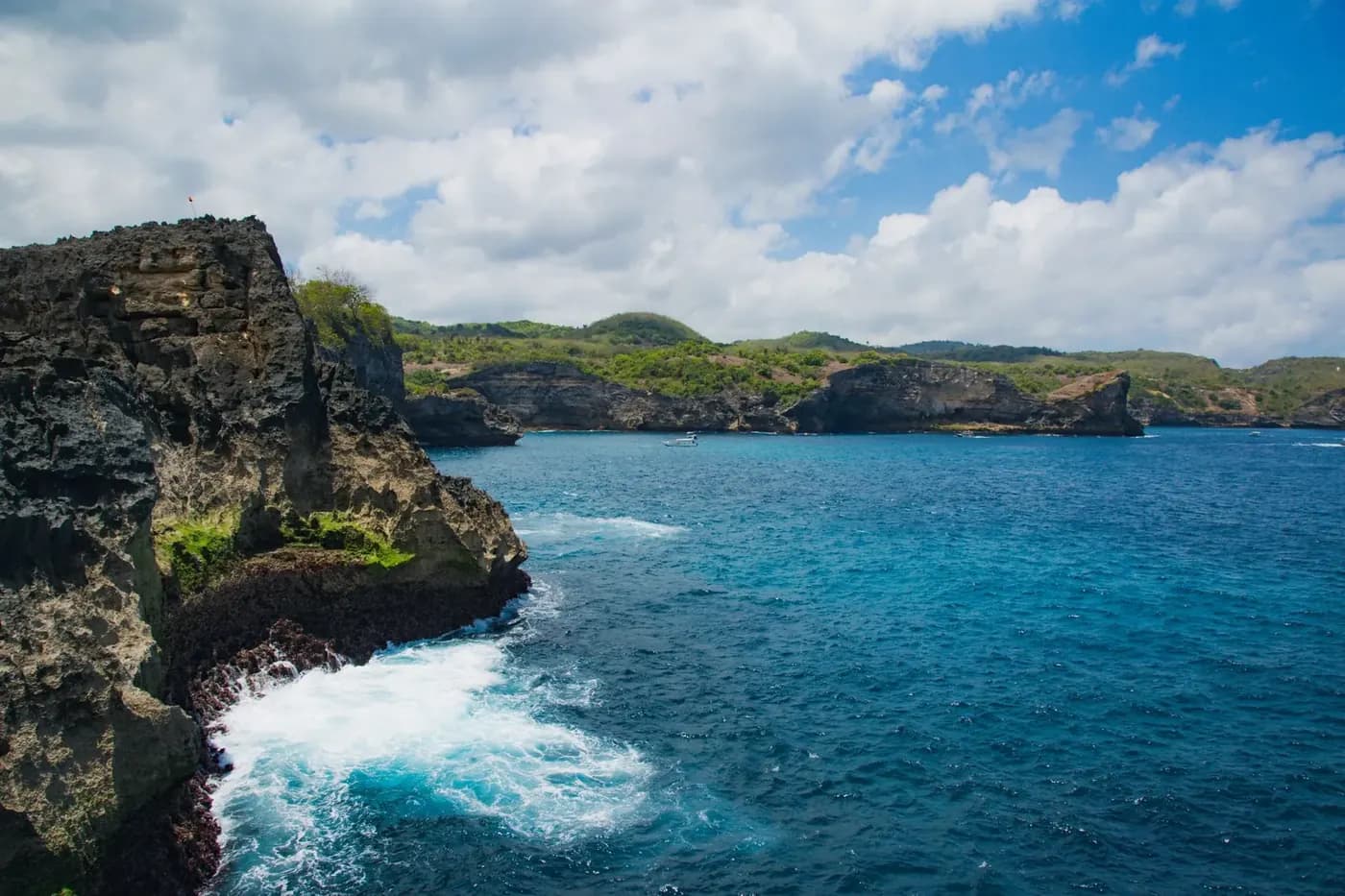
That is also the strongest case for staying a night. People who sleep in Toyapakeh or near Crystal Bay can be on the loop at eight in the morning or at five in the afternoon, when the site is close to empty and the light is better in both directions. Day trippers from Ubud or the southern beaches are locked into the middle of the day by the boat timetable, and they arrive already two hours into their journey.
On rough sea days, one consolation: Broken Beach is arguably better when the swell is up. The arch fills with white water, the cove churns, and none of it costs you anything because you were never going down there. It is the Billabong that loses on those days, and you were only ever going to look at it anyway.
Photographing it
The subject here is a hole in the ground, which is harder to photograph well than a cliff or a beach. Four things that make the difference.
- Walk to the far side. The arch only reads as an arch from the section of rim opposite the entrance, with open ocean visible through it. From the near side you are photographing a pond.
- Put a person on the rim. Nothing in the frame gives scale otherwise, and the cove is much bigger than a photograph of it suggests. A figure on the far path is what makes it obvious.
- Shoot the arch from the ocean side of the loop late in the walk, when the light is coming across the headland rather than straight into the lens over the water.
- Wide lens, and step back from the edge. The instinct is to lean out over an unfenced drop for another few degrees of view. A wider focal length does the same job from two metres further back.
About the drone
The image that made this place famous is the vertical one, looking straight down at the cove from a few hundred feet, and it can only be made with a drone. Flying here is common and generally unremarked, but the practical constraints are real: launch early, before the paths fill, keep well clear of people on the narrow sections, and expect wind coming off the ocean across the headland.
Rules on drones in Indonesia change and are enforced unevenly from one site to another. Check the current position before you count on flying, do not launch over a crowd, and accept that on a busy mid-morning the answer may simply be no. The view from the rim was always the point.
Practical details
Where
West coast of Nusa Penida, between Kelingking and Crystal Bay. One access road, one car park serving both Broken Beach and Angel's Billabong.
Bring
Cash in small notes, water, sun cover and shoes with grip. The path is dusty limestone and there is no shade and nothing sold once you are past the entrance.
On site
Basic toilets, a handful of warungs and drink stalls at the car park, sarongs and coconuts for sale. Patchy mobile signal, no card payment anywhere.
How long
Ninety minutes for both sites without hurrying. Forty-five if you only want the Broken Beach loop and the standard photograph from the far side.
Eating and sleeping nearby
Food at the site
The car park has a row of warungs doing nasi goreng, mie goreng, instant noodles and cold drinks, plus coconuts from a cart. It is honest, cheap and not a destination meal, and it exists because there is nothing else for twenty minutes in either direction. Cash only, and portions arrive slowly when three vans have just pulled in.
If you would rather eat properly, hold out for Crystal Bay in the afternoon, which has beachfront warungs with shade and a sea view, or head back towards Toyapakeh where the choice widens considerably.
Staying on the island
Most accommodation clusters around Toyapakeh and Ped on the north coast, near the piers and the restaurants, with a growing number of cliff-edge villas scattered along the west and south. From Toyapakeh you are forty-five minutes to an hour from Broken Beach, which is close enough to be on the loop before the first boats unload.
One night changes this island completely. It converts a compressed seven hour day trip into two unhurried mornings, it lets you split east coast and west coast properly, and it puts you on the west coast at the two hours when nobody else is there. The full picture of ferries, bases and what is worth doing is on the Nusa Penida guide.
Is it worth it?
A short verdict, by the kind of traveller asking.
First time on Nusa Penida
It is on the standard loop, it costs almost nothing, and it takes half an hour. Skipping it to save time saves you very little and costs you the most unusual formation on the coast.
Anyone avoiding staircases
Kelingking and Diamond Beach both hide their payoff behind a brutal descent. This one does not ask for anything beyond a flat half hour in the sun, and the view is at the top rather than the bottom.
Anyone coming to swim
There is no water access at Broken Beach and the Billabong is a gamble on the tide. If a swim is the point of the day, that is Crystal Bay, or a snorkelling boat, not this headland.
On a half day squeeze
If you land at midday and the last boat is at four, do Kelingking properly rather than three sites badly. Broken Beach rewards being walked around, and a fifteen minute version of it is not worth the drive.
The honest summary is that Broken Beach is the best effort-to-payoff ratio on the island. It is not the most spectacular thing on Nusa Penida, that is still the cliff at Kelingking, and it is not the best hour, which is a boat over the cleaning stations at Manta Point. It is the one that asks least of you and still leaves you with something you have not seen anywhere else.
Broken Beach: common questions
What people ask before making the drive across the island.