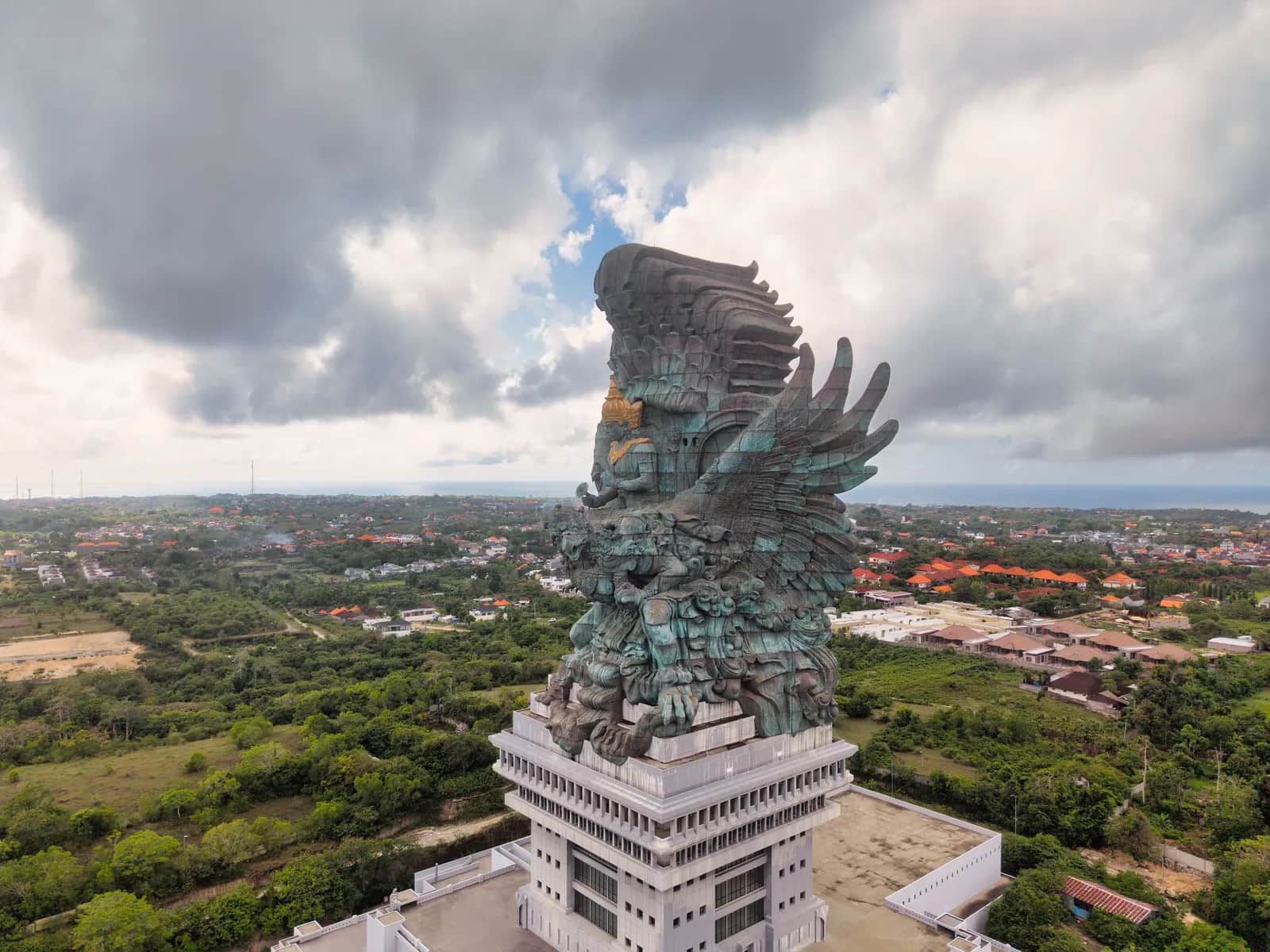
Garuda Wisnu Kencana Cultural Park, GWK to everyone in Bali, is the park built around the tallest statue in Indonesia: Vishnu riding Garuda, 121 metres from the ground to the crown, standing on a plateau cut out of the limestone of the Bukit peninsula in Ungasan.
It sits on the road from the airport to Uluwatu, which is why most people ask the same question about it: is it worth stopping on the way? Yes, if you give it two hours and do not arrive at noon. The rest of this page is what those two hours cost, what they include, and how they fit around the temple and the sunset.
On this page
The Garuda Wisnu Kencana statue: 121 metres of Vishnu and Garuda
The figures first, because they are what people come for. The statue itself is about 75 metres tall with a wingspan of around 65 metres, and it stands on a pedestal building that takes the whole monument to 121 metres. That is taller than the Statue of Liberty with its base, and it makes GWK the largest statue in Bali and in Indonesia by a wide margin. On a clear day you see it from the window of a plane landing at Ngurah Rai.
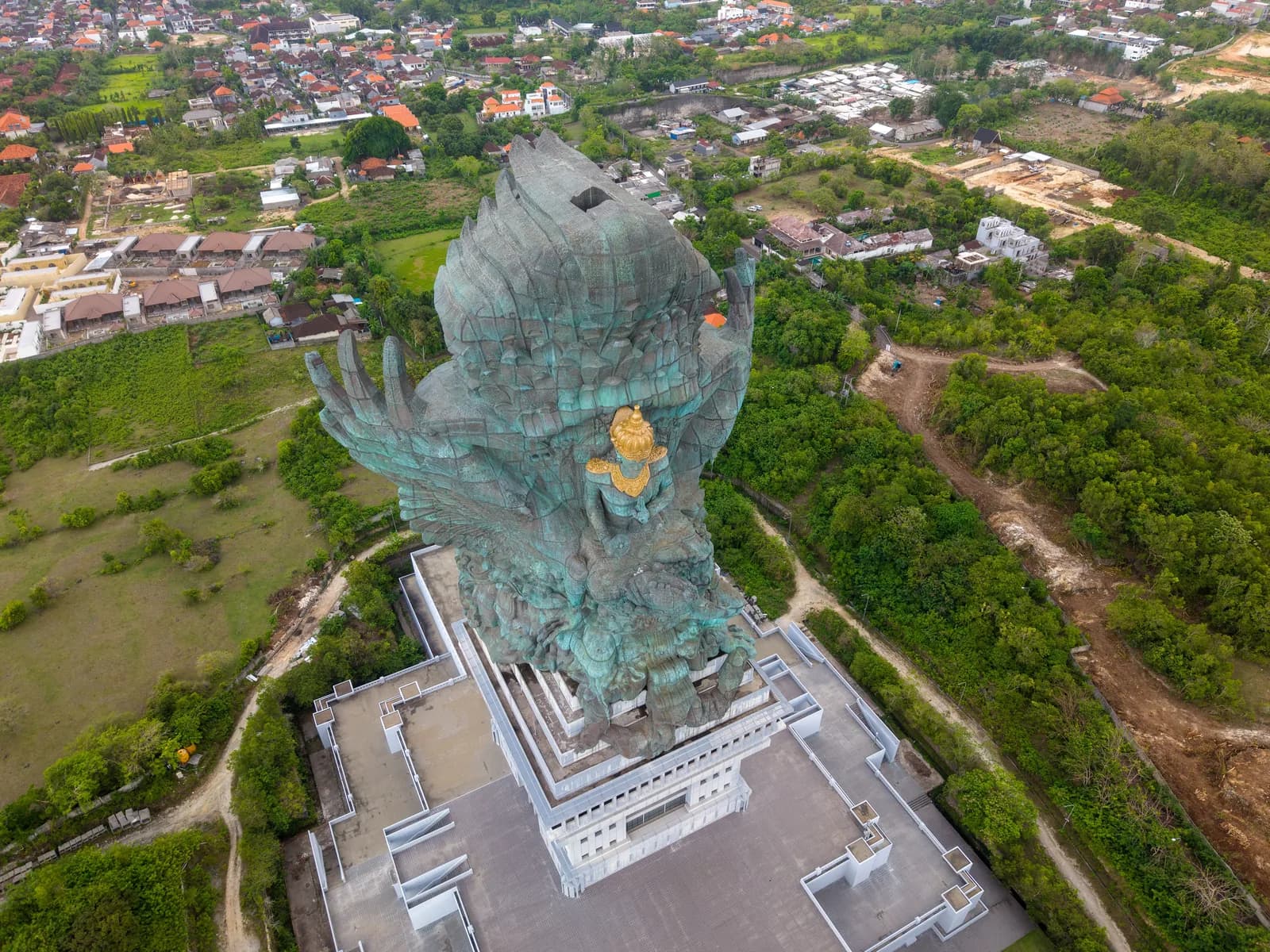
What the statue shows, and the story behind it
Wisnu, the Balinese name for Vishnu, rides Garuda, the half man, half eagle who serves as his mount. In the story, Garuda sets out to find amerta, the elixir of immortality, to buy his mother's freedom from slavery. Vishnu lets him take it on one condition: that Garuda carries him from then on. Balinese read the pair as loyalty and protection, and kencana means gold, the colour the finished statue was meant to carry.
Who built it, and why it took almost thirty years
GWK is the work of the Balinese sculptor Nyoman Nuarta. The project started in the early 1990s, and the park spent most of the following two decades with the head, the hands and Garuda's head standing as separate pieces on the plateau while money ran out and ran out again. There were objections too: some in Bali did not like the idea of a Hindu deity built as a paid attraction. The statue was finally assembled, clad in copper and brass plates over a steel frame and a concrete core, and inaugurated in 2018.
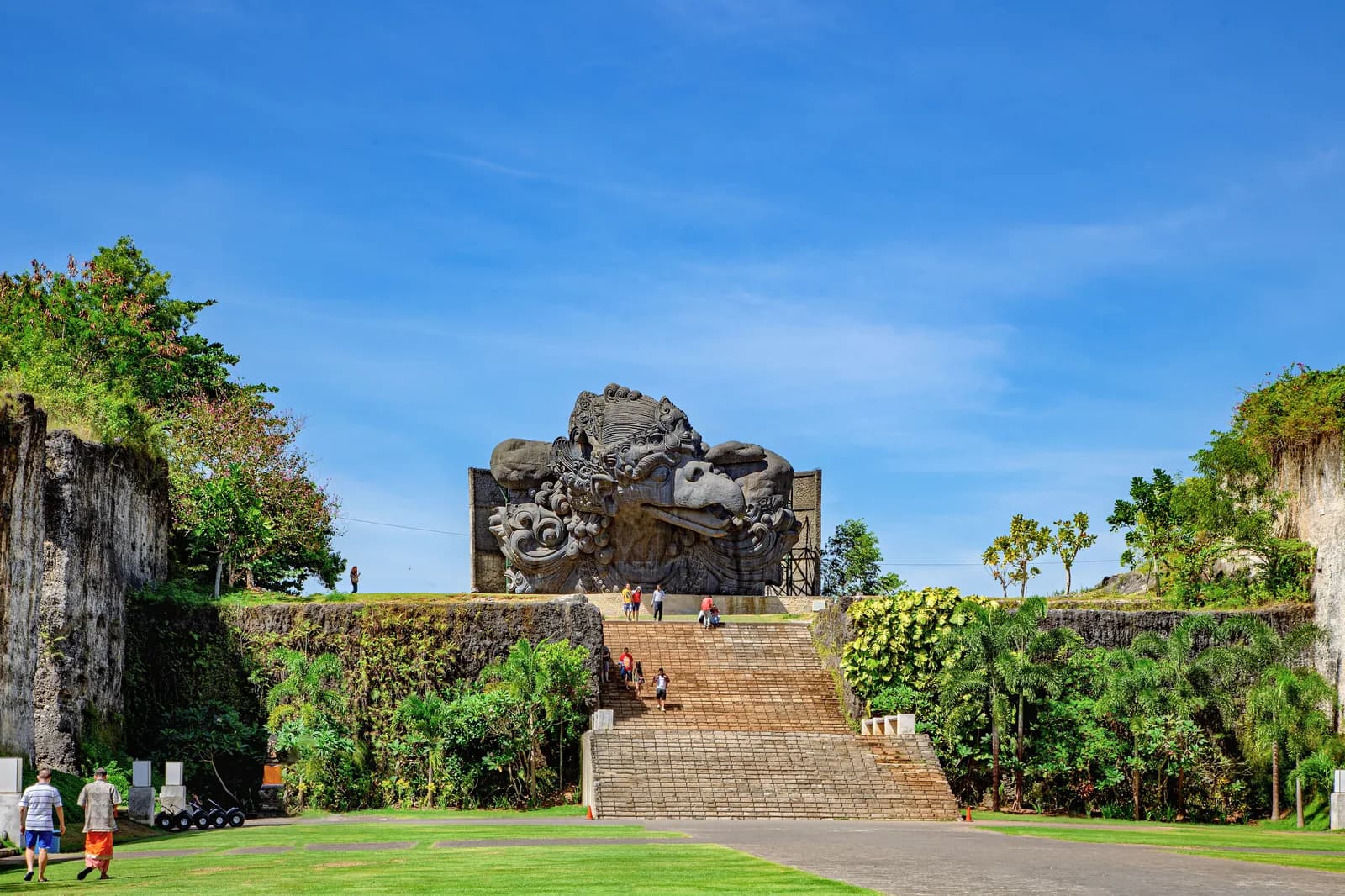
The long wait shaped the park. Plaza Wisnu, with the separate bust of Vishnu, and the giant Garuda head at Plaza Garuda are those earlier pieces, and they are among the best parts of the visit.
Can you go up inside the statue?
Only with the Top of Statue ticket, which adds a guided visit to the 9th and 23rd floors. It has limited slots and does not run every day, so treat it as a bonus if it is available rather than the reason for the trip. Without that ticket, the base building is not worth going into: it is hot and the ground floor has little to show.
GWK ticket prices in 2026, and which ticket to buy
The official site is the cheapest place to buy, and the gate costs a little more. There is no separate foreigner rate at GWK, which is not always the case at Indonesian attractions: everyone pays the same. Children under 100 cm go in free, and there is no senior discount.
| GWK ticket | Detail | Order of magnitude |
|---|---|---|
| Regular entrance | The park, the ASANA Artseum, the daytime performances in the amphitheatre and a free iced or ginger tea at Jendela Bali. Does not take you inside the statue. | IDR 125,000 online, 150,000 at the gate (≈ US$7 to US$8.30) |
| Entrance + Barong show | Everything above, plus the evening Barong performance at 18:00. | IDR 175,000 to 200,000 (≈ US$10 to US$11) |
| Barong show only | The evening performance and nothing else. No access to the statue side of the park. | IDR 100,000 to 125,000 (≈ US$5.50 to US$7) |
| Entrance + Top of Statue tour | A guided visit up inside the pedestal and statue, to the 9th and 23rd floors. Limited slots, and not running every day. | IDR 300,000 to 400,000 (≈ US$17 to US$22) |
| Buggy, Festival Park to the statue | Optional return ride over the last 300 metres. Worth it with small children or in the midday heat. | IDR 40,000 (≈ US$2.20) |
| Parking | Paid at the car park before the free shuttle bus up to the ticket gate. | IDR 2,000 to 5,000 scooter, more for a car |
Prices checked in September 2026 with two resellers whose rates are valid to the end of the year. The sources differ by up to IDR 50,000 on the combined tickets, which is why those are given as a range.
Buying GWK tickets online or at the gate
Online is the better option even if you decide on the spot: you get a QR code by email, it is IDR 25,000 cheaper, and you skip the ticket queue, which has no shade and is at its worst in late morning when the tour groups arrive. The counters take cash and card if you have no data. The ticket gate is at the top of the free shuttle bus ride from the car park, not at the car park itself.
Which GWK ticket is right for you
The regular entrance covers what most people want: the statue from the outside, the limestone corridors, the Artseum and whatever is on in the amphitheatre. Pay for the Barong combo only if you are staying for the evening. The Top of Statue tour is for people who really want the view from inside. The view from Plaza Garuda is free with the regular ticket.
Useful with a driver
Free cancellationGWK Cultural Park tickets and Bukit tours
- ✓Entrance tickets with a QR code, so you walk straight past the counter queue
- ✓Half-day tours that pair GWK with Uluwatu temple and the kecak, driver included
- ✓Free cancellation on most listings, useful in the wet season
- ✓The Top of Statue tour is sold on the official site only, not here
Affiliate link. Booking through GetYourGuide costs you nothing extra and supports the guide. Prices are indicative and vary by option and season.
For the entrance alone, the official site is just as good. The tours are where booking ahead saves you something, because transport is the expensive part of a Bukit afternoon.
GWK Cultural Park shows: what is included and at what time
The amphitheatre runs short Balinese dance performances through the day, and they are included in the regular ticket. They are shorter and simpler than the big evening shows, and they give you twenty minutes out of the sun. The Barong at 18:00 is the paid one.
| Performance | When | Ticket |
|---|---|---|
| Balinese dances (welcome dance, Barong Keris) | From about 10:00, several sessions through the day | Included in the regular entrance |
| Garuda Wisnu ballet | Afternoon sessions, times posted at the gate | Included in the regular entrance |
| Barong show | 18:00 daily | Barong ticket or entrance + Barong combo |
| Kecak in the GWK amphitheatre | Around 18:30 on programmed evenings | Check the programme for the day |
The daytime programme changes with the season and with events in Festival Park. The times posted at the ticket gate on the day are the ones to trust.
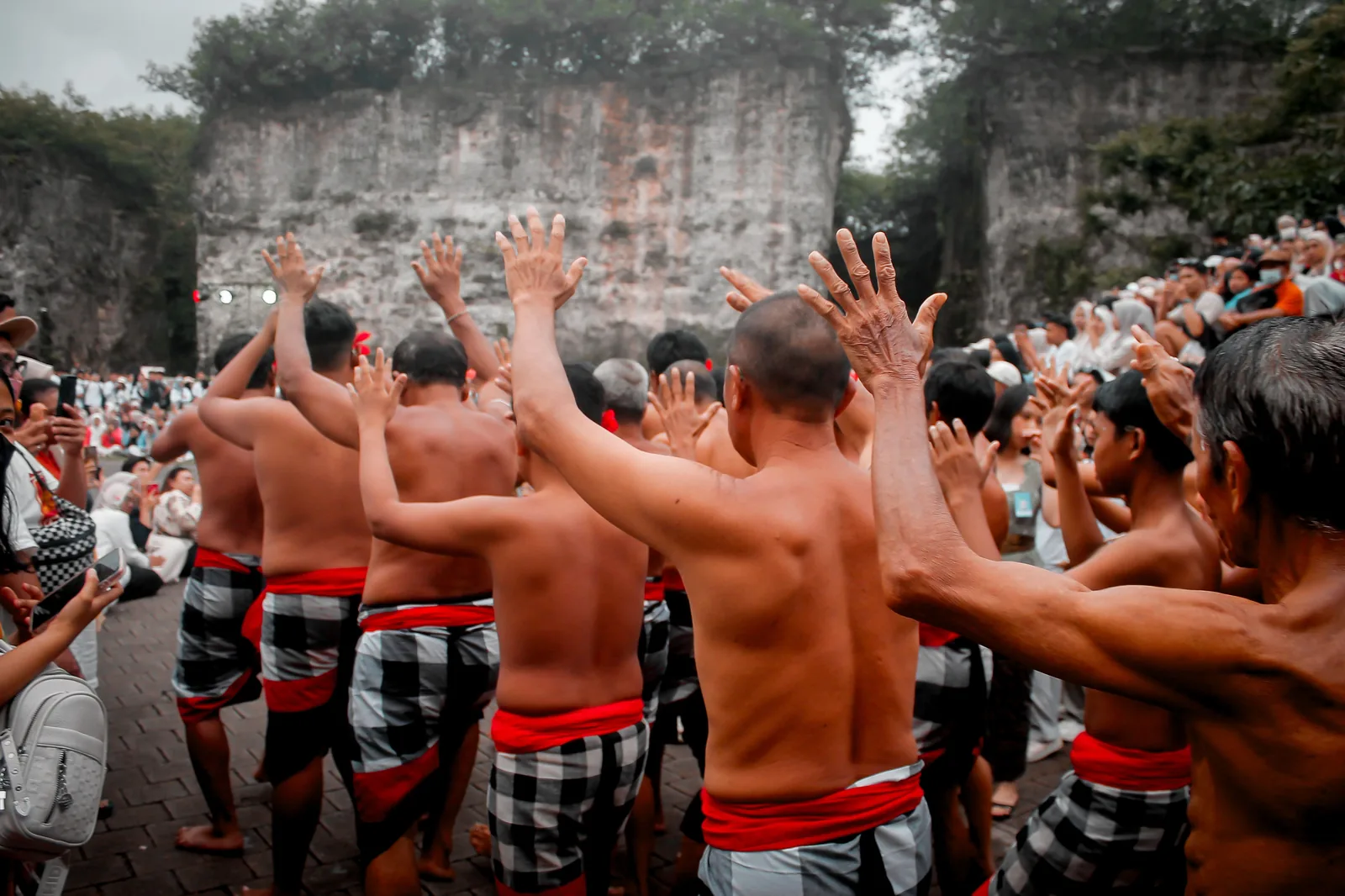
The GWK kecak is not the Uluwatu kecak
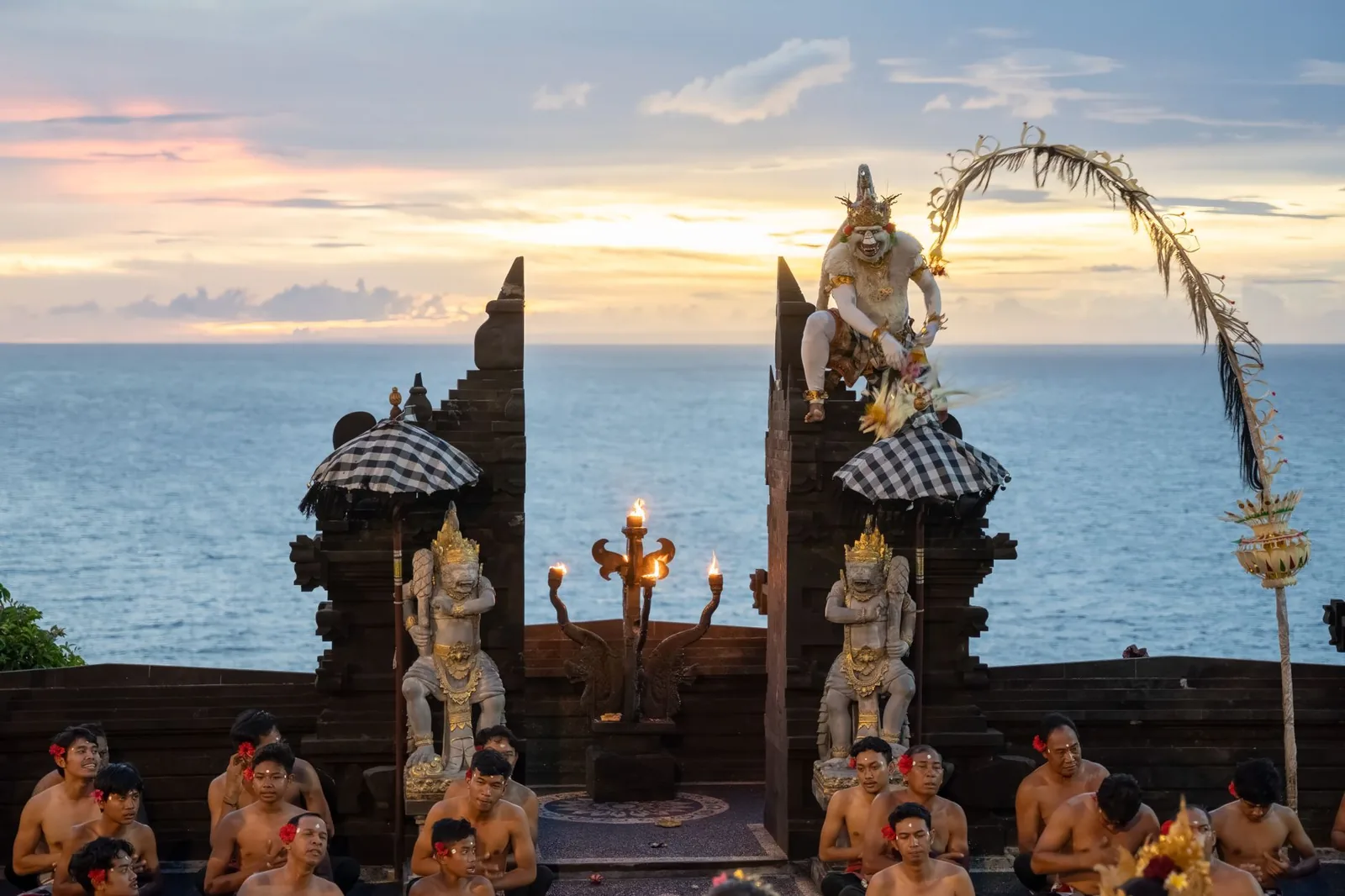
This is worth a line because people book the wrong one. The kecak everyone talks about is performed at sunset in the clifftop amphitheatre beside Pura Luhur Uluwatu, with the ocean behind the stage. GWK sometimes programmes a kecak of its own in its inland amphitheatre. Same dance, very different evening: no cliff, no sunset over the sea, and a smaller crowd. If the sunset is what you are after, the kecak dance at Uluwatu temple is the one to book.
Best time to visit GWK: the heat, the light and the crowds
The hour matters more than the month here. GWK is built on a plateau of pale quarried limestone with very little shade, and between 11:00 and 15:00 the stone reflects the heat back at you. The shuttle, the ticket queue and the walk between plazas all happen outside.
Morning: 9:00 to 11:00
The coolest and quietest slot. Tour groups tend to arrive from late morning, and the ticket queue with them, so an early start gets you the limestone corridors almost to yourself.
Late afternoon: from 15:30
The other good window, with softer light on the limestone. The catch is that it overlaps with the time you should leave for Uluwatu if you want a seat at the kecak, which is the subject of the next two sections.
Which months are best for GWK
The dry season, from May to September, with June and September a little quieter than the July and August school holidays. In the wet season the park stays open, but a downpour on open limestone with nowhere to shelter is miserable, and mornings are more reliable than afternoons. The Bali weather by month has the detail.
Is GWK worth the stop on the way to Uluwatu?
GWK is on the only main road onto the Bukit, so the question sounds easy. It is not, because of time. The visit takes two hours, and the kecak at Uluwatu wants you at the gate by 17:00. A stop that starts after 14:30 is either too short to be worth the ticket or makes you late for the sunset.
Stop at GWK if
- You have a full day on the Bukit and can do GWK first thing, then a beach, then the temple.
- You are flying in or out and have a few hours to fill: it is one of the closest attractions to the airport.
- Monumental scale is your thing. The size of the statue is hard to picture from photos.
- You are staying on the Bukit and can come back at 9:00 on another day instead of forcing it into a sunset evening.
Skip GWK if
- You are driving down from Ubud or Canggu for the kecak and leaving after lunch. There is no time for both.
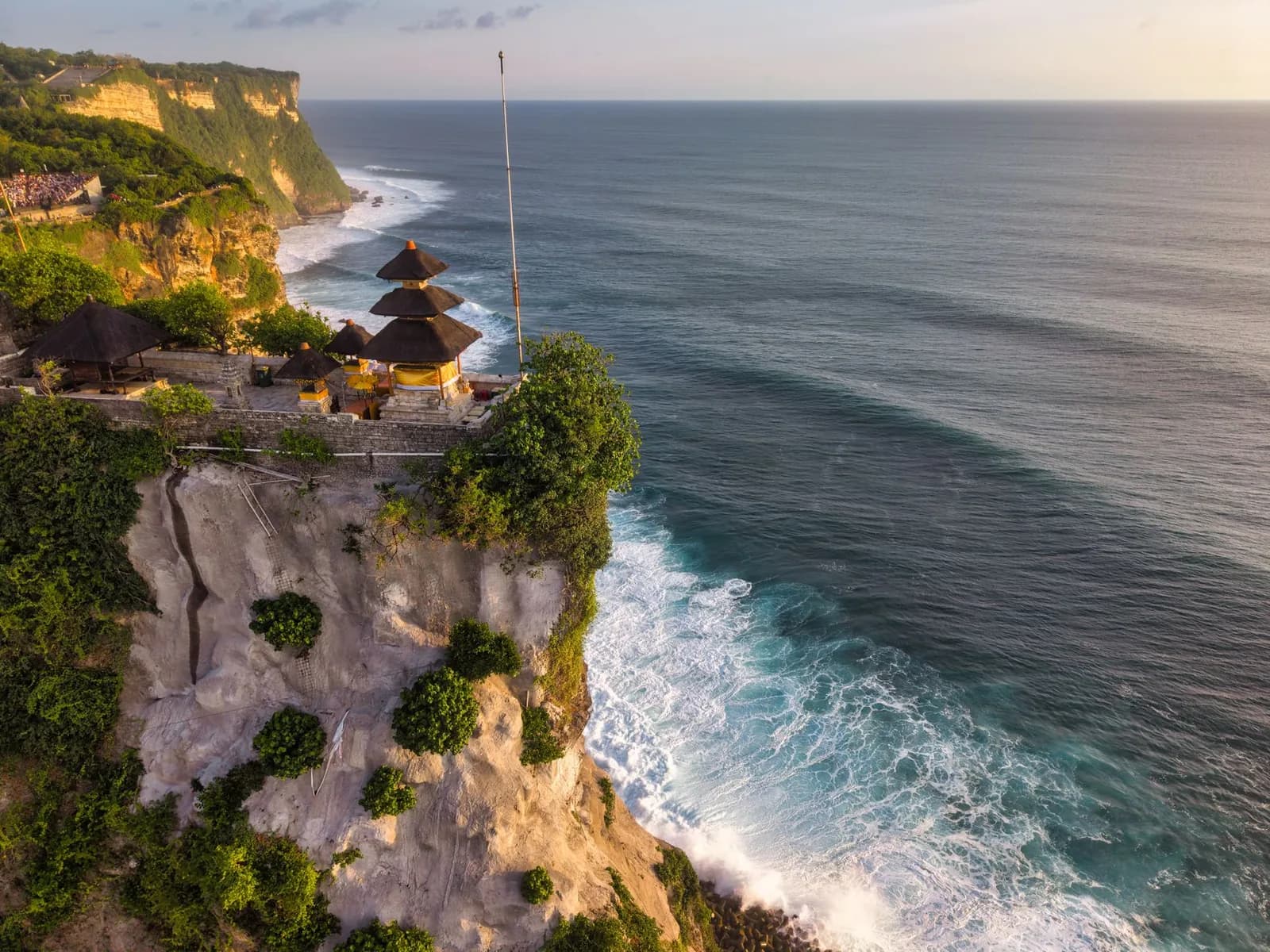
- You only have time for one sight in the south. The cliff at Uluwatu temple is the more memorable place.
- You want an active temple. GWK is a monument and a park, not a place of worship.
In short: GWK is worth a planned visit and not worth a rushed stop. Thirty minutes buys you the car park, a shuttle bus and a queue.
GWK, Uluwatu temple and the kecak in one afternoon
It can be done, with one trade-off: to fit both, you visit GWK in the hottest part of the day. Here is the version that works from Seminyak or Kuta, working back from the 18:00 kecak.
12:30: leave the hotel
Seminyak to GWK takes about an hour at this time of day, less from Kuta or Jimbaran. Hat, water and proper shoes.
13:30 to 15:30: GWK
Buy the ticket online in the car. Do the full loop, use the amphitheatre shows as shade breaks, and take the buggy for the last 300 metres if the heat is getting to you. Leave by 15:45 at the latest.
16:15 to 17:00: Uluwatu temple
About 25 minutes to the temple, longer as the kecak traffic builds. Pay the temple entry, pick up the sarong and walk the clifftop path while the light turns gold. Watch your sunglasses: the monkeys are on this path.
17:00 to 19:00: the kecak
At the amphitheatre gate by 17:00 for a decent seat, show at 18:00, back at the car around 19:15. The kecak page covers where to sit and how to get out of the car park.
If you would rather see GWK in the cool, split the day: GWK at 9:00, lunch and a swim at Padang Padang, then the temple at 16:30. That only makes sense if you are staying in the south. Otherwise, a driver saves you the navigation and the parking, and half-day tours combining GWK, the temple and the kecak follow the same timing. Partner link.
How long to spend at GWK Cultural Park, and the route through it
Two hours at a steady pace, three with a show and a meal. The park covers about 60 hectares and everything is spread out, so here is the loop in the order you walk it.
Car park and shuttle bus
You park at the bottom and a free shuttle runs every few minutes up to the ticket gate. Buy your water here if you did not bring any.
Ticket gate, food court and amphitheatre
Past the gate is a strip of shops, a food court, a Starbucks and the covered amphitheatre. Check the show times as you pass and plan your loop around the one you want to see.
Plaza Wisnu
A few flights of stairs up, the separate bust of Vishnu on a hilltop terrace. This was the first piece of the monument completed, back when the main statue was still a plan.
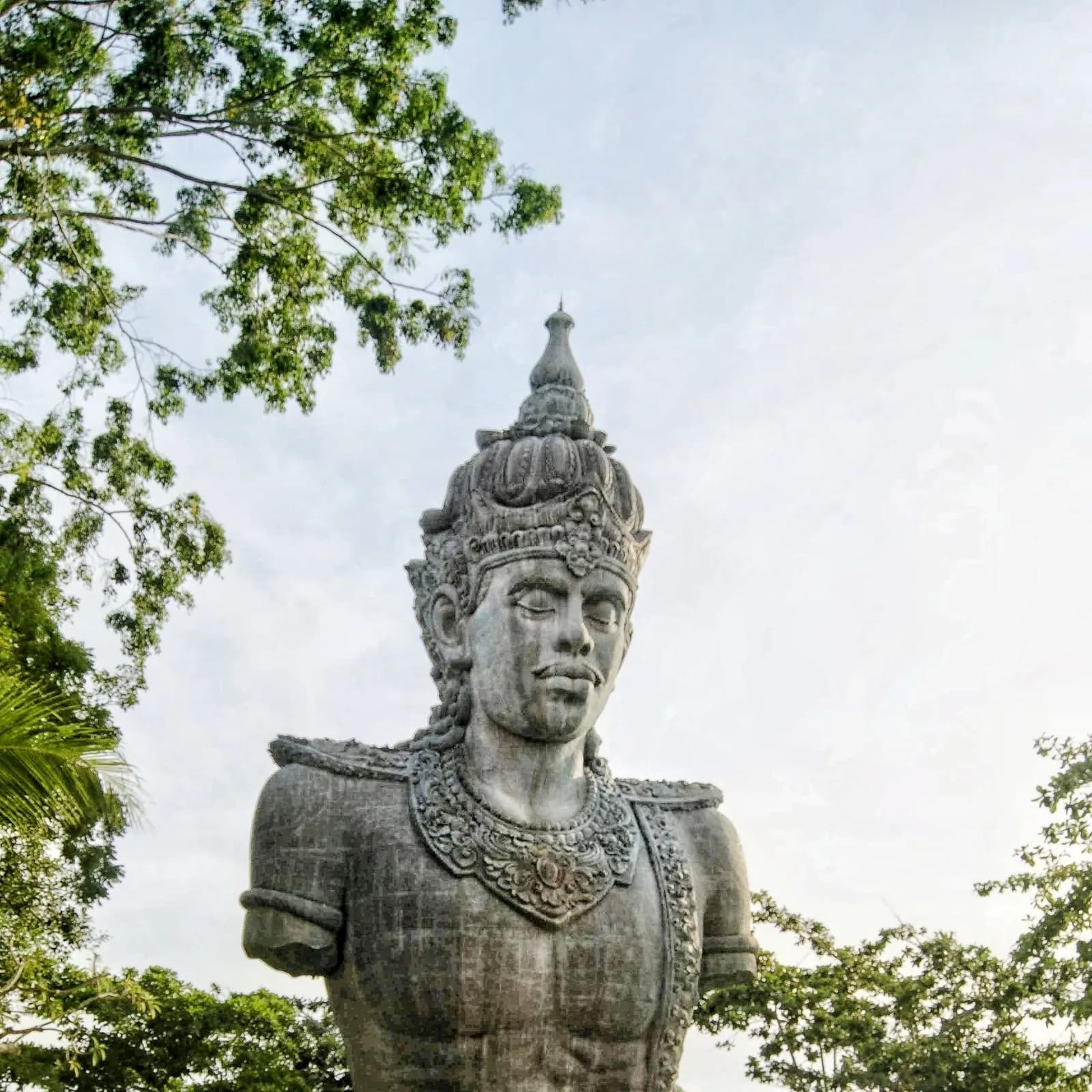
Plaza Garuda and the limestone corridors
This is the part of the park worth the ticket. Paths run between tall walls of quarried limestone, and at one point they frame the main statue between two cliffs: that is the classic GWK photo. The giant Garuda head sits on the plaza.
Festival Park and the statue
A large open lawn used for concerts and ceremonies, then 300 metres to the foot of the statue. This is where the IDR 40,000 buggy helps.
Jendela Bali, on the way back
The regular ticket includes a free iced or ginger tea at Jendela Bali, near the gate, with refills. The terrace looks out over the coast rather than the statue, and it is the best seat in the park to cool down before the shuttle.
Getting to GWK from Kuta, Seminyak and the airport
GWK is in Ungasan on Jalan Raya Uluwatu, the main road onto the Bukit, a few kilometres past the neck of land at Jimbaran. There is no public transport. You arrive by car with a driver, by scooter, or by Grab or Gojek.
| From | To GWK | Note |
|---|---|---|
| Ngurah Rai airport | 20 to 25 min | The easiest attraction to fit around a flight |
| Jimbaran | 15 min | Straight up the hill |
| Kuta | 30 to 40 min | Via the bypass, slower at rush hour |
| Seminyak | 45 to 70 min | The top of the range after 13:00 |
| Uluwatu temple | 25 min | More from 16:00, when everyone heads for the kecak |
| Ubud | 1 h 30 to 2 h | Worth it only as part of a full Bukit day |
Grab and Gojek are fine to get there, but finding a ride back from the Bukit in the evening is harder, and the return leg is where the fares go up. With a stop at the temple and the kecak after, a driver for the afternoon costs less than it sounds and waits for you. The Uluwatu guide explains why nothing on the peninsula is close to anything else.
Where to eat at GWK
The food court does nasi goreng, mie goreng and bakso at local prices, there is a Starbucks and a Mixue for ice cream, and New Beranda does a buffet near the main plaza. Jendela Bali is the one with the view. None of it is a reason to come, and after the visit the warungs and seafood grills of Jimbaran are fifteen minutes away.
GWK Cultural Park, answered
Prices, times and the statue, in short.