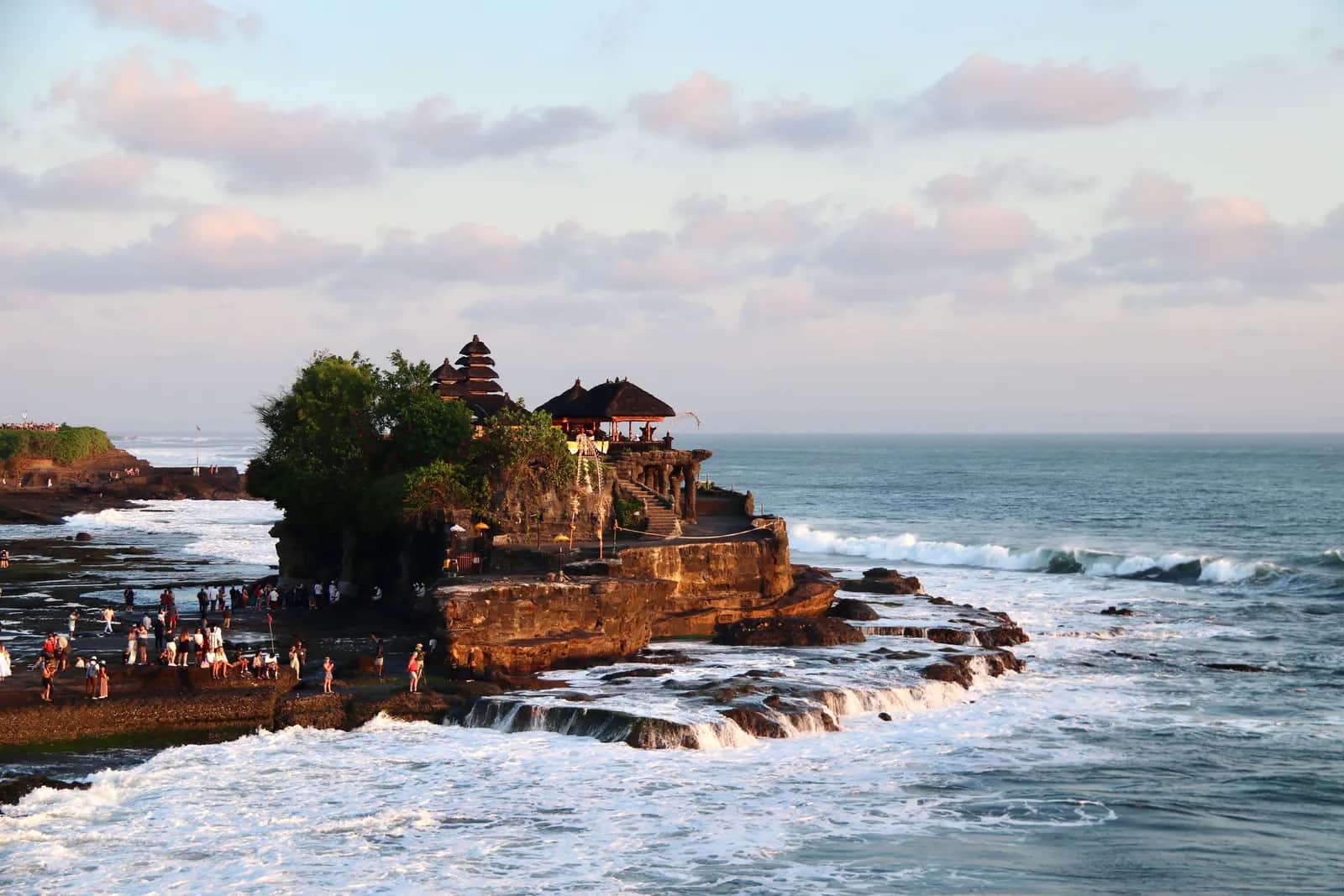
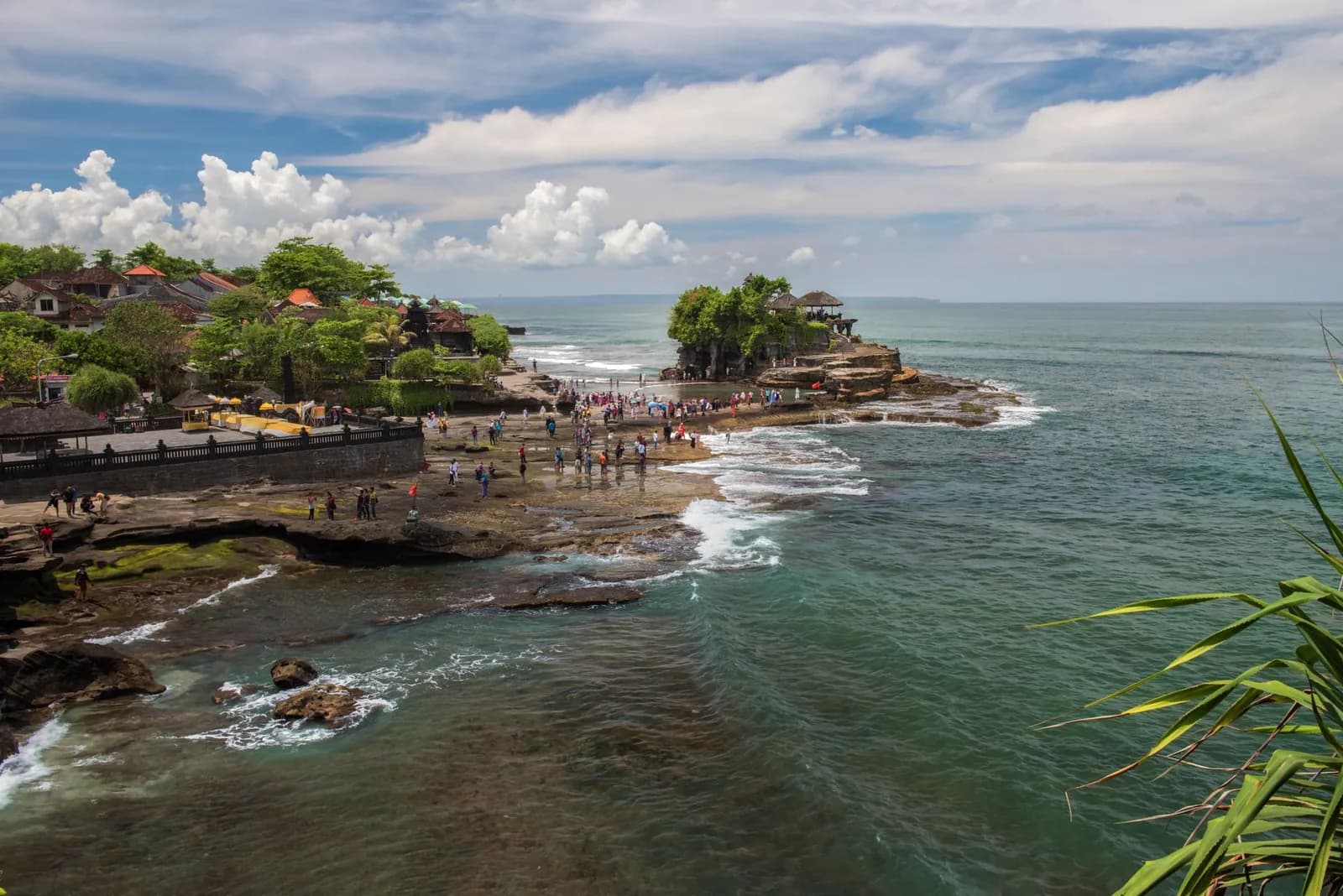
Tanah Lot temple stands on a lump of black rock a short way off the coast of Tabanan, and the sea decides how close you get to it. For a few hours around low water the shelf between the shore and the rock is dry and you walk over to the spring at its base. For the rest of the day that shelf is under the surf and the temple is an island you photograph from the cliff.
Both versions are worth the trip. They are not the same trip, and the guides that rank for this place mostly describe the second one while selling you the first.
One thing to settle before anything else: you do not go inside. The shrine on top of the rock is working consecrated ground and only Balinese Hindus attending a ceremony climb the last staircase. What you get is the base of the rock, the coast around it, and one of the best sunsets on the island.
On this page
The tide decides your visit
This is the single most useful thing to know about Tanah Lot and it is missing from almost every guide to it. The coast here runs a semi-diurnal tide, two highs and two lows a day, with a range big enough to uncover and then bury the causeway between the shore and the rock. Pick what you want out of the visit, then pick the water that delivers it.
The one combination that gets you closest to everything is a rising tide arriving in the last two hours of daylight: you cross while the shelf is still out, come back up as the water returns, and watch the sea close around the rock while the sun goes down behind it. The sky is a separate variable, and which month you come in decides whether there is a sunset to photograph at all.
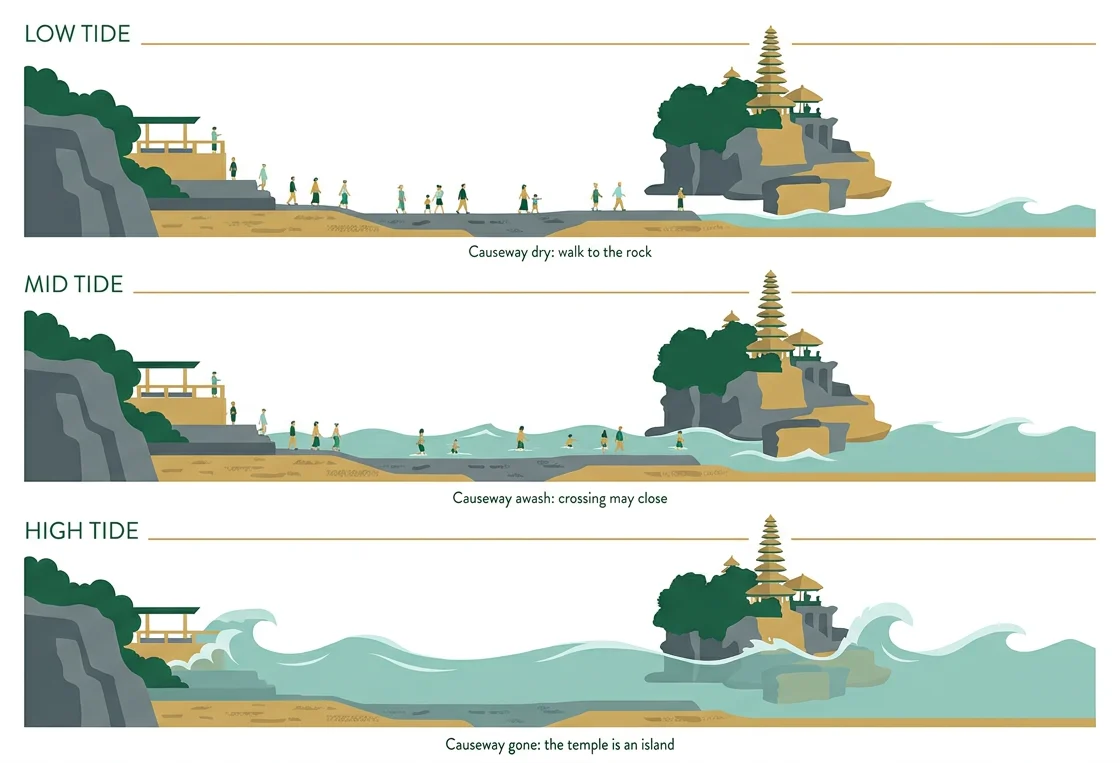
There is no good tide in the absolute. What you want out of the visit decides which water you need, and the table below crosses the two.
| Tide | Walk out to the rock | The temple on the water | Sunset |
|---|---|---|---|
| Low, causeway dry | Go now, and go straight down | The wrong tide for this photograph | Fine, with one adjustment to where you stand |
| Halfway, ankle to knee deep | You will get wet, and it may not be allowed | Close enough, and less crowded than you feared | The combination most people would choose if they knew to |
| High, causeway gone | Not today | This is the picture | Spectacular, and the busiest the site ever gets |
At low tide: cross first, photograph later
The shelf between the shore and the rock is out of the water and everybody is walking on it. You cross barefoot or in sandals over wet, uneven volcanic rock, and it takes two minutes. On the far side there is a queue for the spring, where a priest tips holy water over your hands for a small donation, and a second one at the cave where the sea kraits are kept.
It is the worst light on the rock and the best access to it. Take the detail shots down there, the carved base and the offerings, and cross early in your visit rather than late: the water comes back faster than people expect and the guards clear the shelf well before it is dangerous. For the classic view, a telephoto from the southern cliff puts water back behind the temple. At sunset, get onto the wet reef west of the rock: a thin film of water left on the stone reflects almost as well as the sea.
Halfway: the half hour nobody plans for
On a rising tide the crossing shuts long before the shelf disappears. Staff close it at their own discretion once waves run over rock that was dry twenty minutes earlier. On a falling tide the same depth is treated much more generously, so the same reading on the tide table means two different things depending on the direction. Ask at the bottom of the steps. If the answer is no, walk south to Batu Bolong, which is open at any tide.
For photographs it is the best all round state. Water runs across the causeway in sheets and catches the light, the rock is clear of the shore, and the crowd thins because walking over is off the menu. Stand on the lower terrace on the north side, level with the rock, or on the northern esplanade at sunset with the sun behind it.
At high tide: the temple is an island
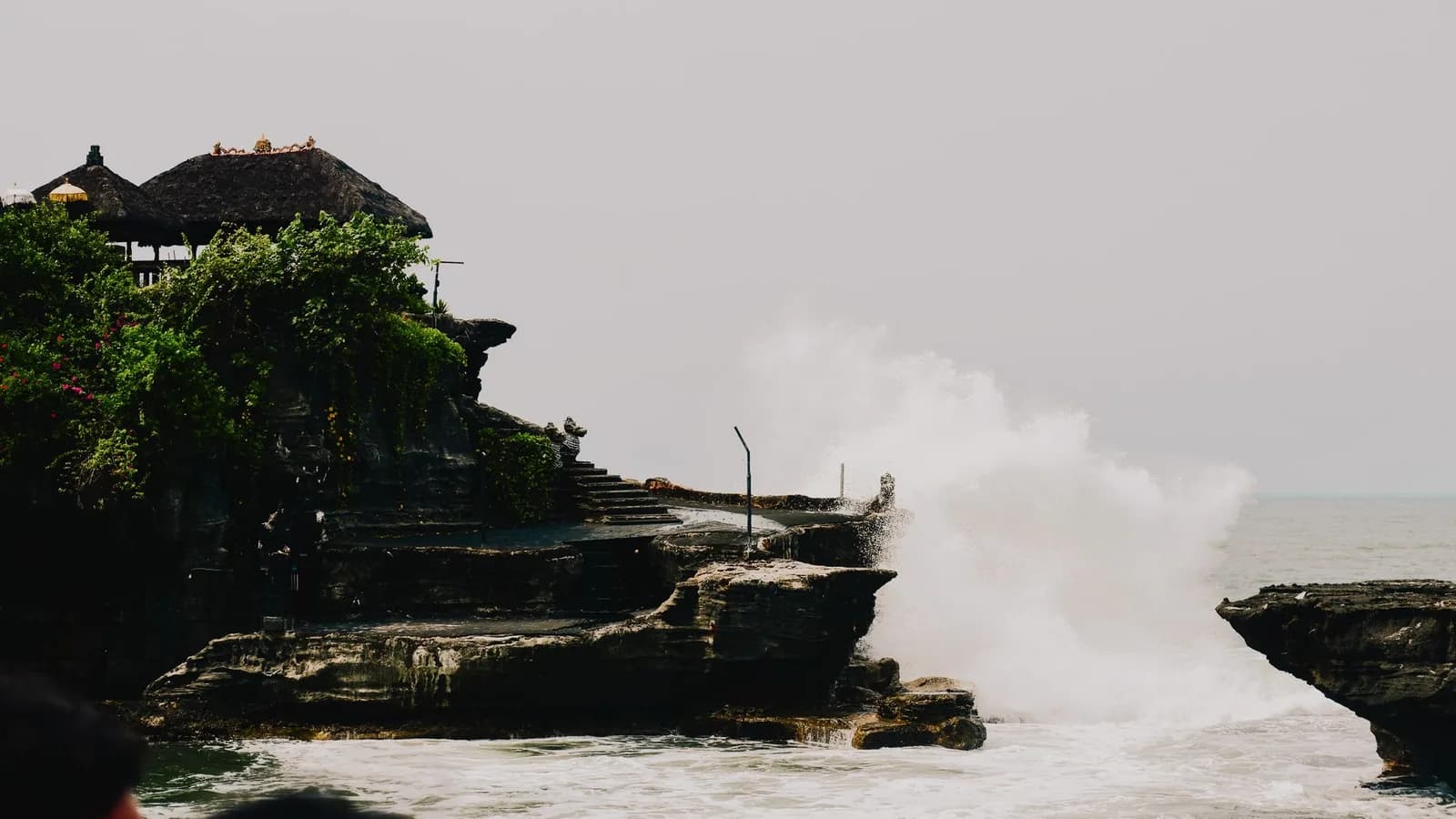
The shelf is under a metre or more of moving water. Nobody crosses, the spring and the snake cave are shut, and the tide takes about six hours to fall, so your visit is the view and nothing else. It is also the picture everyone has seen: surf breaking round a temple on an island, and at sunset the full set of island, surf, backlight and spray.
Take the cliff path south. The further you walk, the more sea you get between you and the temple and the fewer heads in the frame. A high tide at sunset is the peak crowd as well: be in place ninety minutes before, or book a terrace table at one of the southern cliff cafés.
Checking before you go
Search a tide table for Tanah Lot or for Canggu, which is close enough, and read off high and low water for your date. The coast runs on two highs and two lows a day, and each low lands about fifty minutes later than the day before. Over a week that drift moves low water right across the afternoon, which is why a fortnight on the island almost always contains a day where the tide does what you want at the hour you want it.
Then set that against sunset, which barely moves. Bali sits eight degrees south of the equator and the sun goes down within about forty minutes of the same time all year.
| Month | Sunset | Month | Sunset | Month | Sunset |
|---|---|---|---|---|---|
| Jan | 18:35 | May | 18:00 | Sep | 18:05 |
| Feb | 18:35 | Jun | 17:55 | Oct | 18:05 |
| Mar | 18:25 | Jul | 18:00 | Nov | 18:15 |
| Apr | 18:10 | Aug | 18:05 | Dec | 18:30 |
What arriving is actually like
Reviews of Tanah Lot split into two piles, and the dividing line is not the temple. It is the walk in. Here is the site in the order you meet it, so that none of it lands as a surprise.
0 m from the car: the car park and the ticket window
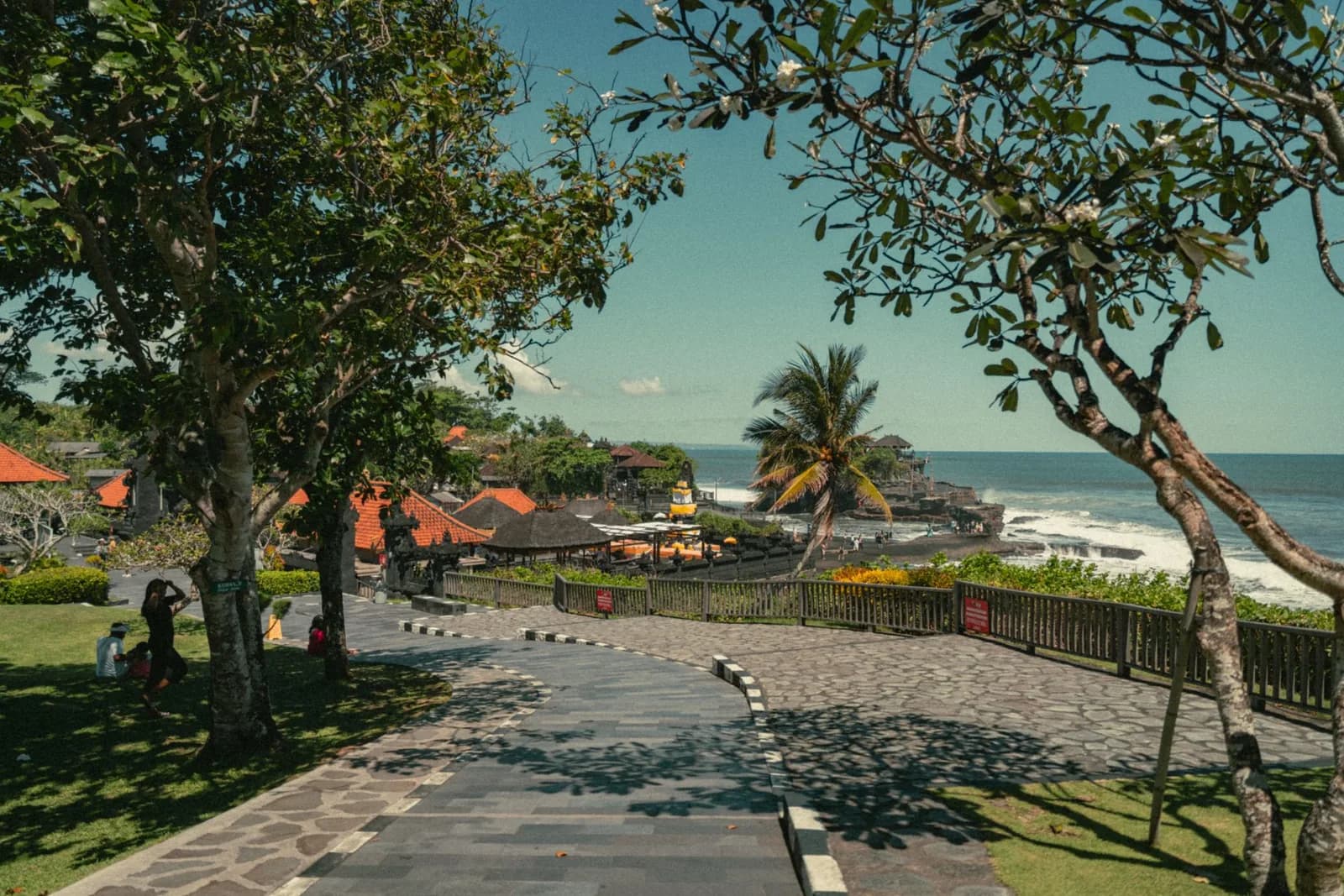
You pay at a booth on the way in, per person, with parking charged separately on the vehicle. It is cash and the rate is set locally. There are several car parks and a driver who knows the site will use the one nearest the north entrance rather than the first one with a space, which saves you a few hundred metres at the end of the day when you are walking back in the dark.
50 m: the arcade begins
From the gate the path runs downhill between two unbroken walls of stalls: sarongs, wooden masks, magnets, football shirts, bottled drinks, and a great deal of the same carved statue. It goes on for roughly five hundred metres and there is no way round it, because it is the way in. Nobody grabs you and nobody follows you. Say no once, keep walking, and it takes five minutes.
550 m: the arcade ends and the sea appears
The stalls stop abruptly at an open esplanade and the whole thing changes character. The temple is in front of you on its rock, the surf is loud, and the commercial half of the site is behind your back and stays there. This is the moment the visit starts, and it is worth knowing it is coming so that the walk in does not colour it.
650 m: the steps down to the shelf
A wide stone staircase drops from the esplanade to the rock platform between the shore and the temple. Whether you go down it is decided by the tide and by the staff at the bottom, not by you. If it is open, you cross to the base of the rock for the spring and the snake cave. If it is closed, you stay above and the visit is the view, the cliff path south, and the light.
Allow twenty minutes from car door to esplanade at a normal pace, and rather more on the way back, when several thousand people leave the sunset terraces through the same five hundred metres of stalls at once.
About those stalls
It is fair to call the approach commercial and unfair to call it a scam. The market is a licensed operation employing several hundred people from the villages around Beraban, the prices are negotiable in the ordinary Balinese way, and the sellers largely leave you alone if you keep moving. What it does is set the wrong tone for the ten minutes before you see one of the great pieces of coastline in Indonesia.
The practical answer is to treat it as a corridor on the way in and as the shopping on the way out. Prices at the far end near the sea are usually a little better than at the gate, and buying on the way back means you are not carrying a wooden statue around a wet rock.
Why nobody gets to the shrine
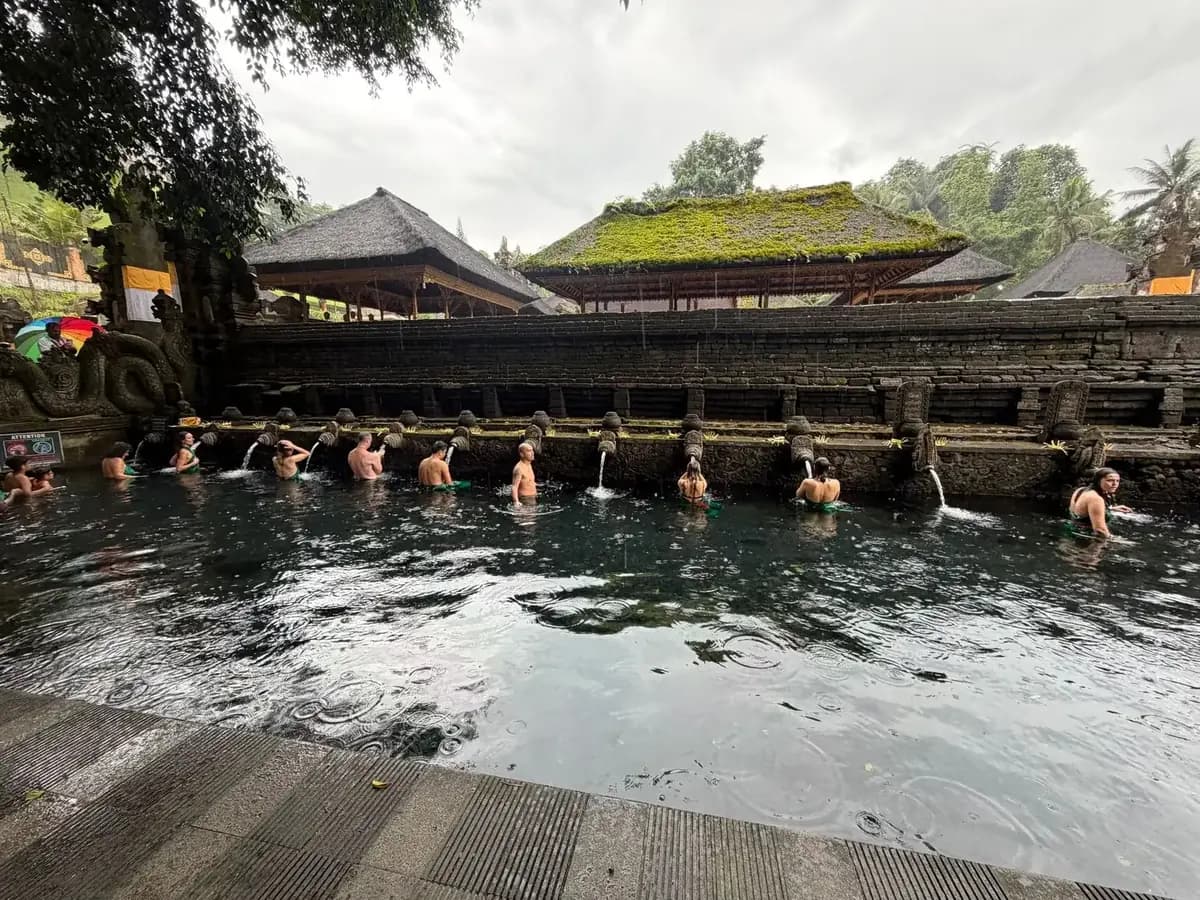
Tanah Lot is not a museum with restricted hours, it is one of the sea temples that ring the island and protect it, and it is in regular use. The staircase from the base of the rock up to the shrine is for worshippers. Visitors reach the spring called Tirta Pabersihan, where a priest pours holy water over your hands and presses wet rice to your forehead, and the cave a few metres along where the sea snakes are kept.
Once you know that, the whole site reads differently. The good angles are all from a distance, the close approach is about the ritual rather than the architecture, and the thing to spend your time on is the coast rather than the queue.
Sunset, the crowd, and where to stand
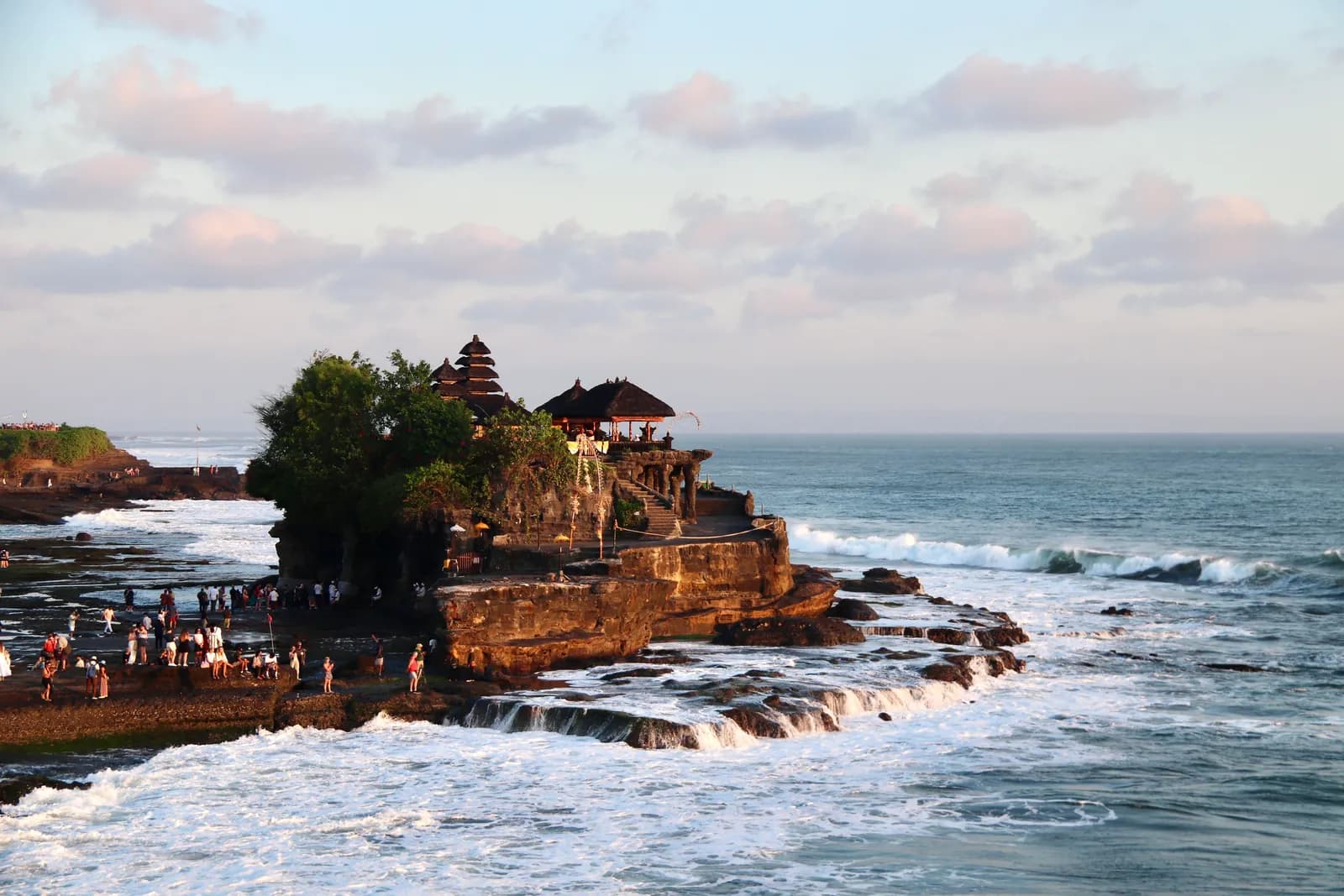
Tanah Lot faces west into open ocean with nothing between it and Java, which is why it has been the island's sunset temple since long before anyone was selling tickets. It is also why every day tour on Bali is written to end here.
The timing
Sunset in Bali lands somewhere between 17:55 and 18:35 depending on the month, and the crowd starts building around ninety minutes out, and earlier still in the July and August peak. The coaches arrive in a block roughly an hour before. If you turn up thirty minutes before the sun goes down you will be behind several rows of raised phones, and you will spend the light looking for a gap instead of watching it.
The reverse trick is worth stating plainly: the site opens early and almost nobody comes. A seven in the morning visit at low tide gets you the crossing, the spring and the rock with a handful of other people on it. You lose the sunset and you gain the place.
Three positions, in order of how hard they are to get
The north esplanade, straight ahead as you come out of the market, is the standard view and the most crowded metre of ground on the site. It puts the sun behind the rock for most of the year and it is where the coaches stop.
The cliff path south, five to ten minutes on foot, thins out fast and opens the angle so that you get sea on both sides of the temple. This is where the photographers go and it costs nothing but the walk.
A terrace table at one of the cafés on that southern cliff. You are paying for the position rather than the food, they take bookings in high season, and it is the only way to hold a front row spot for an hour without standing in it.
Taman Ayun, Bedugul and Tanah Lot in one day
Free cancellationWestern Bali tours ending at Tanah Lot for sunset
- ✓Sunset at Tanah Lot last, which is the order the geography actually supports
- ✓Hotel pickup from Canggu, Seminyak, Kuta or Ubud, and somebody else driving home in the dark
- ✓A driver who waits rather than a coach that leaves, on the private listings
- ✓Free cancellation on most listings, which matters when the whole day hangs on the weather
Affiliate link. Booking through GetYourGuide costs you nothing extra and supports the guide. Prices are indicative and vary by option and season.
Batu Bolong, the temple most visitors skip
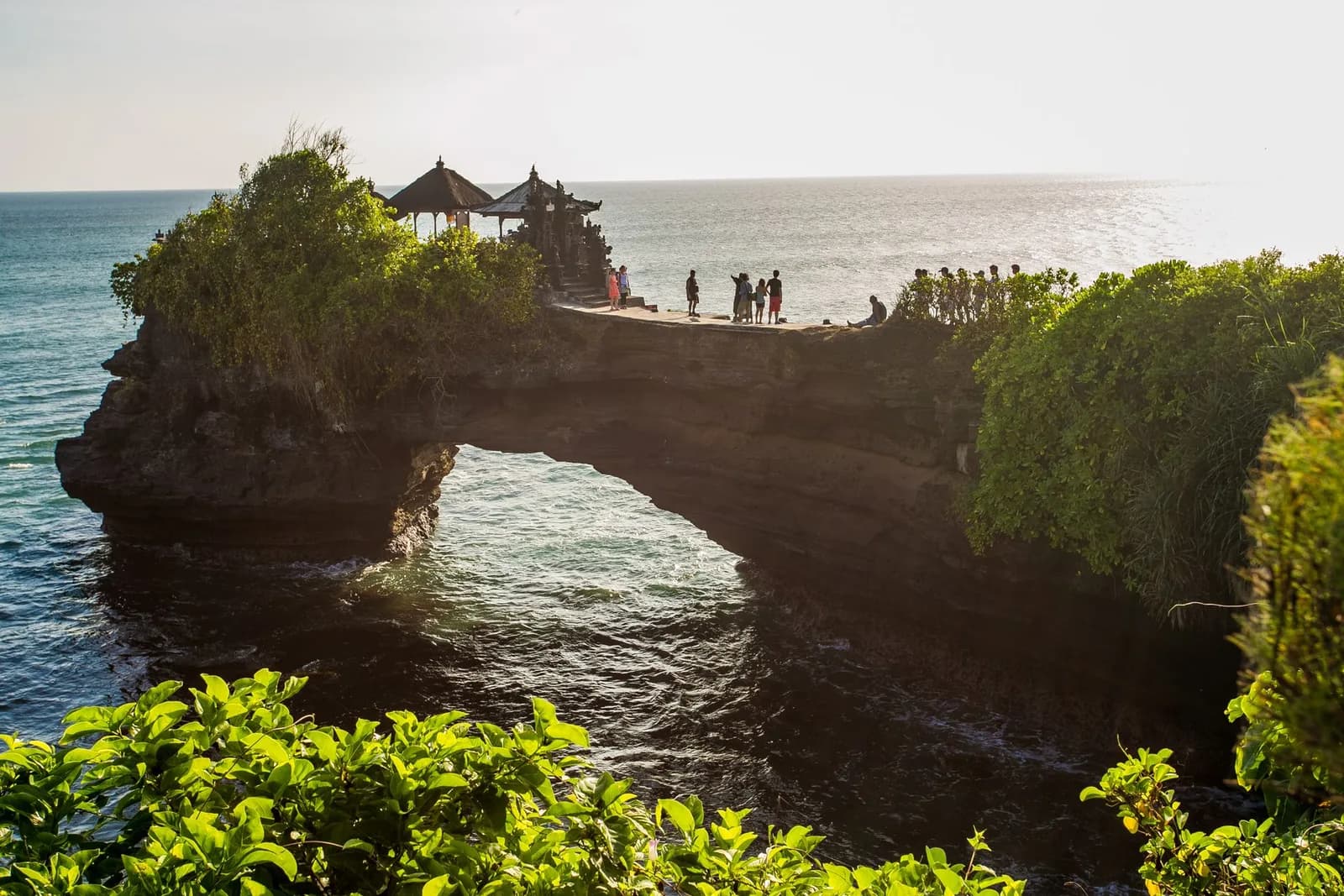
Five minutes south along the cliff there is a second temple, built on a promontory that the sea has bored a hole straight through. The name means holed rock, and you reach it over a natural stone bridge with surf running underneath you on both sides.
Two things make it worth the walk. It is open whatever the tide is doing, which makes it the answer when you arrive at high water and find the crossing shut. And it is the only place on the site where you can stand on a rock in the sea, since the main temple keeps you at its base.
The same rules apply as at the main shrine, and as at Besakih or anywhere else on the island: the inner enclosure is for worshippers and you stay outside it. Nobody minds you on the bridge or the terrace, and the view back north towards Tanah Lot from there is the composition the esplanade cannot give you.
The rock underneath the temple
By the 1980s the base of Tanah Lot was eroding badly enough to threaten the shrine on top. A Japanese government loan funded a large conservation programme through the 1990s, and a substantial part of what now looks like natural rock at the waterline is engineered stone put there to hold the rest up.
It is not something the site advertises and it is easy to miss on the ground. It is also the reason the temple is still there. The same works are why the World Monuments Fund has taken an interest in the site, and why the surf you are photographing is understood locally as a threat rather than scenery.
Getting there and getting away
Tanah Lot sits at Beraban, on the coast of Tabanan regency, west of the airport and north of the surf beaches. From Canggu it is thirty to forty minutes and the obvious afternoon out. From Seminyak or Kuta allow an hour or a little more. From Ubud it is around ninety minutes across the middle of the island, which is why it usually gets attached to a longer day rather than done on its own.
The journey out after sunset is the part to plan for. Several thousand people leave within twenty minutes of each other down roads that were built for a village, and a forty minute drive back to Canggu can take twice that. Either accept it, or leave while the sky is still colouring and take the last of the light from the car.
On a scooter the same problem is smaller, because you filter past the queue. The trade is riding home in the dark on a road with no lighting and a lot of traffic doing the same thing, which is a different proposition from riding to it in daylight.
What it costs
Orders of magnitude rather than prices. Entry is set locally, it is cash, and it moves. Everything on this list except the ticket and the parking is optional.
| What you pay for | Detail | Order of magnitude |
|---|---|---|
| Entrance | Per person, paid in cash at the booth by the car park. Adults and children are priced separately and foreign visitors pay more than Indonesians, which is standard across the island. | ≈ $5 |
| Parking | Charged on the vehicle at the gate, separately from the tickets. Cars and scooters pay different rates. | ≈ $0.30 to $1.30 |
| Blessing at the spring | Holy water and rice from the priest under the rock, at low tide only. There is no fixed price and the donation box sets the tone rather than a sign. | donation |
| Seeing the sea snake | The cave at the base of the rock where the banded sea kraits are kept, again a donation rather than a ticket. | donation |
| Sarong hire | Available at the entrance if you turn up in shorts. Not enforced as strictly here as at Uluwatu, since most of the site is open ground. | ≈ $1 to $3 |
| Table on a sunset terrace | A drink or a meal at one of the cliff cafés to the south, which is how you hold a front row position for an hour. | ≈ $6 to $20 |
| Driver for a half day from the south | Car and driver for an afternoon and evening from Canggu, Seminyak or Kuta, including the wait through sunset. | ≈ $25 to $45 |
The Bali tourist levy is separate from all of this and is paid once on arrival rather than at each site, though officers do run spot checks at the big attractions. See the tourist levy explained for how and when to pay it.
The priest, the rock and the snakes
The temple is attributed to Dang Hyang Nirartha, a Javanese priest who arrived in Bali in the sixteenth century and who is credited with founding a chain of sea temples around the island, Uluwatu among them. The story goes that he spent a night on the rock, that the local village chief resented the following he attracted and told him to leave, and that Nirartha moved the rock itself out into the sea and turned his sash into the snakes that guard its base.
Whatever you make of the account, the function is straightforward. Tanah Lot is one of the temples that face the sea and hold the boundary of the island, part of a system that also includes the lake temple at Bedugul facing the water that irrigates the interior. The pair of them are the two halves of how Bali thinks about water.
The name is usually given as land in the sea, which is as accurate a description of the place as anyone has managed.
The sea kraits
The snakes are genuine and they are banded sea kraits, black and white, highly venomous and famously placid. They live in a cave in the rock at the base of the temple and a handler will bring one out and invite you to touch it for a donation.
It is the most photographed thing at Tanah Lot after the temple and it deserves a word of honesty: the animals are kept in a hole in a rock and handled by strangers all day. Nobody will think less of you for walking past. If you do stop, the twenty seconds of contact are worth more than the photograph.
What to put either side of it
Tanah Lot is a sunset stop, which fixes it to the end of the day and leaves the rest of the day to fill. Two combinations work and one that gets sold regularly does not.
The western loop
Taman Ayun in the morning, the lake temple at Bedugul in the middle of the day and Tanah Lot for sunset. Half an hour separates Taman Ayun from here, the three sit on a triangle you can drive in one direction, and the sunset fixes the schedule. This is the day tour everyone sells and the geography genuinely supports it.
A Canggu afternoon
Lunch on the coast, the rice fields inland of Canggu in the afternoon, then thirty minutes up the road to arrive with the tide you picked. Almost no driving, no early start, and the whole thing fits into half a day. It is the version most people should do and the one nobody books.
Not with Uluwatu
They sit on opposite sides of the south and both are sunset temples, so a day containing both means missing the light at one of them and an hour and a half in traffic between. If you want the cliffs and the fire dance, give the kecak at Uluwatu its own evening.
For how Tanah Lot sits against the rest of the island's sanctuaries, and which ones are worth the drive at all, start from the temples of Bali.