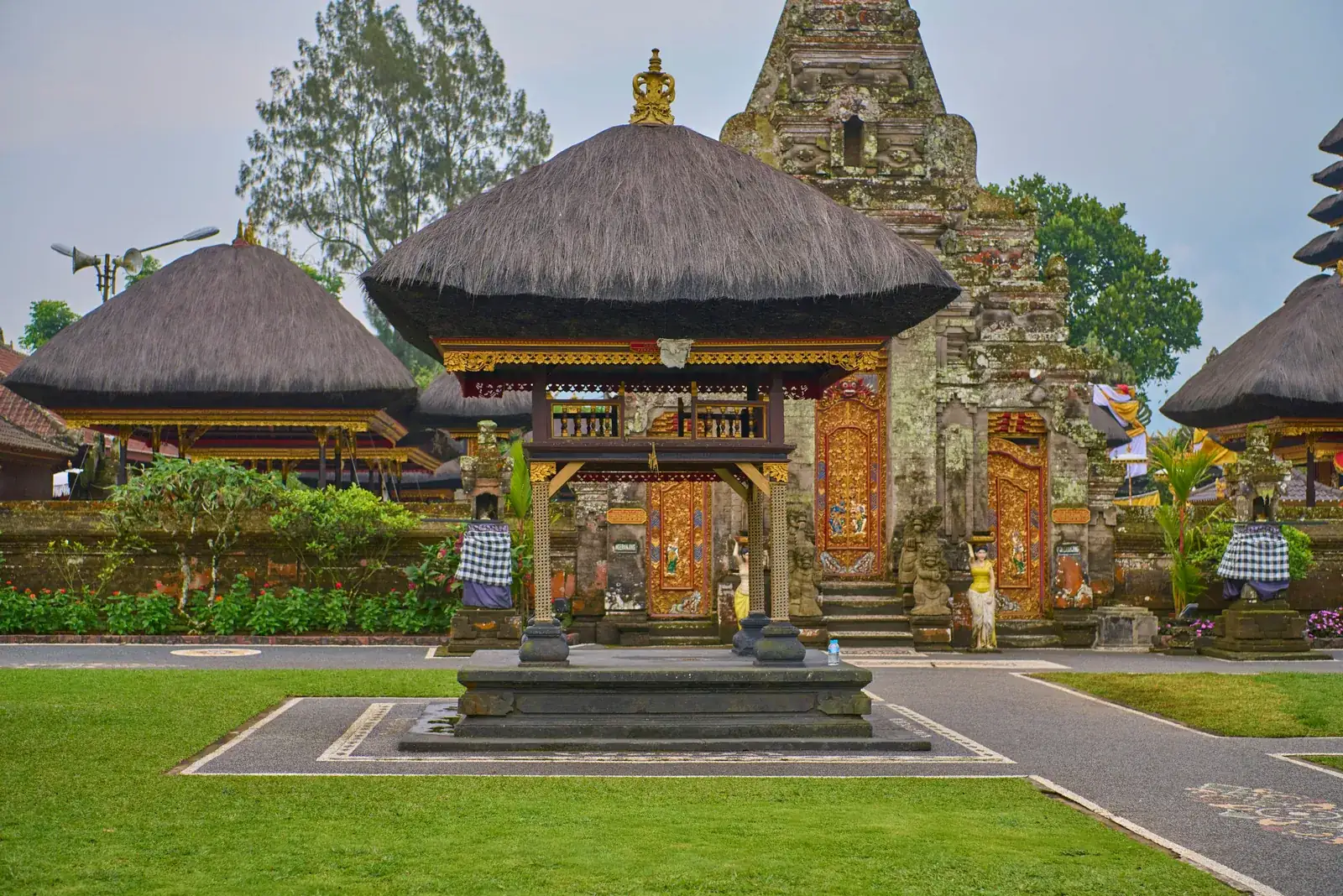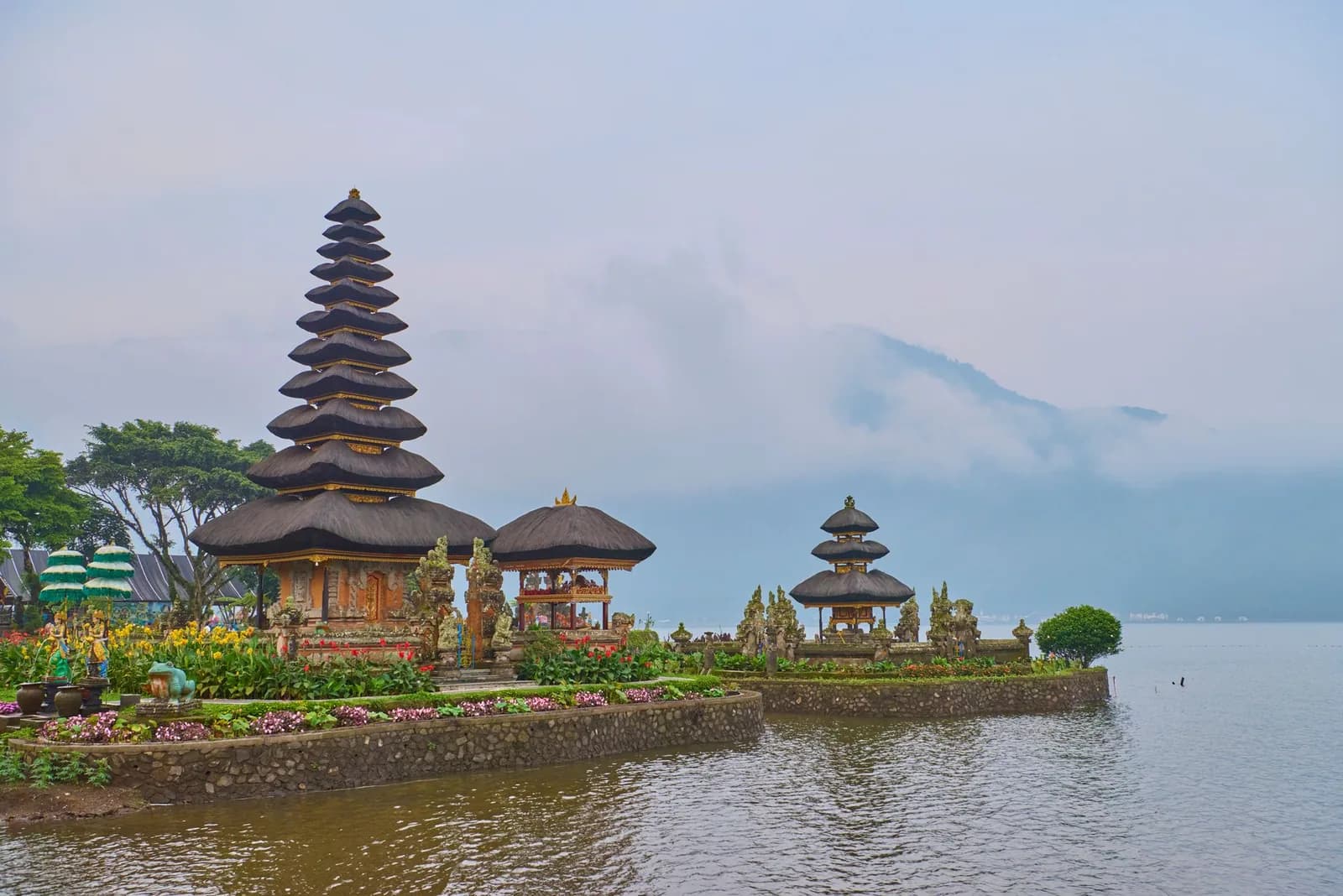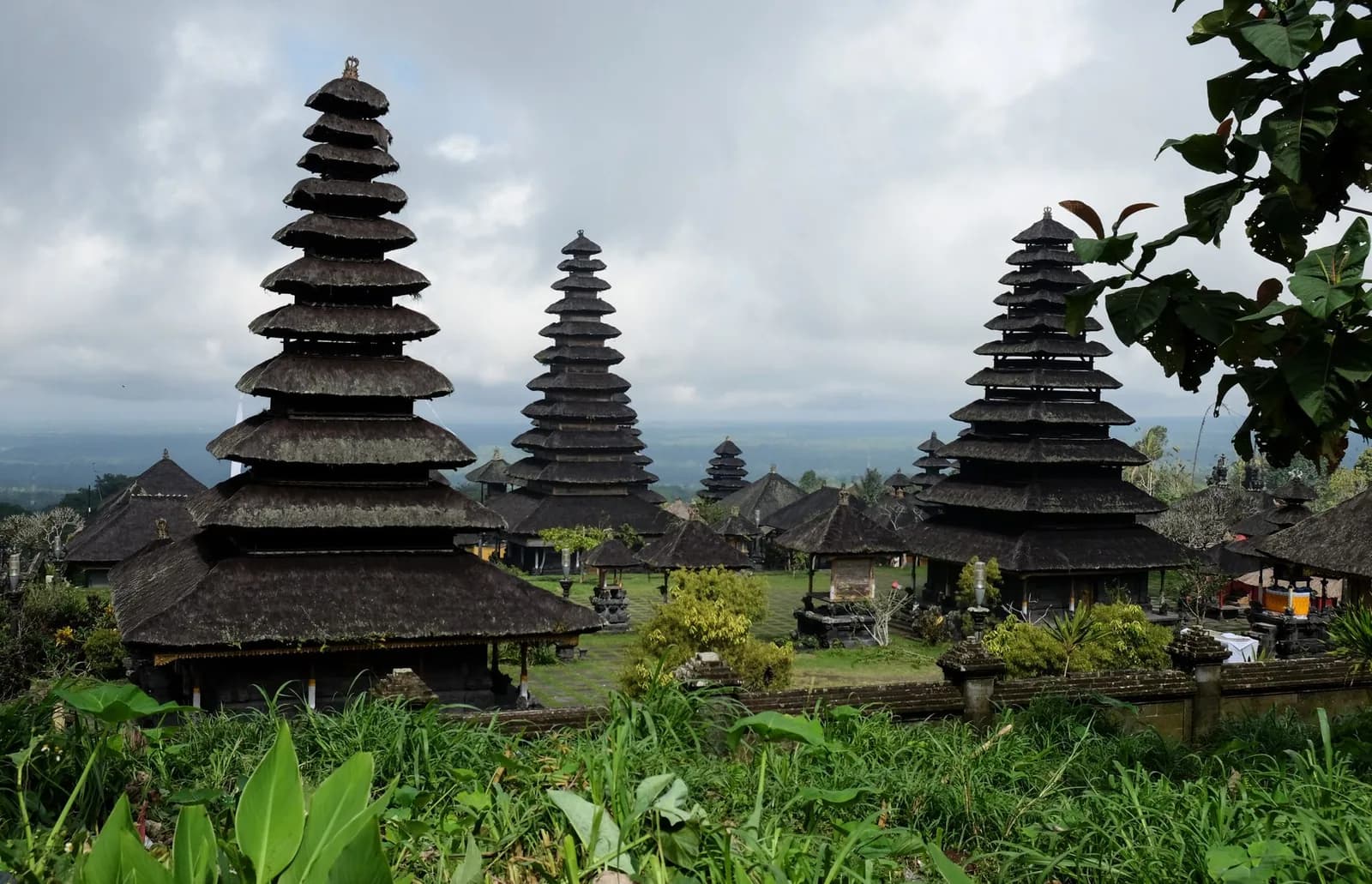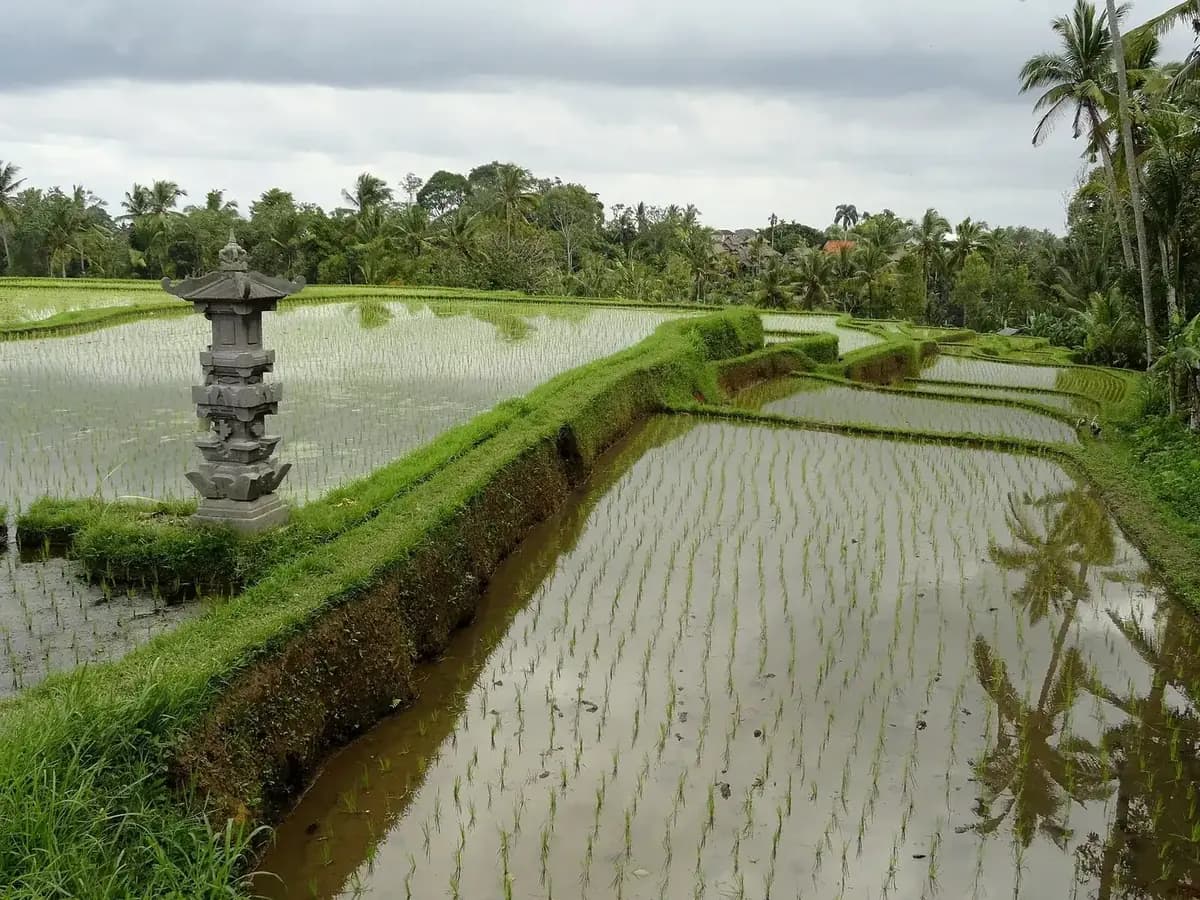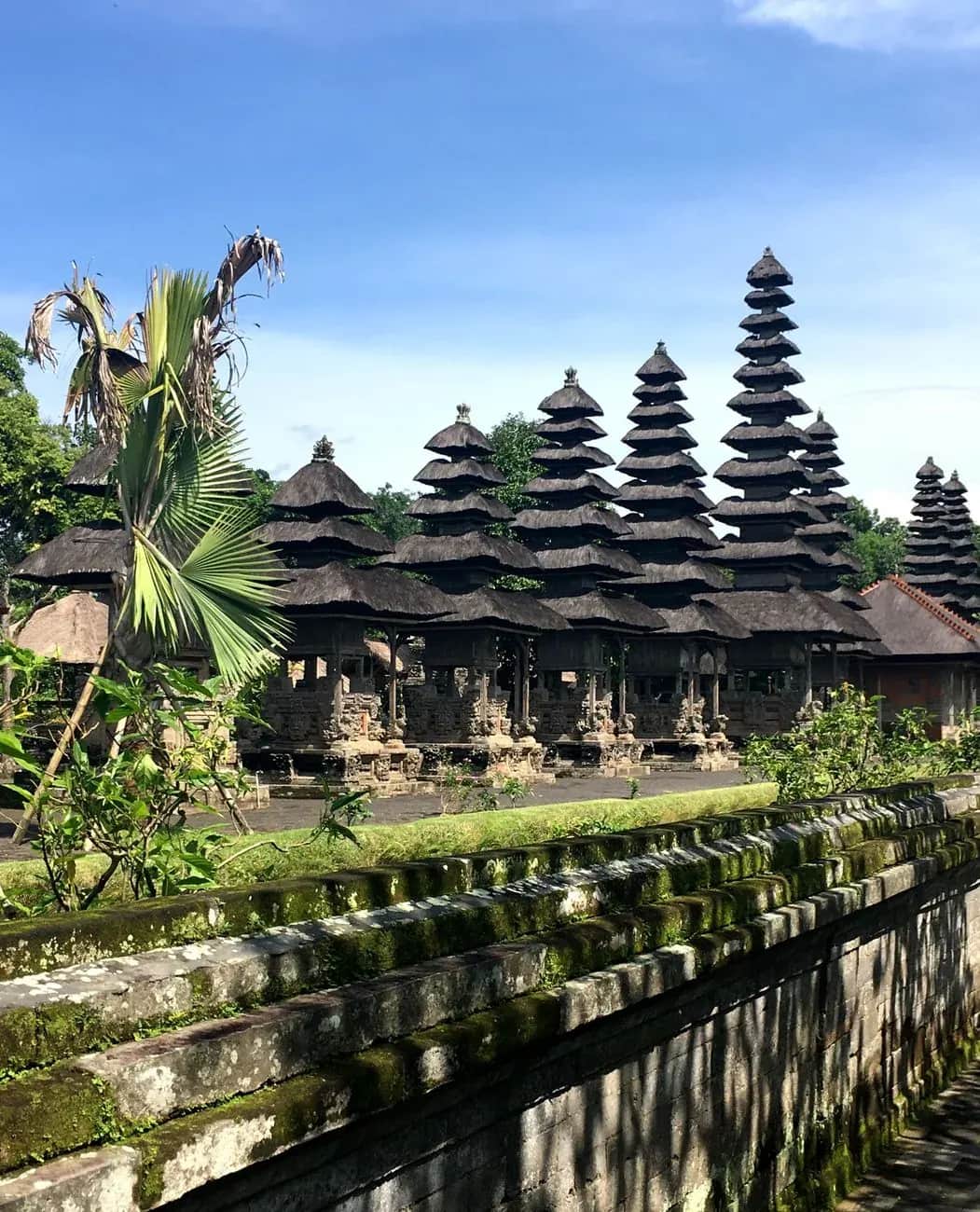
Taman Ayun was built in the seventeenth century as the state temple of the kingdom of Mengwi, which is why it looks less like a village temple and more like a garden. A wide moat runs the whole way round, the lawns are cut, and inside the walls a row of thatched meru towers steps up in odd numbers towards the mountains. The name itself means something close to beautiful garden, and for once the marketing came first and the marketing was accurate.
It is the temple that gets left off itineraries, and the one people are most often quietly glad they stopped at. Nobody queues here. Nobody hands you a numbered ticket for a photograph. On a Tuesday morning you can walk the entire circuit of the moat and pass four other people, which on an island that receives six million visitors a year is close to remarkable.
The trade is that Taman Ayun does not overwhelm anyone. There is no cliff, no volcano framed in a gateway, no spring you can step into. It is architecture in a park, and the reward is proportionate to how much you enjoy looking at architecture in a park. This page is about setting that expectation correctly, and then getting the logistics right so the stop costs you almost nothing.
Taman Ayun, Bedugul and Tanah Lot in one day
Western Bali temple tours from the south
- ✓Taman Ayun, Ulun Danu Beratan and Tanah Lot chained in the right order, with sunset last
- ✓Hotel pickup from Canggu, Seminyak, Kuta or Ubud, which removes the worst hour of the day
- ✓A driver who waits rather than a coach that leaves, on most private listings
- ✓Free cancellation on most listings if the mountain weather turns
Affiliate link. Booking through GetYourGuide costs you nothing extra and supports the guide. Price and rating checked September 2026. Both move with season and demand.
On this page
What you actually get to see
The visit is a single loop, and it is over faster than you expect. Here is what that loop contains, in the order you meet it.
Photo Cindi CGJ, CC BY-SA 4.0
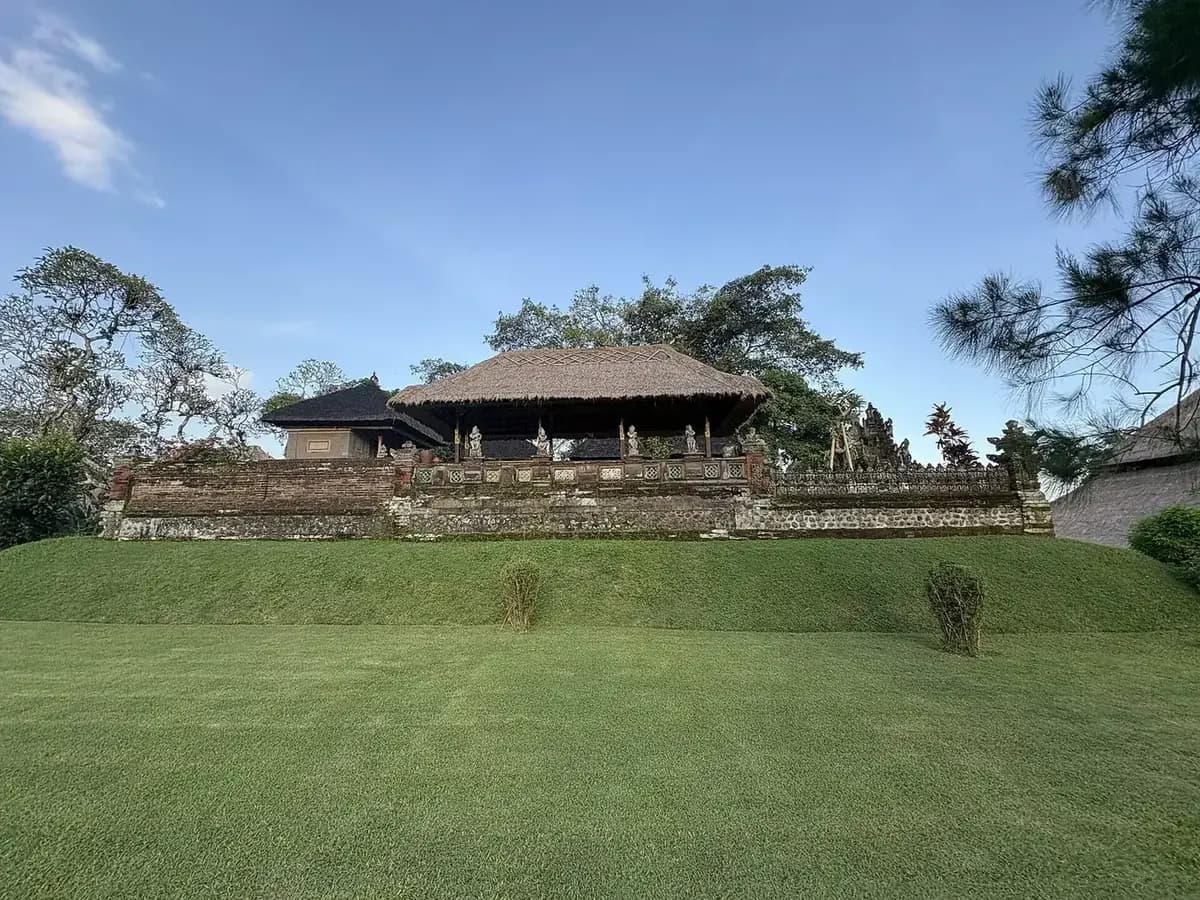
You cross a bridge over the moat, pass a split gate into a wide grassed outer court, and then walk a raised path that runs along the wall of the inner sanctum. From that path you look down into the courtyard where the meru towers stand, thatched in black sugar palm fibre, the tallest of them carrying eleven tiers.
You do not walk among them. The innermost court at Taman Ayun is for worshippers, as it is at most royal temples, and the wall is the point at which visitors stop. People who arrive expecting to wander between the towers come away disappointed. People who know in advance find the elevated view is actually the better composition, because it lifts the tower line clear of the pavilions in front of it.
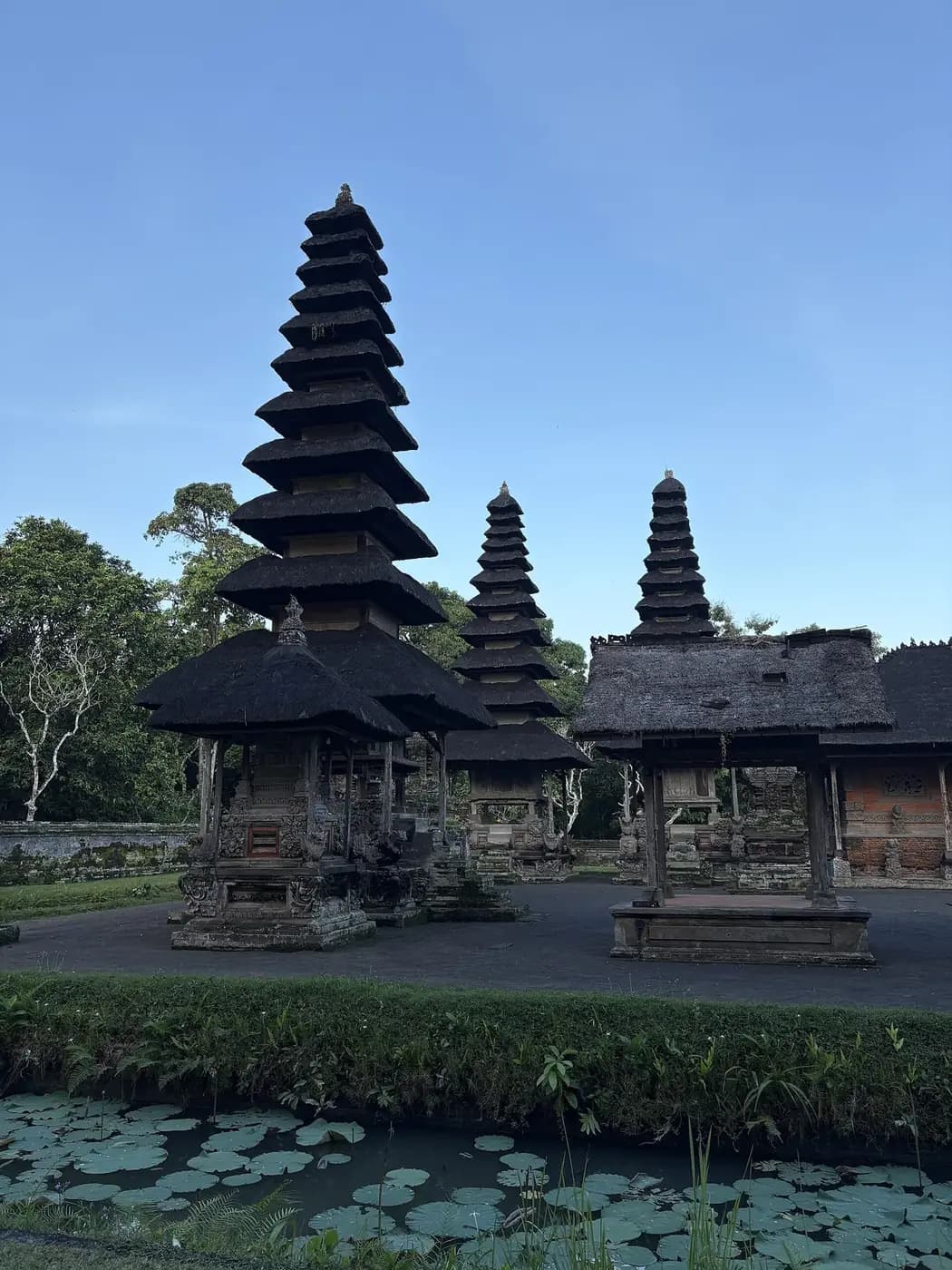
Around the outside there are gardens, a large open pavilion, a small museum on Balinese ritual that most visitors skip, and the moat itself, which on a still morning holds a full reflection of the tower line. That reflection is the photograph, and unlike the famous shot at Lempuyang, it needs no mirror and no queue.
What surprises most people is the scale of the grounds relative to the temple. The sanctuary occupies a modest rectangle. The parkland and water around it occupy considerably more. That ratio is deliberate and it is the whole reason the place feels calm rather than crowded, even on the rare day when a coach turns up.
The architecture, decoded court by court
Almost every guide to this temple lists the Balinese words and leaves you to work out what they mean. The words describe a system, and once you have the system the whole layout reads in about a minute.
A Balinese temple is a gradient rather than a building. Each court is holier than the one before it, and access narrows as you go.
| Zone | Balinese name | Access |
|---|---|---|
| The moat and the causeway | beji / jaba sisi | Walk all of it |
| The outer court | jaba | Fully open |
| The middle court | jaba tengah | Open, and where the visit really happens |
| The sanctuary | jeroan | Not open to visitors |
The moat and the causeway
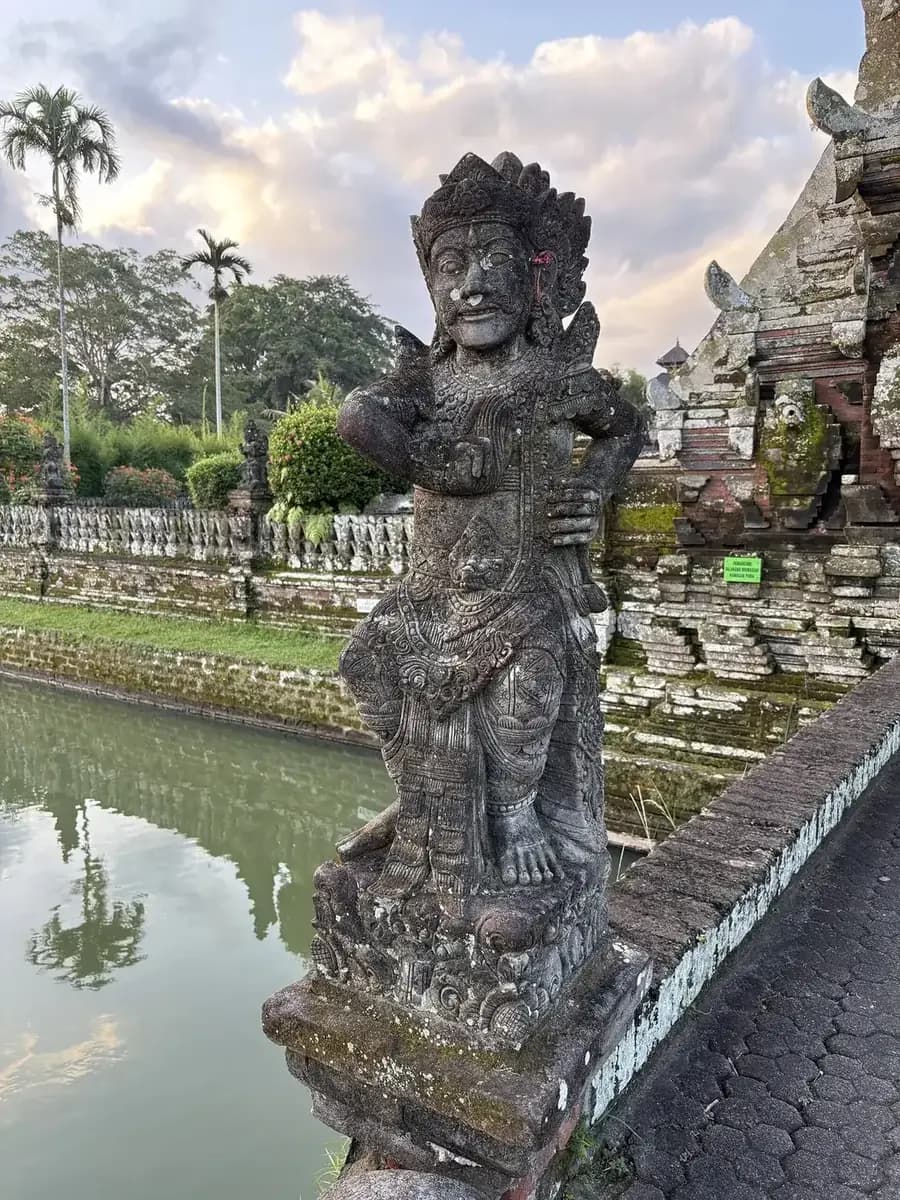
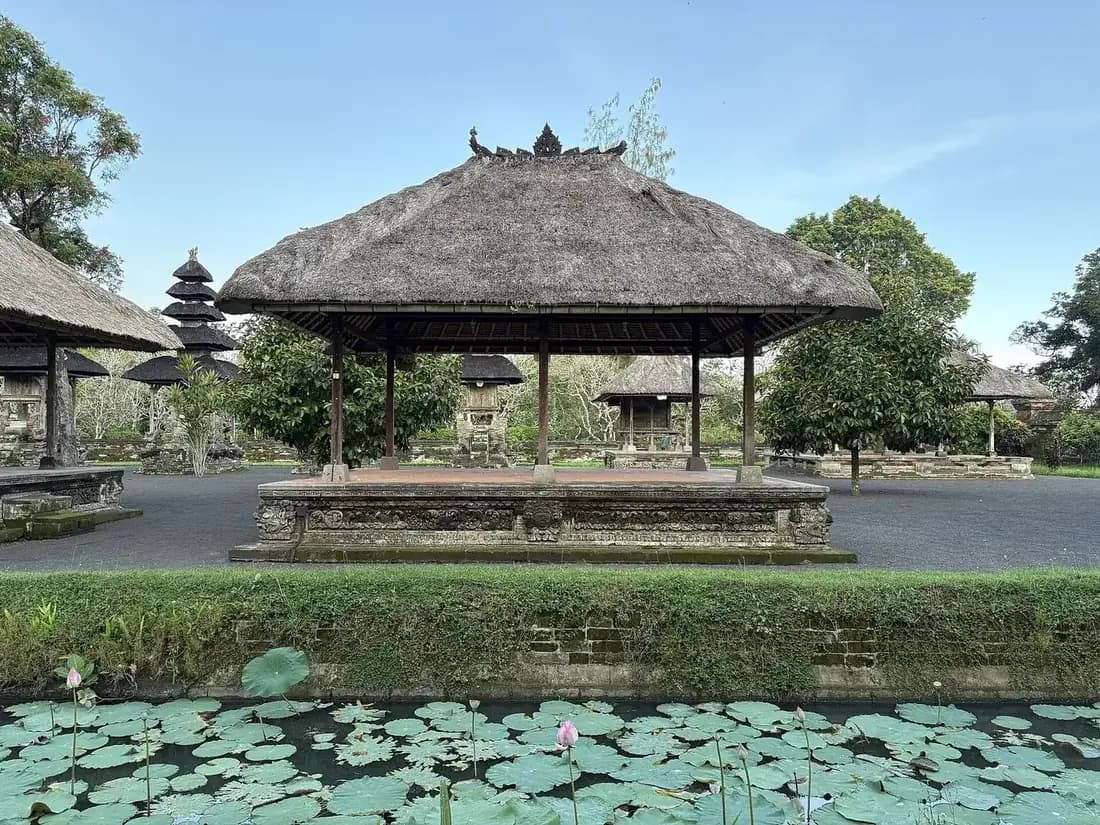
A wide rectangle of still water runs the entire way round the temple, and a single stone causeway crosses it. Lotus and water lilies cover long stretches of it, and the outer bank is planted and mown like a park. Look for the stone guardian figures standing on the causeway parapet, one of the few pieces of carving here you can get close enough to actually read, and the reflection line on a still morning, which is the photograph most people came for and the reason to arrive early. The temple platform sits above the water, so the whole complex reads as an island.
The water is the point rather than the decoration. A royal water temple sat at the top of the irrigation hierarchy, and the moat states that claim in the most literal way available: the kingdom holds the water.
The outer court
Past the split gate you arrive in a large grassed and paved court that feels more like a village green than a sanctuary. This is where community life happens, performances, historically cockfights, gatherings before ceremonies. Look for the wantilan, the big open pavilion with a pyramid of thatch, which is a meeting hall rather than a shrine, the bale kulkul, the tower in the corner that holds the slit drums used to summon the village, and the small museum on Balinese rites, which nearly everybody walks past and which is better than it looks.
Balinese temples are graded rather than enclosed. The outer court is the profane end of the scale, open to anyone, and it exists precisely so that the sacred end can stay separate from daily life.
The middle court
A transition court, quieter and more formal, holding pavilions used to prepare offerings. From here a raised path runs along the outside of the inner enclosure wall, and that path is the whole visitor experience at Taman Ayun. The kori agung, the tall roofed gate into the inner court, is opened only for ceremonies and shut the rest of the year. The elevated walkway, which lifts you above the wall so the tower line reads properly, and the corner shrines here are smaller and easier to examine than anything inside.
This is the compromise the temple makes with visitors. You are not admitted to the sanctuary, but you are given a vantage point over it, which is a more generous arrangement than most royal temples on the island offer.
The sanctuary
The holiest enclosure, and the one in every photograph: a long line of thatched meru towers of different heights, with shrines and pavilions between them. Worshippers enter for ceremonies, visitors look in over the wall from the raised path. The thatched towers always carry an odd number of tiers, and the count is a statement of rank rather than a matter of taste. The black thatch is sugar palm fibre rather than straw, rethatched by hand on a cycle of years. The stepping heights along the row are not random, and the count of a meru's tiers decodes them, with the tallest meru and its eleven tiers the maximum permitted, reserved for the highest dedications:
| Tiers | What it marks |
|---|---|
| 11 | The maximum. The tallest tower at Taman Ayun, and the highest dedication a meru can carry. |
| 9 and 7 | Major dedications, including the shrines that stand in for Bali's great mountain sanctuaries. |
| 5 and 3 | Lesser shrines and ancestral dedications of the royal house of Mengwi. |
This is the single fact worth carrying in before you arrive. The closed inner court is not a temporary restriction or a bad day, it is how a Balinese royal temple works, and expecting to walk among the towers is the main source of disappointed reviews.
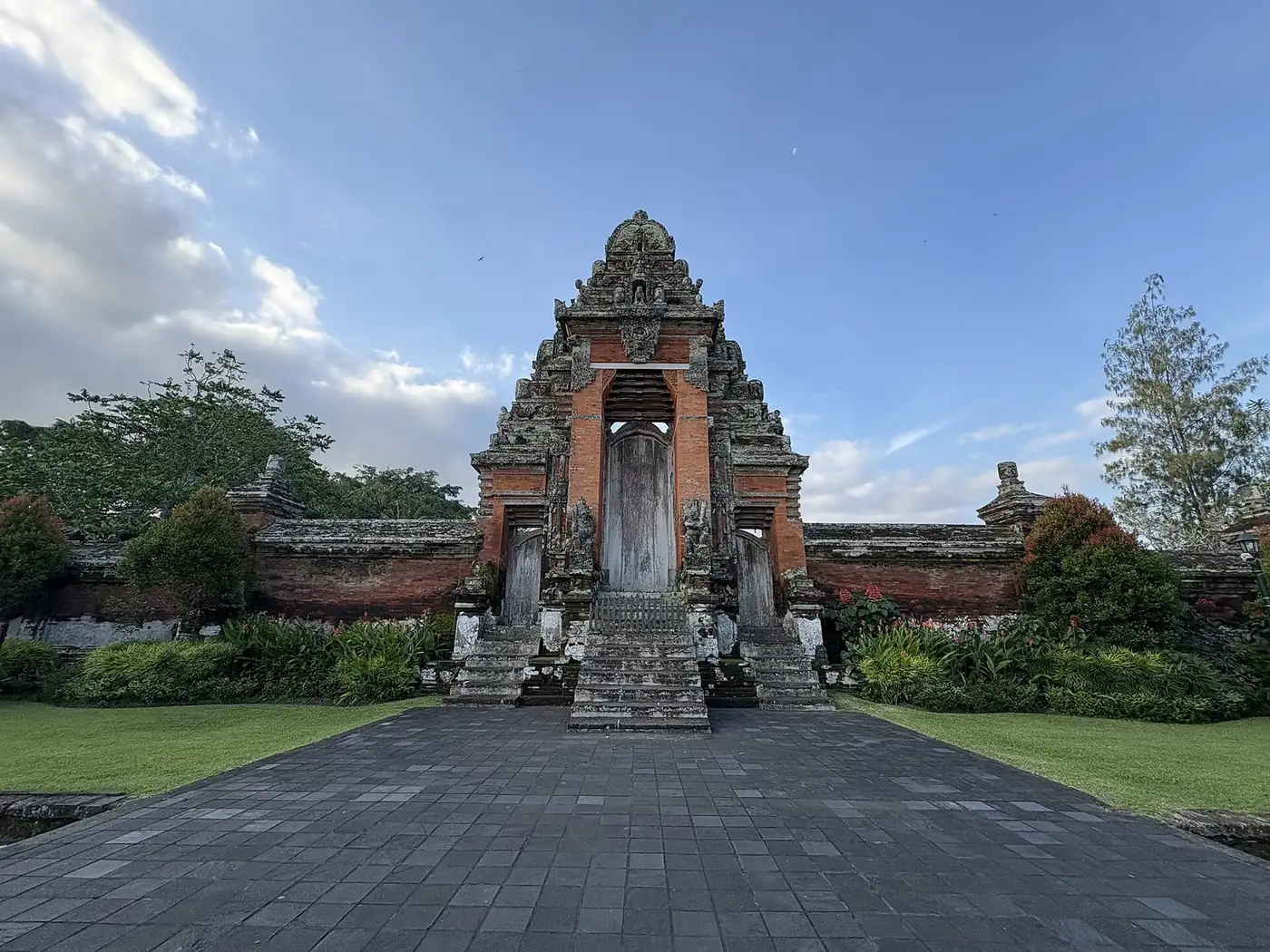
Two gates that mean two different things
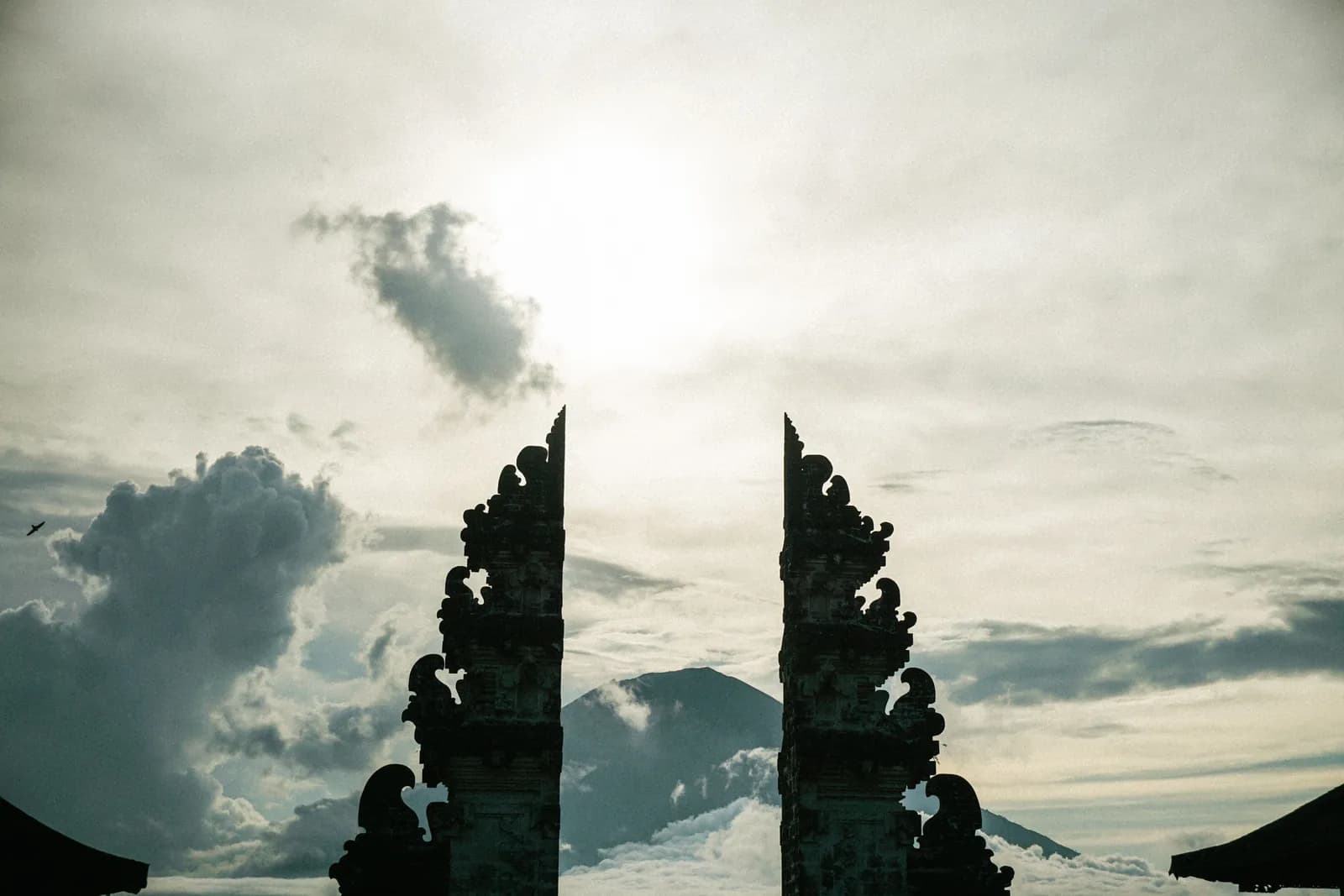
Bali has two gate types and Taman Ayun has both, which makes it an unusually good place to learn the difference. The candi bentar is the one split down the middle, as though a tower had been cut in half and pulled apart. It marks a threshold you are meant to pass through, and it is the same form as the gate at Lempuyang that the internet calls the Gates of Heaven.
The kori agung is the roofed one, a solid tower with a door in it, and it means the opposite: a threshold that is normally shut. At Taman Ayun it stands at the head of a paved causeway, flanked by two lower side doors, and the whole assembly is only opened for ceremony. When you look at it and think it seems designed to keep you out, you are reading it correctly.
Beyond it are the merus, the multi-tiered towers that give the temple its silhouette. Each one is a shrine and each one carries an odd number of thatched roofs, from three up to a maximum of eleven. Height equals rank. A visitor standing on the walkway with nothing but a pair of eyes can therefore read the hierarchy of the sanctuary directly off the roofline, which is a rare thing in any religious architecture.
The thatch is not straw. It is ijuk, the black fibre of the sugar palm, laid in thick layers and replaced by hand on a cycle of many years. It is why the towers photograph almost black against a bright sky, and why the roofline looks soft rather than sharp from a distance.
The part you cannot enter, and why that is fine
Read enough reviews of Taman Ayun and one complaint dominates all the others: you cannot go in. People describe arriving, walking the perimeter, realising the gate is shut, and leaving within twenty minutes feeling short-changed. It is the single most common disappointment attached to this temple, and it is entirely avoidable, because it is a matter of expectation rather than a matter of the site.
Balinese temples are not museums that happen to be religious. They are working sanctuaries, and the innermost court of a working sanctuary is closed to anyone not there to worship. The same rule applies at Besakih and across the island. What makes Taman Ayun feel different is that its inner court is so visible: the wall is low, the walkway is raised, and the thing you are not allowed into is right there in front of you looking photogenic.
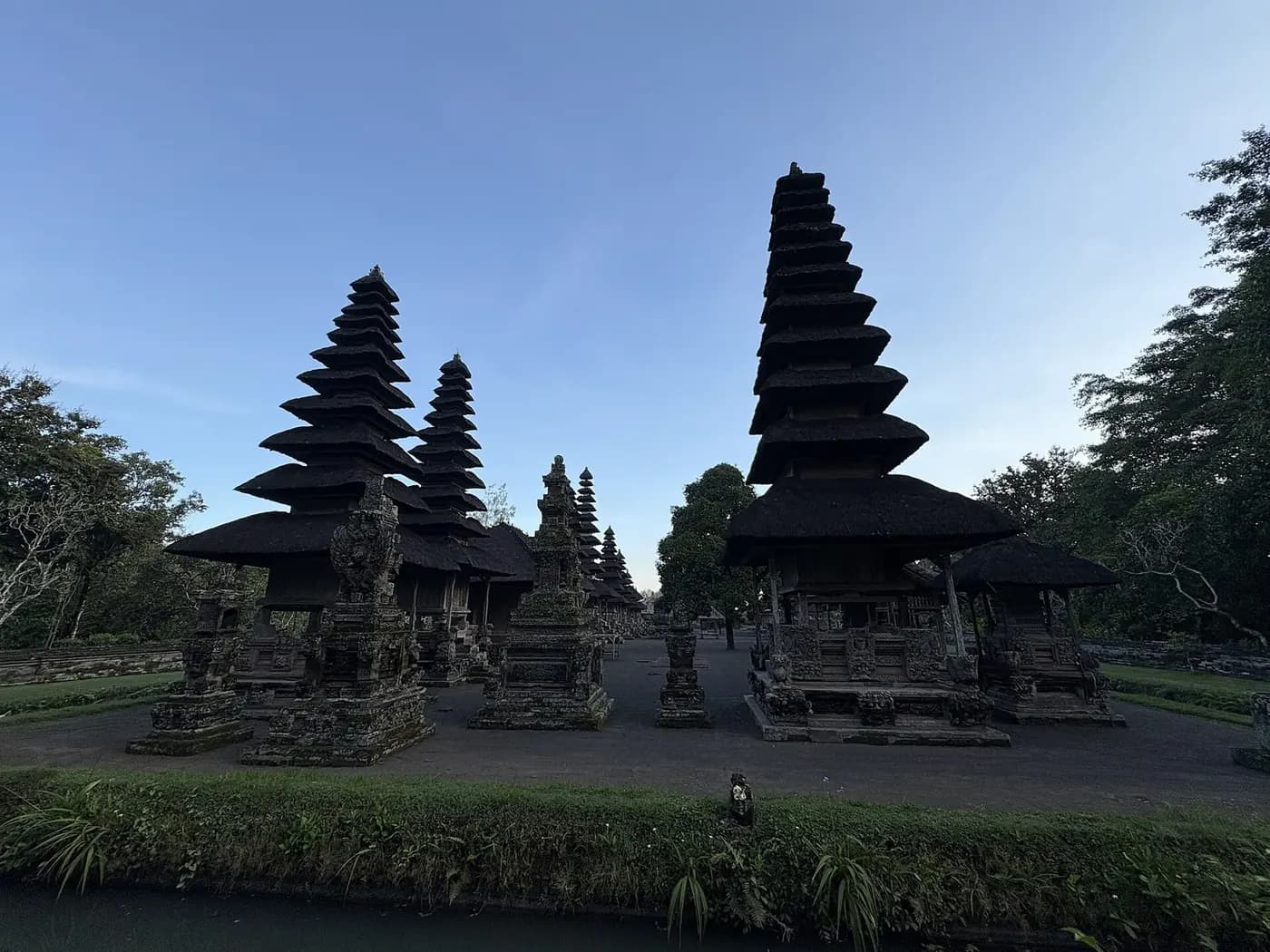
Reframe it and the visit improves immediately. You are being given a viewing gallery over a private courtyard, which is more than most royal temples offer. From ground level inside that court you would see pavilions and the bases of towers. From the walkway you see the entire composition, the moat below it, and the tree line behind it. The restriction has accidentally produced the better vantage point.
If you happen to arrive on a ceremony day, the calculation changes completely. The gates open, the court fills with people in white and gold, and the temple stops being a monument and becomes what it actually is. You cannot plan for this, since the Balinese calendar does not map onto anything you can look up easily, but if you see cars parked along the road and offerings being carried in, park and go and watch respectfully from outside.
A kingdom that no longer exists
Taman Ayun is a political building as much as a religious one, and the politics are the interesting part.
Bali in the seventeenth century was not one place. It was a set of competing kingdoms that fought, married and absorbed each other for three hundred years, and Mengwi was one of the strongest of them, controlling territory that at its height reached across the west of the island and into Java. Taman Ayun was founded by the raja of Mengwi in the 1630s as the state temple of that kingdom.
A state temple did a specific job. It gathered, in one place, shrines standing in for the great sanctuaries scattered across Bali, so that the royal house and its subjects could honour all of them without crossing the island. That is why the inner court holds so many towers of different heights: it is a portfolio of dedications rather than a single shrine, and it declares the reach of the dynasty in the plainest possible way.
Mengwi lost. At the end of the nineteenth century the kingdom was broken up by its neighbours and its territory absorbed, decades before the Dutch finished the job on the rest of the island. The dynasty went, and the temple stayed. It has been repaired and enlarged several times since, most substantially in the twentieth century, and it is still maintained by the descendants of the royal house and the surrounding villages rather than by a tourism board.
This is the thing worth carrying round the moat with you. What you are looking at is the last functioning institution of a state that was wiped off the map, kept alive because it was a temple rather than a palace. It is a considerably better story than beautiful garden, and no sign on site tells it.
The UNESCO claim, stated properly
You will see Taman Ayun described as a UNESCO World Heritage Site. That is true in the way a district is part of a city rather than in the way people usually mean it, and the difference is worth two minutes because it changes what you look at.
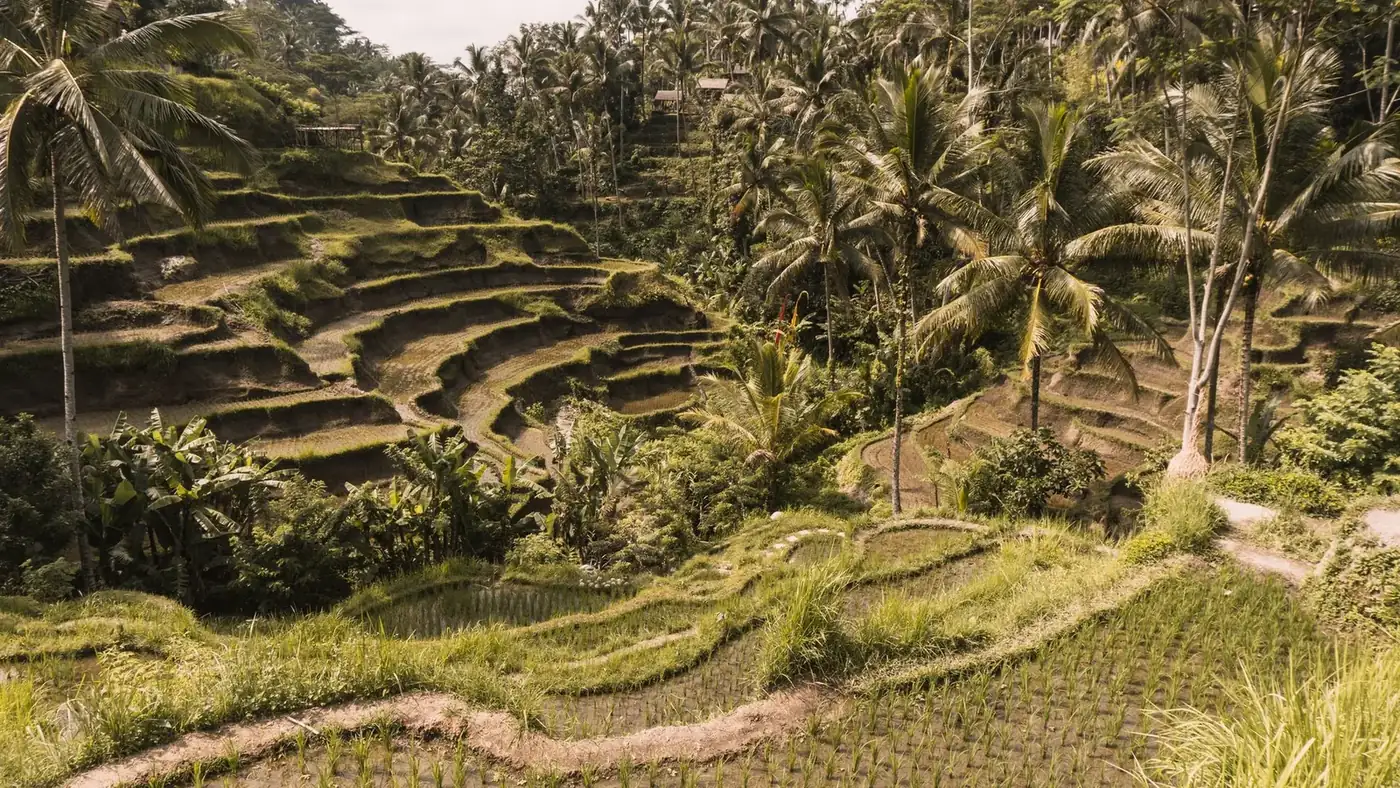
The 2012 inscription is called the Cultural Landscape of Bali Province, and what it protects is subak: the thousand-year-old cooperative irrigation system that shares river water between rice farmers, along with the network of water temples that governs it. Taman Ayun is one of the component sites inside that listing, alongside the rice terraces at Jatiluwih and the lake temple complex in the north. The temple is not independently inscribed, and the thing being honoured is the irrigation culture rather than the architecture.
Subak is a genuinely unusual institution. Water flows downhill through a valley and every farm along it needs some, so the farmers organise into a cooperative that allocates flow, maintains the channels and settles disputes. The allocation is not decided in an office. It is decided at the water temple, in ritual, and the calendar of planting follows the calendar of ceremony. Religion here is the administrative layer, which is why UNESCO listed temples rather than dams.
This matters a little for what you see at Mengwi. The moat is not decoration. A royal water temple sat at the top of that hierarchy, and controlling water was the same thing as governing. The ring of still water round the sanctuary is a claim to authority, made in the only medium that mattered on a wet-rice island.
Getting there
Mengwi is in Badung regency, inland and north of the airport, on the main road that climbs towards Bedugul. Nothing about reaching it is difficult, which is unusual for a Bali temple.
| Coming from | Drive | Notes |
|---|---|---|
| Canggu | 45 min to 1 h | The closest of the beach towns, and the easiest morning run north. |
| Seminyak, Legian | 1 h | Add half an hour if you leave after nine, when the coast road seizes up. |
| Kuta, the airport | 1 h to 1 h 15 | Worth doing on the way north rather than as a separate trip. |
| Ubud | 1 h | West rather than north, on roads that are slower than the distance suggests. |
| Tanah Lot | 30 min | The single most natural pairing, and the reason most people end up here. |
| Ulun Danu Beratan, Bedugul | 1 h to 1 h 15 | Straight up the same road. The two temples are one drive, not two. |
| Uluwatu | 1 h 30 to 2 h | Opposite end of the island's southern traffic. Not a sensible pairing. |
Driver for the day
The default, and the sensible one. A car with a driver for eight or nine hours costs roughly what a mid-range dinner for two costs in Seminyak, and it turns three temples into one day. Agree the itinerary before you set off, because the standard western circuit is fixed in most drivers' heads and deviating from it mid-morning rarely works.
By scooter
Genuinely reasonable here, unlike at most temples. The road from Canggu is flat, the traffic is ordinary rather than terrifying, and there is shaded parking at the gate. If you plan to carry on up to Bedugul, remember the mountain road is cold, wet and steep in a way the coast never prepares you for.
Parking and arrival
There is a proper car park at the entrance with a small fee, and it is never full. The ticket desk is at the gate, the sarong is handed over there, and the walk from the car to the moat is about a minute. No shuttle, no motorbike taxi, no additional charges appearing halfway up a hill.
Building the western temple loop around it
Hardly anybody visits Taman Ayun on its own, and hardly anybody should. It is a forty-five minute stop, and the value comes from where it sits on the map: between the beaches, the mountain lake and the sea temple.
The three western temples sit on a triangle, and the sunset at Tanah Lot fixes the end of the day. Everything else runs backwards from that, which is why the right order changes completely depending on which bed you woke up in.
| Starting from | Order |
|---|---|
| Canggu, Seminyak, Kuta | North first, sunset last, no backtracking |
| Ubud | Straight up to the lake, then back down the west side |
| Staying at Bedugul or Munduk | Downhill all day, nothing is rushed |
| Only a half day | Pair Taman Ayun with Tanah Lot, skip the mountains |
From Canggu, Seminyak or Kuta: north first, sunset last
This is the loop the day tours sell, and the geography genuinely supports it. Mengwi, Bedugul and Tanah Lot sit roughly on a triangle you can drive in one direction, and the sunset at the end fixes the whole schedule.
- 08:00, leave the coast. Traffic north out of Canggu and Seminyak is the worst part of the day. Every half hour later costs you a half hour of it.
- 09:00, Taman Ayun. Forty-five minutes for a lap of the moat and the raised walkway. Morning light is across the towers and the water is still.
- 11:00, Ulun Danu Beratan. An hour further up into the mountains, and roughly ninety minutes on site. It is cooler up there, and the lake fogs over as the day goes on.
- 13:30, lunch at Bedugul, or the strawberry stalls on the way down. You are in the highlands, so the food is different from the coast and the temperature is fifteen degrees kinder.
- 16:30, Tanah Lot. Two hours back down and west. Arrive well before sunset, because the car park and the walkway both fill.
One long but genuinely coherent day, ten hours door to door, no road driven twice. Taman Ayun is the cheapest and easiest of the three stops and the one people are most surprised to enjoy.
From Ubud: straight up to the lake, then down the west side
From Ubud the natural first move is north to the lakes rather than west to Mengwi, so the loop runs the other way round and Taman Ayun becomes an afternoon stop instead of a morning one.
- 08:00, leave Ubud. North through the rice country, which is the pleasant part of this drive.
- 09:30, Ulun Danu Beratan. Get there before the mid-morning coach arrivals and before the lake mist burns off, which is the same window.
- 12:00, down the west road, lunch on the way. The descent towards Tabanan passes the rice terraces at Jatiluwih if you want a detour.
- 14:30, Taman Ayun. Afternoon light is flatter and the reflection in the moat is not what it is at nine, but the site is quiet at any hour and this is still a comfortable forty-five minutes.
- 16:30, Tanah Lot, then back east to Ubud. The return leg after sunset is an hour and a half in the dark. This is the compromise: the day ends further from your bed than it started.
Perfectly doable, and the only version where Taman Ayun gets the wrong light. If photographs matter more to you than the sunset, drop Tanah Lot and do Mengwi first thing instead.
Staying at Bedugul or Munduk: downhill all day
Sleeping in the highlands turns this from a marathon into a morning. You do the lake temple at first light with nobody there, then drift downhill towards the coast with two stops on the way.
- 07:00, Ulun Danu Beratan. Ten minutes from a Bedugul hotel, and empty at that hour. This alone justifies the night in the mountains.
- 10:00, start down the mountain. Coffee plantations and the Jatiluwih terraces are both on this road if you want them.
- 12:00, Taman Ayun. Still late morning light, still quiet, and you arrive with nothing behind you in the schedule. The best-tempered version of this stop.
- 14:00, lunch in Mengwi or Tabanan. Local warungs rather than tourist restaurants, since you are off the main circuit here.
- 16:30, Tanah Lot, then on to the coast. Finish at the sea temple and carry on to Canggu or Seminyak for the night.
The best of the three, and almost nobody does it. A single night up at Bedugul converts a ten hour day into a slow descent with the two temples caught at their quietest.
Only a half day: pair Taman Ayun with Tanah Lot
Bedugul is what makes this a full day. Cut it out and you have a comfortable afternoon: Mengwi and Tanah Lot are only about half an hour apart, both close to the west coast, and neither needs long.
- 14:00, leave the coast. Forty-five minutes north from Canggu, a little more from Seminyak or Kuta.
- 15:00, Taman Ayun. Forty-five minutes. There is no queue and no timed entry, so this stop never overruns.
- 16:30, Tanah Lot. Half an hour south-west. Get in before the sunset crowd and walk the cliff path while the light is still good.
- 19:00, back on the coast for dinner. Home well before the evening is over, which is the whole point of this version.
The efficient answer, and the one to take if temples are a box you are ticking rather than the reason you came. It also avoids the two hour mountain drive, which is the part that turns the full loop into a long day.
The pairing that does most of the work is with Ulun Danu Beratan, an hour further up the same road on Lake Bratan. Those two together make the one temple pairing on Bali that does not involve doubling back, and they complement each other properly: one is architecture in a garden, the other is a silhouette on water. Add Tanah Lot at the end for sunset and you have the classic west coast day, which is classic because the geography made it so.
What does not work is trying to attach Taman Ayun to the eastern temples. Tirta Empul and Besakih are on the other side of the island, and Lempuyang is a full day in its own right. Trying to do both halves of Bali in one day produces nine hours in a car and four rushed temples. Split them across two days, or pick a side.
Tickets, hours, dress code
Ticket
A few dollars per adult, less for children, sarong included and a small parking fee on top. Cash only. Rates are revised locally and are not published anywhere reliable, so carry small notes and do not plan to the rupiah.
Hours
Daytime, opening around eight in the morning and closing in the early evening. Ceremonies can restrict access at short notice, which matters less here than elsewhere because the visit is short and you are usually passing through anyway.
Dress
Sarong for everyone, handed over with the ticket. Shoulders covered, shorts to the knee. Bring your own sarong if you have one: the loaned ones are one-size polyester and they turn up in every photograph you take.
How long
Thirty to forty-five minutes. Add fifteen for the museum in the outer court, which is small and better than it looks. Nothing here rewards a second hour.
When to go, hour by hour
Crowds are not the variable here, because there are none worth planning around. Light is. Early morning gives you the still moat and the reflection, and the low sun comes across the thatch rather than behind it. By late morning the sky goes white and the towers photograph as black cut-outs, which is why so many pictures of this temple look flat.
Late afternoon works too, though the sun is then behind the tower line from the main walkway and you are shooting into it. If your day ends at Tanah Lot for sunset, you will be here in the morning anyway, and that is the better half of the deal.
Wet season and what changes
Between roughly November and March the gardens are at their greenest, the moat is full, and the lotus is in leaf. Rain comes in heavy bursts rather than all day, and there is very little shelter on the walkway, so an umbrella in the car is worth more here than a rain jacket.
The dry season gives you reliable skies and slightly tired lawns. Either works. This is one of the few sites on Bali where the weather does not decide whether the visit is worth making, because there is no view to lose and no summit to be hidden in cloud.
How it compares to Bali's other temples
If you are choosing rather than collecting, this is the honest ranking of what each major temple actually gives you for the time it costs.
| Temple | Setting | Crowds | Time needed | In a sentence |
|---|---|---|---|---|
| Taman Ayun | Gardens and a moat, flat, no view | Very low, all day | 30 to 45 min | The calm one. Best as a stop on a longer drive. |
| Ulun Danu Beratan | Shrines on a mountain lake | Moderate to heavy by mid-morning | 1 h to 1 h 30 | The postcard. Forty minutes further up the same road. |
| Tanah Lot | Rock in the sea, sunset | Heavy, and worst at sunset | 1 h 30 to 2 h | The spectacle, and the market you walk through to reach it. |
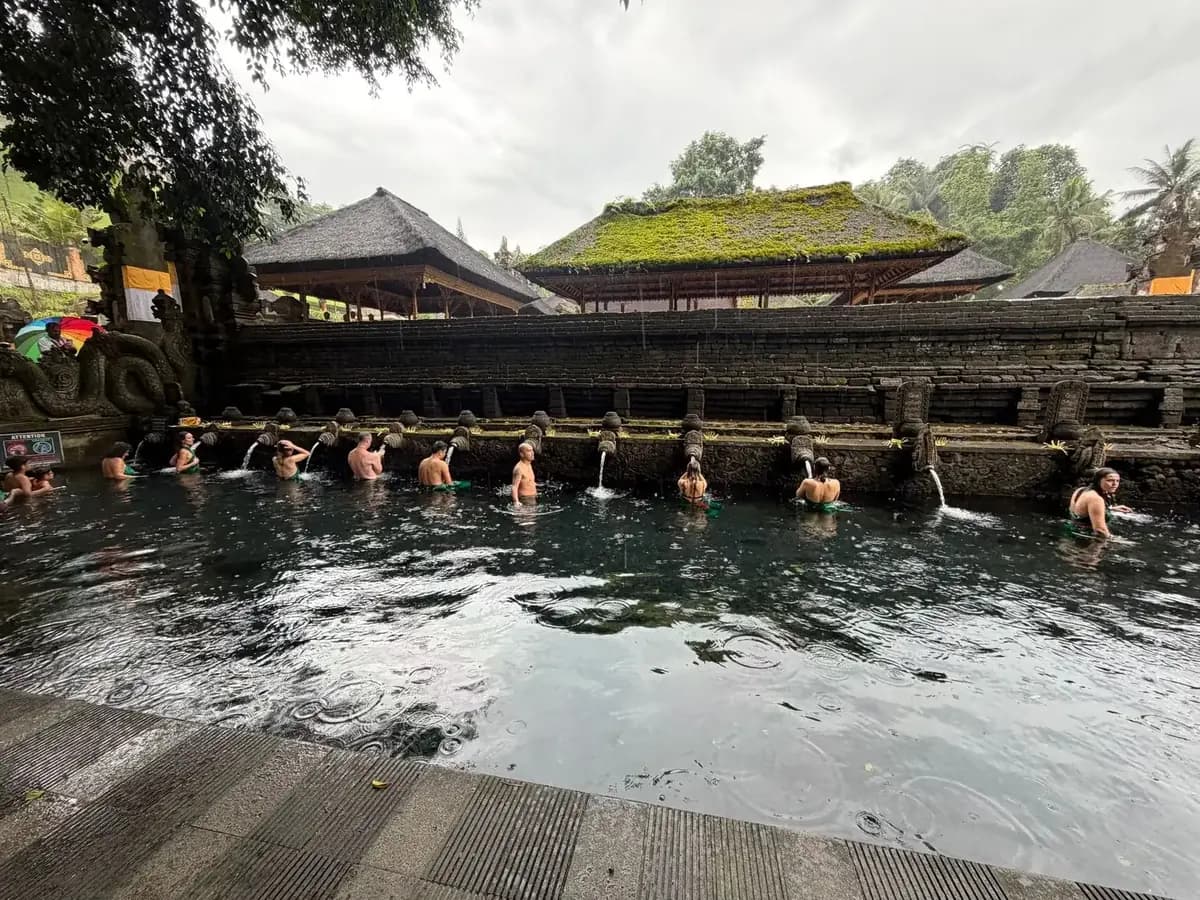
| Tirta Empul | Purification spring, near Ubud | Heavy in the morning | 1 h 30 with the bathing | The only one where you take part rather than look. |
| Besakih | Mother temple, on Mount Agung | Moderate, spread over a huge site | 2 h | The important one, religiously. A long drive east. |
The pattern is clear enough. Taman Ayun is the cheapest stop on the list in every currency that matters: money, time, effort and patience. It is also the one that gives you the least drama. Those two facts are the same fact, and whether that trade suits you is the whole question. Our overview of Bali's temples sets out the rest of the field.
Photographing Taman Ayun
There is no photographer, no mirror and no queue here. There are also only about four compositions that work, and knowing them in advance turns a twenty minute walk into the good version of this visit.
- The reflection in the moat, from the outer bank. Early morning, before any wind. Get low, put the water line in the bottom third and let the tower row sit above it. This is the photograph of this temple and it takes about ninety seconds.
- The tower line from the raised walkway. Shoot along the row rather than square at it, so the merus stack and the different heights read as a sequence. Square on, they merge into one dark mass.
- The kori agung down the causeway. Perfectly symmetrical, framed by the paving, and almost never has anybody standing in it. One of the easiest architectural shots on Bali.
- Detail on the causeway carvings. The guardian figures and the moss on the stonework are the only close-range subjects here, since everything else is behind a wall. They are also the pictures nobody takes.
A practical note on drones, because people ask. The complex is an active sanctuary and aerial footage of the inner court is exactly the kind of thing the closed gate exists to prevent. Enforcement varies and signage is inconsistent, but the polite reading of the rule is obvious enough. Do not fly over the sanctuary, and never during a ceremony.
One thing this site does not have is a good sunset. The temple faces the wrong way, the tree line is high and the gates close before the light gets interesting. That job belongs to Tanah Lot, thirty minutes away, and every itinerary on this page ends there for that reason.
So is it worth it, for you specifically
The generic answer is unhelpful, because the honest answer depends entirely on what kind of trip you are having.
Clear yes: on a west Bali day tour
It is on the road, it costs forty-five minutes and a few dollars, and it is the calmest thing you will do all day. There is no argument against including it.
Clear yes: travelling with children
Flat, short, grassy, no steps, no monkeys and no cliff edges. The easiest temple on the island to visit with a five-year-old, and nobody has to be quiet for long.
Depends: based in Ubud
An hour each way for forty-five minutes on site only makes sense inside a bigger loop. On its own from Ubud, the ratio is poor.
Probably not: one temple, whole trip
If you will see exactly one temple on Bali, see a dramatic one. A lake, a cliff or a spring will stay with you longer than a very good garden will.
The reviews split along exactly this line. The disappointed ones are almost all from people who drove out specifically to see it and found a small site with a closed gate. The enthusiastic ones are almost all from people who stopped on the way to somewhere else and were handed half an hour of quiet in a country where quiet is genuinely scarce. Same temple, different expectation, opposite verdict.
If your trip is already full of temples, this one is where the fatigue lifts, because there is nothing to endure. No stairs, no touts, no crowd, no timed slot. Set against a three hour queue at Lempuyang, forty-five easy minutes in a garden has more value than its entry in a guidebook suggests.
What else is nearby
Mengwi is a working town rather than a tourist one, which is part of its appeal and all of the reason there is nothing to do in it after the temple.
Within thirty minutes
Tanah Lot is the obvious one, half an hour south-west, and it is a completely different experience: a temple on a rock in the sea, reached through a long market, mobbed at sunset and genuinely spectacular anyway. If you do only these two, you have seen both ends of what a Balinese temple can be.
The Mengwi market runs in the mornings a few minutes from the temple and is a produce market rather than a souvenir one. It is the most unfiltered thing within reach of this site and almost no visitor goes.
For food, the honest answer is that the good eating is not in Mengwi. There are simple local warungs around the temple and a couple of tourist-facing restaurants attached to it. If lunch matters, either eat before you leave the coast or push on north towards the highlands, where the food is a proper part of the day out.
Within an hour
North takes you to Ulun Danu Beratan and the lakes, with the Jatiluwih rice terraces and a string of coffee plantations on the way. East is Ubud and, just beyond it, the Tegallalang terraces. South is the coast and the airport.
What is not nearby, despite the two being filed together in most itineraries, is the royal water palace at Tirta Gangga. It belongs to the Karangasem kingdom at the opposite end of the island, three hours away, and it is a separate day rather than an extension of this one.
One route worth knowing: the road between Mengwi and Bedugul passes through farmland rather than resort strip, and it is one of the more pleasant hours of driving on the island. If your driver offers the toll road version to save fifteen minutes, the slow way is better spent.