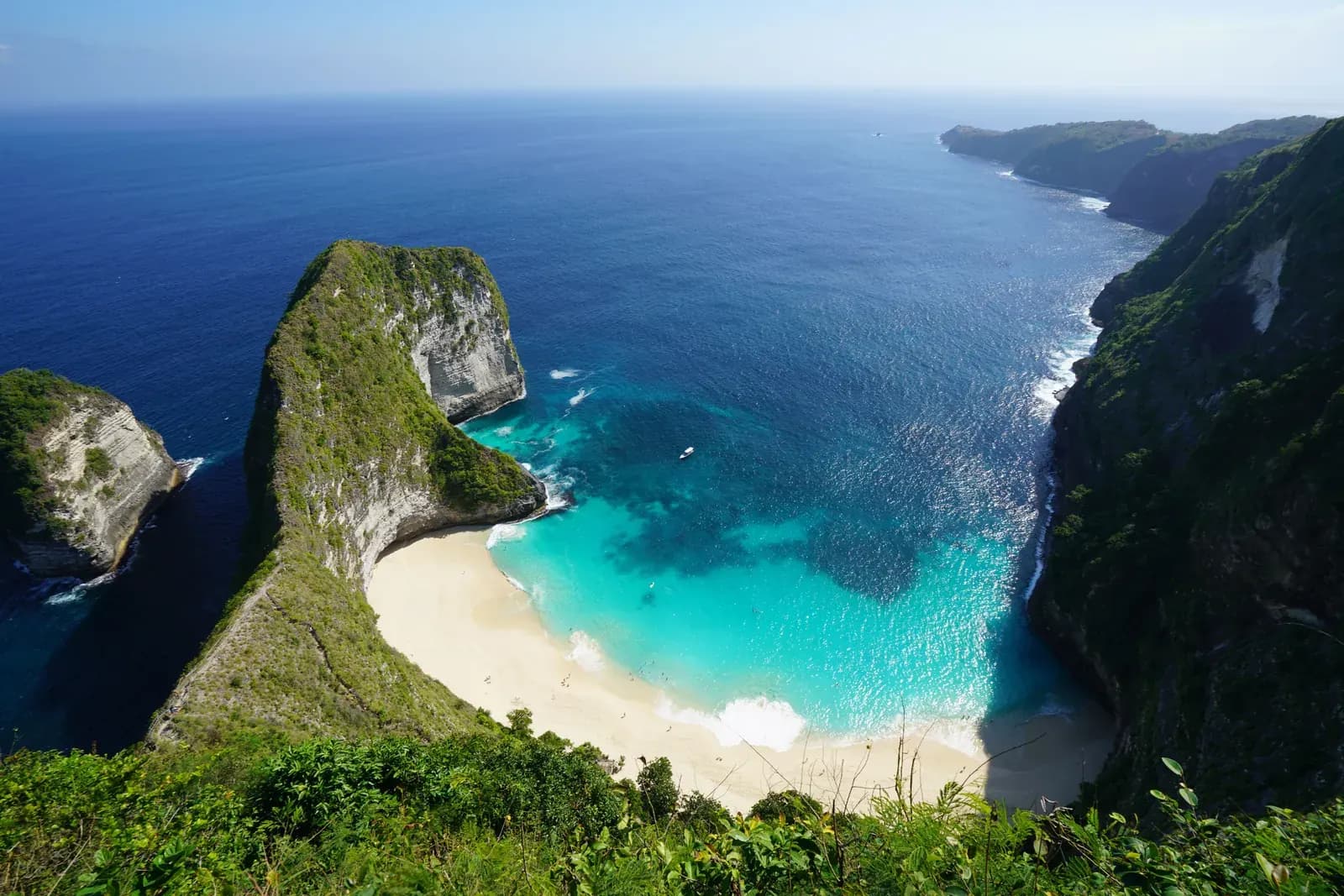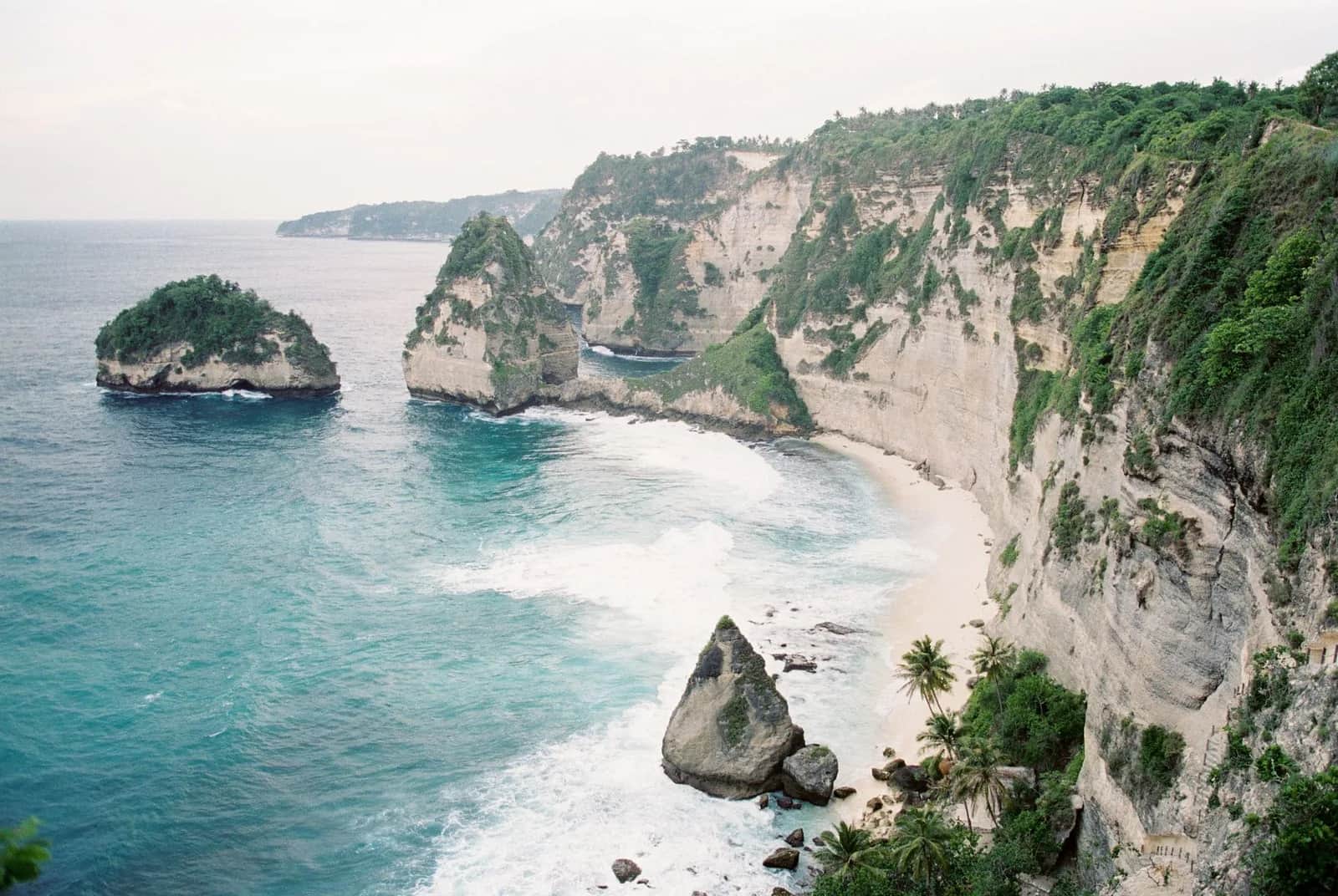
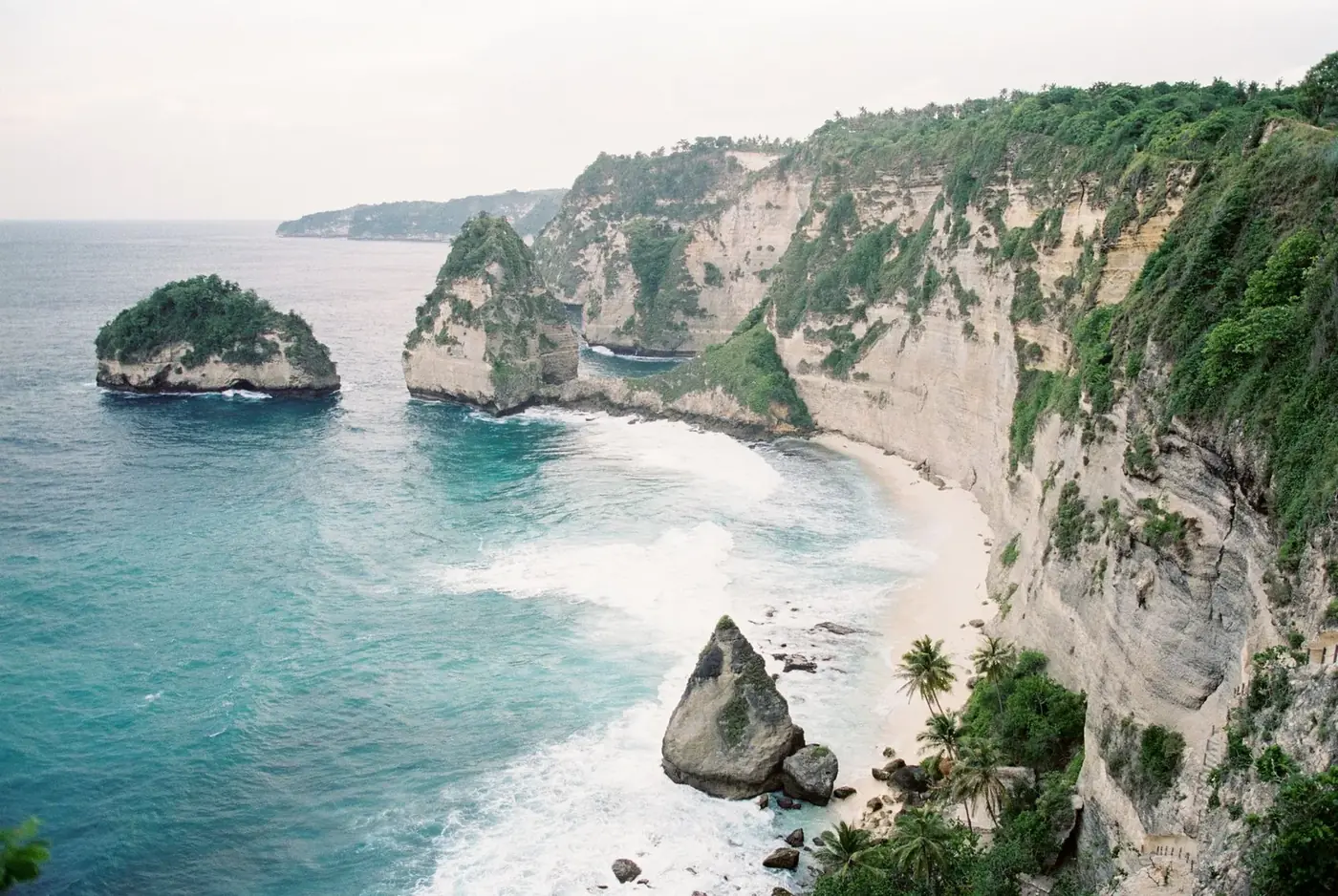
Diamond Beach is a cove on the east coast of Nusa Penida, tucked under a wall of white limestone with a line of sea stacks standing offshore. A staircase cut into the cliff face drops from the clifftop to the sand, and that staircase is the reason the beach is famous and the reason most of the arguments about it happen.
Four hundred metres along the same headland sits Atuh Beach, reached from the same car park on the same ticket. Guides list both and rank neither. That is a gap, because you are realistically going down one set of stairs, not two, and the two beaches want completely different things from your day.
The short version, before anything else: Diamond is what you look at, Atuh is where you stay. You cannot swim at Diamond, there is little shade and nothing much to do on the sand. Descend it for the photograph and the strangeness of standing under that cliff, then go and have your afternoon next door.
Fast boat, a driver for the day and the quiet side of the island
The Nusa Penida east coast, from Bali
- ✓Fast boat from Sanur and hotel pickup on the Bali side, which is the half people forget to plan
- ✓Diamond Beach, Atuh, Thousand Islands viewpoint and the tree house in one loop
- ✓A driver on roads that punish a rented scooter harder than anything on the west coast
- ✓Free cancellation on most listings, which matters when the crossing looks rough
Affiliate link. Booking through GetYourGuide costs you nothing extra and supports the guide. Price and rating checked September 2026. Both move with season and demand.
On this page
Diamond or Atuh: which one deserves the stairs
The question everybody asks in the car park, and the one no guide answers.
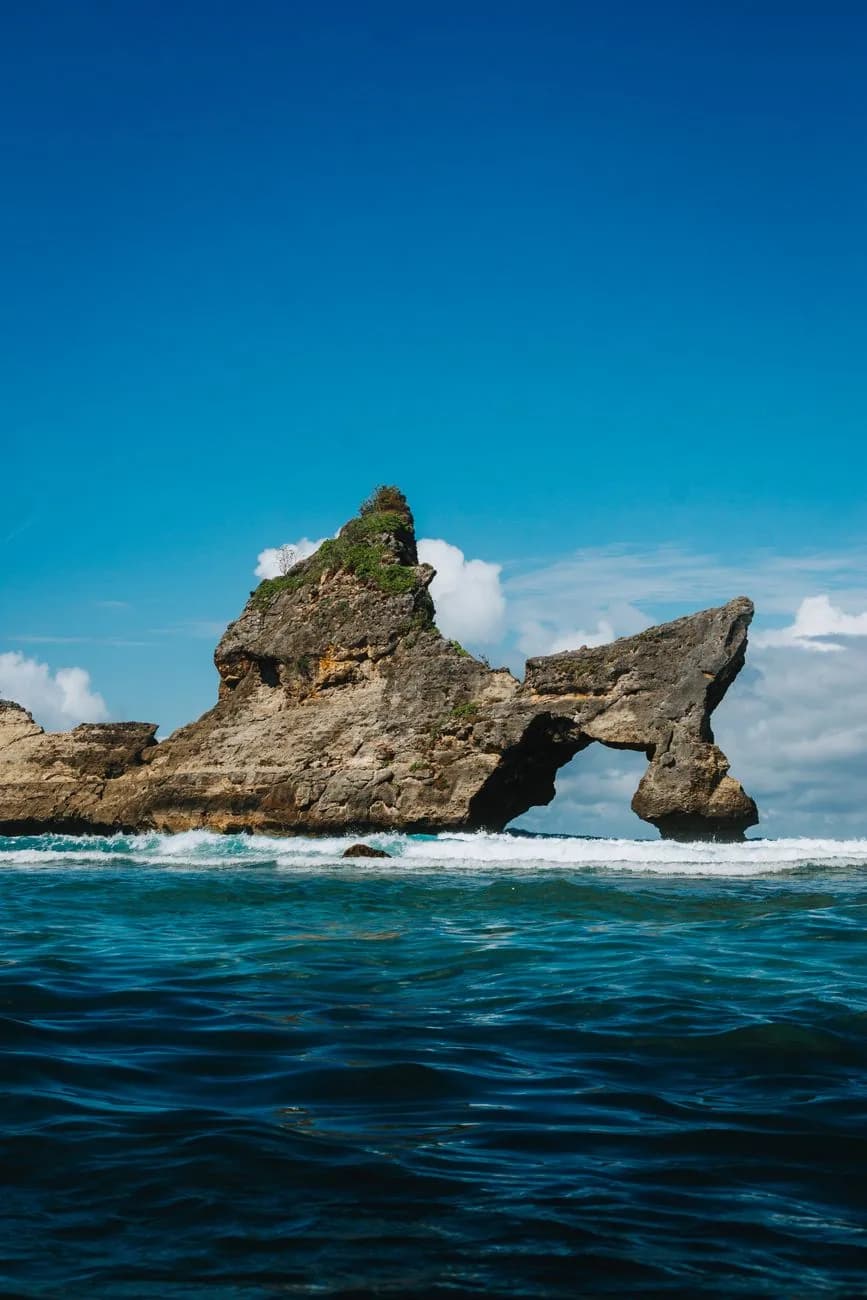
From the clifftop you can see both. Diamond is the one on the right under the white wall, with the stacks in the water and a curve of sand that photographs like a rendering. Atuh is round the corner: longer, flatter, backed by a row of thatched warungs, with a pierced rock arch sitting offshore. Diamond is the more beautiful object. Atuh is the better beach. Those are two different statements and conflating them is how people end up disappointed at the bottom of a staircase.
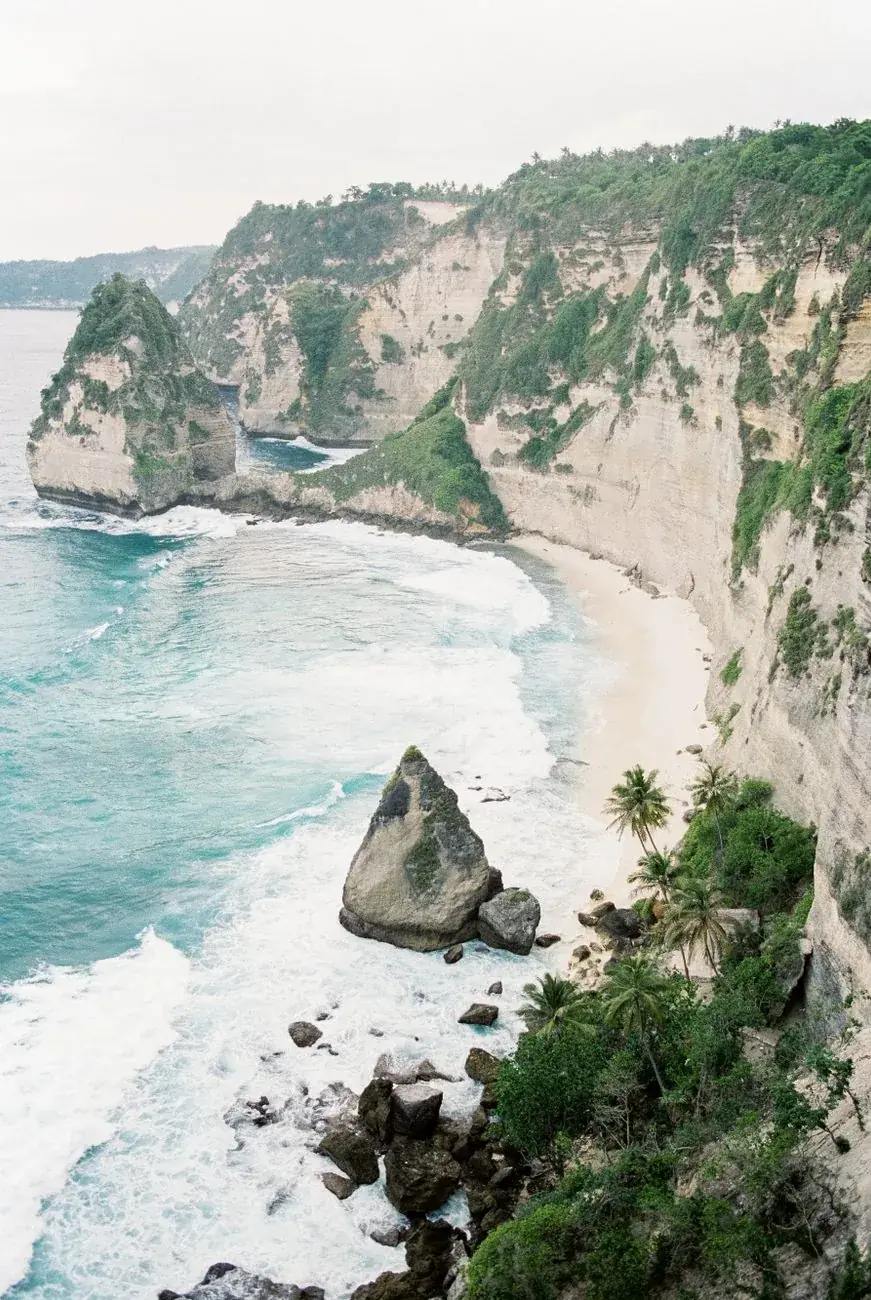
What tips it is what you are allowed to do once you arrive. At Diamond the answer is: look at it. Swimming is prohibited, the shade is a strip against the cliff that is gone by eleven, and the facilities amount to a warung and a swing. Thirty minutes on that sand is a full visit. At Atuh you have loungers, umbrellas, four or five kitchens and water you can get into, and three hours there passes without effort.
So the honest ranking depends entirely on what you came for. Pick yours below and the comparison will tell you which staircase to walk down, including the cases where the answer is neither.
| Criterion | Diamond Beach | Atuh Beach |
|---|---|---|
| What it is | A cove under a white limestone wall, with the Thousand Islands stacks offshore | A long crescent of sand inside a sheltered bay, five minutes along the same headland |
| View from the top | The one on every postcard of this island, and free from the clifftop | Wide and handsome, with a pierced rock arch offshore, but less dramatic |
| The descent | Several hundred carved steps, 15 to 25 min down, a rope only on the lower section | Around 170 concrete steps, 15 to 20 min down, plus a shorter flight on the left side |
| The climb back | The hard half. Exposed, no shade, slippery when the steps are damp | Steep in places but shorter, and under ten minutes by the alternative stairs |
| Swimming | Prohibited. Heavy shore break, strong drag, drownings on record | Yes, inside the bay, with the usual caution about currents and tide |
| On the sand | A warung, a rope swing between two palms, a photo nest, little shade | Four or five warungs, loungers, umbrellas and lunch for a few dollars |
| Crowds | The stop every east coast tour makes, on a staircase too narrow to overtake on | Consistently quieter, close to empty early on a weekday |
| Best hour | Sunrise. Facing east, and you need to be at the top before six | Mid morning, once the sun is on the water and before the afternoon wind |
If you want the photograph
Diamond, and it is not close. The cove, the pale sand against the limestone and the stacks offshore are the reason this corner of the island exists on Instagram. What almost nobody says out loud is that the best version of that view is from the clifftop, before you have descended a single step.
If you want to swim
Atuh, and only Atuh. Swimming at Diamond is prohibited and the reason is a shore break that lands hard on a steep beach with a strong drag off it. Atuh sits inside a bay, the water is calmer most days, and it is where people actually go in. Descending to Diamond for a swim is the single most common mistake made on this coast.
If you want to sit down, eat and stay a while
Atuh. There are four or five warungs on the sand with cold drinks, loungers and umbrellas, which means shade, lunch and somewhere to put your bag. Diamond has a warung and a swing and not much else, and the shade against the cliff has gone by late morning.
If you want the easiest climb back
Atuh, by a clear margin. Its staircase is a defined flight of concrete steps and there is a shorter alternative on the left side that gets you back to the top in under ten minutes. Diamond is several hundred carved steps with a handrail on the upper half and a rope on the lower section, and the return is the part people underestimate.
If you want fewer people
Atuh again. Diamond is the name on the tour itinerary, and the staircase is narrow enough that a group photographing itself halfway down stops everyone behind it. Atuh is five minutes away, gets a fraction of the traffic, and on a weekday morning you can have a good stretch of it to yourself.
What the staircase actually is
Everyone quotes a step count. The number that matters is where the handrail stops.
This coast changes faster than the guides covering it. The original flight was cut into the cliff by hand, a second one was opened alongside parts of it in 2024, and the condition of the lower section moves around with the weather and with whoever last maintained the rope. A page written in 2023 will tell you about a staircase that is no longer quite the one you are standing on, which is worth remembering the next time you read a confident sentence about it.
| Section | Down | Back up | What you hold |
|---|---|---|---|
| The cut steps from the clifftop | 5 to 8 min | 8 to 12 min | Handrail most of the way |
| Where the rail becomes a rope | 5 to 9 min | 10 to 15 min | A fixed rope, and the rock |
| The sand | You are down | Allow 25 to 35 min back up | Nothing to hold, thin shade |
The cut steps from the clifftop
The famous stretch, and the one in every photograph: pale steps carved straight into the limestone, dropping in tight zigzags with the cove opening up below. There is a rail for most of it and the treads are wide enough to pass someone on. Since 2024 a second flight runs alongside parts of the original, which has taken some of the congestion out of the upper half without making the lower half any wider.
Where the rail becomes a rope
Roughly halfway down the engineering stops. The steps become uneven, cut at heights that do not match each other, and the thing you hold is a rope anchored to the cliff rather than a rail you can lean on. Recent visitors describe this section as steep and slippery, and one complaint that comes up often enough to take seriously is finding stretches where the rope was missing. This is the part that decides whether the descent suits you, and it arrives after you have already committed.
The sand
Deep soft sand, palms against the cliff, a rope swing, a photo nest and a small warung selling cold drinks and mie goreng for a couple of dollars. The shade is a strip at the base of the wall and it is gone by late morning. Swimming is prohibited: the shore break is heavy and the water drags hard as it drains off the beach. What you do here is stand on it, photograph it and start back.
The climb back, and the queue on it
Going down takes fifteen to twenty-five minutes. Coming up takes twenty-five to thirty-five, and it is done in full sun on steps that were cut for the rock rather than for a human stride. That is manageable at eight in the morning with water and unpleasant at two in the afternoon without.
The other constraint is width. For long stretches the staircase carries one person, which means the pace of the whole descent is set by the slowest party on it, and from mid morning that party is usually photographing itself. Visitors complain about this more than they complain about the effort. Arriving before nine removes the problem entirely.
Shoes matter more here than the fitness does. The lower steps hold damp, the rock polishes where thousands of feet have crossed it, and flip-flops are the single most common reason people turn round. Trainers with any grip left on them are enough.
Can you swim at Diamond Beach?
No, and this is the fact most worth carrying down the stairs with you.
Swimming at Diamond is prohibited, and the water explains why within about ten seconds of watching it. The beach shelves steeply, so the swell does not roll in so much as land, and the same volume of water then drags back off the sand hard enough to take your feet away. Reviews from people who have stood there use the phrase sudden huge waves, which is exactly what a steep east-facing beach open to the ocean produces.
There have been drownings. There is no lifeguard, the phone signal at sea level is unreliable, and any rescue involves the same staircase you came down. Ankle deep at the edge on a calm morning is one thing. Anything past that is not a decision the sign is making for you out of caution.
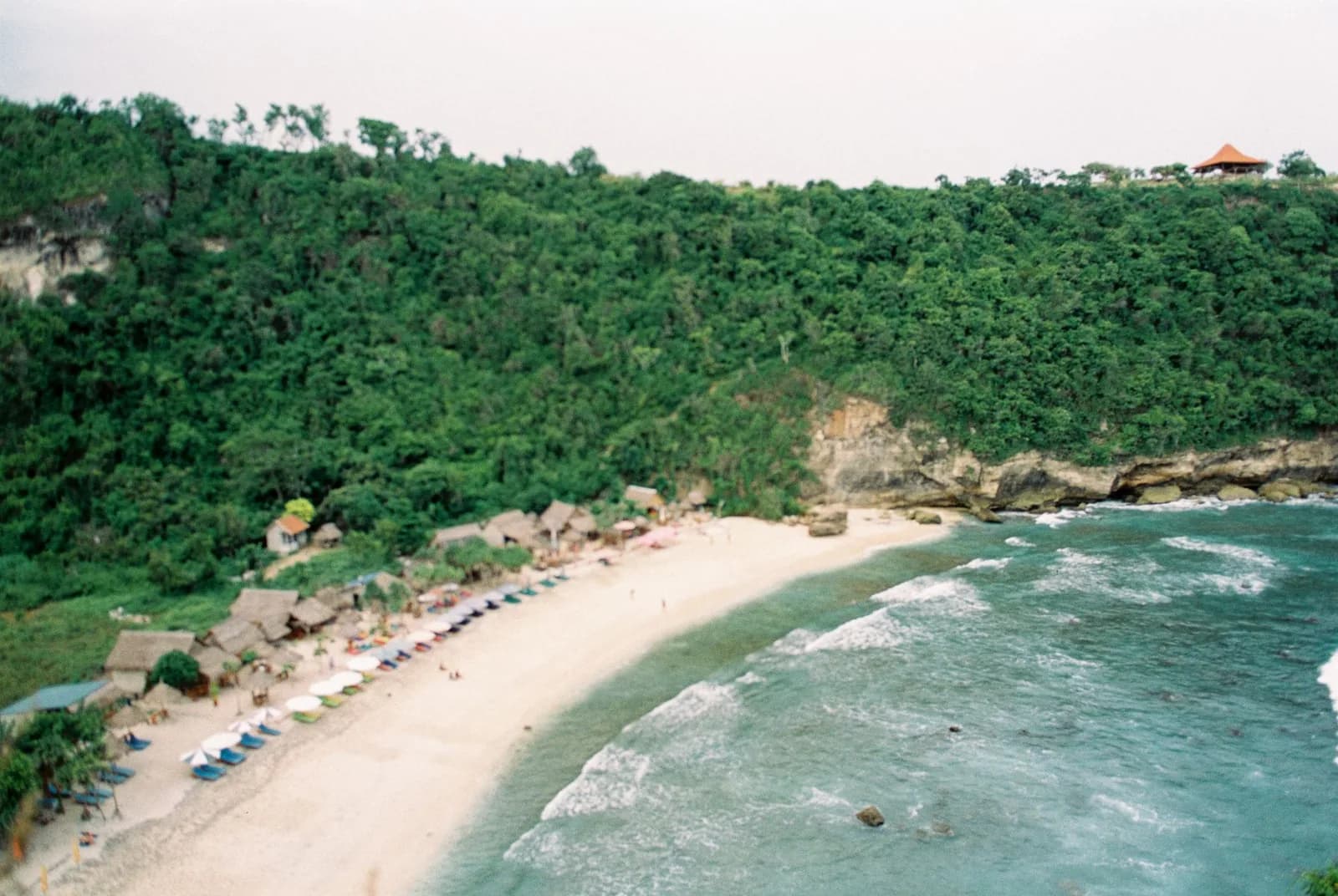
If a swim is the point of your day, that is Atuh, inside the bay, where the water is calmer and people are actually in it. On the west side of the island it is Crystal Bay. Both are covered on the island guide, along with the crossings and where to base yourself.
Is it worth the descent?
Four different visits, four different answers.
The clifftop, for everyone
Two minutes from the car park, and the finest thing on this side of the island. If the drive across is happening at all, this is what it was for.
The stairs before nine
Empty steps, a cool climb back and the cliff to yourself at the bottom. Done at that hour it is one of the good hours of a Nusa Penida trip.
The stairs at midday
A single-file queue on the way down, full sun on the way up and no shade at either end. You get the same photograph from the top for none of it.
The stairs for a beach day
No swimming, thin shade, one warung. Everything you wanted from that plan is at Atuh, four hundred metres away, down an easier flight of steps.
The line that would save most visitors a difficult hour is this: the best of Diamond Beach is visible before you take a single step. Descending is a genuine experience and it is also optional, and what waits at the bottom is a beach you are permitted to stand on and little else. The people who come away happiest tend to do the stairs at first light, climb back for breakfast, and spend the rest of the morning next door with their feet in the water.
Diamond Beach in an east coast day
Four sights within ten minutes of each other, and an hour and a quarter of bad road to reach them.
Diamond and Atuh sit on the same headland as the Thousand Islands viewpoint, which looks back along the stacks you can see from the beach, and Rumah Pohon, the tree house on the ridge that everybody queues for. Goa Giri Putri, the cave temple you enter through a gap in the rock barely wider than your shoulders, is on the road back towards the harbour. That is the whole east coast, and it is a comfortable morning if you start it early.
What it is not is compatible with the west coast on the same day. Crossing the island takes over an hour each way on roads that visitors describe in terms of pothole depth, so a day trying to include both Kelingking Beach and Diamond spends most of itself in a van. Listings that promise both exist. They deliver a photograph at each and nothing else.
If you only have one day on the island, take the west: Kelingking, Broken Beach and Crystal Bay are closer together and closer to the pier. The east coast earns its place on a second day, or on a first day if you have a room on the island and can be at the Diamond clifftop before the first boat has even docked.
Practicalities
The handful of things that go wrong here, and they are all avoidable.
| What | Where it stands | What to do about it |
|---|---|---|
| Entrance fee | Reported anywhere between 10 000 and 45 000 IDR a head, plus 5 000 to 10 000 for parking. It has moved more than once and depends on whether Atuh is included. | Carry 100 000 IDR in small notes per person. Cash only, no ATM on this side of the island. |
| Opening | Daylight hours in practice, with the gate staffed from early. Sunrise access is normal and expected here. | Aim for the clifftop before six for sunrise, or before nine for an empty staircase. |
| The road | The worst surfaces on Nusa Penida. Long potholed stretches are a recurring complaint in recent reviews. | Allow 75 minutes from the piers. Take a driver unless you are genuinely comfortable on a scooter. |
| Footwear | Cut steps, uneven risers, damp and polished rock on the lower section, and a rope rather than a rail. | Trainers. Flip-flops are why most turnarounds happen partway down. |
| Water and shade | None on the staircase, and a thin strip at the base of the cliff that is gone by late morning. | A litre each, and do the climb back before the sun is overhead. |
| The sea | Swimming prohibited. Heavy shore break on a steep beach, strong drag, no lifeguard. | Stay out of it. Swim at Atuh, five minutes away on the same ticket. |
Diamond Beach: common questions
What people ask before the drive across the island, and before the first step down.