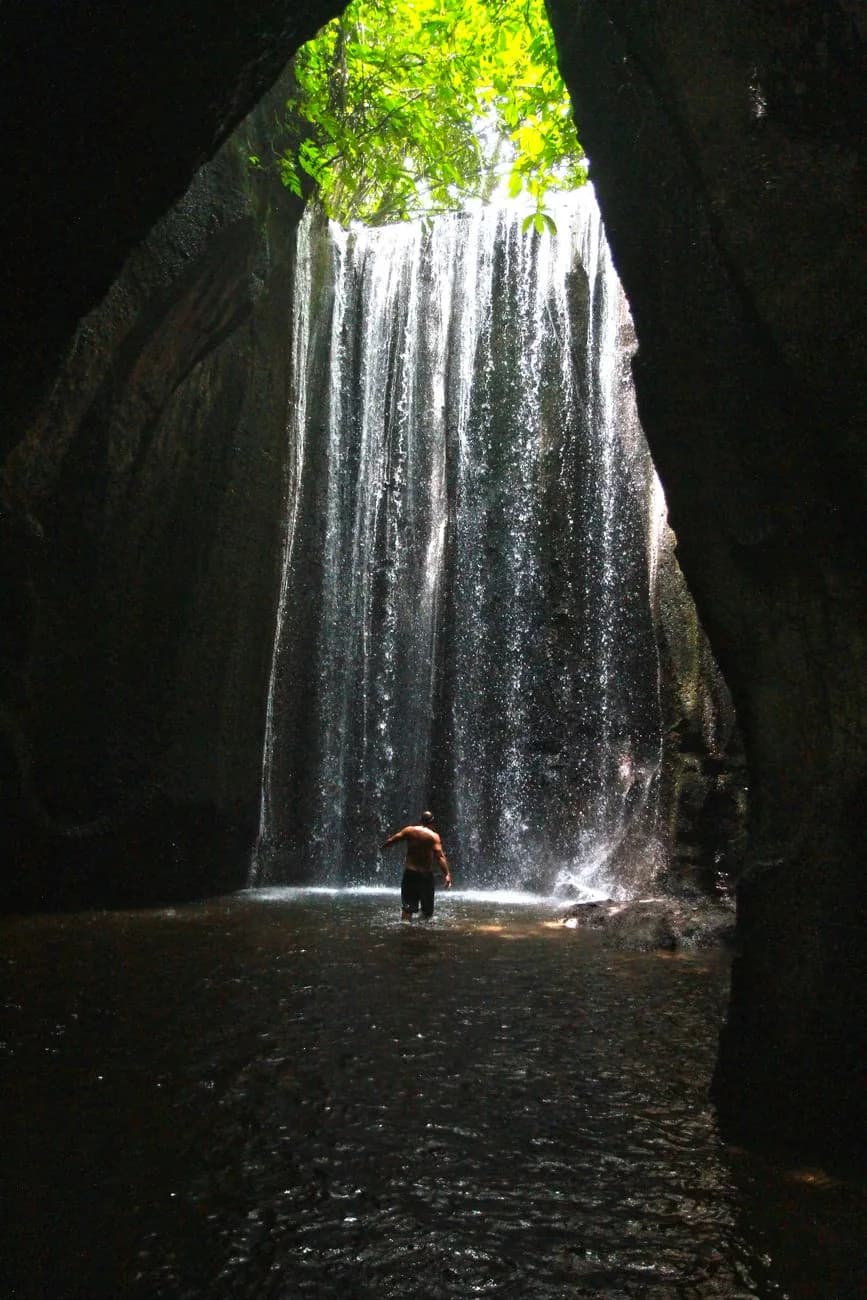
Most waterfalls you look at. This one you stand inside. The stream has cut down through soft volcanic rock in Bangli regency until it opened a chamber that is roofed on all sides except a slot of sky, and the only way in is down a long stairway and then along the riverbed itself. You cannot see any of it from the top. There is no viewpoint, no platform, no photograph from the car park. That is unusual on an island where most of the famous waterfalls are visible from a railing.
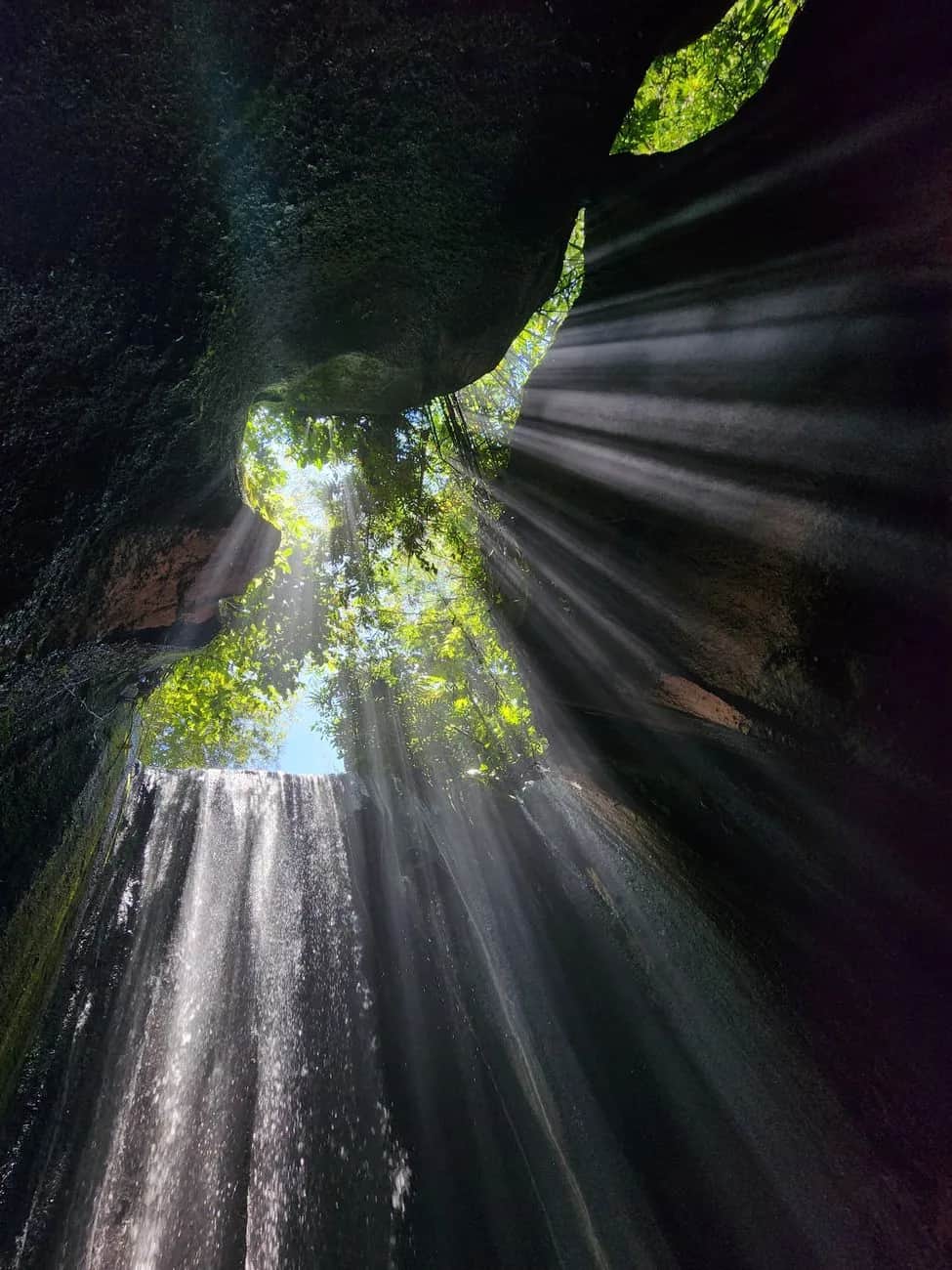
When the sun sits directly over that slot, the light comes down in visible shafts through the spray, and that is the image that put Tukad Cepung on every Bali itinerary. It is genuinely what it looks like. It is also not guaranteed, and a great many people come away without it, which is the part the photographs never mention. The rest of this page is about improving your odds and being honest about them.
If you would rather not work out the driving, the timing and the parking yourself, this is a waterfall that sits on almost every Bangli day trip, usually combined with Tibumana and a rice terrace stop.
On this page
Driver, timing and the whole Bangli loop
Free cancellationTukad Cepung waterfall day trips
- ✓Hotel pickup, which matters here because the light window is the middle of the day and the drive is long
- ✓Usually bundled with Tibumana, Kanto Lampo or Penglipuran village on the same loop
- ✓The driver waits, so a slow wade or a detour to the second fall does not break the day
- ✓Free cancellation on most listings if the forecast turns wet
Affiliate link. Booking through GetYourGuide costs you nothing extra and supports the guide. Price and rating checked September 2026. Both move with season and demand.
What Tukad Cepung actually is
A rock room with a waterfall in it, and a hole in the ceiling. Everything else follows from that geometry.
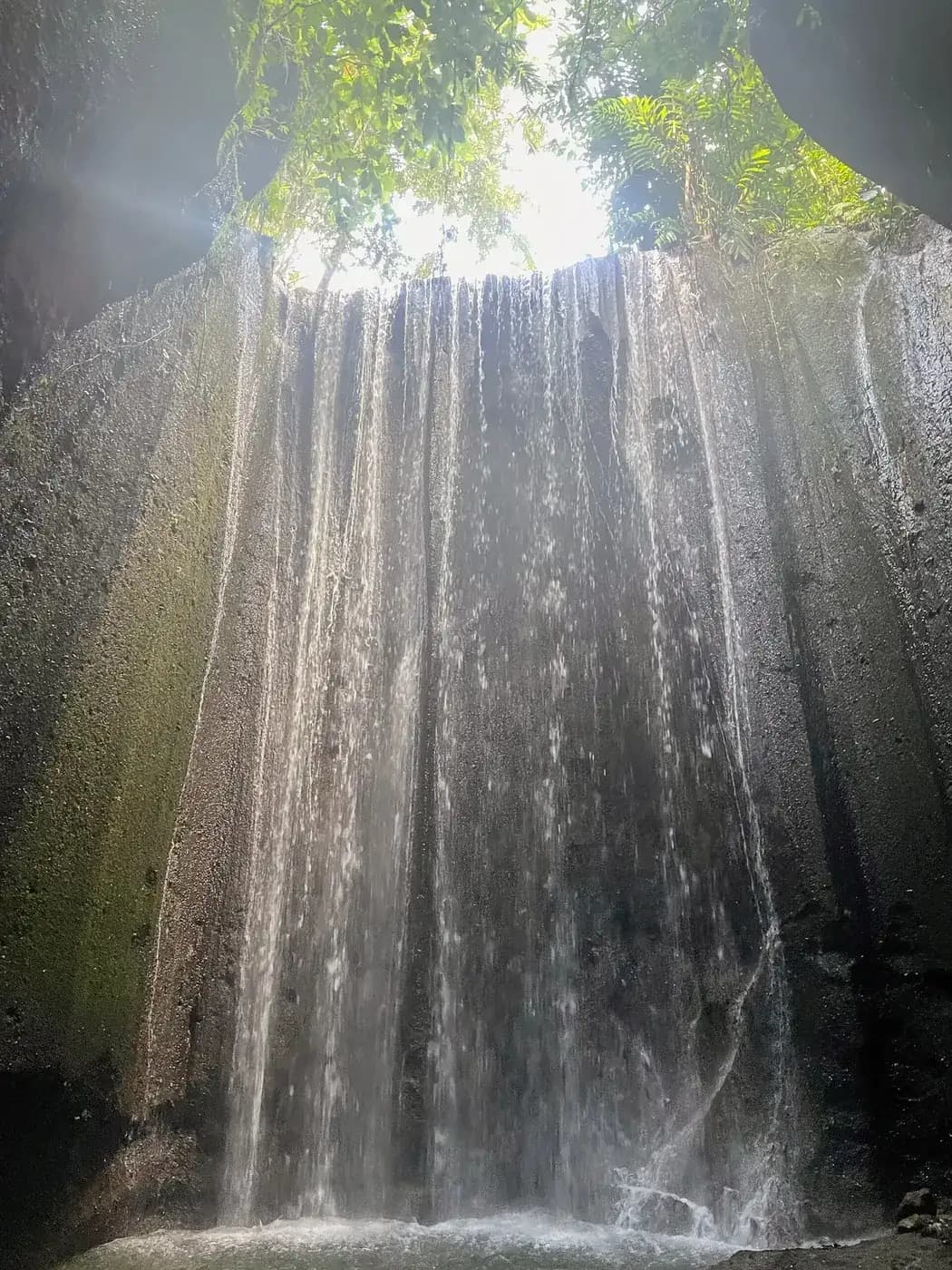
Photo Bex Walton, CC BY 2.0
The fall itself is not tall. Compared with the big drops elsewhere on the island, Tukad Cepung is modest, a broad sheet of water perhaps a dozen metres high spilling over the lip of the gorge. What makes it worth the drive is the room it falls into. The stream has eaten a slot down through the rock and then undercut it, so the walls lean inwards and meet overhead in places. Standing in the middle, you are enclosed on every side, with a ragged opening of sky and hanging vegetation above.
That enclosure is also why the light behaves the way it does. A narrow opening acts like a skylight: for most of the day it lets in ambient daylight and nothing more, and for a short window when the sun crosses directly over it, the beam comes through at an angle steep enough to reach the water. Add spray in the air to catch it, and you get shafts you can see rather than just brightness.
The temperature drop as you walk in surprises people. It is permanently shaded, permanently damp, and the water coming down off the plateau is cold by Bali standards. Fifteen minutes standing in it is enough to feel it, particularly for children, which is worth factoring in before you plan a long session with the camera.
And it is small. The chamber holds perhaps thirty people uncomfortably, and at midday in August that is not a hypothetical number. The same hours that give you the light give you a queue for the good rock to stand on, which is the central trade of visiting this particular waterfall.
The light beam, and your honest odds of seeing it
Every guide tells you to come at midday. Almost none of them tells you what happens when the sky does not cooperate, which is a lot of the time.
Three things decide whether you see the beam, and only one of them is the clock: the month, the hour you are standing in the chamber, and the sky that day. These are odds, not a forecast. Nobody can promise the beam, it depends on cloud you cannot see from the car park, on how much spray is in the air, and on where the sun happens to be when you walk in.
| Month | Season | Midday clear sky odds |
|---|---|---|
| January, February | Peak wet season | Long shot |
| March | Wet season easing | Coin toss |
| April | Shoulder | Coin toss |
| May | Early dry season | Good odds |
| June, July, August | Dry season, peak dry season | Good odds |
| September | Dry season | Good odds |
| October | Shoulder | Coin toss |
| November | Wet season starting | Long shot |
| December | Wet season | Long shot |
January, February, November and December: long shots
January and February are the wettest stretch of the year, with cloud most middays and the stream running high and brown, plus closures after heavy overnight rain common enough to plan around. November has cloud building early and often, so treat a clear midday as a bonus rather than a plan. December brings high water, heavy cloud, and the highest chance of finding the access closed on arrival.
March, April and October: a coin toss
The rain starts backing off late in March, but middays are still often grey. April is the first month where a clear midday is more likely than not, and the water is still full. In October the first storms return, usually in the afternoon, so morning arrivals still work most days.
May through September: the best odds
May is one of the best combinations of the year, reliable sun and a stream that has not thinned out yet. June brings consistently clear middays, the gorge at its most photogenic and at its busiest. July has the best odds on the light and the worst odds on having the chamber to yourself. August is much the same as July, though flow is lower, so there is less spray for the beam to catch, which softens it a little. September stays very good, with slightly thinner crowds than August once the European holidays end.
The crowd, hour by hour
Just after opening, 07:00 to 09:00, the chamber is almost empty and the gorge is yours, but there is no beam at all. From 09:00 to 10:00 it stays quiet, and on a very clear day you may catch a thin, angled shaft towards the end of this hour. From 10:00 to 11:00 the earliest hour that reliably produces the photograph starts filling up, since the tour groups know it too. From 11:00 to 13:00, when the light comes straight down the slot, every driver in Bangli drops off at once and it is the busiest of the day, queueing for your spot on the rock. From 13:00 to 14:00 the beam swings off the water and up the wall then goes, still worth it if the sky is clear, with the crowd thinning. After 14:00 the chamber is quiet again, in shade, and in the wet half of the year this is the hour afternoon storms tend to arrive.
With an overcast or rainy forecast, it is worth checking whether the site is even open before you drive out. Without any forecast at all, the seasonal average for your month is the next best guide.
Reading the bands
Good odds means roughly two visits in three come away with the beam: this is the trip to plan around. A coin toss means call it one visit in two, so go, but go wanting the gorge as much as the photograph. A long shot means around one visit in five, fine as a stop on a wider day out, poor as the reason for one. Under one visit in ten, do not count on it: you are going to see a waterfall in a dark canyon, and that is the whole offer.
One: sun high enough
The gap in the roof is narrow, so the sun has to be almost directly above it. Solar noon in Bali falls around 12:30, which is why the window runs roughly 10:00 to 13:00 and why an early start gets you nothing but shade.
Two: clear sky
Cloud diffuses the light and the shafts vanish. This is why the dry months work better, and it has nothing to do with the waterfall itself. What matters is what is happening several kilometres above it.
Three: spray in the air
A beam is only visible because there is mist for it to light up. Too little water late in the dry season and the shaft goes faint. Too much in the wet and the chamber is unusable. The middle is where it works.
Put those together and the sweet spot is narrower than the internet suggests: a clear day in May, June, September or October, standing in the chamber between eleven and one. July and August give you the most reliable sky of the year, at the cost of the most people and a slightly thinner curtain of water. The wet months are not a write off, but you should go for the canyon and treat any beam as a bonus rather than planning your day around one.
The route in, and the surprises on it
Two car parks, more than one place to pay, a long stairway, and a stretch where the path becomes the river. None of it is signposted well.
You cannot see the waterfall from the top. Here is everything between the car park and the chamber, including the points where you pay and the point where your feet get wet. Timings assume an ordinary day at an ordinary pace. After heavy rain the stream stages change completely and access may be closed at the second booth, whatever you have already paid at the top.
| Stage | Elapsed | You pay | In the water |
|---|---|---|---|
| The car park | Minute 0 | Yes | No |
| The entrance booth | Minute 2 | Yes | No |
| The stairway down | Minutes 3 to 12 | No | No |
| The second payment point | Minute 12 | Yes | No |
| Into the stream | Minutes 13 to 18 | No | Yes |
| The main chamber | Minute 18 | No | Yes |
| The second waterfall | Add 10 to 20 minutes | No | Yes |
| Back up the steps | 15 to 20 minutes | No | No |
The car park and the entrance booth
There is more than one car park signed for Tukad Cepung and the signage does not make it obvious that they lead to the same water. Whichever one your driver picks is fine. Parking is collected here, in cash, separate from the entrance, and if you are on a scooter, park where the attendant points rather than closer to the trees, since the lower spots flood after heavy rain. A small counter at the top of the path then takes the entrance fee. Foreign visitors pay more than Indonesians, standard across the island and posted openly. Keep the paper slip, you may be asked for it further down, and bring small notes for the whole visit, since change for large notes is often short.
The stairway down
A long concrete and stone stairway drops through the trees into the river valley. It is a proper descent rather than a path, with handrails on most of it, ten to fifteen minutes down at an unhurried pace. The steps hold moisture in the shade and are slick even on dry days. This is where the falls happen, not in the canyon.
The second payment point
At the bottom, near the streambed, a second collection point is common, sometimes framed as a local contribution, sometimes as access to the upper fall. It is small and normal, but it catches people out because nothing at the top warned them about it.
Into the stream
From here the route is the river. You walk along and through the water, usually ankle to shin deep, over rounded rock and a few short scrambles, into the narrowing slot. There is no dry alternative. Water shoes or sandals with real grip are the right call. Flip flops come off in the current and dry trainers are simply ruined.
The main chamber
The gorge closes overhead and you are inside a rock room with the fall at one end and a slot of sky above. You cannot see any of this from the top of the stairs, which is why the arrival lands the way it does. Water underfoot, spray in the air, and if the timing is right, the beam. Phones get soaked here, and a waterproof pouch is worth more than a wide lens.
The second waterfall
Most visitors photograph the main chamber and turn around, missing a second fall a short way further upstream, adding 10 to 20 minutes. Go up only if the water is low and clear.
Back up the steps
The same stairway in wet shoes, in humidity, after standing in cold water, 15 to 20 minutes and harder than the descent suggested. Allow an hour and a half on site in total, two if you go up to the second fall.
The multiple payment points are the single thing visitors complain about most, and it helps to understand why they exist rather than reading them as a shakedown. Access to the gorge crosses land held by more than one community, and the arrangements for parking, for maintaining the stairway and for the streambed access are negotiated separately. What reads as a surprise fee at the bottom of the steps is usually a different set of people maintaining a different bit of the route.
The practical answer is boring and effective: bring small notes and expect to pay two or three times. The total is still a few dollars. What ruins the visit is arriving with a single large note and a fixed idea of what you already paid for.
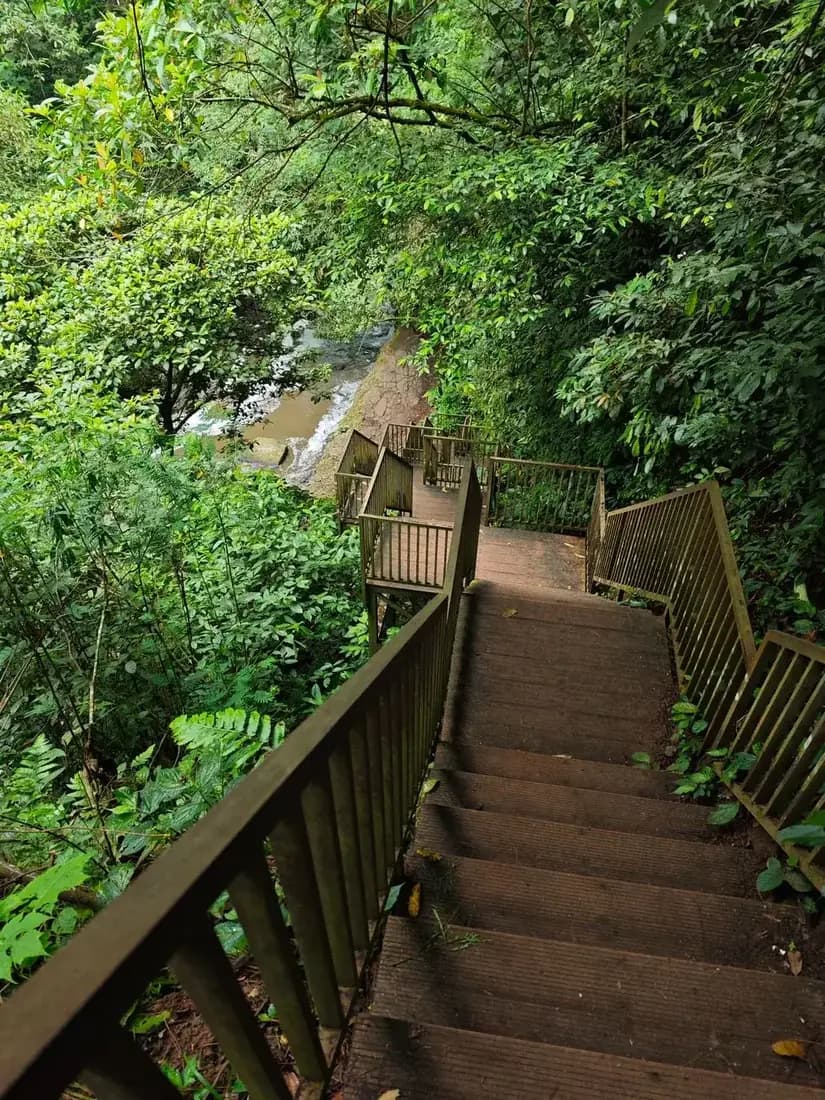
The other underrated part is the stairway. Coming down it takes ten to fifteen minutes and feels easy. Coming back up, in soaked shoes, in humidity, after standing in cold water, is a genuinely different exercise, and it is where anyone who was unsure about their knees finds out. There are warungs at the top selling cold drinks at tourist prices, and after that climb almost nobody argues about them.
The stretch beyond the main chamber deserves more attention than it gets. A second waterfall sits upstream, broader and out in daylight rather than boxed in, and reaching it means another ten to twenty minutes of wading. Most people photograph the slot and turn around without ever knowing it is there. Go when the water is low and clear, and skip it entirely if the stream is running strong.
When the gorge is not safe
The waterfall is not the hazard. The shape of the canyon is.
Signs to turn around on
- Brown water. If the stream is carrying silt, it is already draining a storm somewhere above you.
- A rise you can see. Water climbing the rock while you stand there is the one signal that ends the visit immediately.
- Heavy rain overnight. The gorge can be closed the next morning under a perfectly blue sky.
- Debris in the streambed. Fresh branches and leaf litter high on the rock show you where the water was recently.
- Nobody coming out. A busy site with an empty streambed usually means somebody upstream knows something.
None of this makes Tukad Cepung a dangerous outing. Thousands of people walk in and out every week without incident, and on a dry season morning the risk is close to that of any wet staircase. It is simply a place where the margin depends on the weather in a way that a roadside viewpoint does not, and where checking the sky upstream is worth more than checking it above your head.
What it costs, and why you pay more than once
The site itself is cheap. Reaching it is where the money goes.
| What you pay for | Detail | Order of magnitude |
|---|---|---|
| Parking | Collected at whichever car park your driver stops in, before you reach the entrance counter. | ≈ $0.60 |
| Entrance | Paid at the booth above the stairway. Foreign and Indonesian rates differ, as everywhere on Bali. | ≈ $1 to $2 |
| Second collection point | Common at the bottom of the steps, near the streambed. Small, normal, and never signposted at the top. | ≈ $0.60 to $1 |
| Locker or bag minding | Optional, offered near the start of the wade. Useful if you are carrying anything you cannot get wet. | ≈ $1 |
| Driver for the half day | The real cost. From Ubud it is a comfortable half day, from the southern beaches closer to a full one. | $22 to $45 |
All of it is cash and every figure above moves, so treat them as orders of magnitude rather than prices. The pattern is the same across Bali: the entrance is trivial, the accumulation of small payments is not quite, and the transport dwarfs both. If you are visiting two or three sites on the same loop, a driver for the half day works out cheaper per stop than most people expect, and it removes the problem of riding a scooter back over wet roads in the afternoon.
Getting there
Tembuku, in Bangli regency, northeast of Ubud and inland from everything else. Driving times are the ones that decide whether you make the light window.
| From | Driving time | What that means for the day |
|---|---|---|
| Ubud | 45 min to 1 h | The natural base. Easy half day with Tibumana or Penglipuran added on. |
| Canggu | 1 h 30 to 2 h | Traffic through Denpasar decides this one. Leave early or it eats the light window. |
| Seminyak | 1 h 30 to 2 h | Same road, same problem. A driver for the day makes more sense than a scooter. |
| Kuta | 1 h 45 to 2 h 15 | The longest of the southern runs. Realistically a full day out. |
| Sanur | 1 h 15 to 1 h 45 | Slightly kinder traffic than the west coast beaches. |
| Kintamani | 45 min | Pairs well with a Batur sunrise if you can face the morning. |
Private driver
The default, and the right call from the south. A half or full day with waiting time included, which matters because the visit runs long if you go up to the second fall. Ask to be dropped for late morning, not sunrise.
Scooter
Realistic from Ubud if you are confident on Balinese roads, with the last kilometres narrow and steep. Not sensible from the southern beaches, and not sensible at all in the wet season afternoons.
Grab and Gojek
Fine for the outbound leg, unreliable for the return. Coverage inland in Bangli is thin and you can be left waiting a long time at the top of the steps. Agree a return with your driver instead.
One quirk worth knowing before you argue with your driver: mapping apps list more than one entrance under slightly different names, and both of them work. The paths converge below. If you arrive and the car park looks nothing like the photographs you saw, you are almost certainly in the right place anyway.
Swimming, shoes and what to carry
People arrive expecting a swim and find a wade. The water in the chamber is shallow, cold and uneven underfoot, and the pool at the base of the fall is a shelf of rock rather than a basin you can float in. You will get soaked standing under the spray, which is most of the fun, but nobody is doing lengths here.
If a proper swim is what you want from the morning, pair this with Tibumana, ten minutes away, which has an actual plunge pool and an easy walk in. That combination, canyon first for the light and pool afterwards, is the best half day in Bangli and it costs almost nothing extra in driving.
The single most common mistake is footwear. Flip-flops fail here: they slip on the algae, they come off in moving water, and they leave you picking your way over rock barefoot. Cheap water shoes, or sport sandals with a real sole, change the visit completely.
Pack list for the gorge
- Water shoes or grippy sandals. Non negotiable.
- Swimwear under your clothes. There is somewhere to change at the top, and it is not somewhere you want to spend time.
- A waterproof pouch for your phone. The spray reaches everywhere in the chamber, including the camera you are holding above your head.
- A quick-dry towel and a dry shirt left in the car for the drive home.
- Small notes. Several of them, for the several points at which you will be asked.
- As little else as possible. Everything you carry in gets wet or has to be held.
Photographing it without the disappointment
The chamber is a hard exposure: a bright slot of sky over a dark, wet room. Phones handle it worse than people expect.
Expose for the beam, not the rock
Tap on the bright water and drag the exposure down. Letting the walls go dark is what makes the shafts read as shafts. Automatic metering does the opposite and flattens the whole thing into grey.
Shoot from low and back
Crouching near the entrance to the chamber puts the beam across the frame rather than straight down it, and gets the curve of the undercut wall into the shot. Standing directly under the fall gives you a wet lens and a white blur.
Wipe the lens constantly
A single droplet on the glass turns a backlit scene into a smear. A microfibre cloth in a sealed bag is the most useful thing you can carry in, and almost nobody does.
Wait out the queue
At peak hours there is an informal rotation for the best standing rock. Ten minutes of patience gets you a clear frame. Pushing in gets you somebody else's elbow in it.
Worth saying plainly: the images that made this place famous are shot on perfect days, edited hard, and cropped to remove the twenty people standing behind the photographer. A good photograph here is achievable. An identical one to the ones you saved is largely a matter of weather and luck, and going in knowing that is the difference between a great morning and a sour one.
What to pair it with
Tukad Cepung takes ninety minutes and its light window is fixed. That leaves most of the day, and Bangli has enough within twenty minutes to fill it.
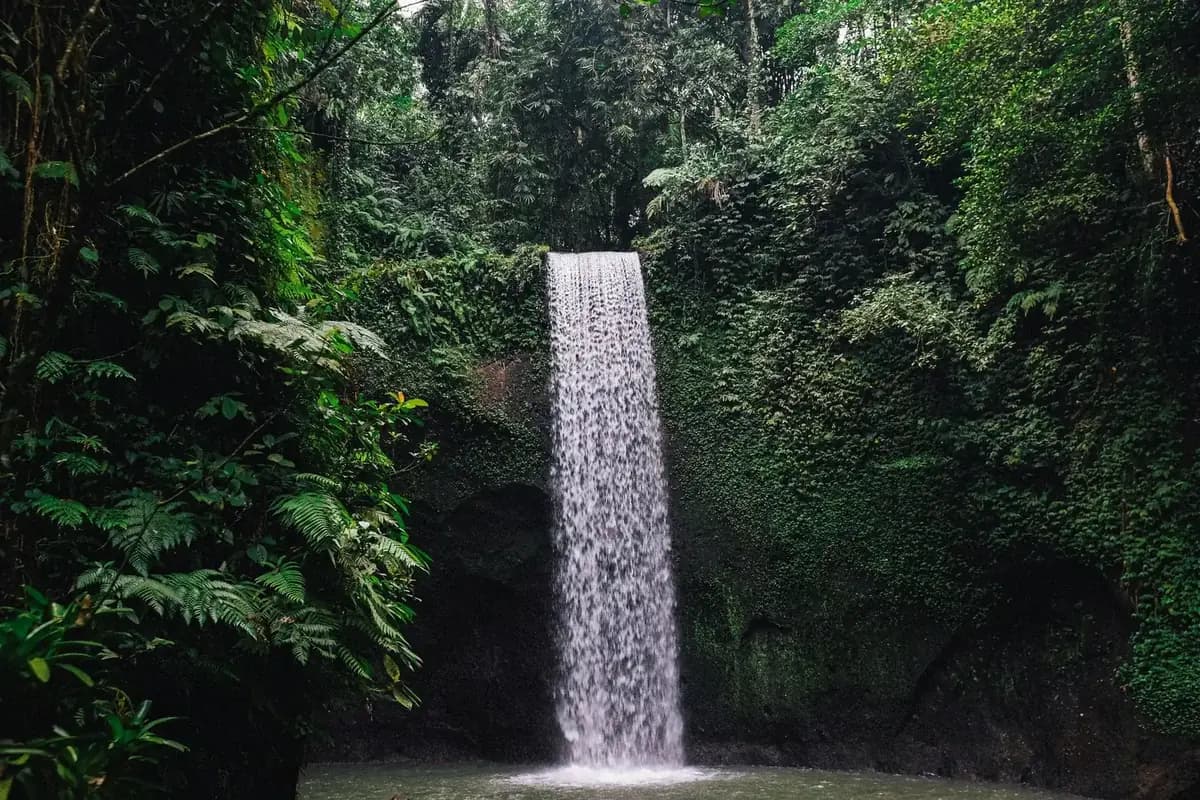
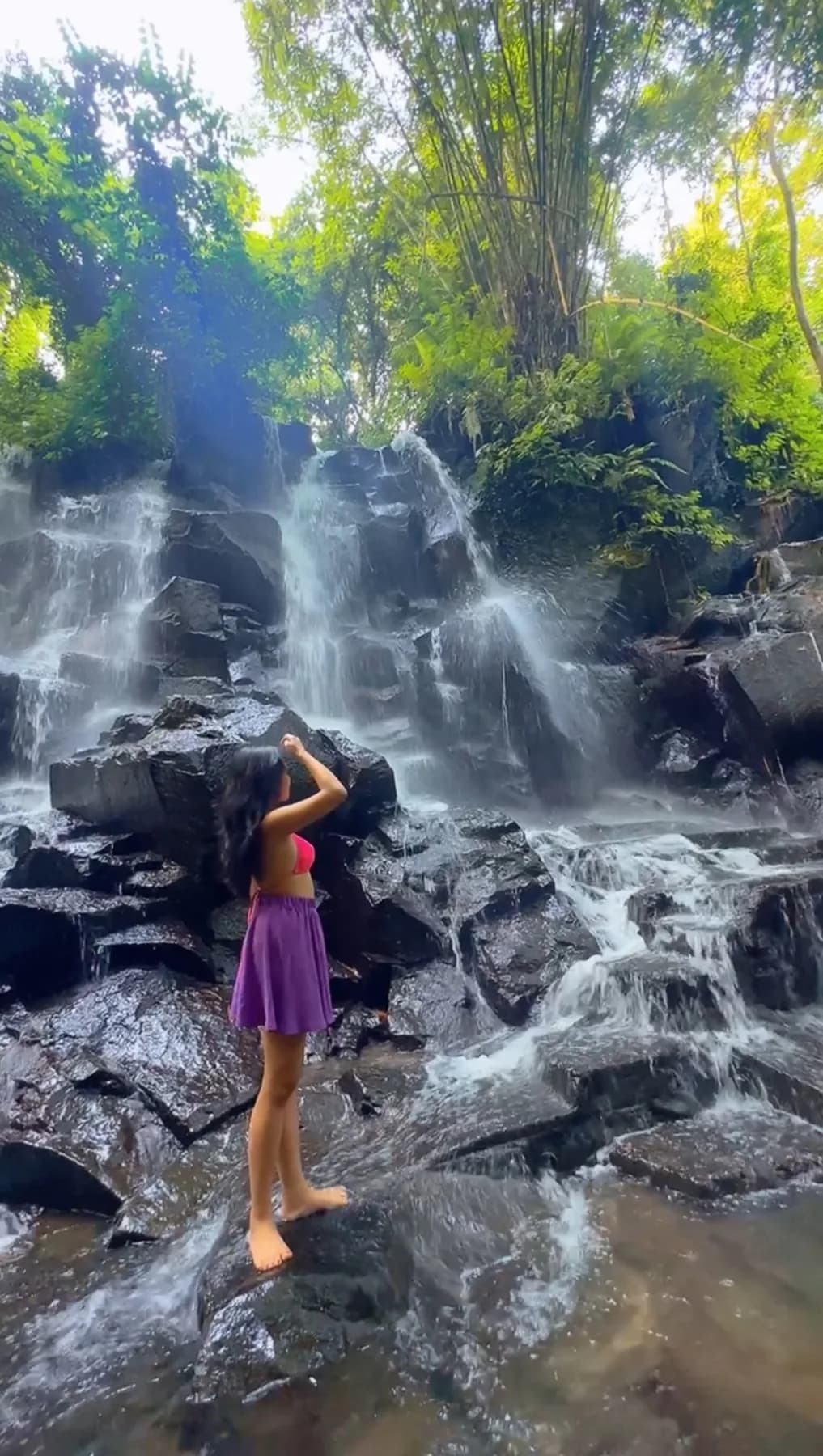
Tibumana is ten minutes away and is the obvious second stop, because it gives you everything Tukad Cepung does not: an easy walk down, a single clean fall, and a pool you can actually swim in. Go to the canyon for the light window, then come here to get warm and float about. Twenty minutes further, Kanto Lampo offers a third thing again, a wide stepped rock face you climb into rather than look at.
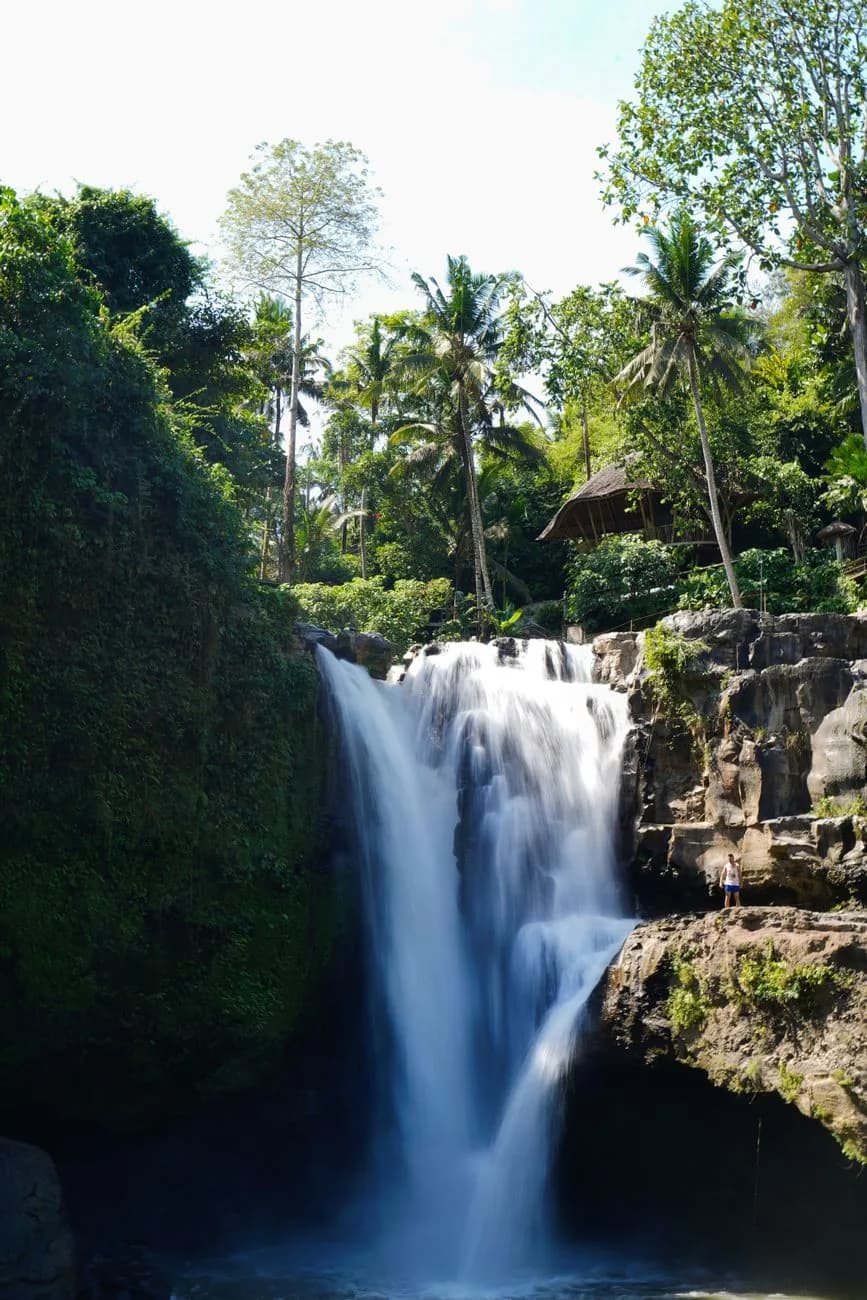
The one to leave out of this loop is Tegenungan. It is the busiest waterfall on the island and the least like this one, and stopping there on the way back to Ubud usually ends a good morning on a crowded note.
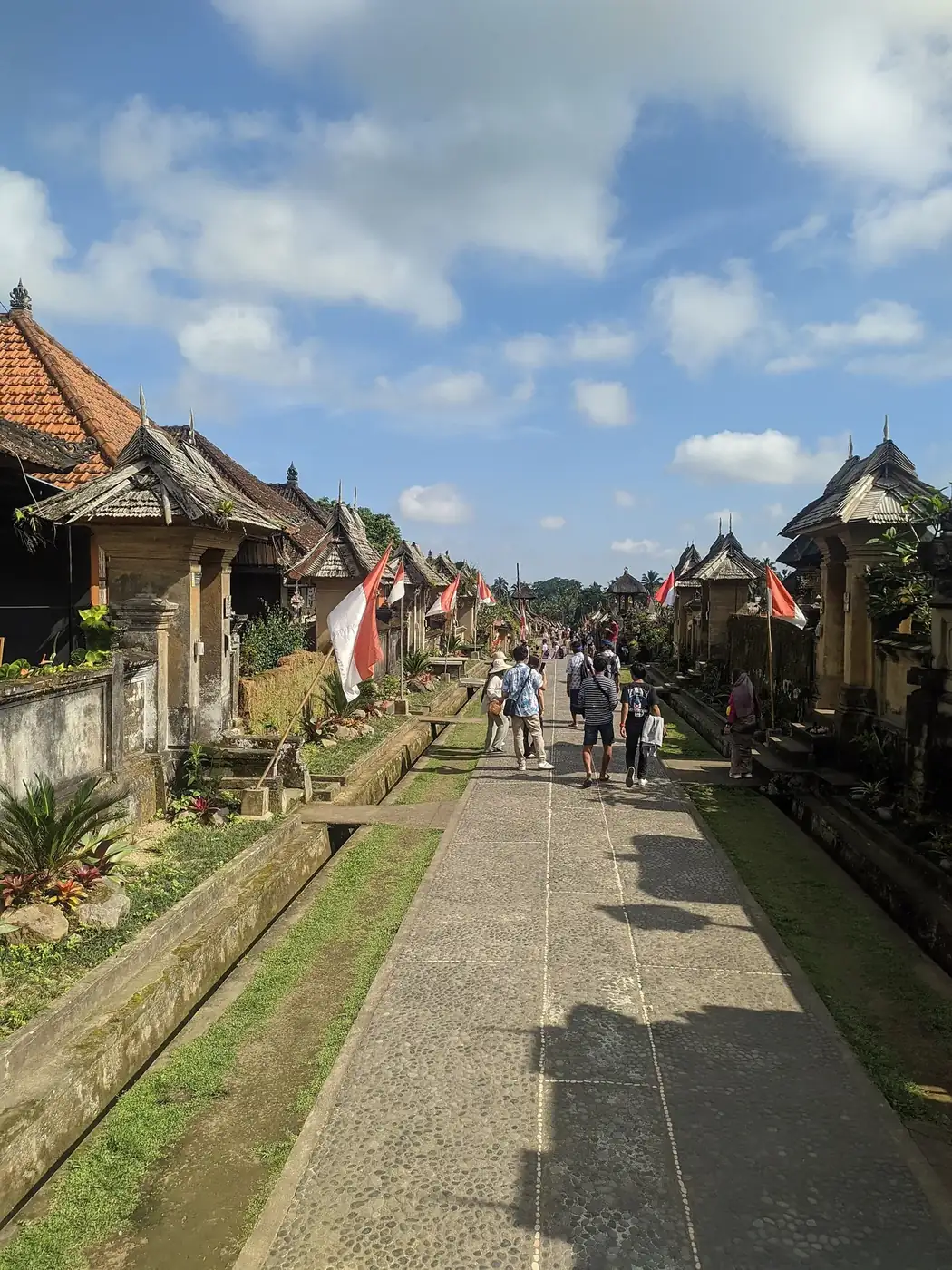
Photo Dare2Leap, CC BY-SA 4.0
Penglipuran, twenty minutes north, is the other kind of stop entirely: a traditional Bangli village with a single cobbled street, identical gateways down both sides and no traffic. It is thoroughly set up for visitors and still worth an hour, particularly as a dry, shaded contrast to a morning spent standing in a river. It also puts you within reach of Kintamani and the volcano rim road for the afternoon.
If you are based in Ubud, the whole loop is comfortable before dinner. From the southern beaches it is a full day, which is worth knowing before you commit: two hours out, ninety minutes in a canyon, and two hours back is a lot of car for one waterfall, and it is exactly why almost everybody visits Tukad Cepung as part of something larger. For the wider picture on which falls are worth the drive and which are not, the waterfalls guide sorts them by what you actually get at the bottom.
So is it worth it?
Go, without hesitating
If you are in Ubud in the dry season, if you like places that feel like a discovery rather than a viewpoint, and if you can arrange to be standing in the chamber around midday. On those terms it is one of the two or three best short outings on the island.
Go, with the expectation adjusted
If you are visiting in the wet months, or on a grey day, or as part of a tour that arrives at whatever hour it arrives. The canyon is still extraordinary. The photograph probably is not going to happen, and deciding that in advance is what keeps the morning good.
Skip it
If steep wet steps are a problem, if you are travelling with very small children, or if you are staying in the far south with one day and a long list. Four hours of driving for a ninety minute wade only makes sense inside a bigger loop.
The reputation of this place rests on one photograph, and the photograph is real. What the photograph does not tell you is that it is a narrow window inside a narrow season, that you reach it by walking down a river in the dark shade of a canyon, and that half the people beside you are seeing exactly what you are seeing and quietly wondering where the light went. Arrive knowing all of that and Tukad Cepung is a genuinely unusual hour. Arrive expecting the postcard and you are handing your morning to the weather.