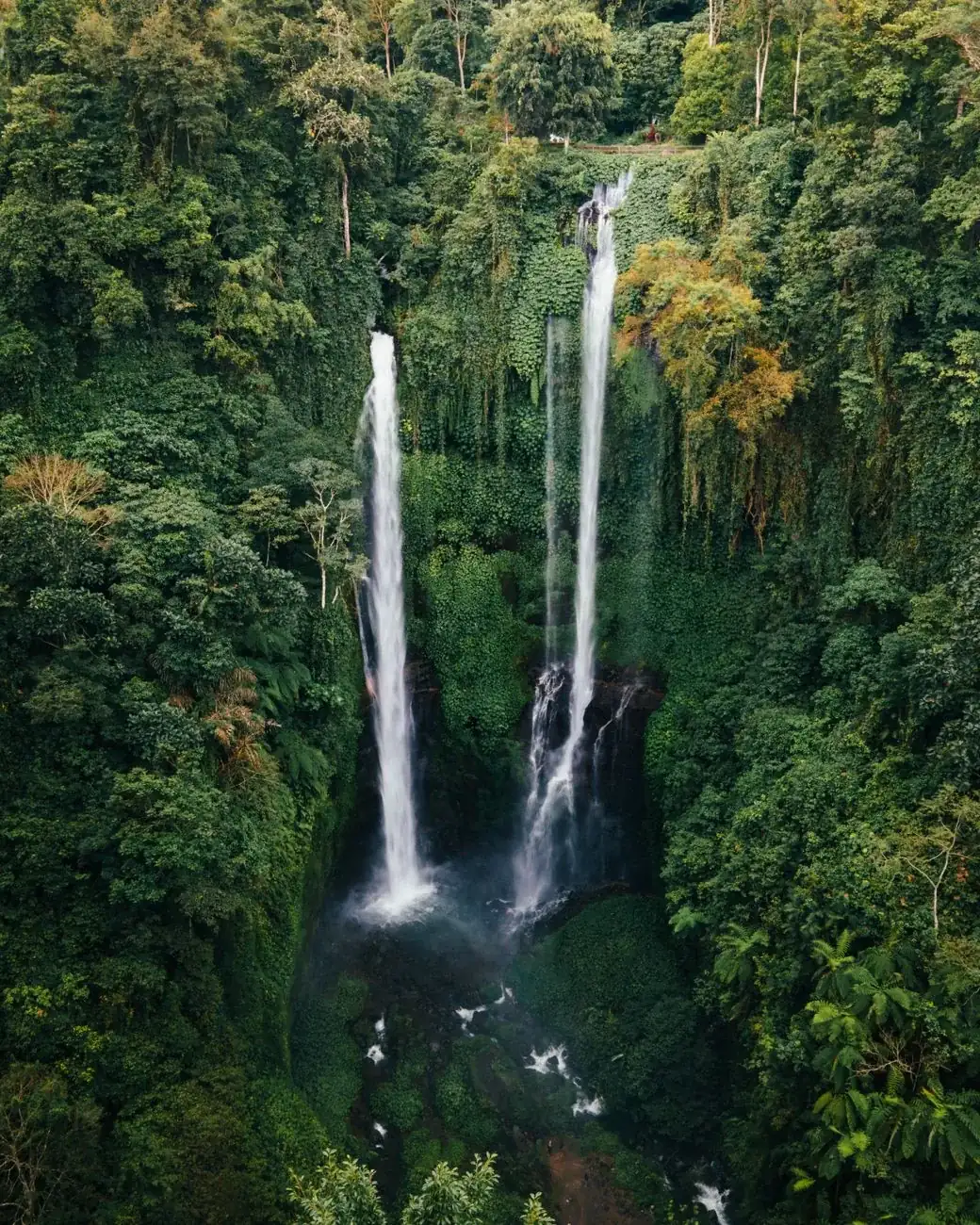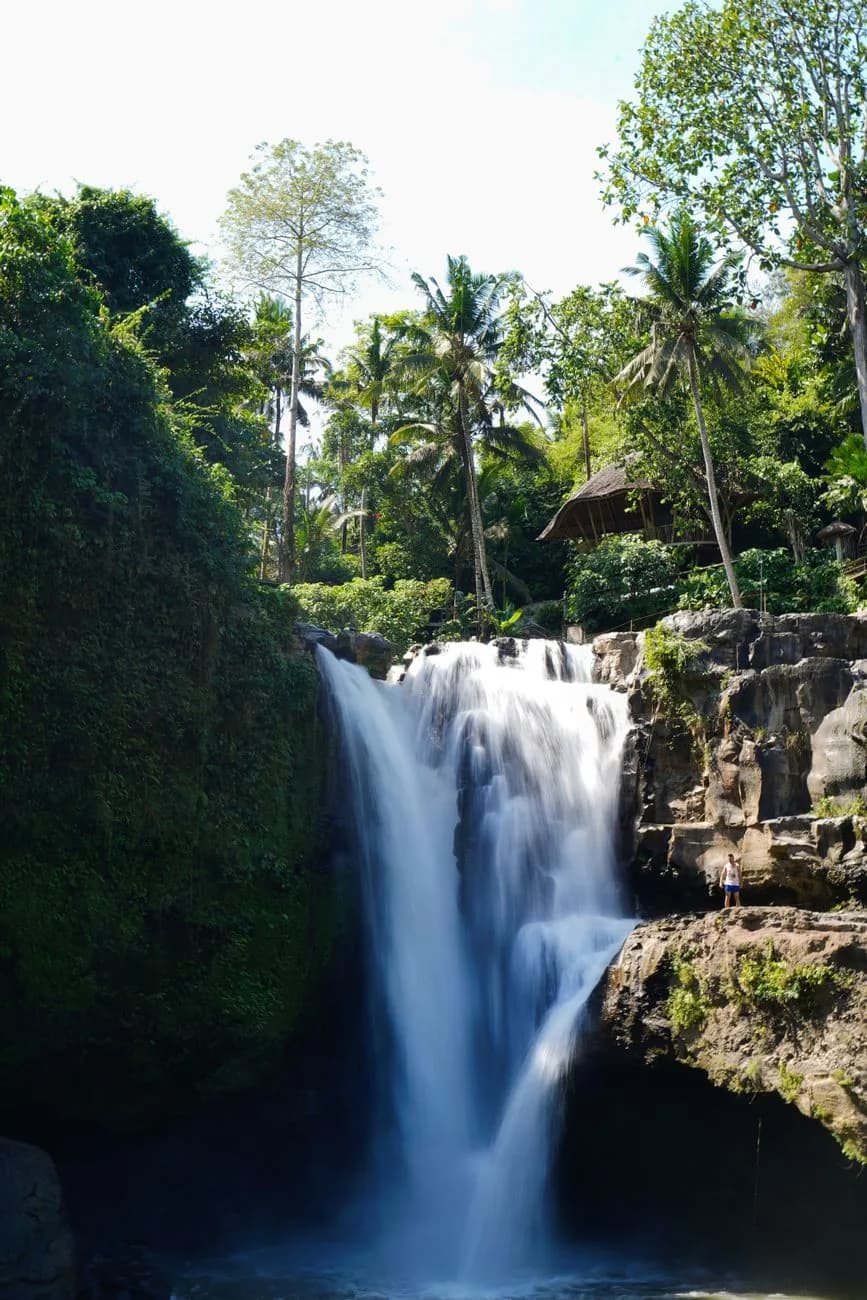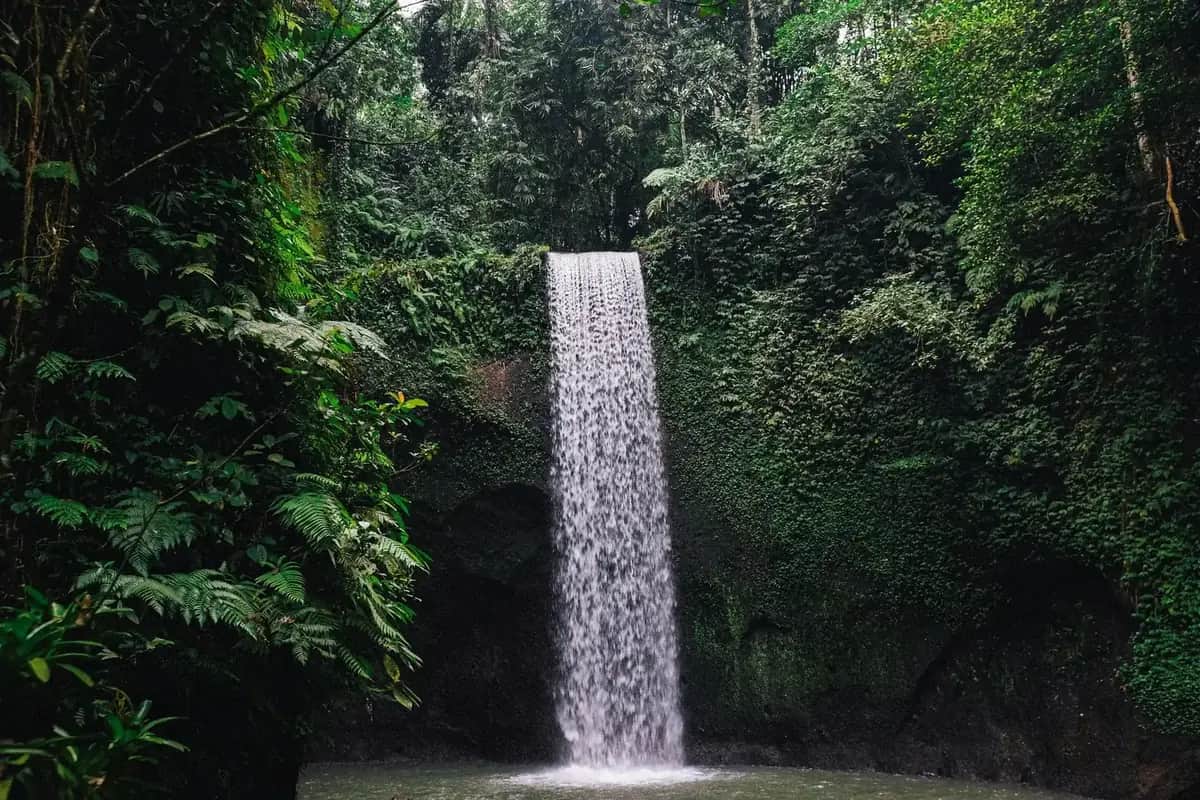
Tibumana does not photograph like Tukad Cepung and it is nothing like the size of Tegenungan, which is exactly why it works. A narrow column of water drops around twenty metres into a wide, shallow bowl walled in ferns, in a fold of Bangli regency that sees a fraction of the traffic its neighbours do. You hear it before you see it, and on an ordinary morning you will share it with a handful of people rather than a hundred.
It is also the waterfall on this island that most closely matches what people actually want from a waterfall, which is to get in it. That is the whole case for Tibumana, and it is a stronger one than it sounds.
On this page
Someone else drives, you swim
Free cancellationWaterfall day trips east of Ubud, Tibumana included
- ✓Hotel pickup in Ubud or the south, which is the part that eats the morning otherwise
- ✓The driver waits while you swim instead of you watching the clock
- ✓Usually chains Tibumana with Tukad Cepung and Kanto Lampo in the right order
- ✓Free cancellation on most listings if the forecast turns against you
Affiliate link. Booking through GetYourGuide costs you nothing extra and supports the guide. Price and rating checked September 2026. Both move with season and demand.
What Tibumana actually is
A single fall, thin rather than wide, dropping clean off a lip of dark rock into a bowl that the jungle has closed over almost completely. The walls on both sides are furred with ferns and creeper, the light comes down through a gap in the canopy rather than across the gorge, and the noise is a steady hiss rather than the roar you get at bigger falls. The scale is domestic, and that is the point: you can take the whole thing in from one spot on the gravel bank.
In the dry months the column narrows to something you could put two arms around. After a run of wet weather it thickens and a second thread often appears alongside it on the left. Both versions are worth the walk, and neither is what you would call spectacular. Visitors who arrive expecting spectacle are the ones who leave the lukewarm reviews.
What makes it unusual is the floor of the bowl. Instead of the deep plunge pool most waterfalls carve, Tibumana has built up a broad gravel shelf that shelves away gently from the bank. That single geological accident is the reason this page exists: it turns a modest waterfall into the most usable swimming stop in the Ubud area.
How to get to Tibumana
Tibumana is in Bangli regency, east of Ubud and inland from the main coastal road, on a lane off the route that runs up towards Bangli town. There is no clever route and no traffic problem: the drive is short, the last kilometre is a village lane, and the car park is signed. The mistake people make is not the navigation, it is the base they set out from. From Ubud this is a comfortable morning. From Canggu or Seminyak it is a whole day, most of it spent in a car.
| Coming from | Drive | On a scooter | Verdict |
|---|---|---|---|
| Ubud centre | 40 to 50 min | Straightforward, one main road east then a lane | The obvious base. Most people do this as a morning out of Ubud. |
| Tegallalang and the northern rice terraces | 40 min | Easy, quiet back roads across Tampaksiring | Pairs naturally with a sunrise at the terraces before the coaches. |
| Canggu | 1 h 45 to 2 h 15 | Long. Take a driver rather than ride it. | Doable in a day, but you are committing the whole day to it. |
| Seminyak, Kuta and the airport side | 1 h 45 to 2 h 30 | Not sensible. Traffic on the way back is the problem. | Only worth it as part of a wider east Bali day, not as a single stop. |
| Sanur | 1 h 15 to 1 h 30 | Manageable for confident riders | The shortest run from the south coast. |
Scooter, driver or tour
Scooter is the cheapest and the most pleasant option from Ubud, on the condition that you already ride. The road east is a normal two lane road with normal Balinese traffic on it, and the last stretch is quiet. Budget a few dollars of fuel and expect the car park attendant to want a small note. A waterfall visit involves getting wet, so plan where your phone and passport are going to sit while you swim, because a scooter seat is not a locker.
A private driver for the day is the option most visitors end up taking, and at Bali prices it is genuinely reasonable split between two or three people. The value is not the driving, it is that the car waits. You are not looking at a clock while you are in the water, and you can chain two or three waterfalls without renegotiating anything.
A booked tour makes sense if you want the day sequenced for you, which for this cluster genuinely matters: Tukad Cepung has a light window and Tibumana does not, so the order is not arbitrary. It also matters if you are coming from the south and want the pickup handled.
Ride hailing apps will get you there and are much less reliable at getting you back, because the return leg from a rural car park depends on a driver being nearby. If you take a car out here, agree the wait rather than hoping.
Parking and the ticket booth
The car park is a compacted patch of ground beside the lane with room for a handful of cars and a lot of scooters. A small booth takes the entrance fee in cash, and there is a separate parking charge that amounts to loose change. Bring small notes. There is no card machine, no ATM within useful distance, and change for a large note is not guaranteed. From the booth the path starts immediately, past a warung and a cluster of stalls that are open on the busier days and shuttered on the quiet ones.
The walk down, honestly measured
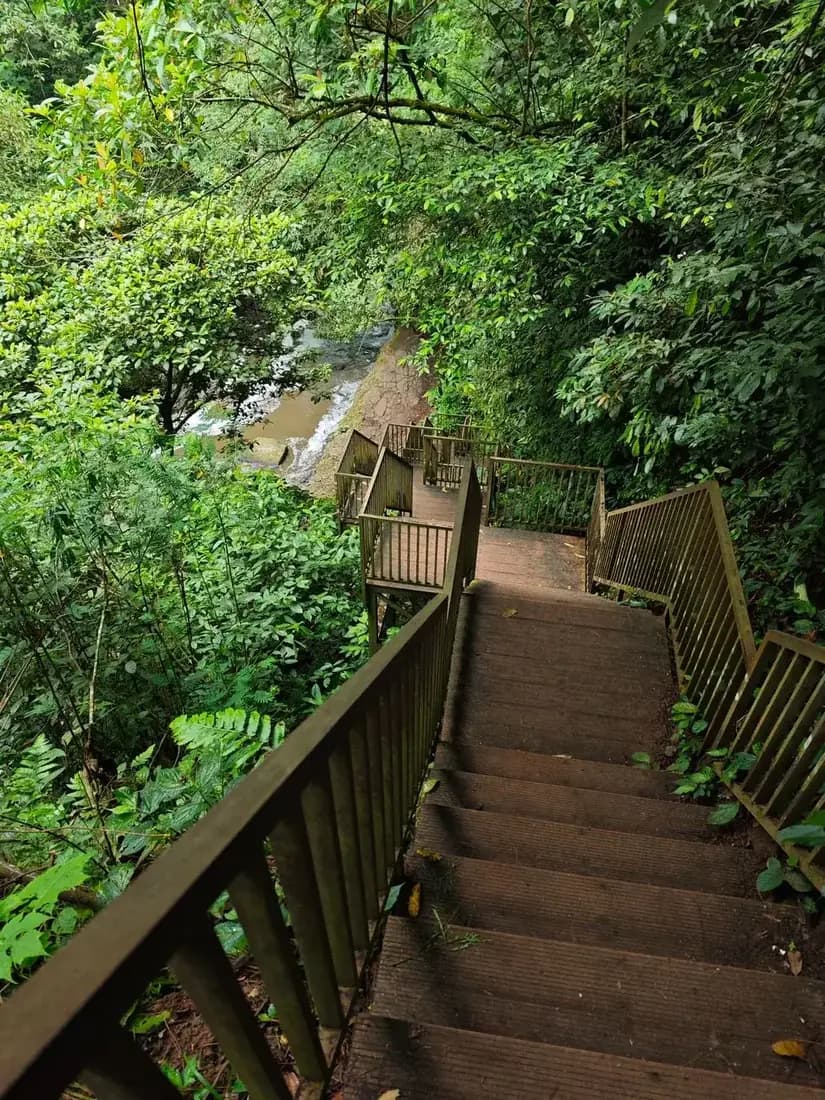
Ten minutes down, twelve to fifteen back up. Roughly a hundred steps, concrete, railed for most of the descent, with a short flat stretch through a garden of banana and taro before the final flight and a small footbridge over the stream. This is the least demanding waterfall access in the Ubud area by a clear margin, and it is the single most useful thing to know about Tibumana if you are travelling with children, with anyone who has a knee, or simply with someone who has already done Sekumpul that week and has no appetite for another five hundred steps.
The surface gets slick where the spray reaches and where moss has taken hold on the lower steps, which is the only part that asks for any care. Flip flops are the wrong choice and people wear them anyway. Trainers or sandals with a strap and some grip cover it. You do not need hiking boots, walking poles or anything else the packing lists suggest.
At the bottom the path opens straight onto the gravel bank in front of the fall. There is no viewing platform, no fence and no queue system, which after Kanto Lampo and Tukad Cepung feels almost strange. You walk out of the trees and you are simply there, twenty metres from the water.
What is at the top
- Ticket booth and parking attendant
- Basic toilets, of the squat and bucket variety on quiet days
- A concrete changing cubicle, functional and no more
- A warung with cold drinks, instant noodles and fried rice
- Intermittent phone signal, enough to message but not to stream
What is at the bottom
- A gravel bank, some flat rocks, and the pool
- Nowhere dry and nowhere secure to leave a bag
- No shade if the sun is directly overhead
- No drinks, no toilets, no shelter if it rains
- Spray on the lens within about eight metres of the fall
Swimming at Tibumana, and when not to
The pool spreads out rather than dropping away, so for most of its width you are standing in water somewhere between knee and chest deep over gravel and flat rock. That is unusual on this island, where a lot of waterfall pools are either too shallow to enter or deep and fast right under the drop. At Tibumana you can walk in from the bank, keep your footing the whole way, and stop wherever the depth suits you.
Directly beneath the fall is the exception. The column hits hard and pushes, and the rock underneath it is smooth. People wade in to stand under it for a photograph, which is fine for a few seconds and genuinely uncomfortable for longer. The current pulls sideways away from the impact zone rather than down, so it is not a drowning hazard in normal conditions, it is a slipping one.
The water is cold in the way jungle water is cold rather than the way a mountain lake is: the first thirty seconds are unpleasant and the rest is not. After heavy rain it clouds, rises and starts carrying debris, and on those days the swim is off. That is true of every waterfall in this part of the island and it is the one condition worth checking before you commit the drive.
The honest answer at Tibumana changes week to week. The colour of the water at the base, checked from the bottom of the steps before you put a foot in, is the one signal that matters most. This is a reading tool, not a safety authority. Conditions at any Bali waterfall can change within an hour of rain falling several kilometres upstream, with no warning at the pool itself.
| Water at the base | Likely depth | Verdict |
|---|---|---|
| Brown, or heavy rain recently | Unreadable, deeper than it looks | Look, do not swim |
| Green and cloudy, a shower yesterday | Knee to waist at the edge, unclear further out | Wade at the edge, stay off the drop |
| Clear, no rain in 48 hours | Knee to chest across most of the bowl | As good as it gets |
| Clear, a shower yesterday | Knee to chest across most of the bowl | Fine to get in |
| Green and cloudy, no recent rain | Knee to waist where you can judge it | Swimmable, not at its best |
Brown water: look, do not swim
Brown water at the base means the catchment upstream is flushing, and a fall that is normally a gentle column turns into something that pushes hard and carries branches with it. The bowl also rises fast in these conditions: the gravel shelf you would be standing on can be a metre deeper than it was the day before. This is the state in which people get hurt at Bali waterfalls, and it is entirely avoidable by treating the visit as a look rather than a swim.
Green and cloudy after a shower: wade, do not swim to the drop
A shower the day before clouds the pool without making it dangerous. The shallow rim where the bed shelves gently is still fine to stand in, and the water is no colder than usual. What changes is visibility: you cannot see where the flat rock ends, so the confident walk out towards the column is the part to skip. Most visitors on a day like this get in to their waist near the bank, take the photograph, and are perfectly happy with that.
Clear water, no rain: as good as it gets
Clear water over a visible gravel bed is the version of Tibumana people come back talking about. The pool spreads wide rather than dropping away, so for most of its width you are standing rather than swimming, and the bed is gravel and flat rock rather than the slick boulders you get at some of the other falls. The only spot to treat with respect is directly under the column, which hits hard and is smooth underfoot. If this happens during the wet season, take it: a clear pool then means a genuine dry window of two or three days, the vegetation is at its greenest of the year, and the fall carries more water than it will in August without the silt that usually comes with it. Get in early, because the afternoon in these months is when the rain returns.
Clear water after a shower: fine to get in
Yesterday's shower has already worked through and the pool has settled. The bed is visible, the flow is normal, and the shallow shelf is where you want to be. The water is cold in the way jungle water is cold rather than the way a mountain lake is, which means the first thirty seconds are unpleasant and the rest is not.
Green and cloudy, no recent rain: swimmable, not at its best
In the wet season, cloudy green water without recent rain is the normal state at Tibumana: the catchment upstream is saturated and never fully clears between showers. It is safe enough to stand in at the edge and you will not regret the stop, but the postcard version of this waterfall, the one with a gravel bed showing through, is a dry season sight. Outside the wet season, green and cloudy without recent rain usually means it rained two or three days ago upstream and the sediment has not finished settling. Nothing about that is dangerous, it just costs you the clarity. Stay near the bank where you know the depth and give it half an hour: pools in this valley clear noticeably through the morning.
Entrance fee, hours and what to bring
Tibumana is maintained by the village, and like every community run site on Bali the pricing is set locally and moves. The honest answer to what it costs is a couple of euros a head plus small change for parking, and anyone quoting an exact rupiah figure is quoting the day they visited. Both are collected in cash at the booth, both are cheap enough that the amount is not part of the decision.
Where
Apuan, Susut district, Bangli regency. Around 40 minutes east of Ubud and 10 to 15 minutes from Tukad Cepung.
Hours
Roughly 07:00 to 18:00 daily. The useful window is 08:00 to 15:00, after which the light leaves the bowl.
Ticket
A couple of euros plus parking, cash only, small notes. No card machine and no ATM nearby.
How long
An hour if you are only looking. Closer to two if you swim, which is the reason to come.
What to bring, and what to leave
Swimwear under your clothes, because the changing cubicle at the top is a concrete box and there is nothing at all at the bottom. A towel, a dry bag or at minimum a plastic bag for your phone, and shoes you are willing to walk wet steps in. A second set of dry clothes for the drive back is the detail people forget and regret, since the climb up in wet swimwear is warm and the air conditioning in the car is not.
Leave the drone. Bali has tightened enforcement around temple and village sites and Tibumana sits in a narrow, enclosed bowl where the noise carries to everyone. Leave valuables in the car or your accommodation too: there is no locker, no attendant at the bottom, and your bag will be sitting on a gravel bank while you are twenty metres away in the water.
Best time of day, best time of year
Through the day
08:00 to 10:00 is the window. The booth is open, the light comes into the bowl from above without hitting the water hard enough to blow out a photograph, and the tour vehicles are still at Tegenungan or queueing at Tukad Cepung. On a weekday in that slot you can have the pool to yourself for twenty minutes at a time.
Late morning to mid afternoon is when the day trippers arrive, usually after Tukad Cepung has released them around midday. It is still a quiet waterfall by Bali standards. Fifteen or twenty people spread across the bank is a busy day here.
After 16:00 the gorge is in shade, the water looks flat and grey, and the walk back up is done in fading light. In the wet season this is also when the afternoon rain tends to arrive. Nothing is closed, there is just nothing left to see properly.
Through the year
Dry season, May to September, gives you a thinner column and clear water. The fall is at its least impressive and the pool is at its most usable, which for Tibumana specifically is the right trade. This is the version to plan for if the swim is why you are going.
Wet season, November to March, gives you a fuller, sometimes doubled fall, vegetation at its most absurd green, and water that is cloudy more often than not. Mornings are frequently fine and the rain comes in the afternoon, so the timing advice above matters more, not less.
April and October are the quiet compromise, and arguably the best two months to come: enough water for the fall to look like something, enough dry days for the pool to clear, and fewer visitors than the July and August peak.
Season and hour matter less here than they do at the famous waterfalls, and the reason is simply the number of people. At Tegenungan the difference between 08:00 and 11:00 is the difference between a waterfall and a queue. At Tibumana the worst hour of the worst month still leaves you room to stand in the pool on your own. That is the whole trade you are making by driving the extra half hour east.
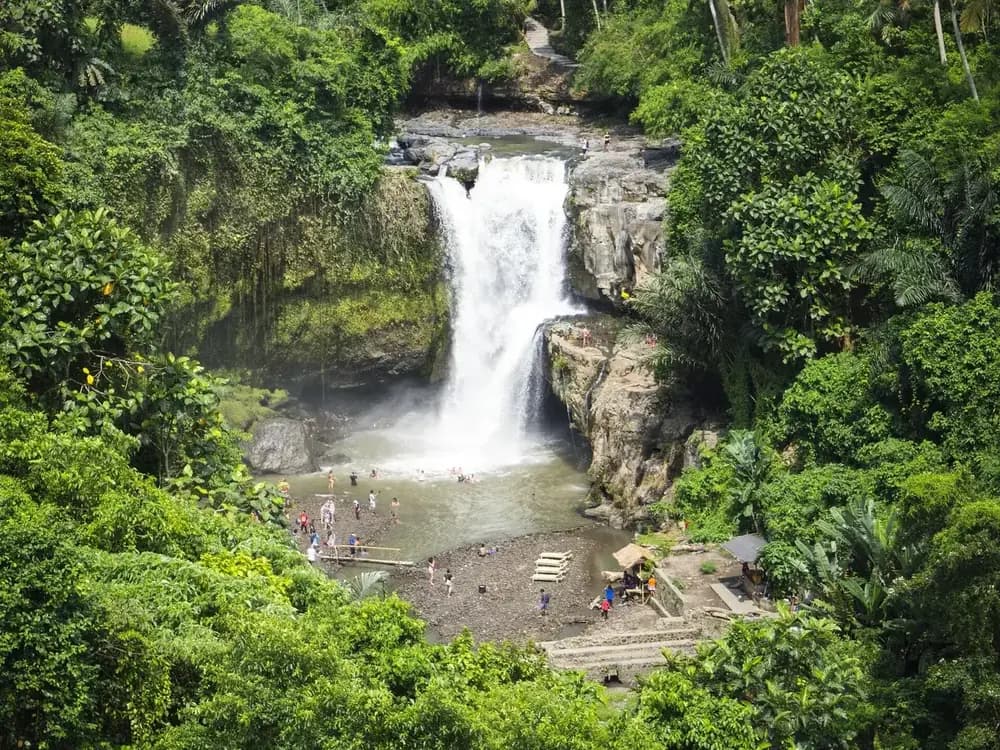
Photo John Ellis, CC BY 3.0
Photographing Tibumana
The composition here is handed to you: a single vertical white line against a dark green wall, symmetrical, with a foreground of pale gravel and a foreground pool that reflects when the surface settles. There is no wrong angle and there is no time window to catch, which is precisely the opposite of Tukad Cepung. That is why it is a good waterfall to shoot with a phone and a poor one to build a whole trip around.
From the bank
Step back to where the path opens out. You get the whole fall, both fern walls and the pool in one frame, and you stay out of the spray.
From the water
Waist deep, a few metres out, shooting back at the drop. The classic Tibumana shot, and the reason to keep the phone in a dry bag rather than on the bank.
Under the fall
The one everybody wants. Ask someone to shoot from the bank, go in, hold it for three seconds, come out. Longer is unpleasant and the rock is slick.
Two technical notes worth having. Spray reaches roughly eight metres out, so anything closer needs a cloth and a habit of wiping the lens between frames. And the dynamic range in the bowl is brutal on a bright day: bright water against near black rock. If your phone lets you, expose for the water and lift the shadows afterwards, because a blown out column cannot be recovered and a dark fern wall can.
Long exposure work needs a tripod and the light to be low, which in practice means the first hour after opening. Nobody will stop you setting up, since there is no queue system and no photographer working the site, which after Kanto Lampo is a relief.
Tibumana or one of its neighbours
Almost nobody drives out here for Tibumana alone, and nobody should. Four waterfalls sit within twenty minutes of each other on the eastern edge of the Ubud area, and they are genuinely different from one another rather than four versions of the same thing. Pick on what you actually want out of the morning, then let the pairing follow.
Tibumana, Tukad Cepung, Kanto Lampo and Tegenungan sit close enough to do two of them in a morning. Which two depends entirely on what you came for.
| Waterfall | Steps | Swimming | Crowd | Time on site |
|---|---|---|---|---|
| Tibumana | Around 100, gentle | Yes, broad shallow pool | Thin most mornings | 60 to 90 minutes |
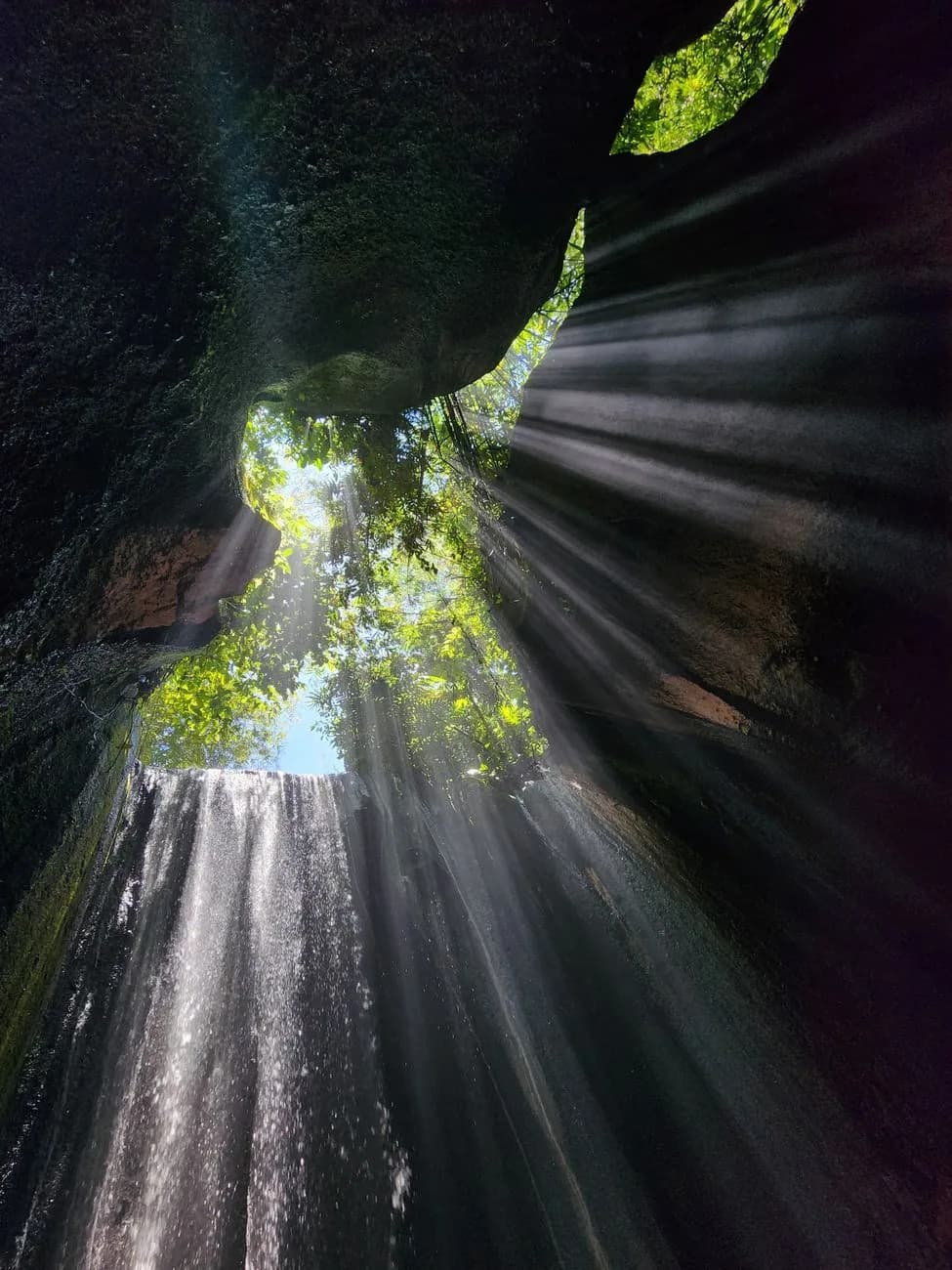
| Tukad Cepung | Around 200, plus a wade | Not really, ankle to knee in the cave | Heavy inside a narrow chamber | 90 minutes to 2 hours with the queue |
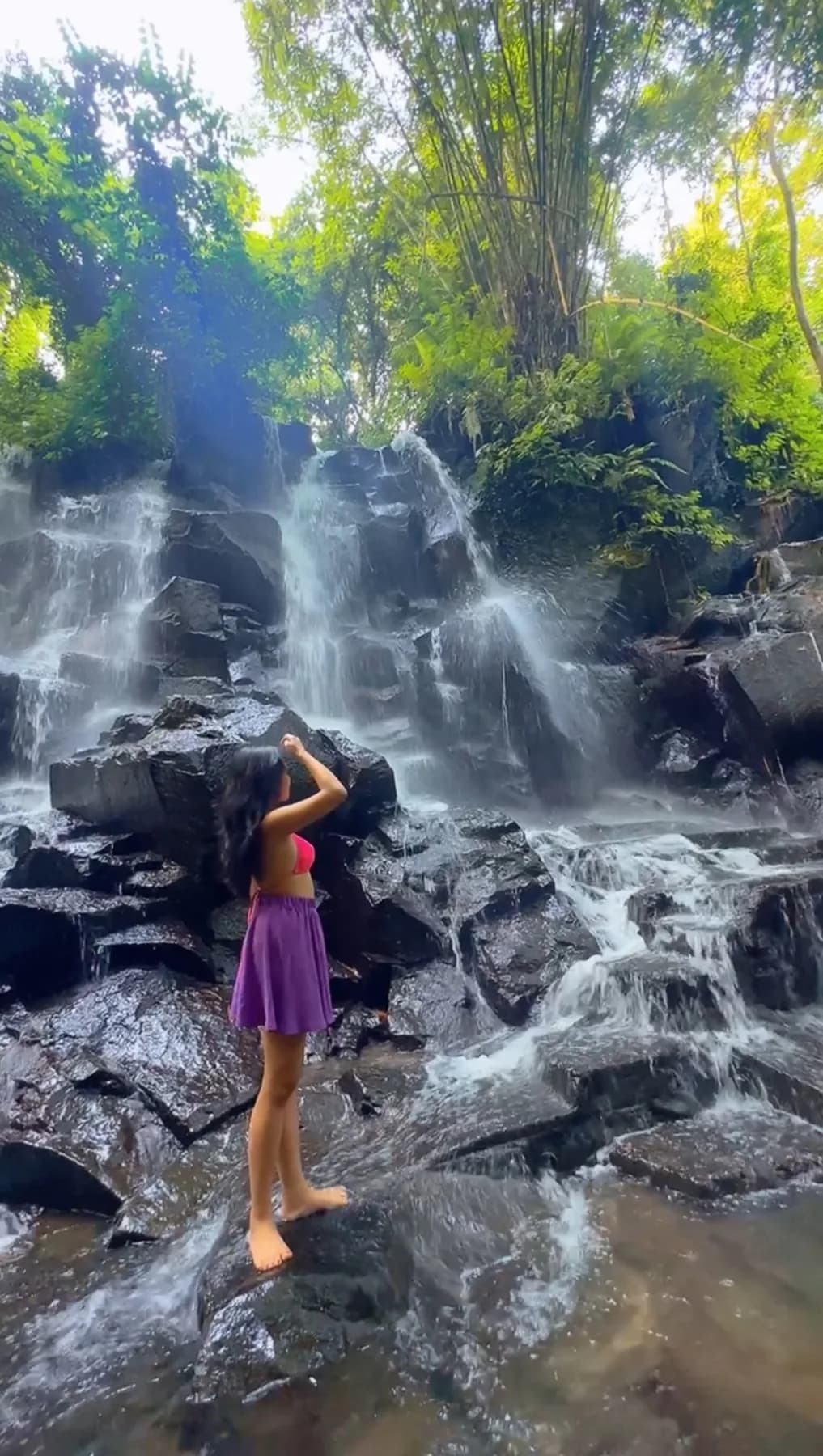
| Kanto Lampo | Around 60, the shortest of the four | Shallow and fast, more standing than swimming | Busy, with a queue for the photo spot | 45 to 60 minutes |
| Tegenungan | Around 160 | Possible, but deep, cold and pushed by the current | The busiest on this side of the island | 60 minutes plus the car park |
If you want to get in the water
Tibumana ranks first with its broad shallow pool you can stand up in, well ahead of Tegenungan, whose base is deep, cold and pushed by current, and Kanto Lampo, more standing than swimming over stepped rock. Tukad Cepung is not really a swim at all, just ankle to knee deep water inside the cave. A half day that works: Tukad Cepung at opening while the light beam is still worth queueing for, then Tibumana from around 11:00 for the actual swim. Two stops, one driver, back in Ubud for a late lunch.
If you want the photograph
Tukad Cepung gives the best single photograph in the cluster, but only between roughly 10:00 and 12:00 when the light beam is high enough. Tibumana and Kanto Lampo both photograph well too, one clean vertical drop against a fern wall at any hour, or the stepped rock face taken from the water with a local photographer. Tegenungan is big and wide but hard to frame without other visitors in it. A half day that works: Tukad Cepung between 10:00 and 12:00 for the light beam, then Kanto Lampo on the way back west for the stepped rock face. Both are photo stops, so budget queueing time at each.
If you want it quiet
Tibumana is thin most mornings, the quietest of the four, well ahead of Kanto Lampo and Tukad Cepung, both busy with a queue at their signature spot. Tegenungan is the busiest waterfall on this side of the island. A half day that works: Tibumana first thing, then Tukad Cepung once the crowd there has thinned in the early afternoon. Skip Tegenungan entirely, which is where the tour buses are.
If you hate steps
Kanto Lampo asks the least of you at around 60 steps, the shortest access of the four, followed by Tibumana at around 100, gentle, with a small bridge at the bottom. Tegenungan runs to around 160 steps down a wide concrete staircase, and Tukad Cepung is the hardest at around 200 steps plus a wade up a stream bed. A half day that works: Kanto Lampo and Tibumana together. Between them that is under 200 steps in total, and they are twenty minutes apart on the same road east of Ubud.
Whichever you pick, each is the all-rounder or the specialist it sounds like. Tibumana has nothing that is the best on the island, and nothing that is a problem either. Tukad Cepung is a photograph with a time window, not a swim, so go first while the sun is high enough. Kanto Lampo is built around one picture, fine, quick, and not a place you linger. Tegenungan is the one every driver suggests because it is closest to Ubud, volume rather than quality.
What else is within twenty minutes
Taman Sari waterfall is the one nobody mentions until they are standing at Tibumana, and it is a short walk upstream from the same valley. It is smaller, it has a natural pool that locals use, and on most days there is nobody there at all. Ask at the booth whether the upstream path is passable, because after heavy rain it is the first thing to go.
Tirta Empul, the purification temple at Tampaksiring, is around half an hour west and works well as the cultural half of a day whose other half is water. Going in the other direction, the Tegallalang rice terraces are roughly forty minutes north west and are best done at first light, which puts them before the waterfalls rather than after.
Bangli town itself, ten minutes on, is a working Balinese regency capital with almost no tourism infrastructure and a large temple complex at Kehen. It is not a stop most people make, and that is roughly the recommendation: worth it if you like places that are not arranged for you, skippable otherwise.
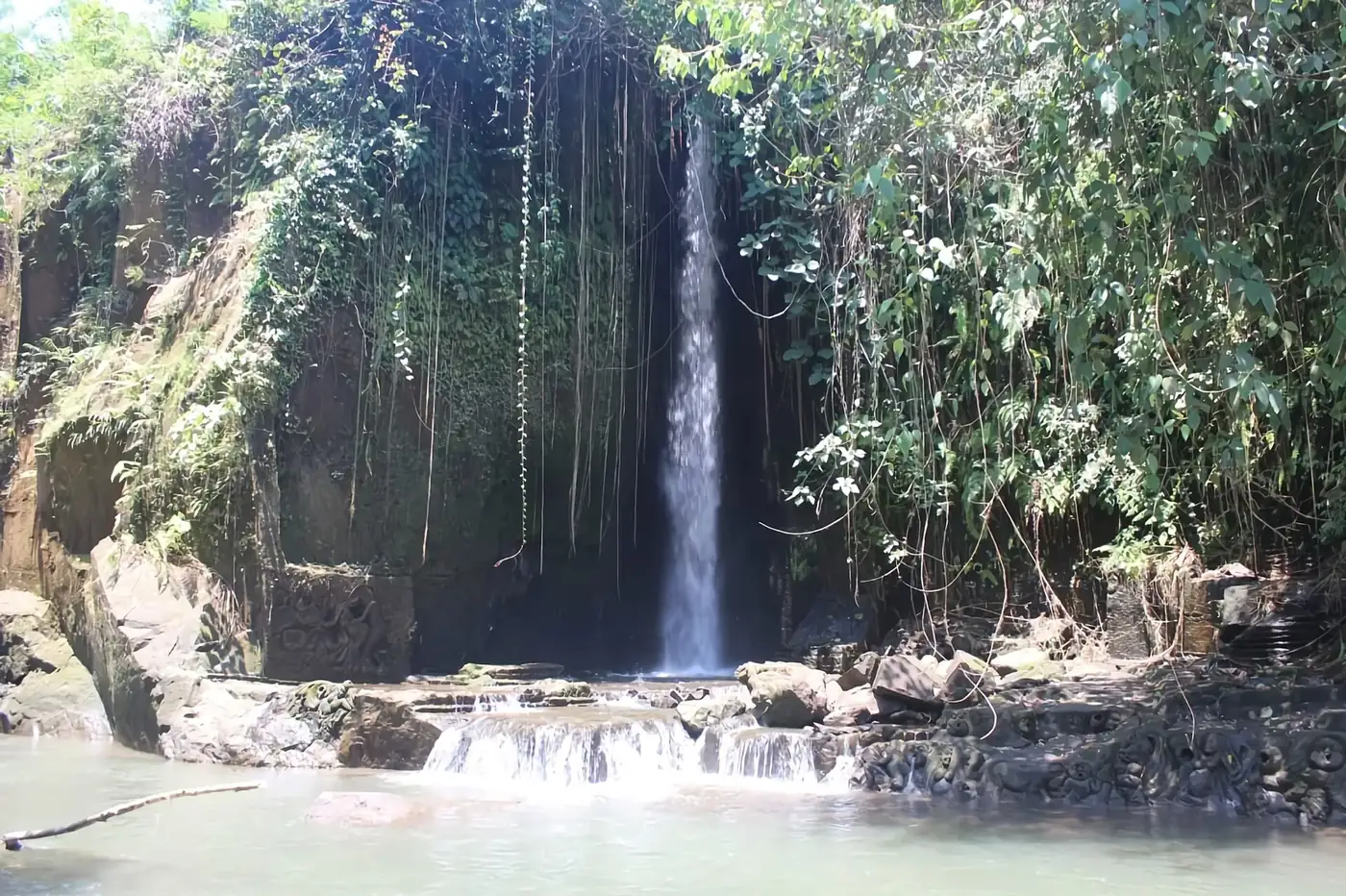
Photo Anggabuana, CC BY-SA 4.0
Who should go, and who should not
Go if
- You want to swim, properly, in water you can stand up in. Nothing else in the Ubud area does this as well.
- Steps are a problem for you or for someone with you. A hundred railed steps is as easy as Bali waterfalls get.
- You have already done a famous one and came away wondering what the fuss was. This is the corrective.
- You are travelling with children. Short access, shallow shelf, gravel bed, no cliff edges.
Skip it if
- You are hunting one big photograph. Tukad Cepung and Sekumpul both beat it, and neither is close.
- You are based in Canggu or Seminyak and only have a spare half day. The drive costs more than the stop is worth.
- It has rained hard for two days. The swim is the reason to come, and brown water removes it.
- You want scale. Twenty metres of thin water is modest and it never pretends otherwise.
The broader point about waterfalls on this island is that the famous ones are famous for proximity rather than quality. Tegenungan is fifteen minutes from Ubud, so every driver offers it, so every review site ranks it, so it fills up, so the experience degrades. Tibumana is forty minutes out and modest looking in photographs, so it stays quiet, so the experience holds up. That gap between reputation and reality is the single most useful thing to understand about choosing a waterfall on Bali.