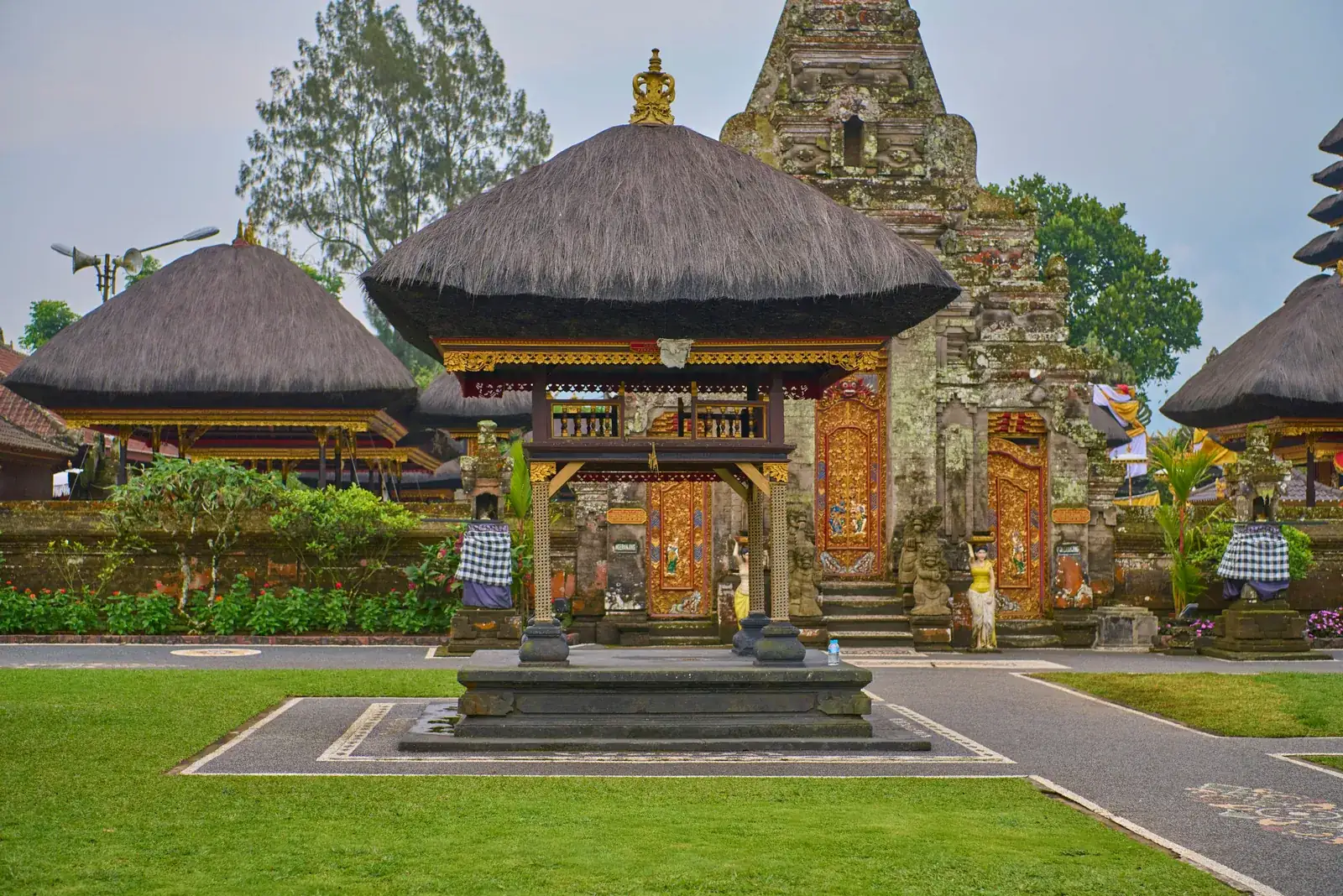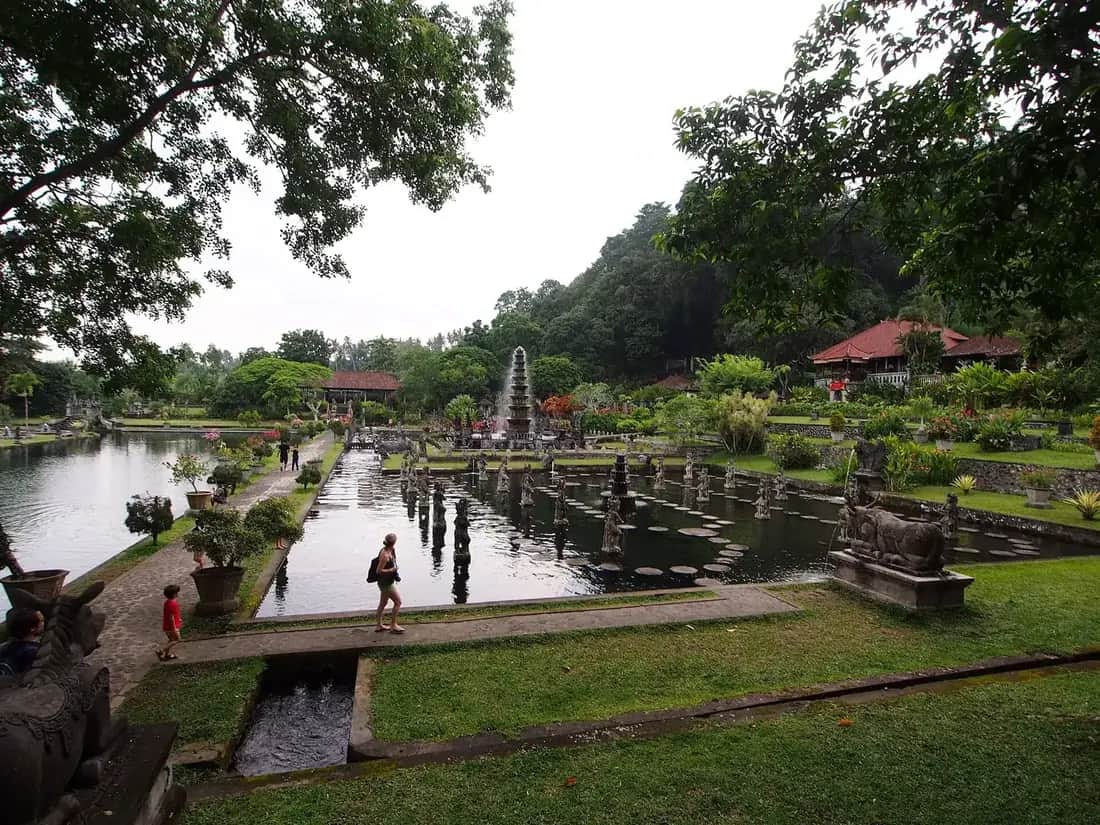
Tirta Gangga was built in 1946 by I Gusti Bagus Jelantik, the last king of Karangasem, who by all accounts drew much of it himself and used it as a place for his family to swim rather than as anything sacred. It covers about a hectare on a slope near the village of Ababi, seven kilometres north of Amlapura, and it is a garden of terraces, channels and ornamental ponds fed by a spring, built around a tiered stone fountain and a line of flat stepping stones that crosses the water between carved figures.
Those stepping stones are the reason anybody outside Karangasem has heard of the place, and they are genuinely as good as they look. What the photographs do not tell you is the scale: the whole complex takes about an hour, and it sits two and a half hours from where most visitors sleep. Everything useful anyone can say about Tirta Gangga follows from those two numbers.
So this page is arranged around the real decision. Not whether the garden is nice, because it is, but how to fit an hour in Karangasem into a day that also includes Lempuyang at sunrise and a drive home, and how not to confuse this with the two other water sites people mix it up with.
One driver, the whole loop
East Bali day trips: Lempuyang, Tirta Gangga, Taman Ujung
- ✓Pickup before dawn, which is the part that decides whether Lempuyang works at all
- ✓Tirta Gangga is almost always bundled with Lempuyang rather than sold alone
- ✓The driver waits between stops, so a long queue does not cost you the next site
- ✓Free cancellation on most listings if the forecast over Agung turns
Affiliate link. Booking through GetYourGuide costs you nothing extra and supports the guide. Price and rating checked September 2026. Both move with season and demand.
On this page
Two confusions worth clearing up first
This site is mixed up with two different places, and one of those mix ups is so common that stock photo libraries get it wrong and drivers take people to the wrong regency.
Not Tirta Empul, which is on the other side of the island
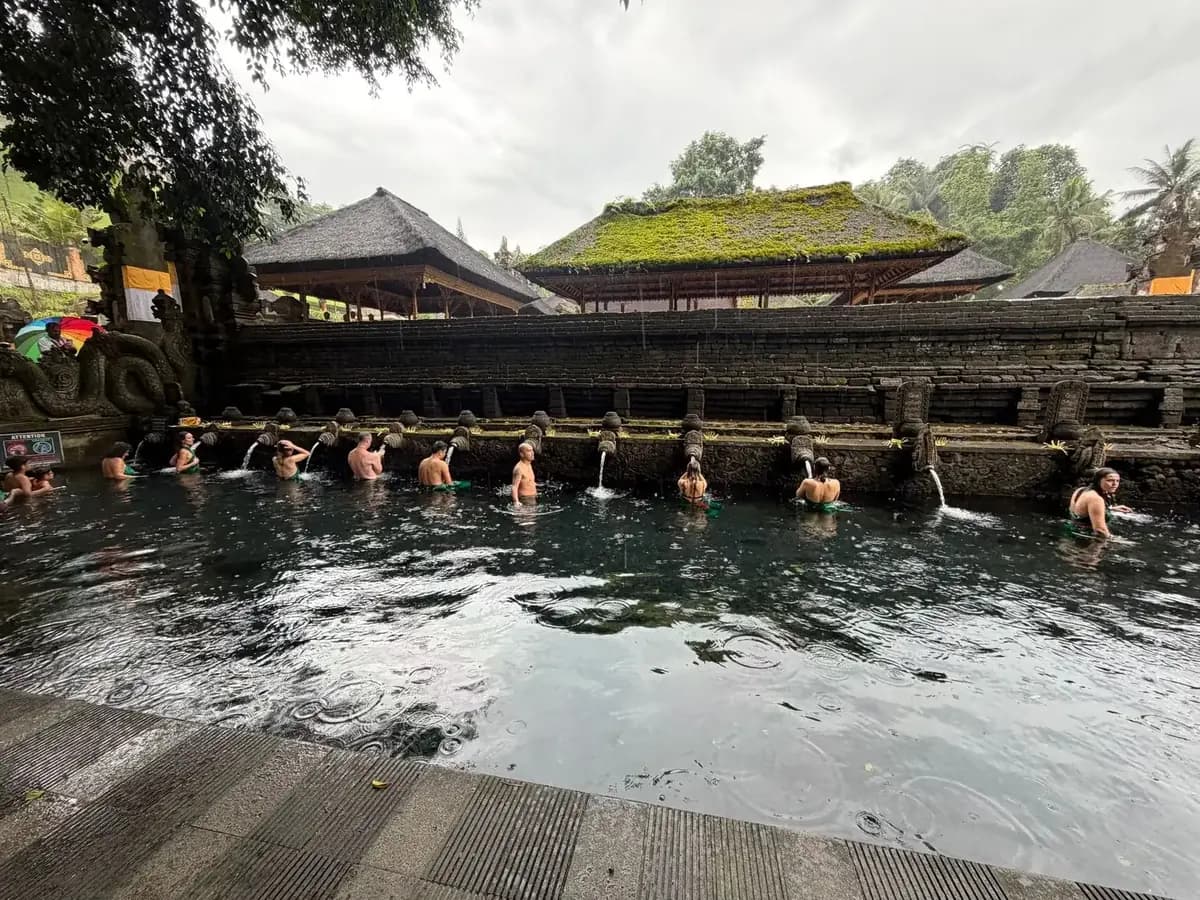
Tirta simply means water, and that is the entire overlap. Tirta Empul is a working purification temple twenty minutes north of Ubud, where Balinese Hindus queue in a spring fed pool and pass under a line of carved stone spouts in a ritual called melukat. Visitors join it, in a sarong, with an offering, under supervision.
Tirta Gangga is a royal pleasure garden in the far east, over ninety minutes away by road on a good day. You look at the water here. You do not get into it, and there is no ceremony to join. Booking one while meaning the other is the most common planning mistake on this part of the island, and it costs an entire morning.
The simplest test: if the description mentions a queue of people standing under spouts, it is Tirta Empul. If it mentions koi and stepping stones, it is Tirta Gangga. And if an Ubud itinerary lists a "water palace" with a lotus pond, it means the Ubud Water Palace, a temple in the middle of town and not a palace at all.
Not Taman Ujung, which is twenty minutes down the road
Taman Ujung, sometimes called Ujung Water Palace or Taman Soekasada, is the other water palace of Karangasem, built by the same king a few years earlier and also wrecked by the 1963 eruption. It sits on the coast south of Amlapura, and photographs of the two are constantly filed under the wrong name.
Telling them apart takes one glance once you know what to look for. Tirta Gangga is compact, green and stepped, with a tiered stone fountain and round stepping stones across a koi pond. Taman Ujung is wide, flat and open: two large rectangular ponds, long ornamental bridges with pillared gateways, clipped lawns and rows of tall conifers, with the sea behind.
This matters practically, not just pedantically. They are twenty minutes apart, they cost about the same, and doing both back to back is a good use of a morning. Turning up at one expecting the other is not.
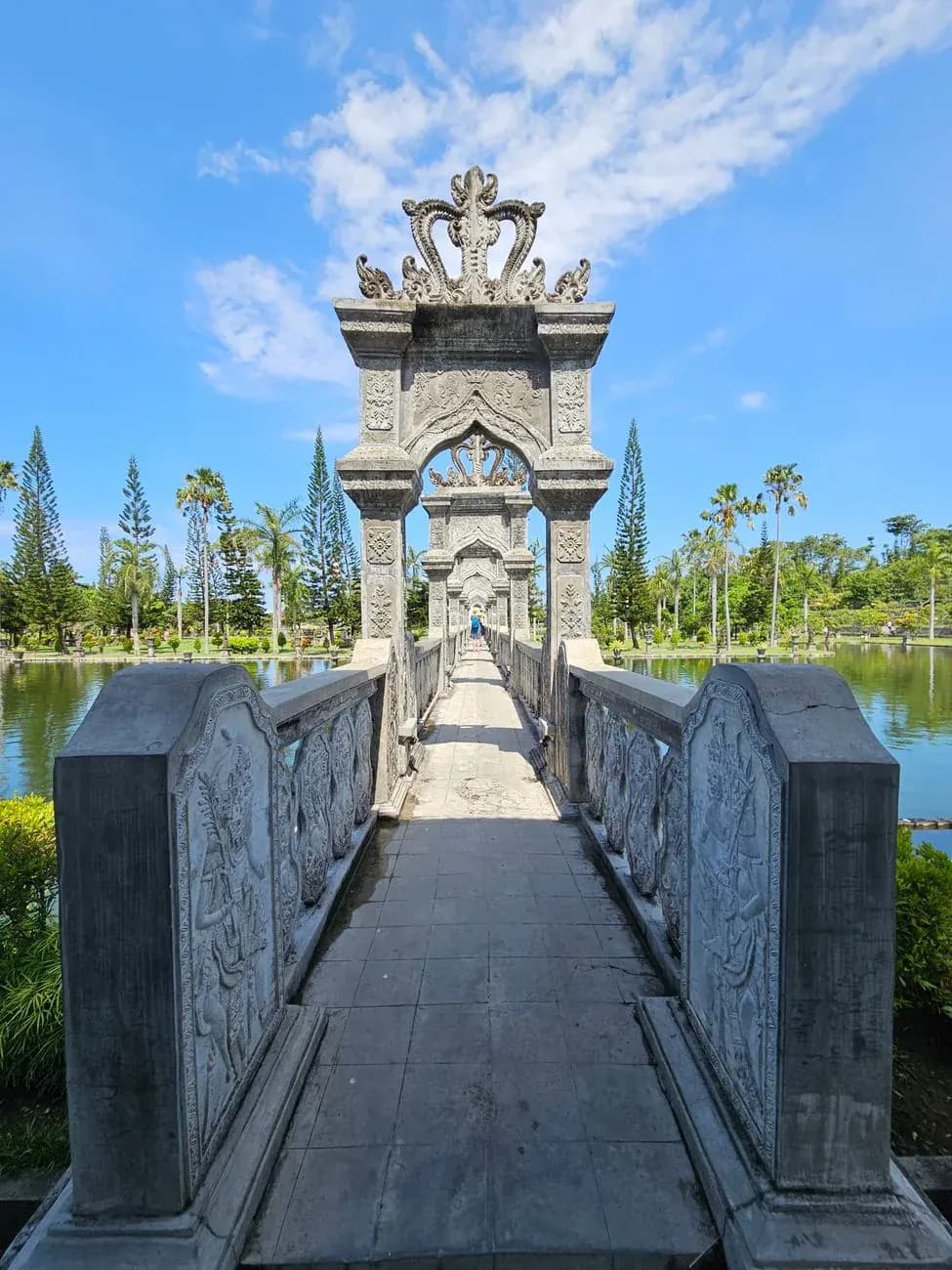
What is actually in there, level by level
The garden climbs a slope in three stages, and visitors routinely miss the third one entirely because it is up a flight of steps and nothing points to it.
| Level | Where | Swimming | The photograph |
|---|---|---|---|
| Lower pond | Straight ahead of the entrance | No, ornamental | This is it |
| Tiered fountain | Behind the stepping stones | No, ornamental | The second good angle |
| Bathing pools | Up the steps to the north | Yes, extra fee | Not the famous view |
The lower pond
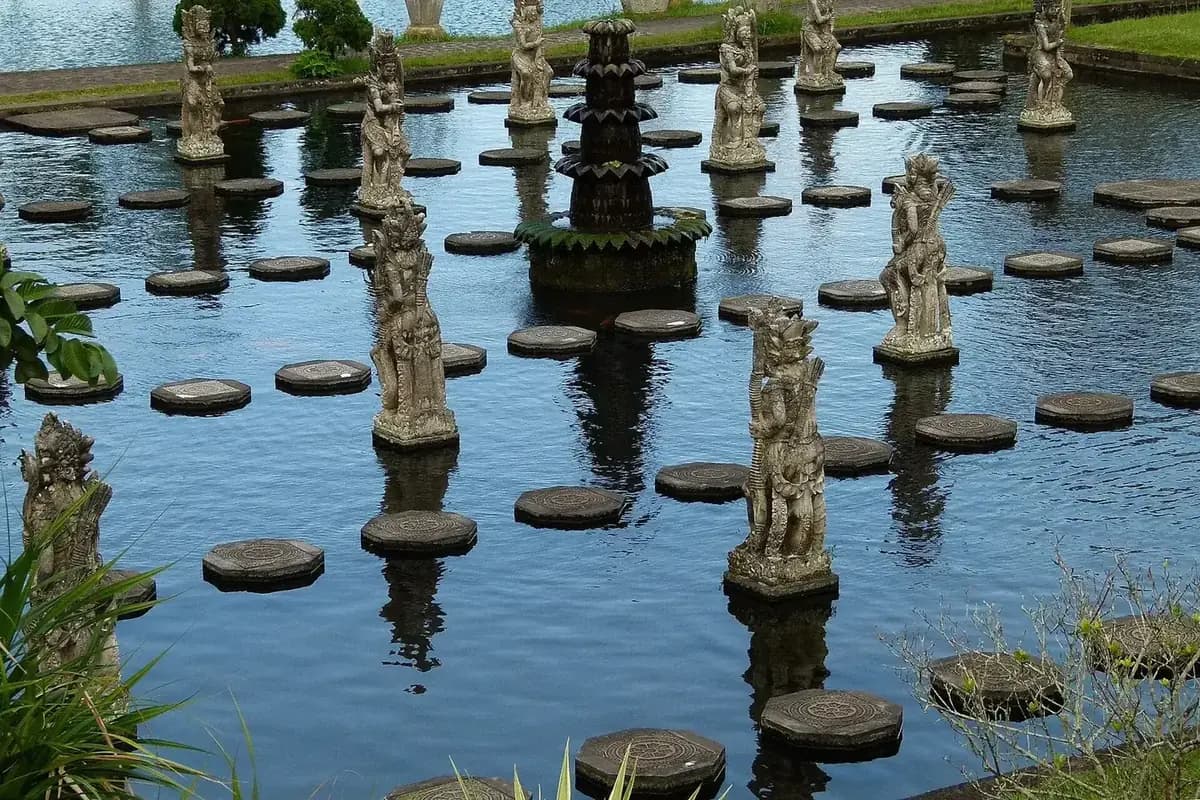
Two shallow ornamental basins, joined by a line of round stone discs a few centimetres above the water, with a carved figure standing on a plinth every few steps. This is the picture that brought you here, and it is the first thing you see when you walk in.
The water is thick with koi, some of them a very long way past the size a garden pond usually produces, because visitors have been feeding them by the bagful for decades. Fish food is sold at the gate for a few coins and it is the entire experience for anyone travelling with children.
The discs are wet, uneven and worn smooth in the middle. People go in. Not far in, since the water is knee deep, but far enough to ruin a phone.
The tiered fountain
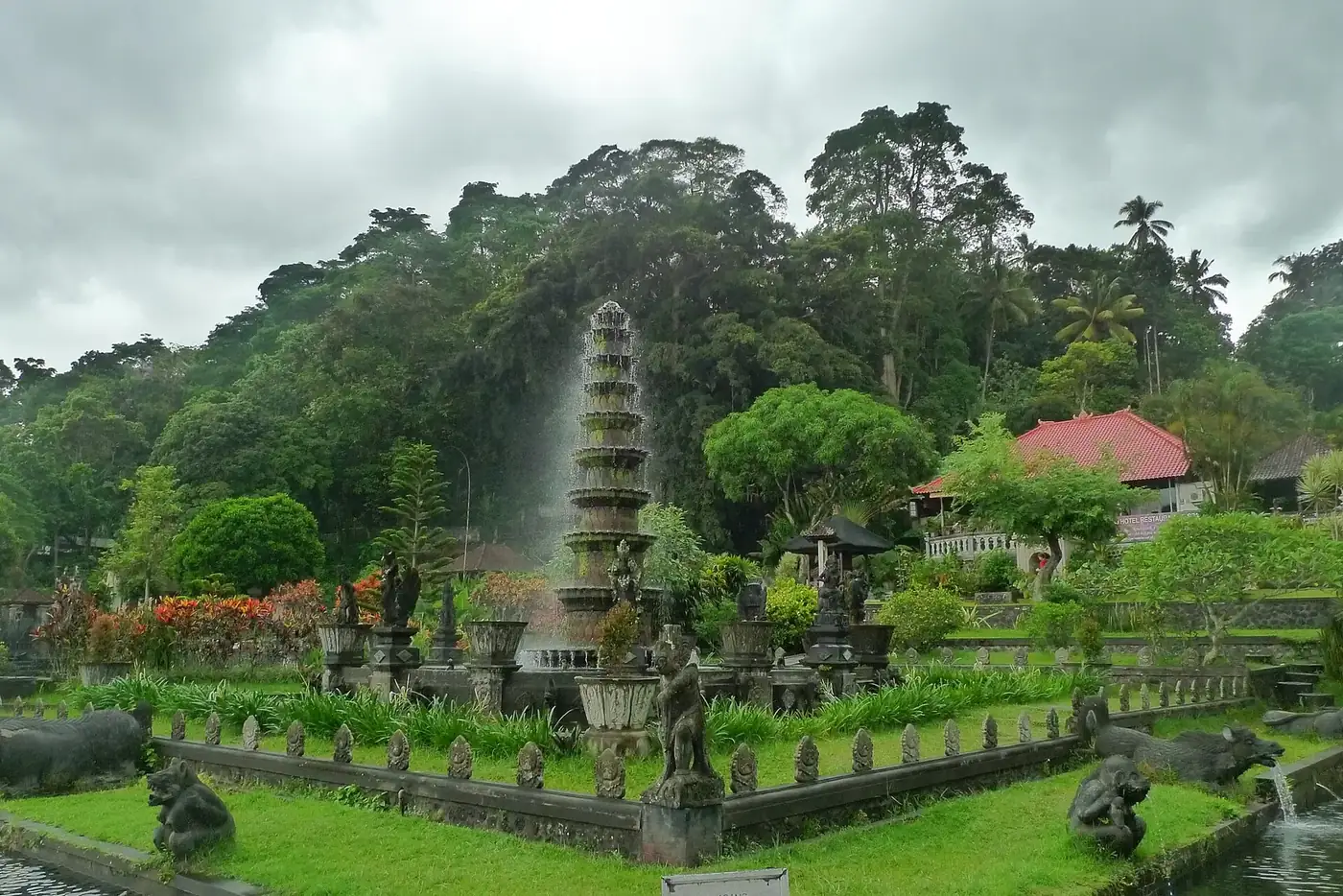
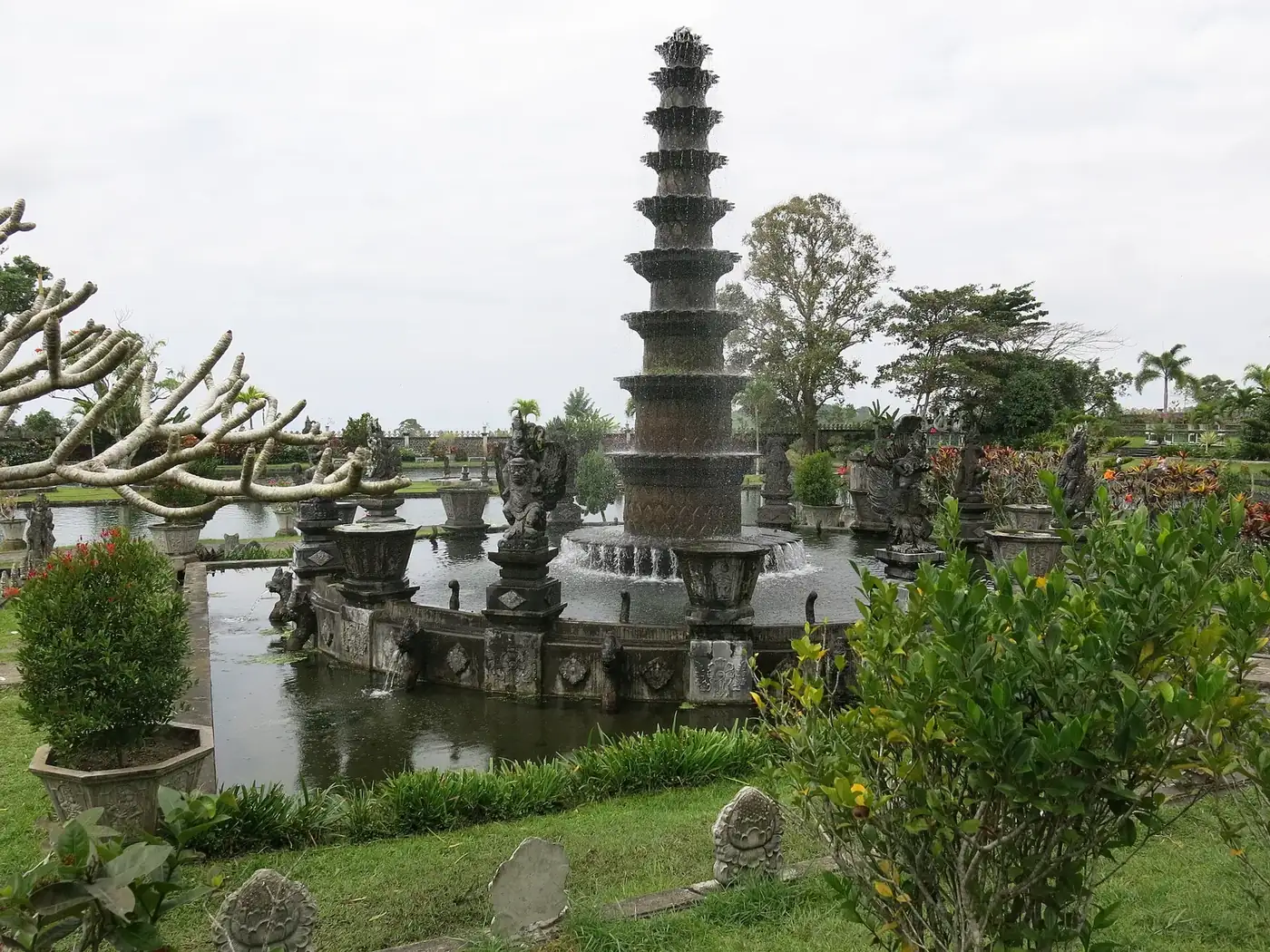
A stone tower of stacked, overflowing tiers stands in the middle of its own pond, water spilling off every level at once. It is the structural centrepiece of the garden and the feature that identifies the site in any photograph, which matters more than it sounds when so many pictures of east Bali are captioned wrong.
The number of tiers carries a meaning in Balinese cosmology rather than being decorative arithmetic, and the fountain is set in the garden as a kind of axis. Nobody explains this on site: there is very little signage anywhere in the complex.
Shoot it from the grass on the right hand side rather than head on. Head on puts the spray between you and the stone, and the tiers disappear into white.
The bathing pools
Above the ornamental section, reached by steps, are two long rectangular pools fed by the same spring. These are the ones you can actually get into, for a small charge on top of the entrance, and they are the part most visitors never walk up to.
Do not expect a natural bathing hole. They are tiled, chlorinated to a degree, and function as village swimming pools with an unusually good view. On a hot afternoon with a child in tow that is a better proposition than another lap of the ornamental ponds.
The spring itself rises higher up on the northwest side and is treated as sacred: its water is collected as tirta, holy water, for ceremonies in the surrounding temples. That is the one genuinely religious thread running through what is otherwise a pleasure garden.
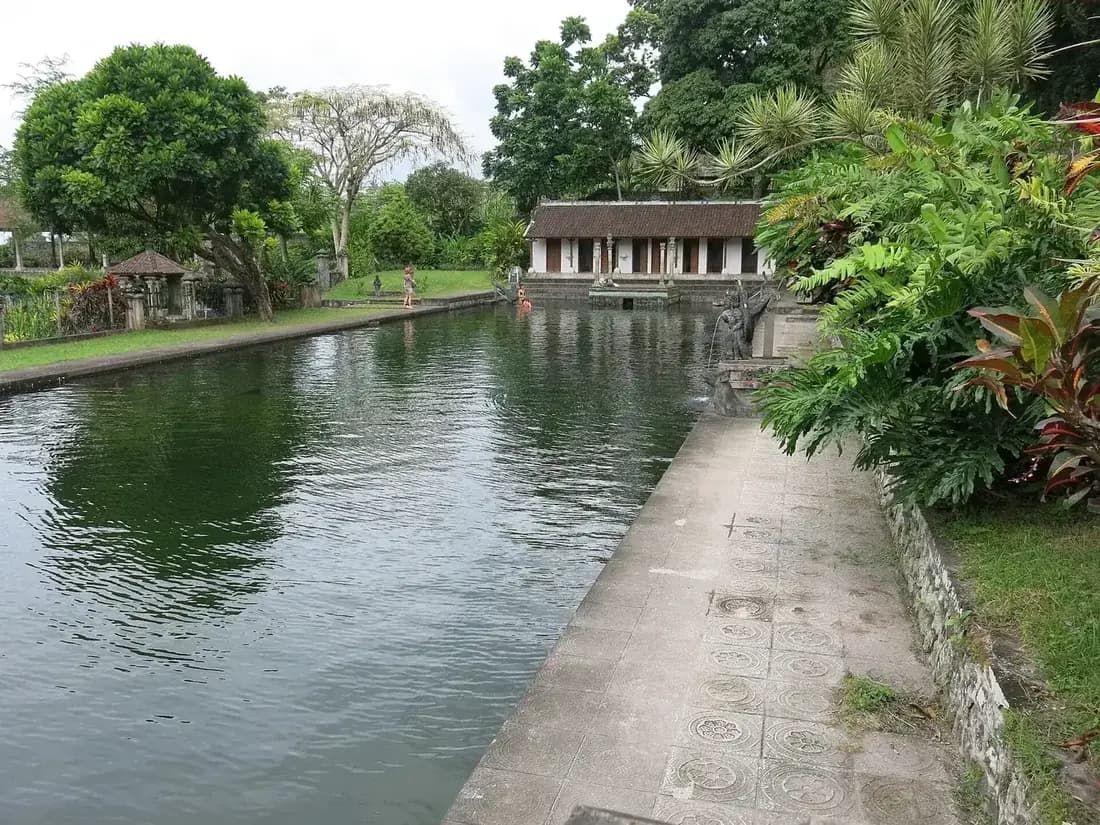
Photo Schnobby, Manuae, CC BY-SA 3.0
The detail nobody photographs
Around the edges of the lower ponds are heavy carved animals with water running out of their mouths, and they are the best stonework on the site. A bull, a naga and a row of guardian figures stand at the corners where the channels feed in, weathered and moss covered in a way the restored central fountain is not. Twenty seconds of looking at these is worth more than a third crossing of the stepping stones.
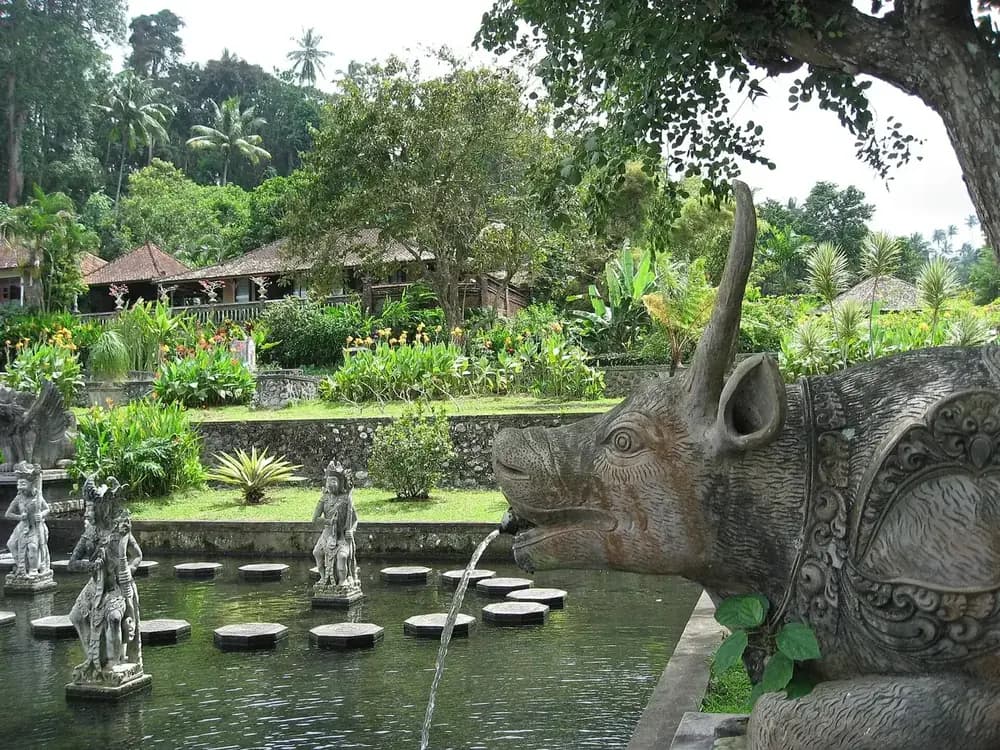
Photo Liné1, CC BY-SA 3.0
There is also almost no interpretation anywhere. No panels, no numbered route, no leaflet at the gate. What you get is a garden and the freedom to walk around it, which is pleasant and also means most visitors leave without knowing they were in a royal residence that a volcano destroyed.
The restaurant terrace above the ponds is a genuinely good place to sit. Ordinary Indonesian food, unremarkable prices, and a view straight down the length of the garden. If you have driven from Ubud and you are eating anywhere in Karangasem today, eat here.
The stepping stones, and how to actually photograph them
One picture carries this entire site online, and it is taken from a spot about four metres wide. By ten in the morning there is a polite queue for it.
Getting the shot
- Shoot along the line of stones rather than across it. The picture that works has the discs receding away from the camera with the statues rising between them.
- Go early. The pond faces open sky, and after about ten the surface turns into white glare that hides the koi completely.
- Let the person on the stones stop walking. Everyone tries to be caught mid stride, the stones are slippery, and the result is usually a blurred arm and a nervous face.
- Take the fountain from the grass on the right rather than head on, so the spray does not flatten the tiers into a white column.
Feeding the koi
Bags of pellets are sold at the entrance to the pond for a few coins, and the fish know exactly what a person crouching on a stepping stone means. Throw a handful and the water in front of you boils. Some of these carp are enormous, and they have been fed by visitors for decades.
This is the part children remember, and it is worth planning around if you are travelling with any. Buy two bags rather than one, and expect ten minutes of crouching at the water's edge rather than the thirty second stop you had in mind.
The stones themselves are wet and worn smooth in the middle. Nobody is stopping you from crossing in flip flops, and the water is only knee deep, but a phone goes in every few days.
A king, a spring, and a volcano
The garden is younger than most visitors assume and it has been destroyed once already, which explains more about how it looks than any description of the ponds.
Karangasem was the last of the Balinese kingdoms to keep real standing into the twentieth century, and its final king, I Gusti Bagus Jelantik, spent a good part of his later years building water gardens. Taman Ujung came first, on the coast. Tirta Gangga followed in 1946, inland and uphill, built around a spring the surrounding villages already treated as sacred.
The name is a claim rather than a description. Tirta is water and Gangga is the Ganges, and naming a Balinese spring after the great river of Hindu India was a way of saying what the king thought the water was worth. That belief is still live: the spring supplies holy water collected for ceremonies in temples across the district, which is the one genuinely religious thread in a place that is otherwise a pleasure garden.
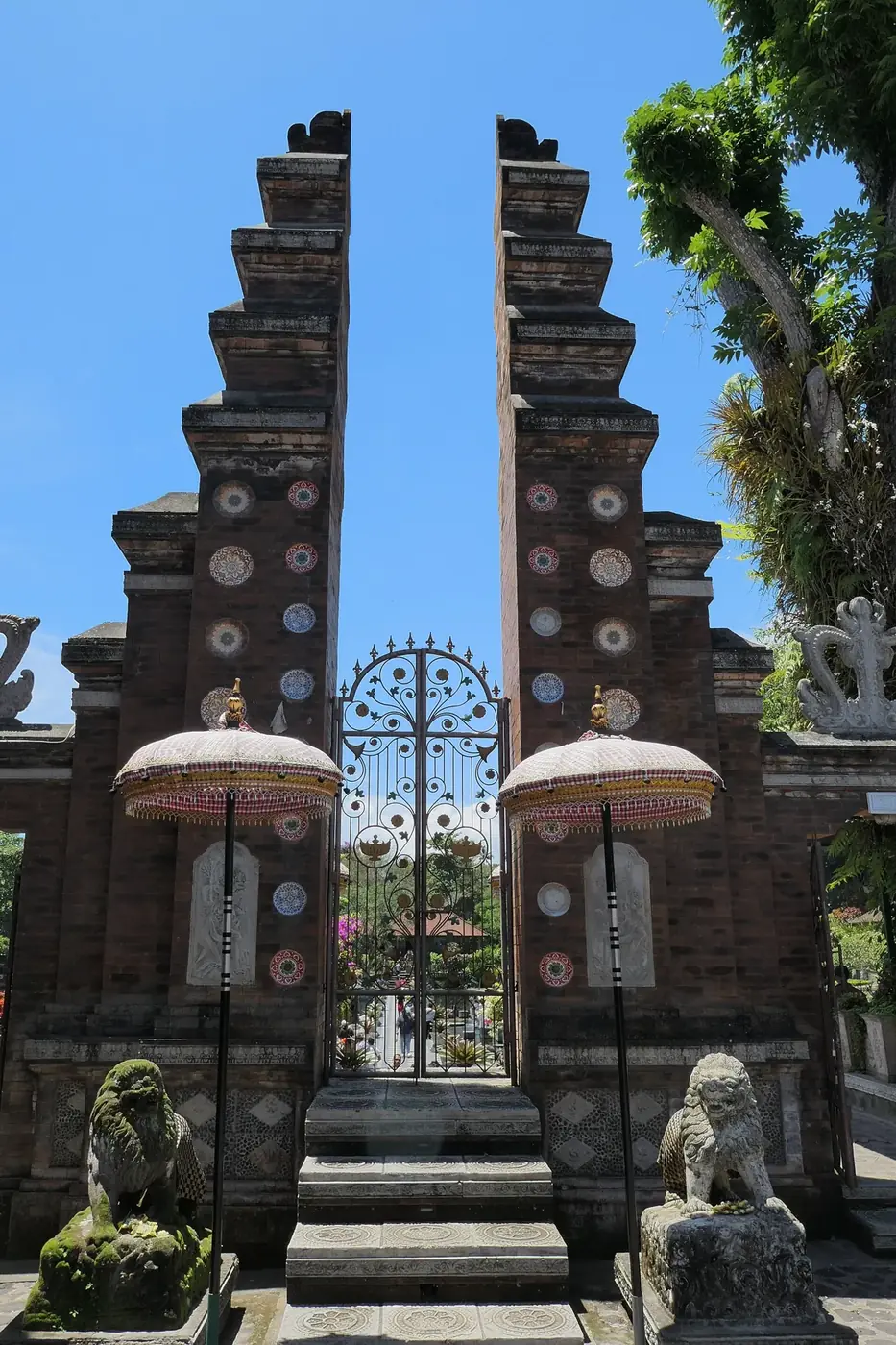
Photo Anandajoti, CC BY-SA 4.0
Seventeen years after it was finished, Mount Agung erupted. The 1963 eruption killed well over a thousand people across east Bali and it destroyed almost all of Tirta Gangga, which lies directly southeast of the summit. What you walk through today is a restoration, rebuilt in stages over the decades that followed and still owned by the descendants of the royal family.
That is why the stonework does not read as uniformly old. Some of the carved figures around the lower ponds are weathered and dark, others are visibly newer, and the central fountain has the clean edges of a rebuild. Knowing this turns an ordinary walk around a garden into something a good deal more interesting.
How far it is, from wherever you are
Tirta Gangga is in Karangasem, the far eastern regency, near the village of Ababi. Every honest assessment of the place starts with the drive rather than the garden.
| Coming from | Drive, one way | What that means |
|---|---|---|
| Amed | 30 to 40 min | The closest realistic base, and the reason to sleep on the east coast. |
| Candidasa | 40 min | Flatter, more hotels, slightly further from Lempuyang. |
| Amlapura | 15 min | The regency town, 7 km south. Nobody stays here, but every road passes through it. |
| Ubud | 2 h to 2 h 30 | Long enough that Tirta Gangga alone does not justify the day. |
| Sanur or Denpasar | 2 h 30 | Add an hour if you leave after eight in the morning. |
| Seminyak, Canggu, Kuta | 3 h to 3 h 30 | Six to seven hours of driving for a one hour garden, unless you chain it. |
By driver
What almost everyone does, and the only sane option from the south. A driver for the day is priced by the day rather than the distance, so adding Lempuyang and Taman Ujung to the same trip costs you nothing extra. Agree the stops before you set off.
By scooter
Reasonable from Amed or Candidasa, where the ride is short, scenic and mostly empty. Genuinely inadvisable from Ubud or the south: three hours each way on unfamiliar roads, in heat, before you have looked at anything.
Parking and arrival
The car park is right on the main road, immediately below the entrance, with warungs and souvenir stalls along it. No shuttle, no walk in, no queue at the gate. After Lempuyang that simplicity is a relief.
Building the east Bali day around it
Tirta Gangga is a stop, not a destination, and the stop before it is always the same one. Get the order wrong and you spend the morning in a queue and arrive here in flat midday light.
| Sleeping in | Alarm | Time in the car |
|---|---|---|
| Amed or Candidasa | 04:45 | About 2 h in total, spread over the day |
| Ubud | 03:30 | 5 h to 6 h in total |
| Seminyak, Canggu, Kuta | 02:30 | 6 h to 7 h in total |
Sleeping in Amed or Candidasa: the version that works
Everything is within forty minutes of the bed you woke up in, the queue at Lempuyang has not formed yet, and you are back on the coast for a swim before the afternoon rain. If you are doing east Bali at all, sleeping here once is the single decision that changes it.
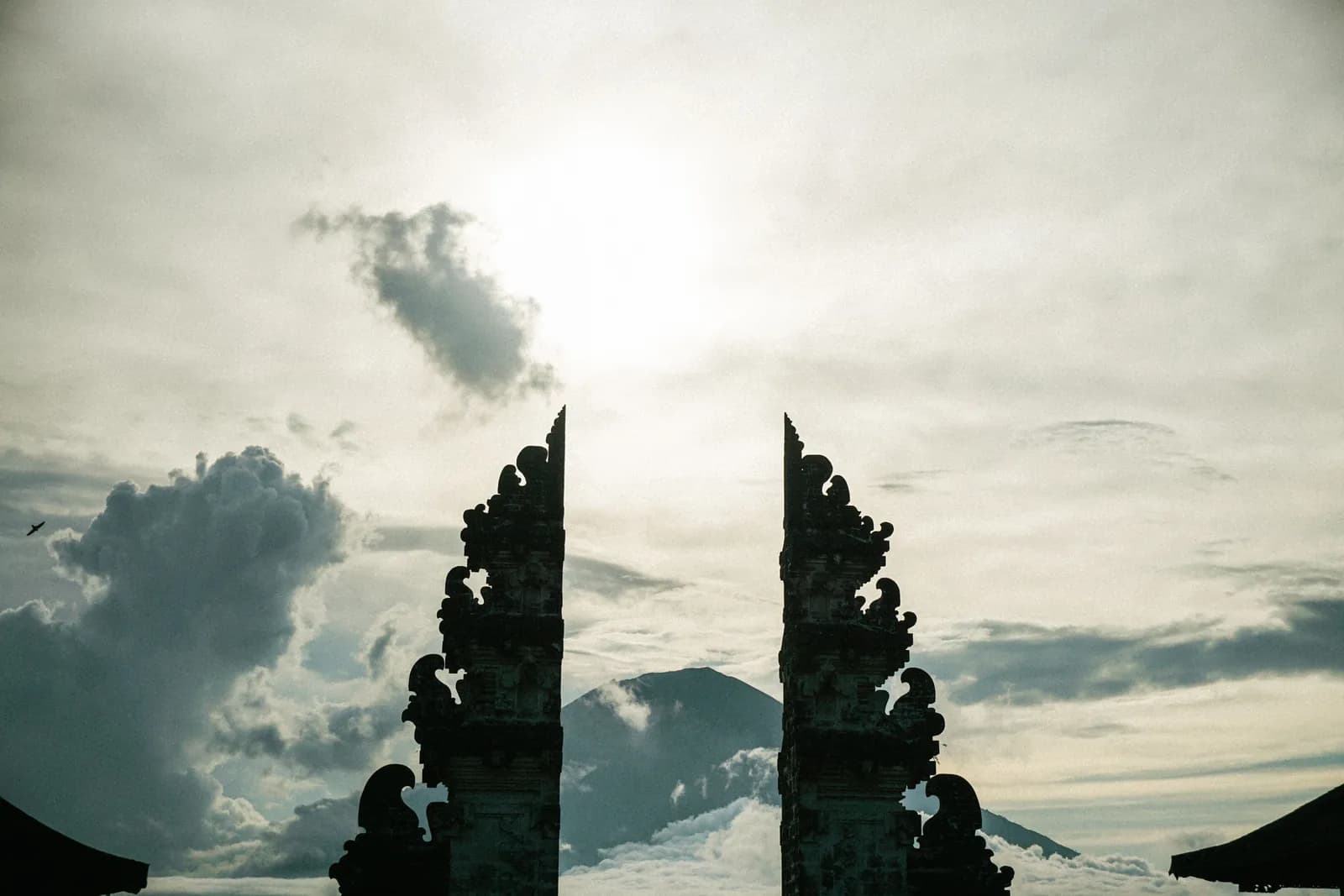
Leave at 05:45 for Lempuyang, at opening: the Gates of Heaven photograph only exists early, since after nine the wait runs to three hours and Mount Agung has usually gone into cloud. Stop for breakfast in Abang or Ababi around 08:30 on the road down, since Tirta Gangga does not open its restaurant terrace to any real breakfast crowd. Reach Tirta Gangga around 09:30, while the light is still low enough to read the bottom of the koi pond and before the coach groups that leave Ubud at eight arrive. Taman Ujung at 11:00 is cuttable if water palaces have stopped being interesting by then, twenty minutes south for the same royal family in a completely different garden. Be back on the coast by 13:00 for lunch in Amed, then snorkelling or the Tulamben wreck in the afternoon, which is why the east coast base wins.
Sleeping in Ubud: doable in one long day
The only reasonable version puts Besakih on the way home rather than adding a fourth stop in the east. If a three thirty alarm is not happening, drop Lempuyang entirely and treat this as a Tirta Gangga and Taman Ujung day leaving at seven.
Leave at 04:00, two and a half hours east on empty roads: later than this and you arrive into the queue rather than ahead of it. Allow two hours at Lempuyang from 06:30, most of it waiting for your number to come up at the gate. Tirta Gangga at 09:30 is twenty minutes down the hill, an hour there plus lunch on the terrace above the ponds if you are hungry early. Taman Ujung at 11:30 is the second water palace, twenty minutes further south, and the first thing to cut if the morning has run late. Besakih on the way back at 14:00 sits roughly on the return road on the western flank of Agung, but it closes late afternoon, so this only works if nothing before it overran. Expect to be back in Ubud around 17:30, thirteen hours door to door, the only single day version that gets the east in one go.
Sleeping in the south: the version that disappoints people
Twelve to fourteen hours door to door, most of it in a car, for about ninety minutes of actual looking at things. If you are set on the east from the south, book a night in Amed and do it properly, or accept that you will see Tirta Gangga at midday with everybody else.
Leave at 03:00, three hours to three and a half, and only because the road is empty at that hour: the same drive at eight in the morning is closer to four and a half. Lempuyang at 06:30 has already been paid for with a night of sleep, so everything else that day is a bonus. Tirta Gangga at 09:30 is still the right slot, and the natural place to eat since nothing before it was open. At 11:30, pick one more stop, Taman Ujung or Besakih, never both: the drive home is three hours and the afternoon traffic around Denpasar is worse than the map thinks. Expect to be back in the south around 16:30, assuming nothing went wrong. Something usually does.
If you are sleeping on the coast, the next morning belongs to the water. Padang Bai is about an hour south, and Blue Lagoon Beach is at its clearest before ten, with gear for 50,000 IDR on the sand.
What it costs
The site is one of the cheapest ticketed attractions on Bali. Getting to it is not, and that is the line most guides never draw.
| What you pay for | Detail | Order of magnitude |
|---|---|---|
| Entrance | Paid at the gate, cash, foreigner rate. Children pay less. | ≈ $2 |
| Parking | Charged separately from the ticket, per vehicle, and usually collected on the way out. | ≈ $0.60 |
| The bathing pools | A second ticket on top of the entrance if you want to swim in the upper pools. | ≈ $1 to $2 |
| Fish food | Bags sold at the entrance to the pond. The whole point of the visit for small children. | ≈ $0.35 |
| Sarong hire | Optional here, unlike at a working temple. Some visitors rent one anyway for photographs. | ≈ $1 |
| Driver for the day | From the south this is a full day rate rather than a transfer. From Amed it is a half day. | $40 to $65 |
All of it is cash, none of it is posted anywhere official, and every figure above moves with the season and the rate. The entrance itself is trivial. What you are really paying for is the day of driving that gets you into Karangasem. Carry small notes, because the parking attendant and the fish food stall will not have change for a hundred thousand.
Hours, dress code and how long you need
Hours
Roughly 07:00 to 18:00, with the desk closing a little earlier. Nowhere authoritative publishes this and it moves for ceremonies, so treat it as a working assumption rather than a timetable.
Dress
No sarong required. This is a garden, not a sanctuary, and nobody is checked at the gate. Shoes with grip for the stepping stones, a swimsuit if you plan to use the upper pools, and a hat, because the shade runs out fast.
When
Before ten, for the light on the water and because the tour buses that leave Ubud at eight land here mid morning. Late afternoon is the second best window and the garden empties out completely.
How long
One hour without hurrying, ninety minutes with the fish and the upper pools, two or more if you swim or eat on the terrace. Anything longer and you are waiting for someone.
What else is within half an hour
Karangasem is the least visited quarter of Bali and everything worth seeing in it is clustered around this one road.
Lempuyang (20 min north)
The Gates of Heaven, and the reason most people are in this regency at all. Go at opening or do not go. Full detail on the Lempuyang page, including the mirror behind the photograph.
Taman Ujung (20 min south)
The other royal water palace, by the same king, wrecked by the same eruption. Larger, flatter, emptier, and a good contrast rather than a repeat.
Amed (35 min north)
Black sand fishing villages, cheap rooms and the best snorkelling on the main island, with the Tulamben wreck a little further up the coast. The base that makes this whole region easy.
Besakih (1 h 15 west)
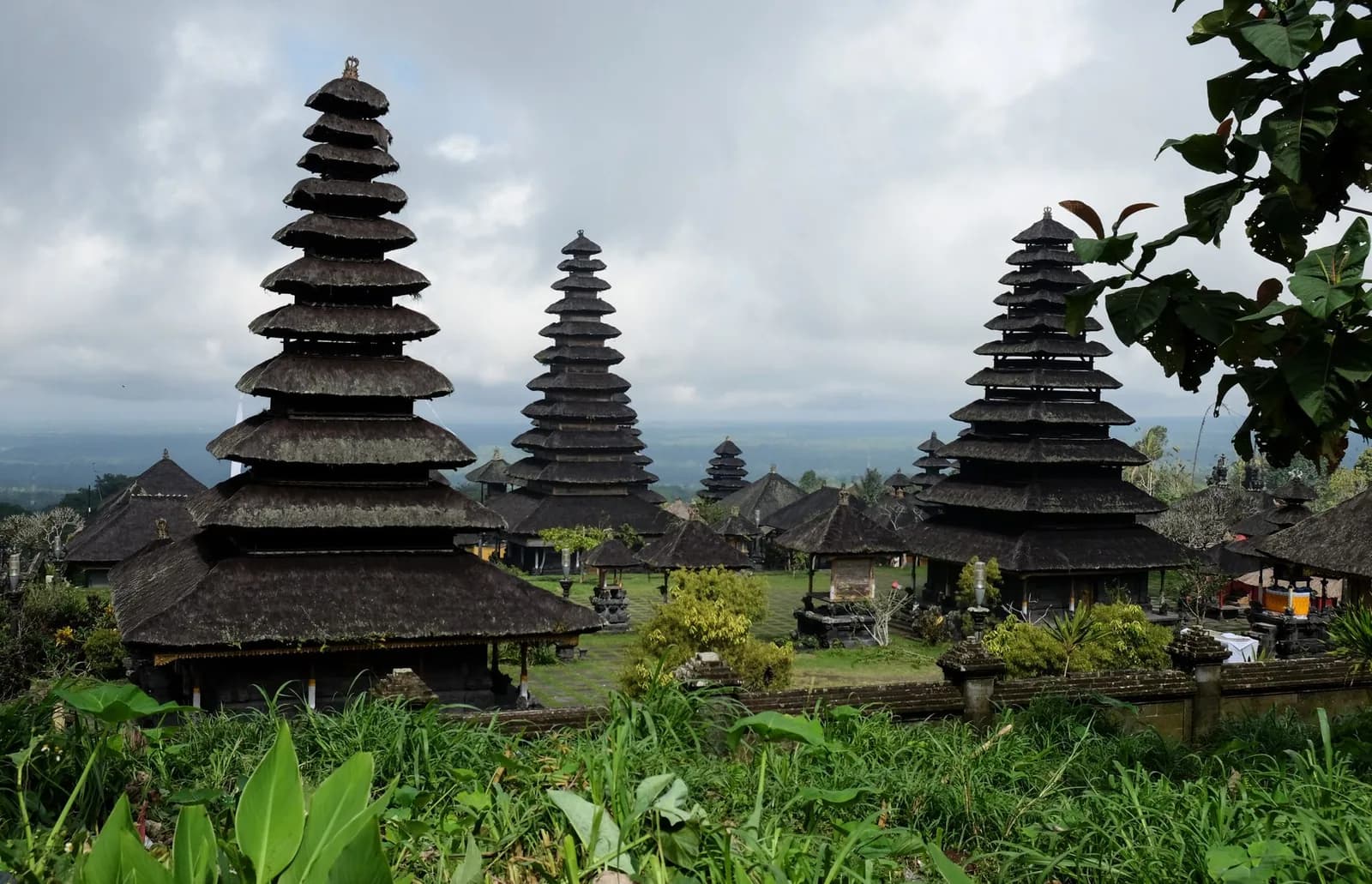
The mother temple, high on the flank of Agung and on the way home if you are heading back to central Bali. A serious religious site rather than a garden.
The rice terraces nobody stops for
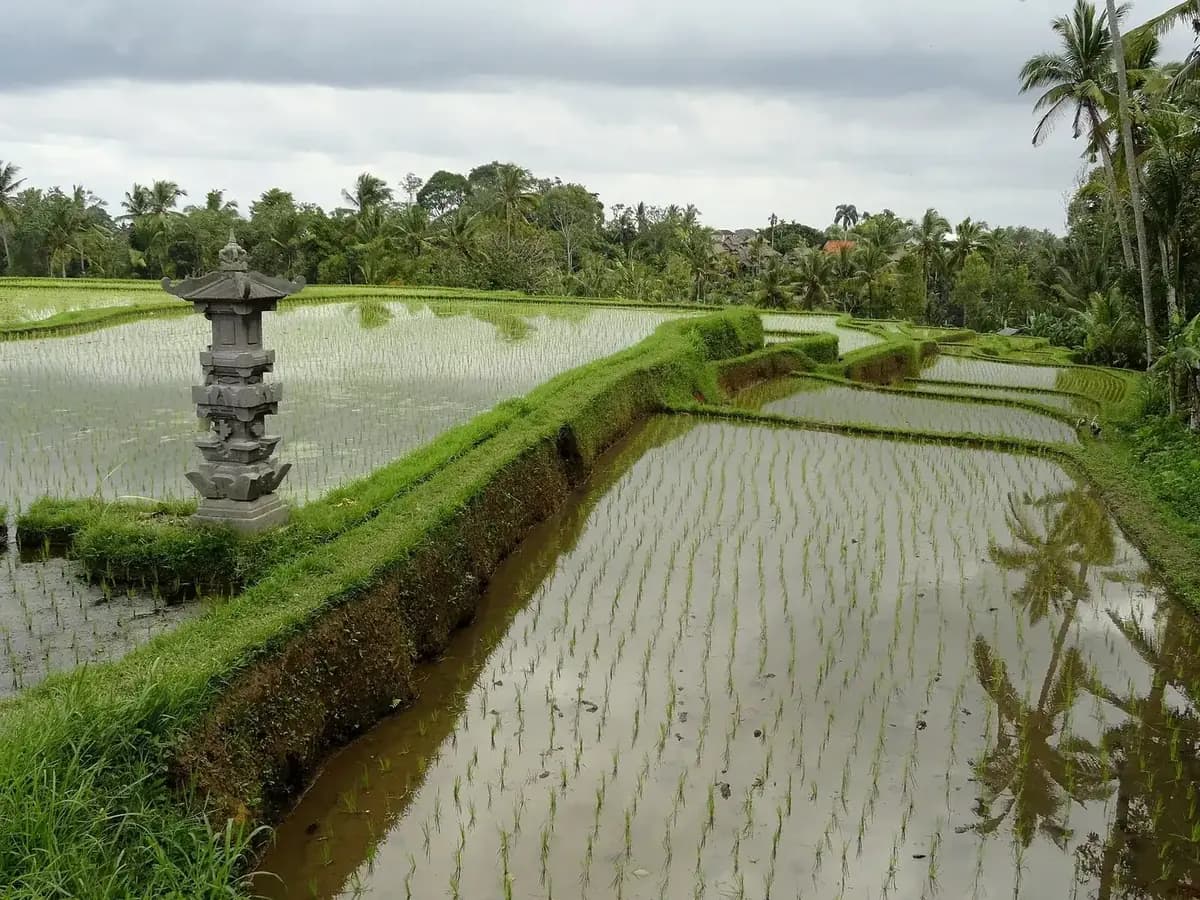
The hills immediately behind Tirta Gangga hold some of the best rice terraces in Bali, and virtually nobody walks them. Unlike Tegallalang, there is no entrance booth, no swing, no queue and no line of cafés: just field paths between flooded terraces with Mount Agung behind them when the cloud lifts.
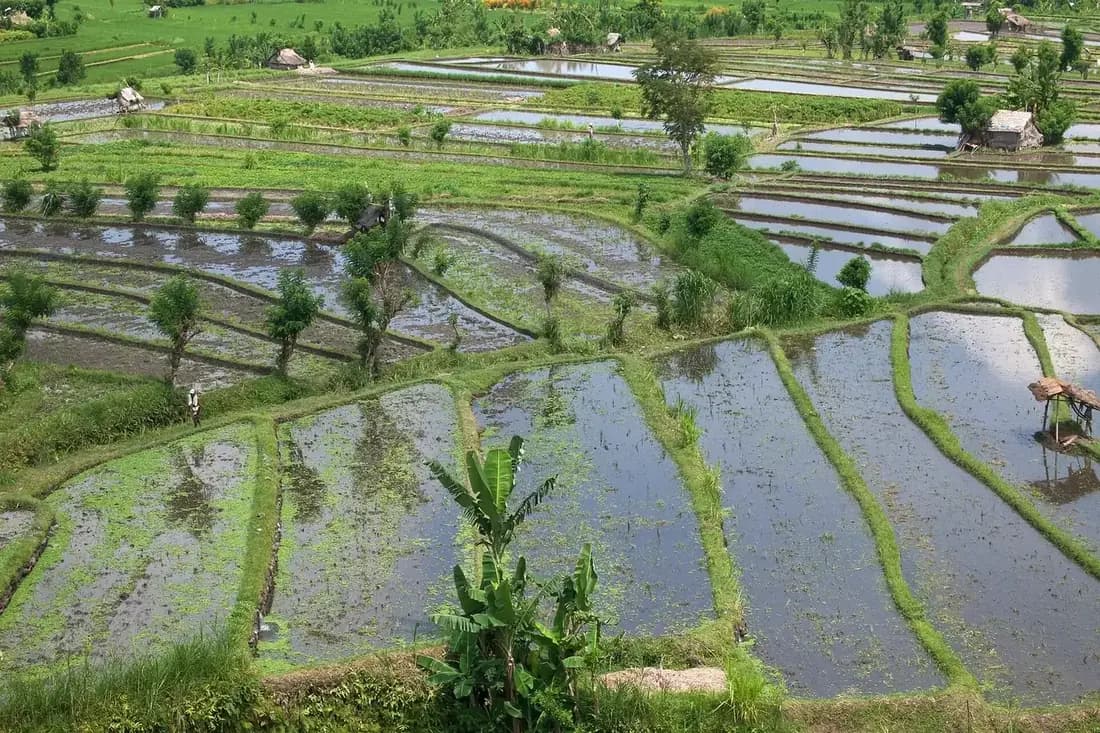
Photo Vyacheslav Argenberg, CC BY 4.0
A loop of one to two hours starts from the road just north of the garden and returns through Ababi. Guides can be arranged in the village, and are worth it less for the route than for knowing which paths cross private ground. Go early, take water, and accept that you will be muddy.
This is the strongest argument for sleeping in the east rather than day tripping. Nobody driving back to Seminyak at two in the afternoon is walking a rice terrace, which is exactly why these ones are still empty.
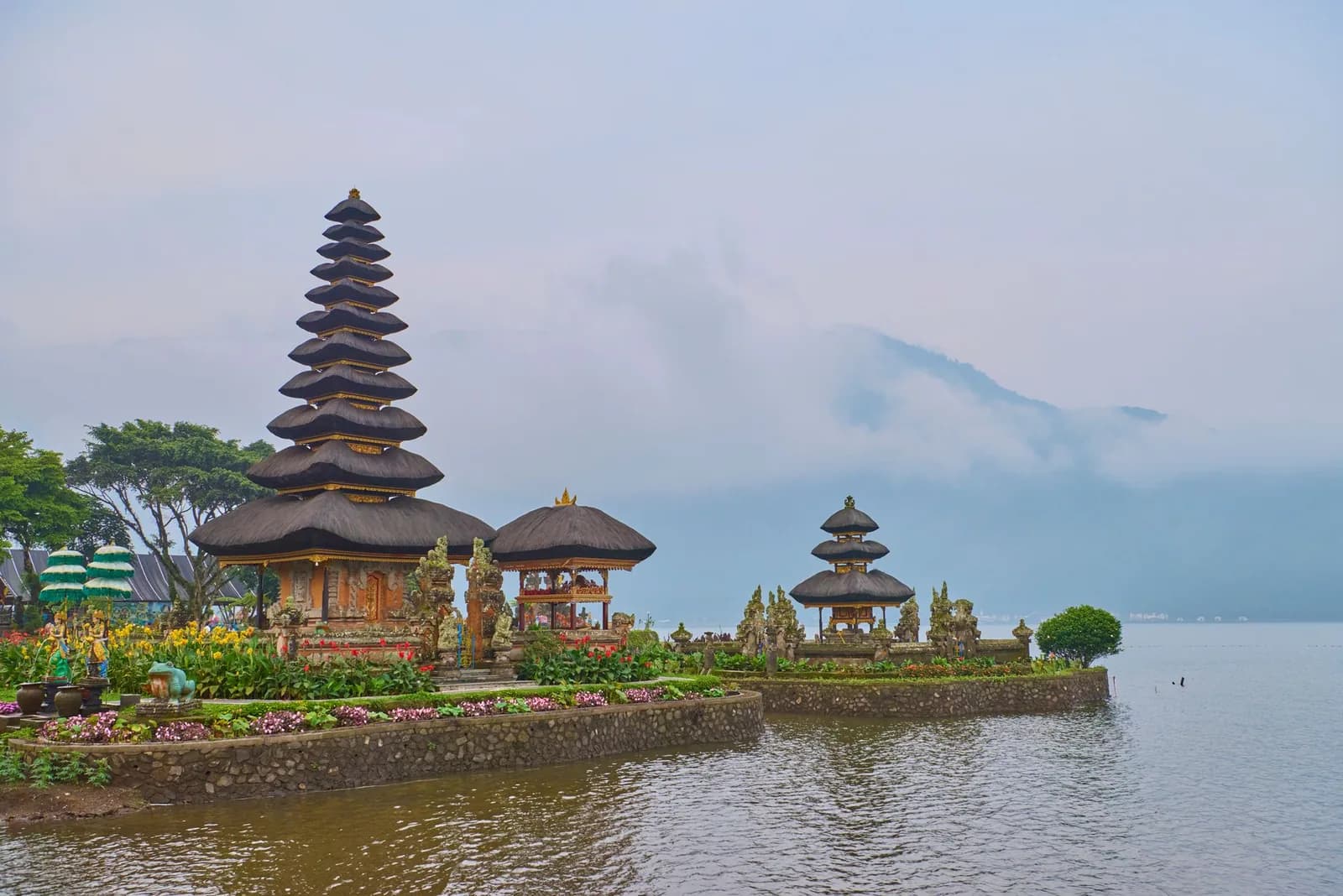
Bali has three sites where water is the architecture rather than a feature, and they are nothing like each other. This one is a garden you walk into, on stepping stones, among carp. Ulun Danu Beratan is a shrine you look at across a highland lake and never approach. Taman Ayun is a royal temple ringed by a moat that exists to keep you out. Only the first of the three lets you get your feet wet, which is the reason to come all the way east for it.
Is it worth it, and for whom
The reviews split cleanly along one line, and it is not about the garden at all. It is about how far people drove to see it.
Go: if you are already in the east
Staying in Amed or Candidasa, or doing Lempuyang at sunrise. Half an hour of driving for an hour of garden is an easy trade, and there is very little else of this quality nearby.
Go: if you are travelling with children
Fish to feed, stones to jump between, a swimming pool at the top and no rules about behaviour. On an island where most attractions are temples with a dress code, that combination is rare.
Skip: if it is a special trip from the south
Six or seven hours in a car for an hour in a garden is the single most reliable way to be disappointed by Tirta Gangga. Either chain it with Lempuyang and Taman Ujung, or leave it for a trip where you sleep on this coast.
Set against the rest of the island, this is a second tier attraction that punches above its ticket price. It is not Besakih and it is not the Gates of Heaven. It is a small, strange, beautifully kept royal garden that a volcano flattened and a family rebuilt, and it costs less to enter than a coffee in Canggu.
The mistake is treating it as a headline. Treat it as the civilised part of a hard day in the east, the stop where you sit down, eat something and look at water after three hours in a car, and it is one of the more pleasant hours of a Bali trip. More of the island's temples and sacred sites are worth ranking the same way.