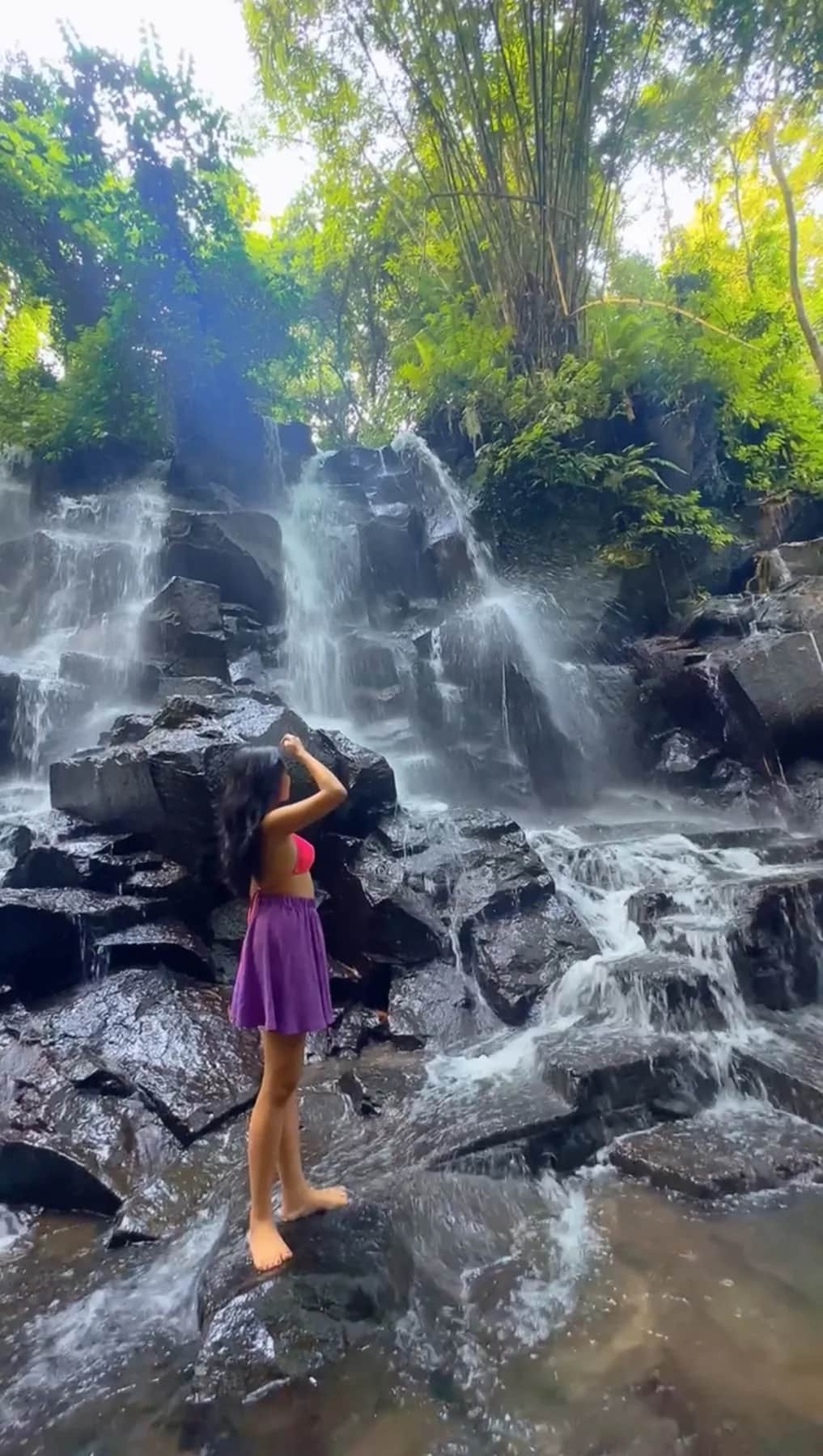
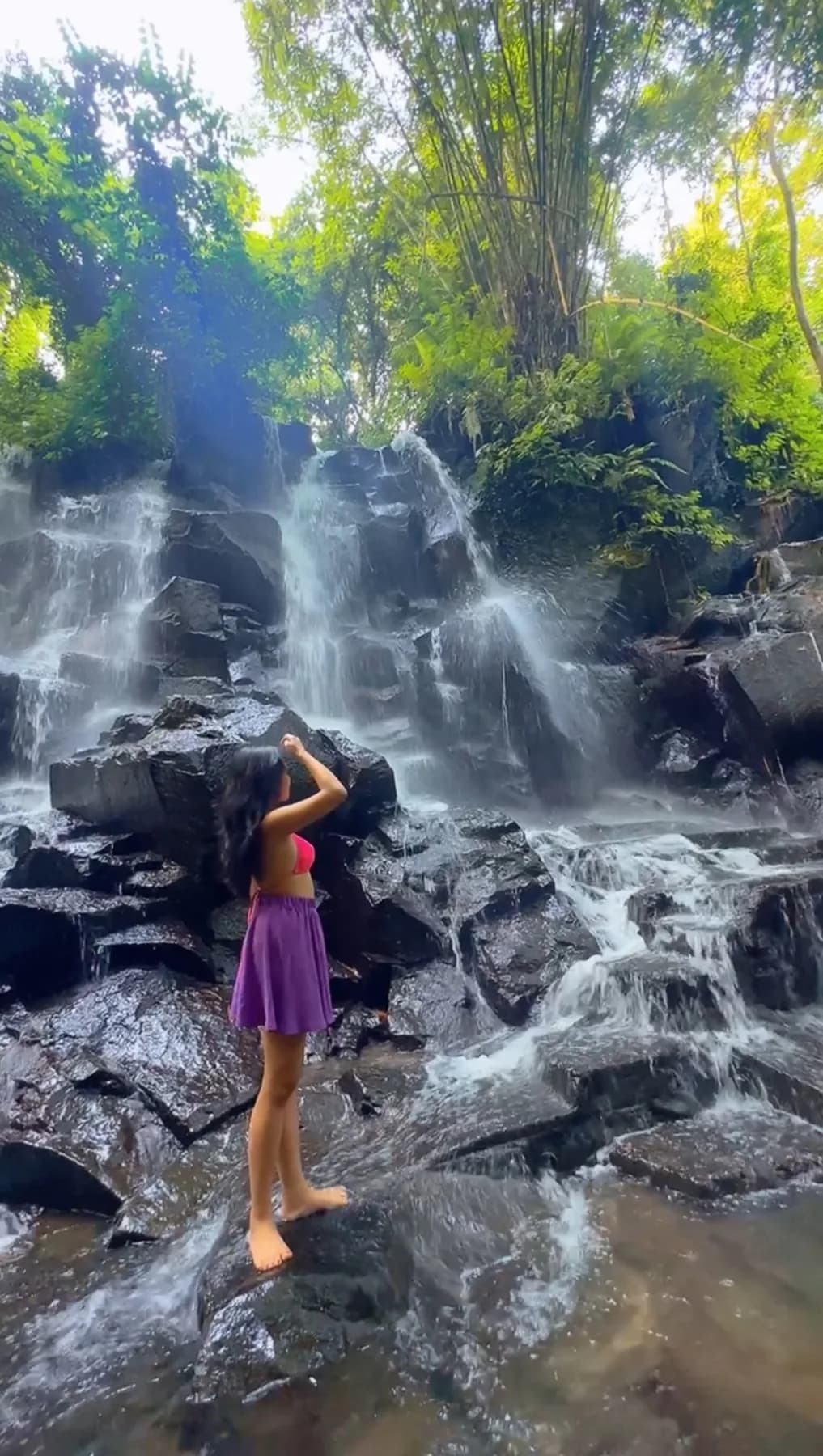
Kanto Lampo does not behave like the other waterfalls near Ubud. Instead of falling clear from a lip into a plunge pool, the stream comes over a broad staircase of dark volcanic rock and spreads out across it, so the whole face runs with water in overlapping curtains. It is wider than it is tall, which is the opposite of what most people picture when they hear the word waterfall, and it is the reason a place this small ended up on so many phone screens.
That geometry is why it photographs the way it does, and it is also why people climb onto it. Every well-known image from here was taken by somebody standing on wet rock inside the flow, usually with a local hand on their forearm and a stranger holding their phone. Nobody mentions that part, and it is most of what actually happens during a visit.
The site is in Gianyar regency, close enough to Ubud that it slots into a morning without any planning at all. It is also small enough that a single arriving minibus fills it, and shallow enough that swimming is not really on the table. Getting those three facts in the right order before you drive out is what this page is for.
On this page
Usually sold as a three waterfall morning
Free cancellationKanto Lampo waterfall trips from Ubud
- ✓Hotel pickup in Ubud or the south, which removes the scooter question entirely
- ✓Normally bundled with Tibumana and Tukad Cepung, the two that reward the extra drive
- ✓The driver waits at the top, so the visit is not timed by your ride home
- ✓Free cancellation on most listings, which matters when the forecast decides the water colour
Affiliate link. Booking through GetYourGuide costs you nothing extra and supports the guide. Price and rating checked September 2026. Both move with season and demand.
What Kanto Lampo actually is
Almost every guide calls it a hidden gem. It is neither hidden nor especially a gem, and it is more interesting than either word suggests.
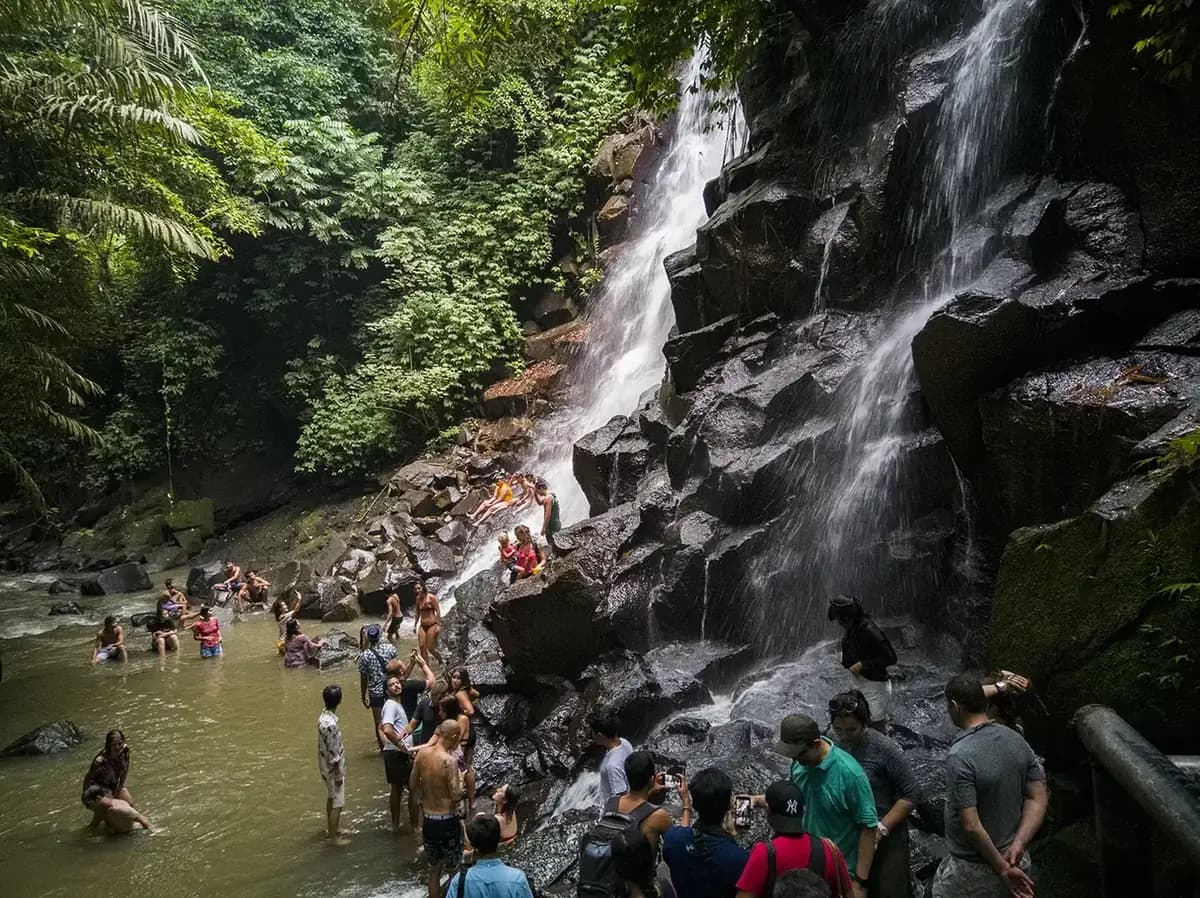
Photo Lamacchiacosta, CC BY-SA 4.0
The stream drops through a short gorge in the volcanic bedrock of southern Gianyar. Where most Bali waterfalls have cut a single deep notch, this one runs into a face that has fractured into broad horizontal shelves, and the water spills from one to the next instead of falling clear. From below you see a dozen small cascades stacked on top of each other rather than one column, and the whole thing glistens because every surface is wet.
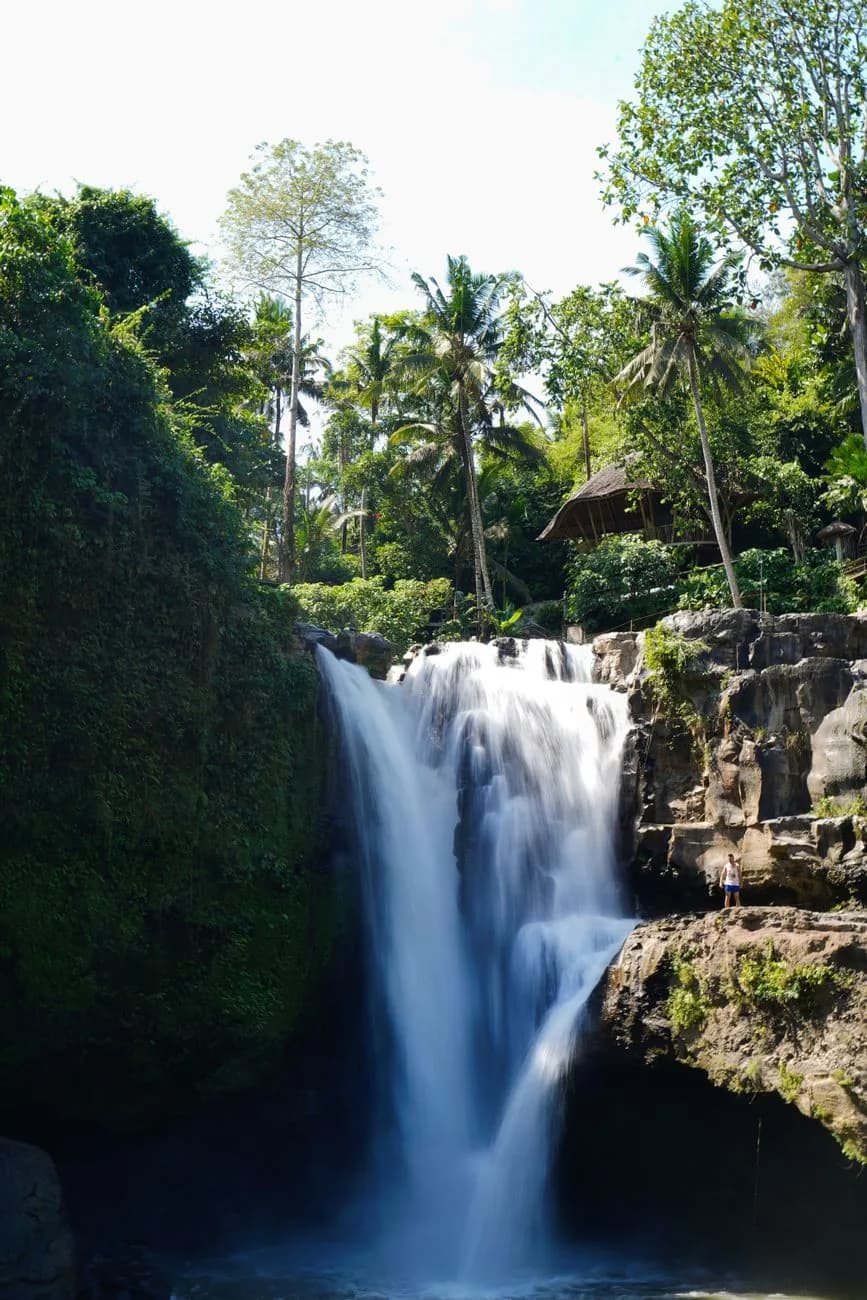
In photographs that stacking reads as texture, which is why the place went viral in the first place. A person standing on the second or third shelf is surrounded by moving water on three sides and still only a metre or so above the pool. You cannot do that at Tegenungan, where the flow would flatten you, and you cannot do it at Tukad Cepung, where the fall lands in a slot canyon.
The scale takes people by surprise in both directions. The face is genuinely wide, maybe fifteen metres across, but the drop is modest and the pool at its foot is ankle to thigh deep over loose stone. Standing at the railing you can see the entire site without moving your head, and you have already photographed everything there is to photograph within about ten minutes.
None of that makes it a bad stop. It makes it a specific kind of stop: short, easy, unusually photogenic for its size, and completely dependent on when you turn up.
The photograph, and exactly where to stand
Four positions, two metres apart, four completely different images. Most people take one of them by accident and miss the other three.
There is one waterfall here and four completely different photographs of it, separated by about two metres of wet rock.
| Position | Footing | Best light | Verdict |
|---|---|---|---|
| In the shallow pool | Easy | All morning | The safe frame, set up in ten seconds |
| On the first ledge | Slippery, take the hand | Around 09:00 to 11:00 in the dry season | The famous shot, worth thirty seconds of help |
| Under the sheet | Genuinely risky | Any time, overcast is kind here | Skip above normal flow |
| From the right bank | Easy, dry rock | Late morning | Do this one first |
In the shallow pool
Stand in ankle to knee deep water at the foot of the face, a few steps back from the rock, on loose stones with nothing steep. This is the shot that reads as a place rather than a portrait, with the whole width of the cascade behind you and a person small in the frame. It is the only angle that shows how wide the sheet actually is, and it stays usable even when the top of the rock is blown out, because the gorge is shaded. Nobody needs to help you here, so nobody will ask.
On the first ledge
One step up onto the lowest shelf of the stepped rock, water running over your feet and calves. This is the classic image: water breaking around you, the tiers rising behind, and enough height that the pool disappears from the bottom of the frame. It is best when the sun clears the gorge wall and light lands on the upper tiers while you stay in shade. The rock is permanently wet volcanic stone with a film of algae where the current does not scour it, so grip is poor. Staff step in here: someone will take your forearm and place your feet. Let them, then hand over a small note afterwards. It is worth it, in decent footwear, on a normal flow day.
Under the sheet
Two or three steps up, tucked into the hollow where the water passes over your head and shoulders. Water pours straight down the frame with you inside it, dramatic and almost always slightly out of focus because the lens gets soaked. You climb with water hitting you and come back down with your eyes half shut, which is where people actually slip. Two people usually work this one, one to pull you up and one to hold the phone, so think about the handoff before you commit. Skip it if the flow is anything above normal, and skip it entirely without a waterproof pouch.
From the right bank
Dry rock on the far side of the stream, shooting across the face rather than from inside it, with only a short scramble to reach and dry footing you can cross with a bag on your shoulder. It gives the full staircase of rock in profile, water fanning across the tiers, no people in the water if you time it, and it is the most useful frame nobody takes. Late morning light, when the top of the face is lit and the base is still dark, is what separates this from a flat grey photo. Do this one first, while the light is still low and before the queue builds, and keep it as your fallback on a day when the flow makes the face a bad idea.
Bring a way to keep the phone dry
Everything about this waterfall involves handing an unprotected phone to somebody standing in spray. A cheap waterproof pouch costs less than a coffee in Ubud and removes the one genuine way this visit can go badly wrong. It also means you can stop worrying halfway through the shot, which is visible in the photograph.
A microfibre cloth in a pocket is the other thing nobody packs. Lenses fog and bead constantly here, and most of the disappointing images from this site are simply out of focus water droplets on glass.
Decide your frame before you climb
There is one queue and one good position, and you are on it for perhaps a minute while people watch. Working out your pose while standing in cold water with an audience is how the awkward version of this photograph happens.
Look at the face from the bank first, pick your shelf, and know whether you want the wide frame or the one from inside the sheet. Then the whole exchange takes thirty seconds and everybody behind you is happier.
The men on the rock, and how to handle the tip
This is the part of a Kanto Lampo visit that generates the confused reviews, and it is much simpler than the reviews make it sound.
Two or three local men work the base of the fall. They stand in the water, they help visitors up the wet shelves, they take your phone and they shoot the photograph you came for, from angles they have worked out over thousands of repetitions. They are very good at it, considerably better than whoever you came with, and they are not paid by your entrance ticket.
What unsettles some visitors is that nobody explains the arrangement. A hand arrives, your phone is taken, six or seven frames are shot, and then there is a pause in which a tip is expected. Read as a transaction that was never agreed, it feels like a trap. Read as what it actually is, a service performed in the open in front of fifty witnesses, it is the ordinary economy of a small site with a big reputation.
The clean way to handle it is to decide in advance that you will tip and roughly how much, and then simply do it at the end without negotiating. A small note per group is normal and is received as normal. Haggling before you climb turns a thirty second interaction into a standoff, and you still end up paying.
If you would rather not engage at all, that is available too. Stay in the shallow pool or shoot from the right bank, take your own photo, and nobody will approach you. The help is offered to people who climb, because climbing is the thing that needs it.
“Are there any risks at Kanto Lampo?”
It is one of the most searched questions about this waterfall, which tells you people can see what the photographs involve. The answer is yes, in an ordinary and manageable way.
To get the shot you climb two or three steps up the wet face and stand with the water coming over you. The rock is volcanic, permanently wet, and carries a film of algae in the places the current does not scour. It has about as much grip as a wet bar of soap, and the drop from where you stand is not far but it is onto more rock. Nobody is falling to their death here. People do come away with a bruised hip and a wet phone, and both are avoidable.
Local staff stand in the water and hand people up and down. This is not a shakedown. It is the sensible way to do it, and a small tip is the right response. Take the hand even if you think you do not need it, because the step you slip on is the one you took confidently.
The other half of the answer is the flow. After heavy rain upstream the sheet becomes a push rather than a trickle, and the same rock that was awkward becomes genuinely dangerous. Gorges like this one also rise faster than you expect, because the catchment above is small and steep. On those days the honest move is to look at it from the bottom and drive on.
Rain decides what you will actually see
No other single factor changes this waterfall as much, and none of the guides that rank for it will tell you. The photograph you have in mind requires clear water on black rock, and clear water is a weather condition rather than a season.
This waterfall changes more with recent rainfall than with the season on the calendar. The catchment above the gorge is small, which cuts both ways: it browns fast after a downpour and it also clears fast. A single dry day is often enough to bring the colour back, so a rained out morning is usually a reason to come back tomorrow rather than to write the place off.
| Recent weather | Water colour | Call |
|---|---|---|
| Dry for days | Clear, black rock reads black | Go, early |
| A shower overnight | Faint tint, mostly gone by mid morning | Go, give it an hour or two after opening |
| Heavy rain yesterday | Brown or milky coffee most of the day | Worth a look if passing, not a dedicated trip |
| Storm, or rain still falling | Thick brown, no visibility into the pool | Do not go |
Dry for days
With no real rain in the last two or three days, the flow is thin and even, spread across the full width of the tiers. This is the postcard: the sheet is thin enough to see the steps through it, the water breaks white against dark stone, and you can stand anywhere on the face without being pushed around. The rock is still slippery because it is permanently wet, but nothing is moving you off it. Go early, because everybody else has read the same forecast.
A shower overnight
Light rain that stopped hours ago, typical of the shoulder months, leaves the flow slightly fuller and still readable as separate curtains, with only a faint tint that is mostly gone by mid morning. This is arguably better than a bone dry day: there is enough volume to give the fall some body and the greenery around the gorge is at its best, with more spray than usual on the upper steps. Give it an hour or two after opening for the colour to settle.
Heavy rain yesterday
After a proper wet season downpour the afternoon or evening before, the flow is noticeably stronger, the tiers starting to merge into one curtain, and the colour turns brown or milky coffee for most of the day. Sediment kills the contrast that makes this waterfall work, and a brown sheet over brown water reads as a muddy river rather than a cascade. The push is real on the upper steps, and while staff will usually still help people up, the margin has shrunk. It is worth a look from the bottom if you are already passing, but not worth a dedicated trip. Tukad Cepung, further into the hills, often runs clearer on the same day.
Storm, or rain still falling
Sustained heavy rain overnight, or a river visibly up when you arrive, means one heavy curtain across the whole face, loud, with debris coming through, and thick brown water with no visibility into the pool at all. You cannot get onto the rock, and from the bank the whole scene is one brown mass. This is when the site closes, or should: flash rises in these gorges are quick, the steps down are slick, and the pool bottom is invisible. Check recent visitor photographs from the same week before you commit a morning to it, and keep the day flexible.
The mechanism is simple. The stream drains farmland and village land above the gorge, so a downpour washes soil straight into it. Within hours the sheet turns the colour of milky coffee, and the contrast between white water and dark stone that makes every famous photograph from here simply disappears. The waterfall is still running. It just looks like a flooded ditch.
This is also the honest answer to why the site sometimes appears to be closed. Sustained rain raises the flow, the shelves stop being climbable, and management shuts the descent until it drops. It is usually a matter of a day or two, not a season.
The practical consequence is that this stop should stay flexible in your itinerary. It is twenty-five minutes from Ubud, so it costs nothing to postpone it by a day. Locking it into a fixed schedule during the wet season is how people end up photographing brown water and writing disappointed reviews.
The hour you arrive, and what it costs you
The site is small enough that one arriving group changes it completely. The light in the gorge moves on a different schedule from the crowd, and the two do not line up.
| Arrival | How busy | Light in the gorge | Verdict |
|---|---|---|---|
| At opening, around 07:00 to 08:00 | A handful of people, often nobody on the rock | Still dim at the base, soft and even | Best for having the place to yourself and for the wide frame from the bank |
| 08:00 to 09:00 | Filling up, first minibuses arriving | Coming up fast, top of the face lit | The compromise hour, and the one to aim for if you only get one shot at it |
| 09:00 to 11:00 | Busiest window of the day, a queue for the rock | The good light, reaching down onto the tiers | Best photographs, worst crowd. Expect to wait for your turn |
| 11:00 to 14:00 | Still busy, thinning after lunch | Harsh overhead sun, blown highlights on the water | The worst combination, and when most day tours arrive |
| After 15:00 | Quiet again | Going flat, gorge in shadow early | Peaceful, and the wet season risk of an afternoon downpour is real |
If you are choosing between the two good windows, be honest about what you want. Arrive at opening for the experience, when you can stand in the pool alone with the noise of the water and nobody waiting behind you. Arrive around ten for the photographs, and accept that you will spend part of that time queueing on a wet ledge with strangers.
Season matters less than people expect. The dry months from roughly April to October give you clearer water and safer footing but a thinner sheet, the wet months give you a fuller, more dramatic fall that is brown half the time. Neither is wrong, and the recent rainfall of the last forty-eight hours will tell you more than the calendar does.
Getting to Kanto Lampo
The single most useful thing about this waterfall is how little effort it takes to reach. It sits just off a normal road in Gianyar, with a car park at the top of the steps.
| Coming from | Drive | Sensible way to do it |
|---|---|---|
| Central Ubud | 25 to 30 min | Scooter or a Grab car. Close enough to go before breakfast and be back for it |
| Gianyar town | 15 min | Anything. This is the local waterfall for the regency |
| Sanur | 1 h | Half day driver, combined with Tibumana or Goa Gajah |
| Seminyak, Canggu, Kuta | 1 h 15 to 1 h 45 | Driver for the day. Not worth the drive on its own, worth it as part of a waterfall loop |
| Airport, Kuta side | 1 h 30 to 2 h | Only as a stop on the transfer up to Ubud, with a driver who waits |
By scooter
The natural choice from Ubud. The road is sealed the whole way and the final turn is signposted. Park in the small lot at the top for a token fee. Ride in the morning and you avoid both the heat and the afternoon rain, and remember that a soaked phone on a scooter is a worse problem than a soaked phone on foot.
Grab and Gojek
Getting out here by app is straightforward. Getting back is the problem, because coverage thins outside the main towns and you may wait a long while for a return car. Either ask your driver to wait for an agreed sum or book a round trip before you set off.
Driver for the day
The standard solution from the south, and the one that makes sense if you are chaining several stops. A half day covers Kanto Lampo with one or two neighbours. A full day covers the waterfalls plus Tirta Empul and a rice terrace.
One navigation warning worth taking seriously. Maps applications occasionally route people to the river bed below the falls rather than to the official car park, down a track that is not a road for a rental scooter. If your route stops looking like a village lane, turn around and look for the gate and ticket booth on the main approach.
Tickets, hours, and why people search for “Kanto Lampo closed”
Two questions dominate the searches around this waterfall, and both have short answers that guides manage to make long.
Entrance
A couple of euros or dollars per person, collected in cash at a booth by the car park. Children pay less or nothing.
Parking
A token amount for a scooter, a little more for a car, paid separately to an attendant. Small notes again.
Hours
Daylight hours, roughly from early morning until late afternoon. The gorge goes dark well before sunset, so the last hour is not worth much.
Tips
Not included in anything above, and not obligatory, but expected if somebody helps you onto the rock or takes your photograph.
On the closure question: this waterfall has never been permanently shut, and the search results that suggest otherwise are almost always old. Temporary closures happen, and they happen for the reason you would expect. After sustained heavy rain the site shuts until the flow drops and the path is safe, and it has also closed for periods of maintenance on the steps and railings. Both are measured in days.
There is a second reason the word closed keeps appearing, and it is worth knowing. Balinese sites observe Nyepi, the day of silence in March, when everything on the island stops, and individual sites close for temple ceremonies without much notice. If a ceremony is happening in the village above, the waterfall may simply not be receiving visitors that morning.
None of this warrants dropping the stop. It warrants keeping it loose, checking recent photographs before you drive out, and having another waterfall in mind as a substitute.
What is actually on site
More infrastructure than the phrase hidden waterfall implies, and less than a full facility. Here is what you can count on.
The descent
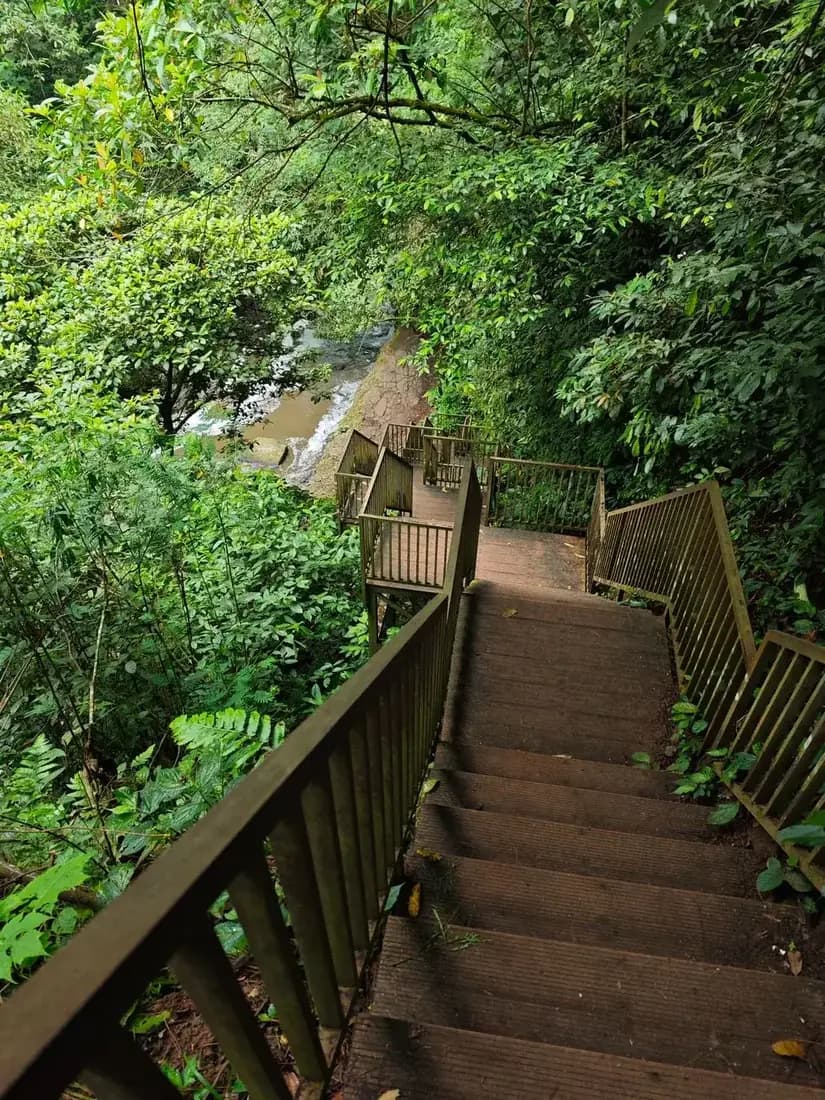
A short flight of concrete and stone steps with a handrail on part of it, a couple of minutes down and a slightly sweatier couple of minutes back up. Nothing that counts as a hike.
Changing and toilets
Basic changing rooms and toilets near the entrance, sometimes with a small charge. Functional rather than pleasant, and there is nothing at the bottom of the steps.
Food and drink
A couple of warungs by the car park doing fried rice, coconuts and cold drinks. Cheap and perfectly good. For a real meal you drive back towards Ubud.
Somewhere to leave things
No lockers worth relying on. Take what you need to the water and leave the rest with somebody in your group or locked in the car.
Accessibility
Poor. The steps are the only way in, the surface at the bottom is wet and uneven, and there is no viewpoint from the top that shows you anything. Not a stop for wheelchairs or unsteady knees.
With children
Fine at the pool, where the water is shallow and slow. Not fine on the face, where adults slip. Keep small children off the shelves entirely and the visit is easy.
The site has been steadily tidied up over the years, with paving, a railing at the base and a proper ticket booth. Purists complain about that. In practice it is the reason a waterfall in a gorge can be visited in flip flops by people who then, unfortunately, try to climb wet rock in those same flip flops.
Can you swim at Kanto Lampo?
Not in any real sense. The water spreads across the face rather than punching a deep basin at its foot, so what you get at the bottom is a broad shallow pan over loose stone, mostly ankle to knee deep with a few thigh deep pockets. You can wade, sit down in it and stand under the flow, and that is the extent of it.
That is not a flaw so much as a consequence of the same geology that makes the place photogenic. A waterfall that fans out over shelves dissipates its energy instead of drilling a hole. If you want the other thing, the two obvious candidates are within half an hour.
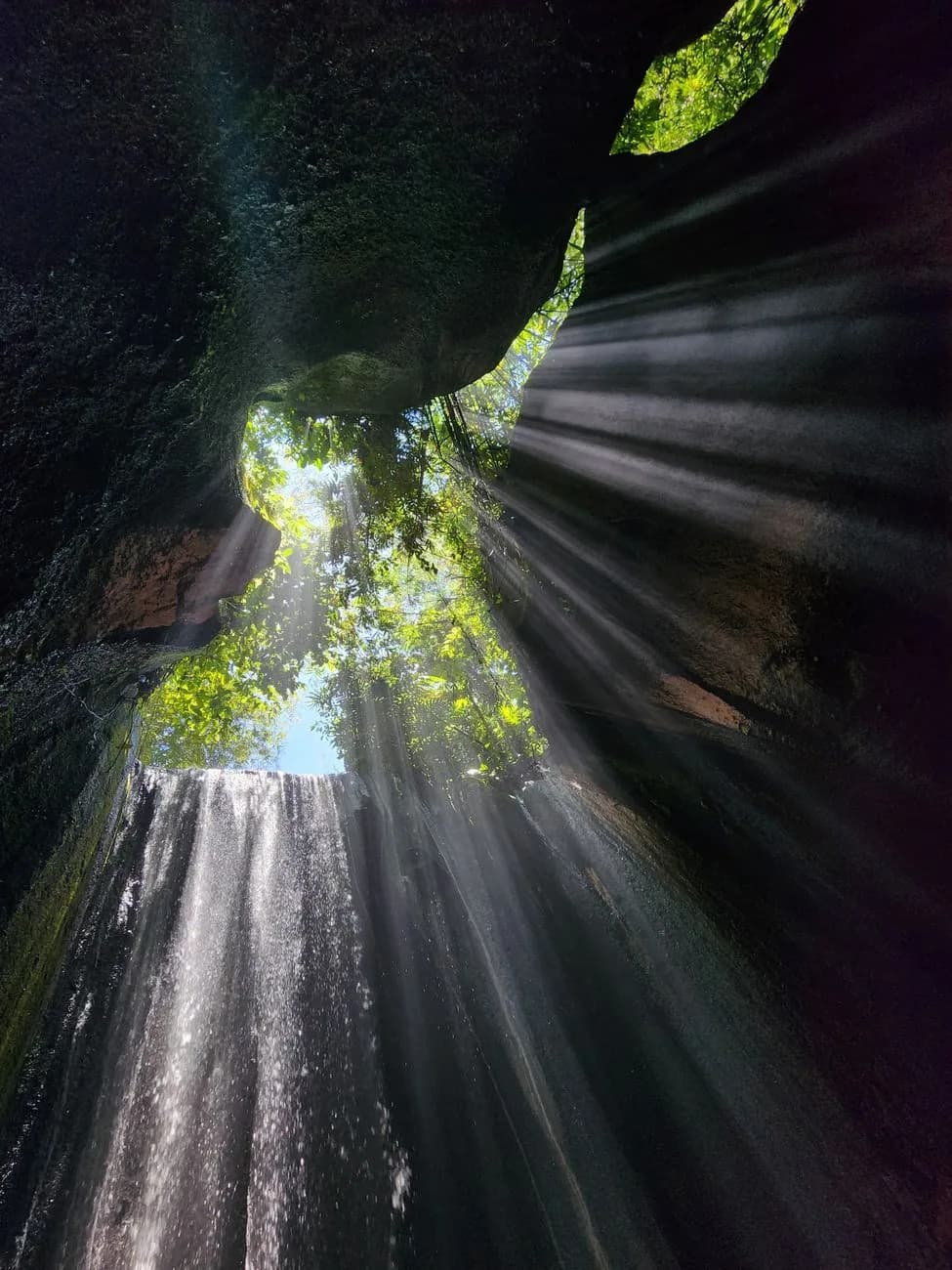
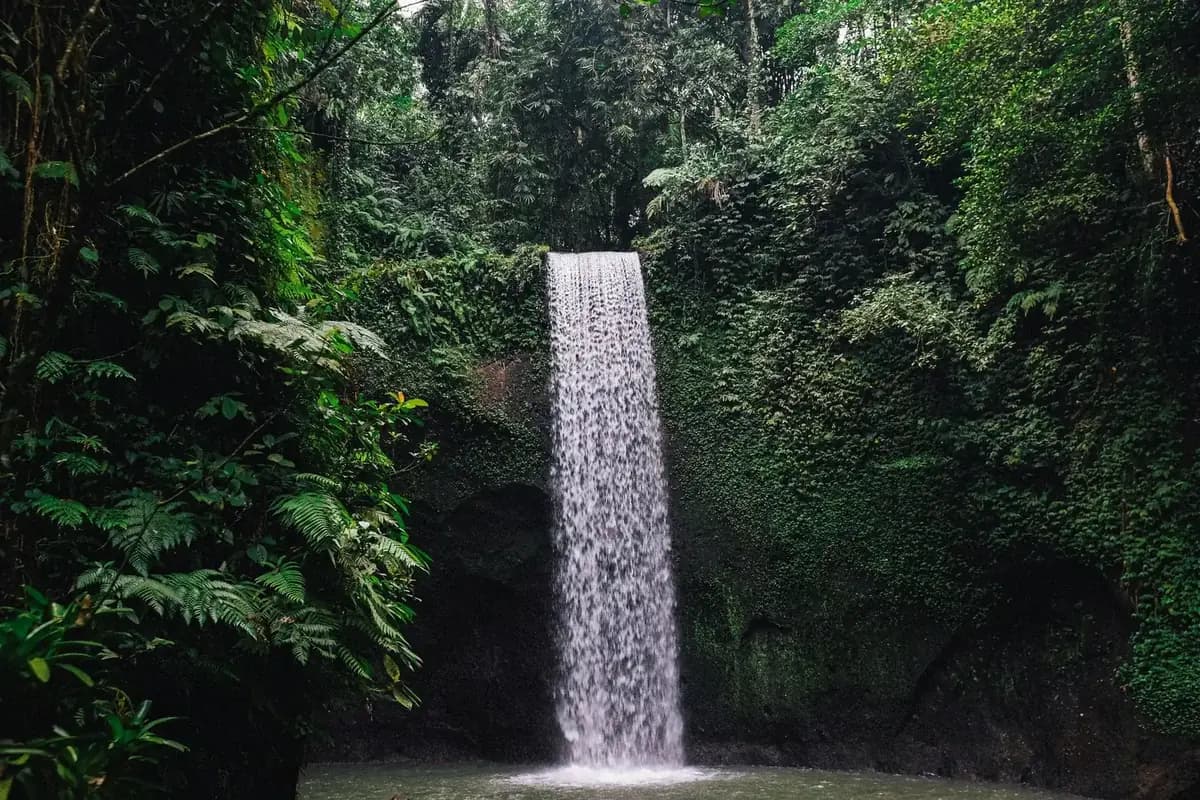
Tibumana has the deep, calm pool and the jungle amphitheatre, and it is the one to pick if swimming is the point of the morning. Tukad Cepung is a different experience entirely, a fall inside a slot canyon with a beam of light that only works for a few hours a day. Between the three of them you can build a genuinely good waterfall morning east of Ubud.
What to combine it with
Kanto Lampo is forty minutes of your day. It only makes sense as part of a morning, and the surrounding corner of Gianyar is unusually dense with things worth stopping for.
| Stop | From Kanto Lampo | Why bother |
|---|---|---|
| Tibumana waterfall | 20 min | The swim, the jungle setting, and far fewer people |
| Tukad Cepung waterfall | 30 min | The slot canyon and the light beam, best mid morning |
| Tegenungan waterfall | 20 min | The big, wide, heavily developed one closest to the south |
| Goa Gajah, the Elephant Cave | 15 min | A ninth century carved cave mouth and bathing pools, half an hour well spent |
| Ubud centre | 25 min | Lunch, the palace, the market and everything else |
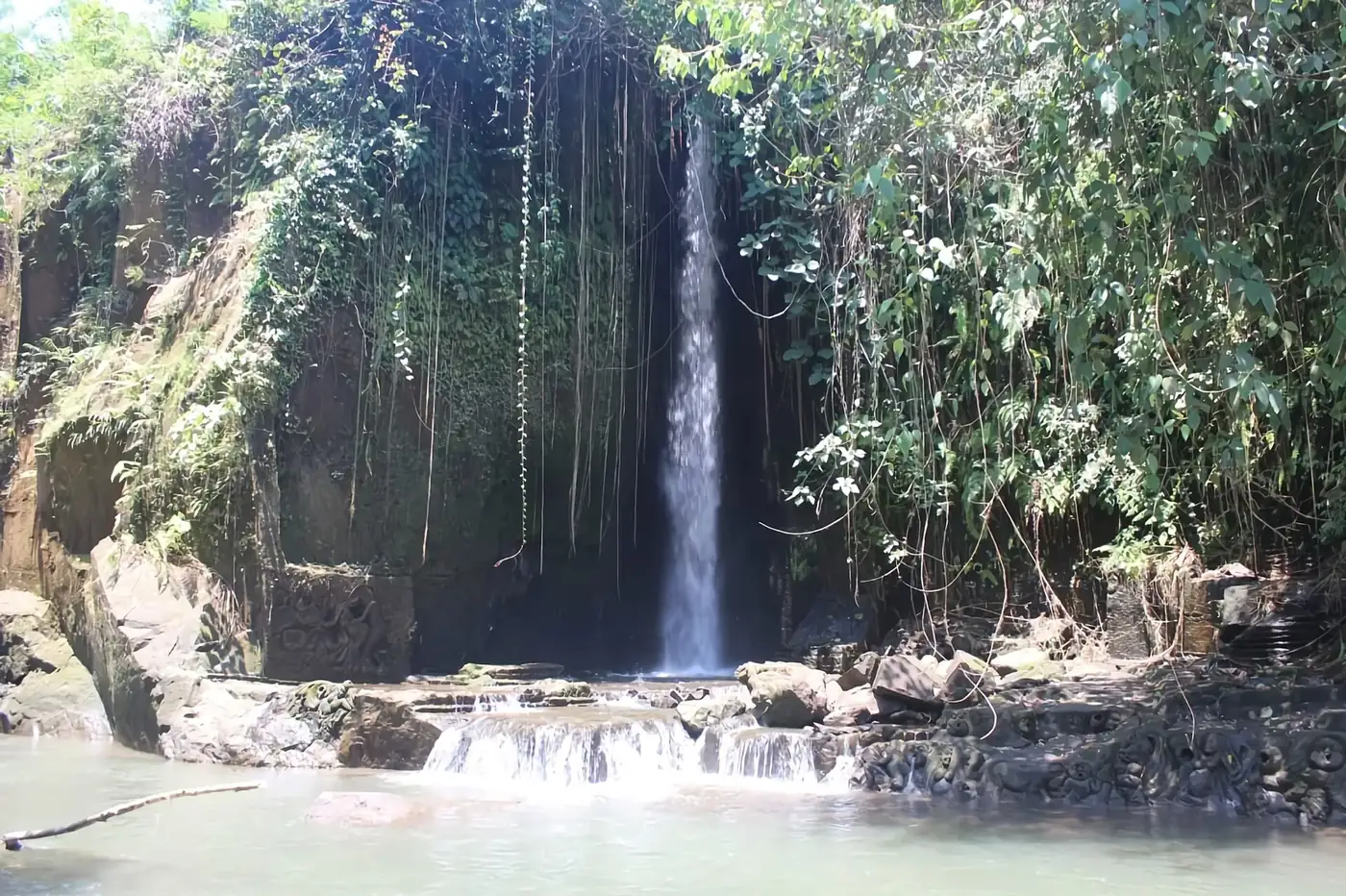
Photo Anggabuana, CC BY-SA 4.0
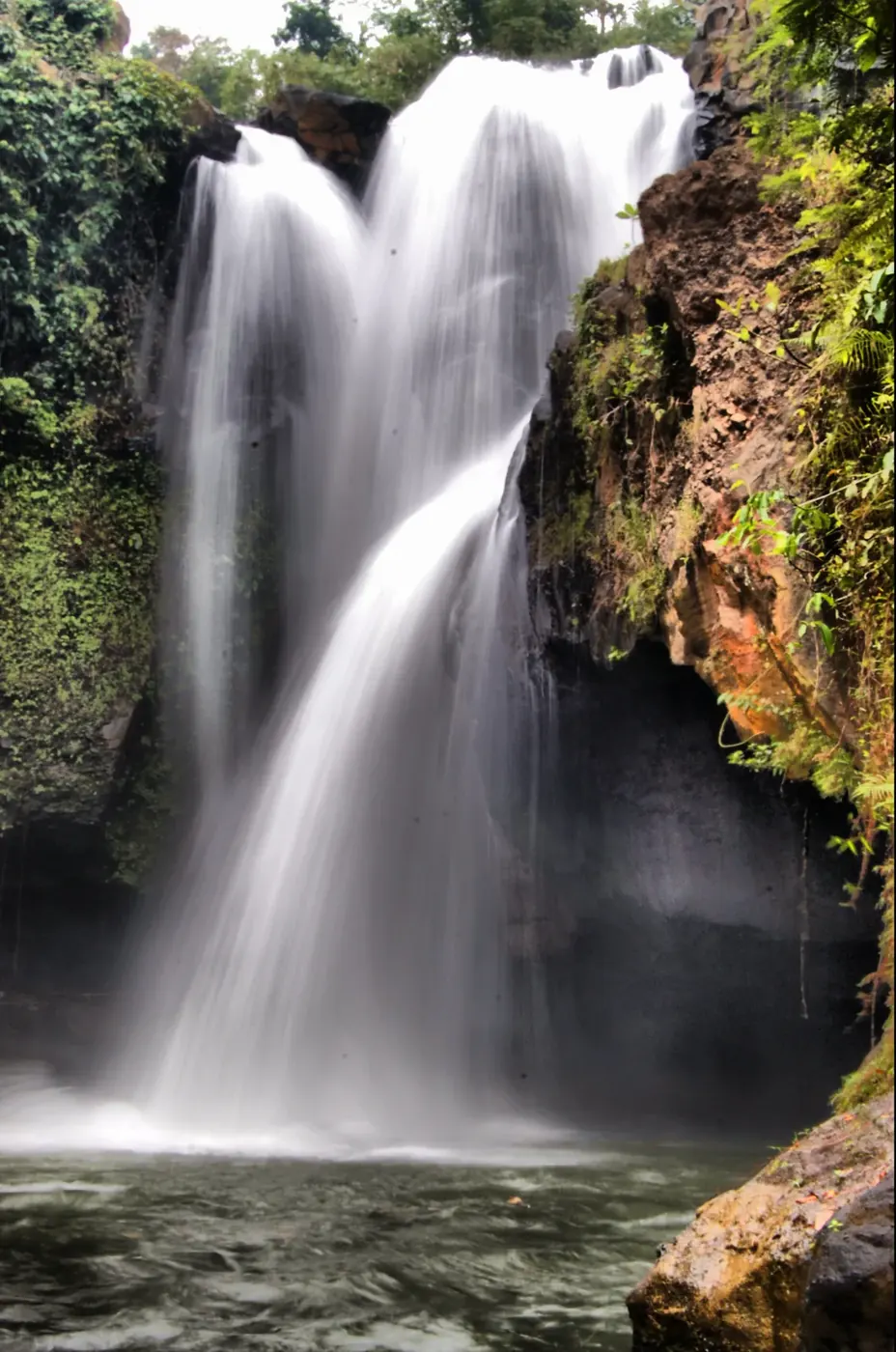
Photo I Made Yanuarta DPY, CC BY 2.0
The itinerary that works best starts early and moves west to east. Kanto Lampo at opening, because it is the one that suffers most from crowds, then Tibumana while the morning is still cool, then Tukad Cepung in the window when its light beam is working. Lunch back in Ubud, and the afternoon at Tegallalang or on the Campuhan ridge.
If you would rather not drive it yourself, this exact loop is what the waterfall day trips sold out of Ubud do, and it is one of the rare cases where the packaged version and the sensible version are the same thing.
So is Kanto Lampo worth visiting?
The most asked question about this waterfall in both the American and Australian search results, and the answer depends entirely on who is asking.
Based in Ubud
Yes, clearly. Twenty-five minutes each way for a waterfall you can stand inside. At that distance the question barely arises. Go early, go once, keep it short.
After the photograph
Yes. No other waterfall on Bali lets you stand mid-flow this safely and this easily. If that image is what you came for, this is where you get it.
Staying in the south
Only as a stop. Ninety minutes each way for forty minutes on site does not stand up alone. Bundle it with two other waterfalls or leave it out.
Wanting wilderness
Probably not. Paved, ticketed, busy and forty metres from a car park. If you are chasing the empty jungle version of Bali, drive north to Sekumpul instead.
The reviews that call it disappointing almost all share one detail: they describe arriving at midday, in a queue, after rain. The reviews that call it magical describe arriving at opening on a clear morning. Both are accurate accounts of the same waterfall, and the difference is three hours and a rain gauge, not taste.
Treat it as a short, cheap, easy stop with one very good photograph in it, arrive before the minibuses and after a dry night, and it is among the best value forty minutes in the Ubud area. Treat it as a destination and it will not carry the weight.