The currency in Bali is the Indonesian rupiah (Rp, IDR), and on 19 November 2026 US$1 was worth about Rp 18,300 and C$1 about Rp 12,700. The converter tells you that much. What it does not tell you is where the money leaks: an ATM that charges your card Rp 50,000 a time, a changer who palms a note, a card terminal that converts into dollars at its own rate. This page covers each one.
Contents
What is the currency in Bali? The Indonesian rupiah in 2026
Bali uses the same money as the rest of Indonesia. The rupiah is written Rp on price tags and menus, IDR at banks and on your statement. Prices drop the decimals and use a dot or a comma for thousands depending on the shop, so “Rp 50.000”, “50,000” and “50K” all mean fifty thousand rupiah.
| You have | Detail | In rupiah or dollars |
|---|---|---|
| US$1 | Rate of 19 November 2026. In January 2026 it was closer to Rp 16,700. | about Rp 18,300 |
| US$100 | What one US$100 note brings at a good money changer, a little less after the margin. | about Rp 1.83 million |
| C$1 | Calculated from the US dollar rate of the same day. | about Rp 12,700 |
| C$100 | Canadian dollars are rarely taken by changers: withdraw or pay by card instead. | about Rp 1.27 million |
| Rp 100,000 | The red note, the one you will handle most. | US$5.50 · C$7.85 |
| Rp 1 million | Two or three warung meals a day for a week, roughly. | US$55 · C$79 |
The rupiah has been weak through 2026, sliding from about Rp 16,700 to the dollar on 1 January to Rp 18,275 on 19 November, its lowest of the year. For a visitor paid in US or Canadian dollars that is good news: Bali costs about 9% less in dollars than it did in January, before any price rises.
How far does $1 go in Bali?
| What US$1 to US$7 buys | Detail | Order of magnitude |
|---|---|---|
| Bintang 330 ml at a minimart | The classic one-dollar purchase. | Rp 18,000 to 25,000US$1 to US$1.40 |
| Nasi campur in a warung | Rice with three or four side dishes, local price. | Rp 25,000 to 50,000US$1.40 to US$2.75 |
| Flat white in a café | Canggu, Seminyak or Ubud. | Rp 40,000 to 55,000US$2.20 to US$3 |
| Casual café meal | Where most visitors eat lunch. | Rp 70,000 to 125,000US$3.80 to US$6.85 |
A dollar goes a long way in a warung and not very far in a Canggu café, where prices are close to those at home. The full picture, day by day and trip by trip, is in our Bali trip cost guide.
Indonesian rupiah notes and coins
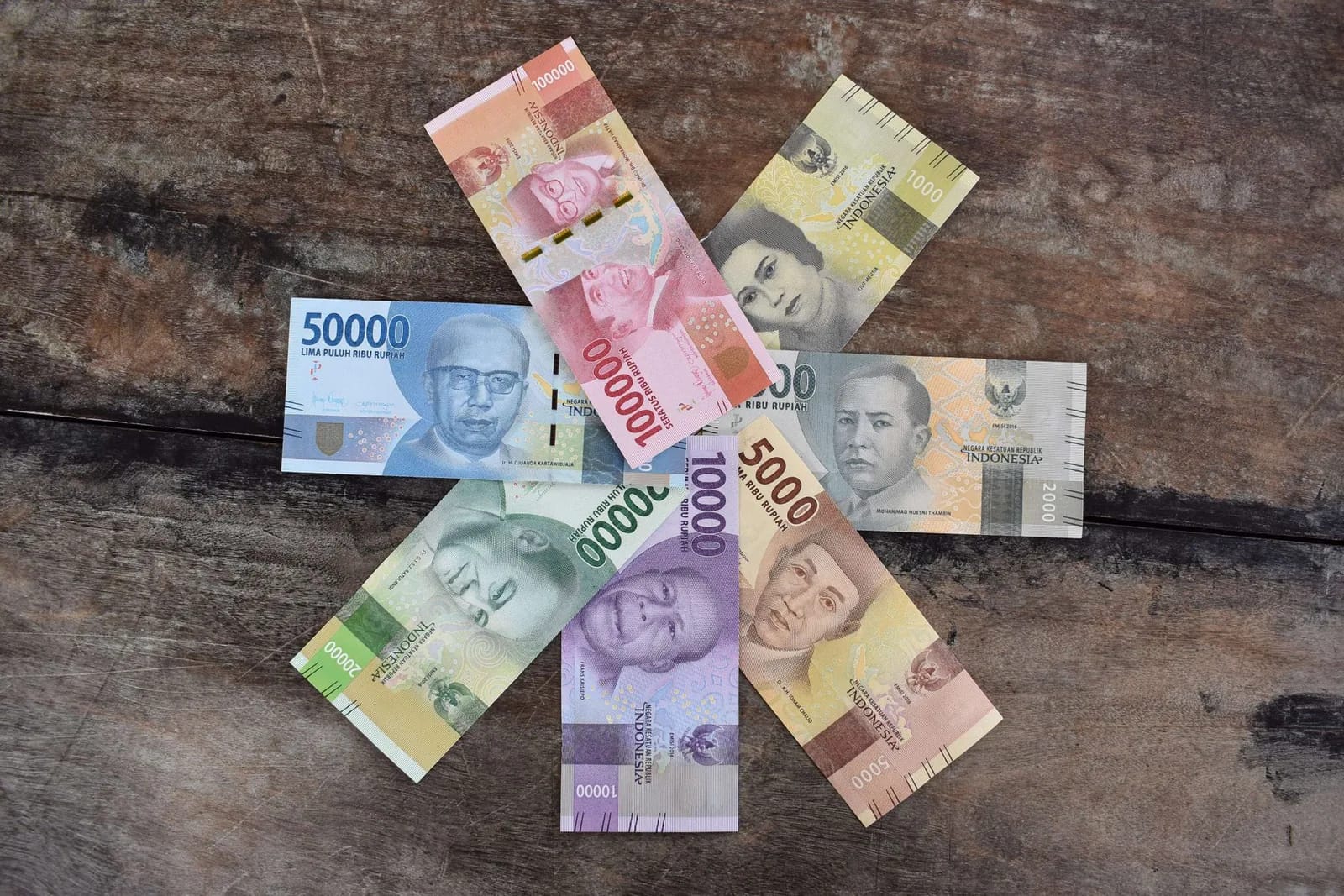
There are seven notes: Rp 1,000, 2,000, 5,000, 10,000, 20,000, 50,000 and 100,000. Bank Indonesia issued a new series on 18 August 2022, with the same national heroes as the 2016 notes and brighter colours. The older series are still legal tender, so you will get a mix of both. The two you will handle most are the red Rp 100,000 and the blue Rp 50,000.
Coins come in Rp 50, 100, 200, 500 and 1,000. They are worth almost nothing (Rp 1,000 is about five US cents), and minimarts often give a sweet or round down instead of small change.
The trap is the zeros. Rp 10,000 and Rp 100,000 look alike in a hurry, especially in a dim taxi at night. Keep the large notes in a separate pocket, and say the amount out loud when you pay.
What currency is best to take to Bali?
US dollars, if you bring cash at all. Every authorised money changer takes them, and the best rate goes to clean, recent US$100 notes. Smaller notes get a lower rate. Changers refuse notes that are torn, written on, folded hard or from older series, so bring the newest bills your bank can give you.
Canadian dollars are taken by few changers, at a poor rate. Canadians do better arriving with a card and withdrawing rupiah. Do not buy rupiah at home: US and Canadian banks rarely stock them and the rate is worse than anything you will get in Bali.
Cash or card in Bali: what to pay with
You need both. Cards work in hotels, supermarkets, tour companies and most restaurants in Seminyak, Canggu, Ubud, Uluwatu and Nusa Dua. Cash is still the rule at warungs, markets, temple entrances, parking attendants, small shops, surf schools on the beach and drivers you flag on the street.
- Card surcharges of 2% to 3% are common, especially in smaller businesses. Ask before you pay if the bill is large.
- Visa and Mastercard are everywhere cards are taken. American Express is accepted far less often.
- When a terminal or an ATM offers to charge you in US or Canadian dollars, refuse and pick rupiah. That offer, dynamic currency conversion, applies the machine's own rate and costs several percent.
- Grab and Gojek take cards in the app, which saves cash for everything else.
A good habit for a week in Bali: carry Rp 500,000 to 1 million in cash (US$27 to US$55 · C$39 to C$79), pay by card where it is free, and keep a second card in the hotel safe in case the first is swallowed or blocked.
QRIS in Bali: can tourists pay by QR code?
QRIS is Indonesia's national QR payment standard, and you will see its sticker at almost every counter, down to the smallest warung. Payments by foreign visitors through QRIS rose 222% year on year in the first quarter of 2026, according to Bank Indonesia. For a US or Canadian traveller, the way in is an Indonesian wallet such as GoPay or OVO, which visitors can now link to a foreign card.
It needs mobile data at the till, which is one more reason to land with an eSIM for Bali already installed. QRIS links directly with Malaysia, Singapore, Thailand, South Korea, Japan and China, but not with US or Canadian banking apps.
The best card for Bali: no foreign transaction fee
What makes a card good for Bali is simple: no foreign transaction fee, a fair exchange rate, and few or no ATM fees of its own. Many US travel credit cards already waive the foreign transaction fee, and some Canadian ones do too. Check yours before you fly. For withdrawals, a multi-currency account such as Wise or Revolut usually beats a standard debit card on both the rate and the fees.
Wise account and debit card
Wise- Rupiah: Converts to IDR at the mid-market rate, with the fee shown before you pay
- ATMs: A few free withdrawals each month, then a small fee
- Card: Visa or Mastercard debit card, depending on the country
- Available: In the US and Canada
ATMs in Bali: fees, limits and which banks to use
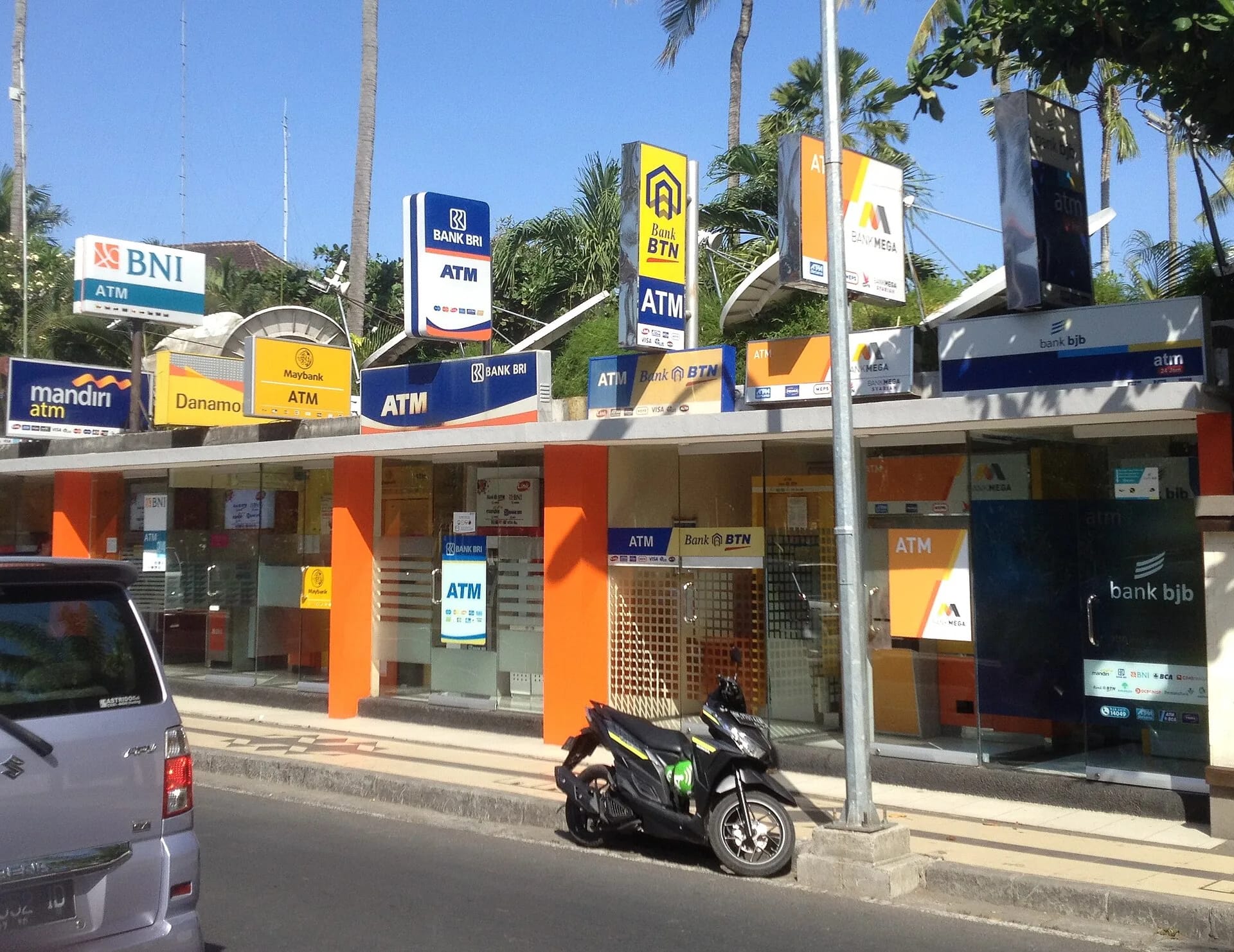
Photo Christophe95, CC BY-SA 4.0
ATMs are everywhere in the south, in Ubud and in the larger towns, and harder to find in the villages, on the Bukit beaches and on Nusa Penida. Since February 2026 the bank on the machine matters: Mandiri now charges foreign cards an access fee on every withdrawal, on top of whatever your own bank charges.
| ATM | Detail | Fee for a foreign card |
|---|---|---|
| Mandiri | Access fee on foreign Visa and Mastercard cards since 22 February 2026. JCB and UnionPay cards are exempt. Mandiri has also announced a rise to Rp 100,000. | Rp 50,000 per withdrawalUS$2.75 · C$3.95 |
| BCA, BNI | Travellers using Wise and Revolut cards reported no access fee in 2026. The screen has the final word. | Rp 0 reported |
| BRI, CIMB, Maybank and others | No published fee for foreign cards. Read the screen before you confirm. | Shown on screen |
| Your own bank | Foreign transaction fee plus an out-of-network ATM fee, on every withdrawal. | Often 1% to 3% + a fixed fee |
The other cost is the withdrawal limit. Most machines give between Rp 1.25 million and 3 million per withdrawal (US$68 to US$164 · C$98 to C$236), some paying out in Rp 50,000 notes, others in Rp 100,000. Taking out enough for a week means several withdrawals, and several fixed fees from your bank. Take the maximum each time rather than small amounts, and check your bank's daily limit before you fly.
How to use an ATM in Bali safely
- Use machines inside a bank branch, a mall or a minimart, in daytime, rather than standalone booths on the street where skimmers turn up.
- Give the card slot a tug before you insert the card, and cover the keypad with your hand.
- Some machines hand back the card after the cash. Wait for it: forgotten cards are the most common ATM problem in Bali.
- Pick a machine with the Visa or Mastercard logo that matches your card.
- If a machine swallows your card, call the number on the booth and your bank straight away. The theft and card loss risks are covered in our guide to travel insurance for Bali.
Bali money exchange: where to change money
If you bring dollars, change them at an authorised money changer (in Indonesian, KUPVA BB) or at a bank. Bali has about 600 licensed changers, the second-largest network in the country, and since 2025 the governor's rules for tourists ask visitors to change money only at authorised ones. An honest changer gives a rate about 2% to 3% under the market rate, with no commission added at the end.
An authorised money changer is easy to recognise:
- a proper office with a counter, often air-conditioned, rather than a corner of a shop selling SIM cards or tours,
- a sign reading “Authorized Money Changer” and the Bank Indonesia logo with a QR code you can scan to check the licence,
- the rates on a board, and a printed receipt.
Bank Indonesia's Bali office publishes the full list on moneychangerbali.com, with the address of each licensed changer. Chains such as BMC and Central Kuta have branches all over the south.
Money changer scams in Bali and how to avoid them
The scam happens during the count. A small shop shows a rate better than the banks, counts your rupiah quickly in front of you, then folds a few notes away as it recounts or hands the pile over. Variants include a calculator that “makes a mistake”, a commission announced after the count, or a pile that goes back across the counter “to check”.
- Be wary of any rate clearly better than the banks', especially in a back room off Kuta or Legian.
- Ask for the total in rupiah before you hand over your dollars, and get it written down.
- Count the money yourself, at the counter, then hand over your dollars. Do not let the pile go back to the cashier.
- If anything feels off, walk out. Nothing has been exchanged until you hand over your notes.
More on the island's scams, from fake levy websites to ATM skimming, is in Is Bali safe?
Changing money at Bali airport
The exchange booths in the arrivals hall of Ngurah Rai give worse rates than the changers in town. They are fine for enough cash for the first evening. You do not even need that: the taxi counter and Grab take cards, and the ATMs in arrivals belong to BNI, Mandiri and BCA. Details are in our Bali airport guide.
Tipping in Bali: who to tip and how much
Tipping in Bali is not expected, but it means a lot to people whose salaries are low. The Bali minimum wage is around Rp 3 million a month, so a Rp 50,000 tip is real money. These are the amounts most visitors give.
| Who | Detail | Usual tip |
|---|---|---|
| Private driver, full day | For a good day. Some give more on a long trip to the north or east. | Rp 50,000 to 100,000US$2.75 to US$5.50 |
| Tour or trekking guide | Per guide, on top of the tour price. | Rp 50,000US$2.75 · C$3.95 |
| Massage or spa | Only when no service charge is on the bill. | Rp 20,000 to 50,000US$1.10 to US$2.75 |
| Hotel porter | Per trip with the bags. | Rp 10,000 to 20,000US$0.55 to US$1.10 |
| Housekeeping | Per stay, left in the room or handed over. | Rp 20,000 to 50,000US$1.10 to US$2.75 |
| Warung or café without service charge | Round up, or leave 5% to 10%. | 5% to 10% |
Hand the tip over directly, in rupiah. A driver who has spent ten hours with you on a trip to the north appreciates it at the end of the day rather than on a group card. Our guide to hiring a private driver in Bali covers what the daily rate already includes.
Service charge and tax on a Bali restaurant bill
Look for “++” next to the prices on the menu. It means two lines will be added at the end: a service charge, usually 5% to 10%, and the regional tax on food and drink, usually 10%. A Rp 100,000 dish can come to Rp 115,000 to 121,000. In a restaurant that adds a service charge, there is no need to tip on top. Warungs rarely add either line, and prices there are what you pay.
Haggling in Bali: markets, prices and how to bargain
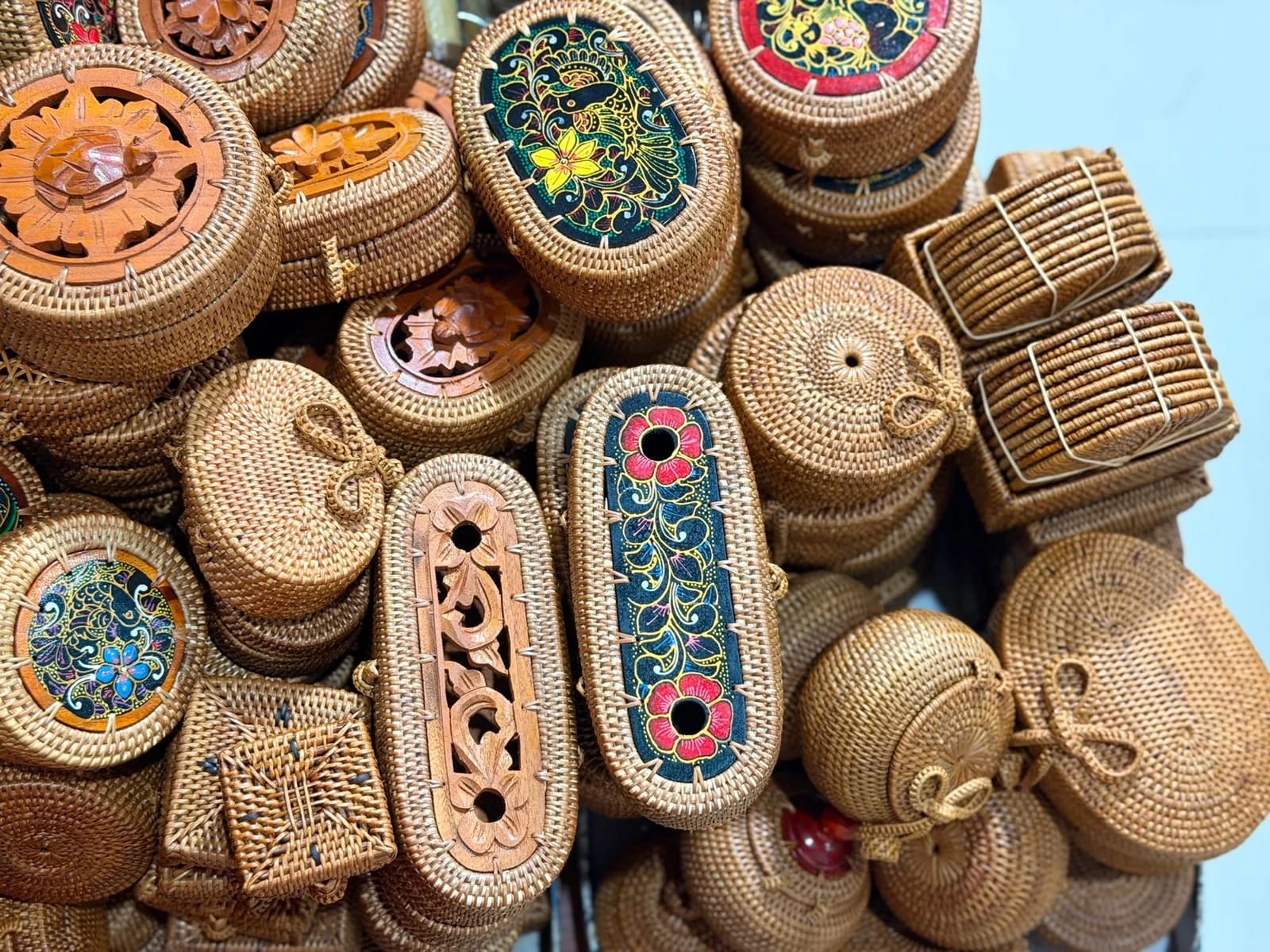
Bargaining is normal in markets and souvenir stalls, at the Ubud Art Market, the Sukawati art market south of Ubud, and the beach vendors. It is not done in shops with price tags, supermarkets, restaurants, or for a Grab ride.
- Ask the price, smile, and offer around half. Then meet somewhere in the middle.
- Sukawati is usually cheaper than Ubud for the same baskets, sarongs and carvings.
- Buying several pieces at the same stall is the easiest way to a lower price.
- Only name a price you are ready to pay. Agreeing on a price and then walking away is rude.
- Pay in cash, with small notes. Vendors rarely have change for a Rp 100,000 early in the morning.
Keep it friendly. A few thousand rupiah is a few cents for you, and the morning's first sale is considered lucky for the vendor, which is when the best prices come.
How much cash can you bring into Bali?
There is no limit on what you bring in, but cash worth Rp 100 million or more must be declared to customs on arrival (about US$5,470 · C$7,850), in rupiah or in any foreign currency. The declaration is part of the customs section of the All Indonesia arrival card. Few tourists come close to that amount. Keep the receipts of large withdrawals and exchanges in case you are asked on the way out.
Bali currency: questions travellers ask
Rates of 19 November 2026. Bank fees change: the screen of the ATM has the final word.